



Community hub
Recent from talks
Knowledge base stats:
Talk channels stats:
Members stats:
Servomotor
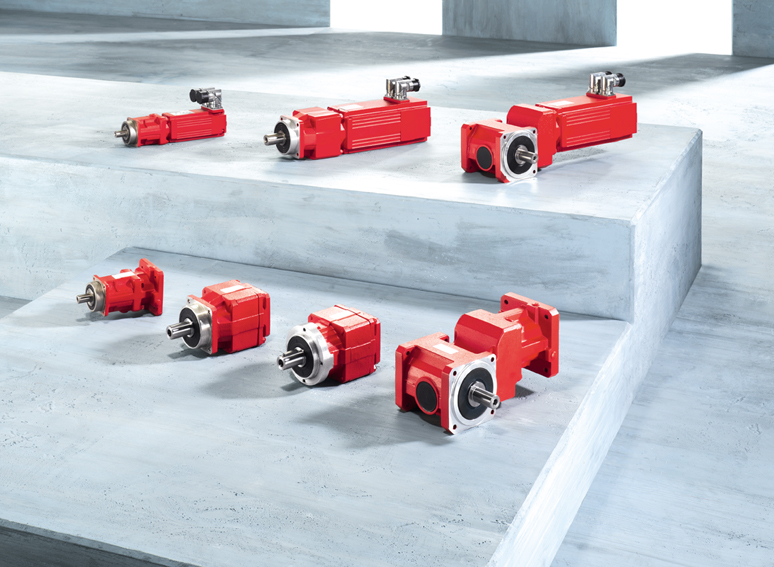
A servomotor (or servo motor or simply servo) is a rotary or linear actuator that allows for precise control of angular or linear position, velocity, and acceleration in a mechanical system. It constitutes part of a servomechanism, and consists of a suitable motor coupled to a sensor for position feedback and a controller (often a dedicated module designed specifically for servomotors).
Servomotors are not a specific class of motor, although the term servomotor is often used to refer to a motor suitable for use in a closed-loop control system. Servomotors are used in applications such as robotics, CNC machinery, and automated manufacturing.
Various mounting patterns exist. NEMA ICS 16 defines several flange mounting patterns and corresponding bolt circles that are defined in either millimeters or inches.
A servomotor is a closed-loop servomechanism that uses position feedback (either linear or rotational position) to control its motion and final position. The input to its control is a signal (either analog or digital) representing the desired position of the output shaft.
The motor is paired with some type of position encoder to provide position feedback (and potentially also speed feedback in more sophisticated designs). The controller compares the measured position with the desired position to generate an error signal, which when fed back causes the motor to rotate in the direction needed to bring the shaft to the desired position. The error signal reduces to zero as the desired position is approached, stopping the motor.
Simple servomotors use position-only sensing via a potentiometer and bang-bang control of their motor; the motor only rotates at full speed or is stopped. This type of servomotor is not widely used in industrial motion control, but it forms the basis of the simple and cheap servos used for radio-controlled models.
More sophisticated servomotors make use of an absolute encoder (a type of rotary encoder) to calculate the shaft's position and infer the speed of the output shaft. A variable-speed drive is used to control the motor speed. Both of these enhancements, usually in combination with a PID control algorithm, allow the servomotor to be brought to its commanded position more quickly and more precisely, with less overshooting.
Servomotors are generally used as a high-performance alternative to the stepper motor. Stepper motors have some inherent ability to control position, as they have built-in output steps. This often allows them to be used as an open-loop position control, without any feedback encoder, as their drive signal specifies the number of steps of movement to rotate, but for this, the controller needs to 'know' the position of the stepper motor on power up. Therefore, on the first power-up, the controller will have to activate the stepper motor and turn it to a known position, e.g. until it activates an end limit switch. This can be observed when switching on an inkjet printer; the controller will move the ink jet carrier to the extreme left and right to establish the end positions. A servomotor can immediately turn to whatever angle the controller instructs it to, regardless of the initial position at power up, if an absolute encoder is used.
Hub AI
Servomotor AI simulator
(@Servomotor_simulator)
Servomotor
A servomotor (or servo motor or simply servo) is a rotary or linear actuator that allows for precise control of angular or linear position, velocity, and acceleration in a mechanical system. It constitutes part of a servomechanism, and consists of a suitable motor coupled to a sensor for position feedback and a controller (often a dedicated module designed specifically for servomotors).
Servomotors are not a specific class of motor, although the term servomotor is often used to refer to a motor suitable for use in a closed-loop control system. Servomotors are used in applications such as robotics, CNC machinery, and automated manufacturing.
Various mounting patterns exist. NEMA ICS 16 defines several flange mounting patterns and corresponding bolt circles that are defined in either millimeters or inches.
A servomotor is a closed-loop servomechanism that uses position feedback (either linear or rotational position) to control its motion and final position. The input to its control is a signal (either analog or digital) representing the desired position of the output shaft.
The motor is paired with some type of position encoder to provide position feedback (and potentially also speed feedback in more sophisticated designs). The controller compares the measured position with the desired position to generate an error signal, which when fed back causes the motor to rotate in the direction needed to bring the shaft to the desired position. The error signal reduces to zero as the desired position is approached, stopping the motor.
Simple servomotors use position-only sensing via a potentiometer and bang-bang control of their motor; the motor only rotates at full speed or is stopped. This type of servomotor is not widely used in industrial motion control, but it forms the basis of the simple and cheap servos used for radio-controlled models.
More sophisticated servomotors make use of an absolute encoder (a type of rotary encoder) to calculate the shaft's position and infer the speed of the output shaft. A variable-speed drive is used to control the motor speed. Both of these enhancements, usually in combination with a PID control algorithm, allow the servomotor to be brought to its commanded position more quickly and more precisely, with less overshooting.
Servomotors are generally used as a high-performance alternative to the stepper motor. Stepper motors have some inherent ability to control position, as they have built-in output steps. This often allows them to be used as an open-loop position control, without any feedback encoder, as their drive signal specifies the number of steps of movement to rotate, but for this, the controller needs to 'know' the position of the stepper motor on power up. Therefore, on the first power-up, the controller will have to activate the stepper motor and turn it to a known position, e.g. until it activates an end limit switch. This can be observed when switching on an inkjet printer; the controller will move the ink jet carrier to the extreme left and right to establish the end positions. A servomotor can immediately turn to whatever angle the controller instructs it to, regardless of the initial position at power up, if an absolute encoder is used.