



Community hub
Recent from talks
Knowledge base stats:
Talk channels stats:
Members stats:
Television antenna
A television antenna, also called a television aerial (in British English), is an antenna specifically designed for use with a television receiver (TV) to receive terrestrial over-the-air (OTA) broadcast television signals from a television station. Terrestrial television is broadcast on frequencies from about 47 to 250 MHz in the very high frequency (VHF) band, and 470 to 960 MHz in the ultra high frequency (UHF) band in different countries.
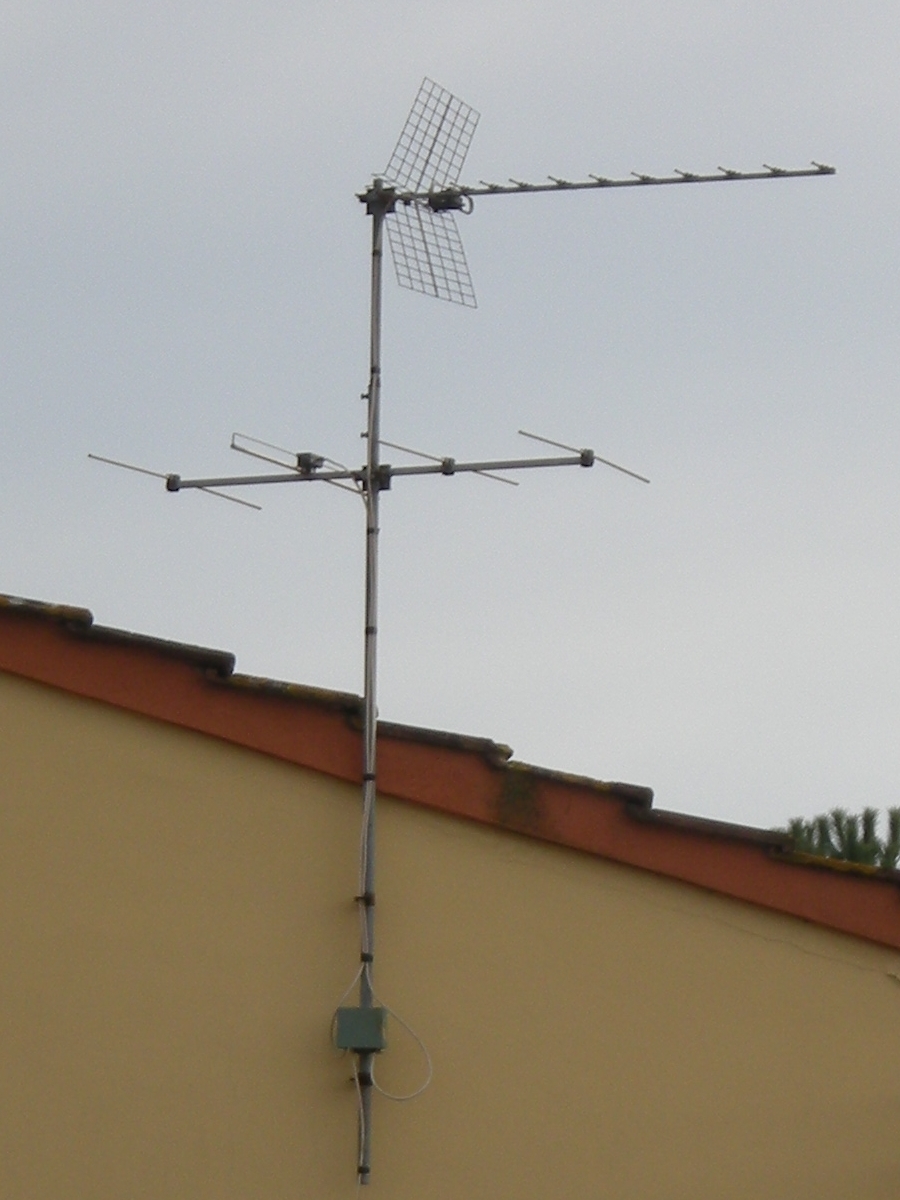
Television antennas are manufactured in two different types: indoor and outdoor antennas. Indoor antennas are designed to be located on top of or next to the television set, but are ideally placed near a window in a room and as high up as possible for the best reception. The most common types of indoor antennas are the dipole ("rabbit ears"), which work best for VHF channels, and loop antennas, which work best for UHF. Outdoor antennas on the other hand are designed to be mounted on a mast on top of the owner's house, or in a loft or attic where the dry conditions and increased elevation are advantageous for reception and antenna longevity. Outdoor antennas are more expensive and difficult to install but are necessary for adequate reception in fringe areas far from television stations; the most common types of these are the Yagi, log periodic, and (for UHF) the multi-bay reflective array antenna.
The purpose of the antenna is to intercept radio waves from the desired television stations and convert them to tiny radio frequency alternating currents which are applied to the television's tuner, which extracts the television signal. The antenna is connected to the television with a specialized cable designed to carry radio current, called transmission line. Earlier antennas used a flat cable called 300 ohm twin-lead. The standard today is 75 ohm coaxial cable, which is less susceptible to interference which plugs into an F connector or Belling-Lee connector (depending on region) on the back of the TV. To convert the signal from antennas that use a twin-lead line to the modern coaxial cable input, a small transformer called a balun is used in the line.
In most countries, television broadcasting is allowed in the very high frequency (VHF) band from 47 to 68 MHz, called VHF low band or band I in Europe; 174 to 216 MHz, called VHF high band or band III in Europe, and in the ultra high frequency (UHF) band from 470 to 698 MHz, called band IV and V in Europe. The boundaries of each band vary somewhat in different countries. Radio waves in these bands travel by line-of-sight; they are blocked by hills and the visual horizon, limiting a television station's reception area to 65–95 km (40–60 miles), depending on terrain.
In the previous standard analog television, used before 2006, the VHF and UHF bands required separate tuners in the television receiver, which had separate antenna inputs. The wavelength of a radio wave equals the speed of light (c), divided by the frequency. The above frequency bands cover a 15:1 wavelength ratio, or almost 4 octaves. It is difficult to design a single antenna to receive such a wide wavelength range, and there is an octave gap from 216 to 470 MHz between the VHF and UHF frequencies. So traditionally, separate antennas (outdoor antennas with separate sets of elements on a single support boom) have been used to receive the VHF and UHF channels.
Starting in 2006, many countries in the world switched from broadcasting using an older analog television standard to newer digital television (DTV). However, the same broadcast frequencies are generally used, so the antennas used for the older analog television will also receive the new DTV broadcasts. Sellers often claim to supply a special digital or high-definition television (HDTV) antenna advised as a replacement for an existing analog television antenna; at best this is misinformation to generate sales of unneeded equipment, At worst, it may leave the viewer with a UHF-only antenna in a local market (particularly in North America) where some digital stations remain on their original high VHF or low VHF frequencies.
Places unable to be reached by television broadcast transmitters are known as black spots in Australia. In East Germany, the areas that could not receive western TV signals were referred to as the Tal der Ahnungslosen, or Valley of the Clueless.
Indoor antennas may be mounted on the television itself or stand on a table next to it, connected to the television by a short feed line. Due to space constraints, indoor antennas cannot be as large and elaborate as outdoor antennas, they are not mounted at as high an elevation, and the building walls block some of the radio waves; for these reasons, indoor antennas generally do not give as good reception as outdoor antennas. They are often perfectly adequate in urban and suburban areas, which are usually within the strong radiation footprint of local television stations. Still, in rural fringe reception areas, only an outdoor antenna may give adequate reception. A few of the simplest indoor antennas are described below, but a great variety of designs and types exist. Many have a dial on the antenna with a number of different settings to alter the antenna's reception pattern. This should be rotated with the set on while looking at the screen until the best picture is obtained.
Hub AI
Television antenna AI simulator
(@Television antenna_simulator)
Television antenna
A television antenna, also called a television aerial (in British English), is an antenna specifically designed for use with a television receiver (TV) to receive terrestrial over-the-air (OTA) broadcast television signals from a television station. Terrestrial television is broadcast on frequencies from about 47 to 250 MHz in the very high frequency (VHF) band, and 470 to 960 MHz in the ultra high frequency (UHF) band in different countries.
Television antennas are manufactured in two different types: indoor and outdoor antennas. Indoor antennas are designed to be located on top of or next to the television set, but are ideally placed near a window in a room and as high up as possible for the best reception. The most common types of indoor antennas are the dipole ("rabbit ears"), which work best for VHF channels, and loop antennas, which work best for UHF. Outdoor antennas on the other hand are designed to be mounted on a mast on top of the owner's house, or in a loft or attic where the dry conditions and increased elevation are advantageous for reception and antenna longevity. Outdoor antennas are more expensive and difficult to install but are necessary for adequate reception in fringe areas far from television stations; the most common types of these are the Yagi, log periodic, and (for UHF) the multi-bay reflective array antenna.
The purpose of the antenna is to intercept radio waves from the desired television stations and convert them to tiny radio frequency alternating currents which are applied to the television's tuner, which extracts the television signal. The antenna is connected to the television with a specialized cable designed to carry radio current, called transmission line. Earlier antennas used a flat cable called 300 ohm twin-lead. The standard today is 75 ohm coaxial cable, which is less susceptible to interference which plugs into an F connector or Belling-Lee connector (depending on region) on the back of the TV. To convert the signal from antennas that use a twin-lead line to the modern coaxial cable input, a small transformer called a balun is used in the line.
In most countries, television broadcasting is allowed in the very high frequency (VHF) band from 47 to 68 MHz, called VHF low band or band I in Europe; 174 to 216 MHz, called VHF high band or band III in Europe, and in the ultra high frequency (UHF) band from 470 to 698 MHz, called band IV and V in Europe. The boundaries of each band vary somewhat in different countries. Radio waves in these bands travel by line-of-sight; they are blocked by hills and the visual horizon, limiting a television station's reception area to 65–95 km (40–60 miles), depending on terrain.
In the previous standard analog television, used before 2006, the VHF and UHF bands required separate tuners in the television receiver, which had separate antenna inputs. The wavelength of a radio wave equals the speed of light (c), divided by the frequency. The above frequency bands cover a 15:1 wavelength ratio, or almost 4 octaves. It is difficult to design a single antenna to receive such a wide wavelength range, and there is an octave gap from 216 to 470 MHz between the VHF and UHF frequencies. So traditionally, separate antennas (outdoor antennas with separate sets of elements on a single support boom) have been used to receive the VHF and UHF channels.
Starting in 2006, many countries in the world switched from broadcasting using an older analog television standard to newer digital television (DTV). However, the same broadcast frequencies are generally used, so the antennas used for the older analog television will also receive the new DTV broadcasts. Sellers often claim to supply a special digital or high-definition television (HDTV) antenna advised as a replacement for an existing analog television antenna; at best this is misinformation to generate sales of unneeded equipment, At worst, it may leave the viewer with a UHF-only antenna in a local market (particularly in North America) where some digital stations remain on their original high VHF or low VHF frequencies.
Places unable to be reached by television broadcast transmitters are known as black spots in Australia. In East Germany, the areas that could not receive western TV signals were referred to as the Tal der Ahnungslosen, or Valley of the Clueless.
Indoor antennas may be mounted on the television itself or stand on a table next to it, connected to the television by a short feed line. Due to space constraints, indoor antennas cannot be as large and elaborate as outdoor antennas, they are not mounted at as high an elevation, and the building walls block some of the radio waves; for these reasons, indoor antennas generally do not give as good reception as outdoor antennas. They are often perfectly adequate in urban and suburban areas, which are usually within the strong radiation footprint of local television stations. Still, in rural fringe reception areas, only an outdoor antenna may give adequate reception. A few of the simplest indoor antennas are described below, but a great variety of designs and types exist. Many have a dial on the antenna with a number of different settings to alter the antenna's reception pattern. This should be rotated with the set on while looking at the screen until the best picture is obtained.