
Recent from talks
Twin-lead
Knowledge base stats:
Talk channels stats:
Members stats:
Twin-lead
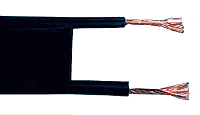
Twin lead cable is a two-conductor flat cable used as a balanced transmission line to carry radio frequency (RF) signals. It is constructed of two, stranded copper wires, or solid copper-clad steel wires. The wires are held a fixed distance apart by a plastic ribbon that is a good insulator at radio frequencies (usually polyethylene). It is also called (two wire) ribbon cable. The uniform spacing of the wires is the key to the cable's function as a transmission line: Any abrupt change in spacing would cause some of the signal to reflect back toward the source, rather than passing through. The plastic also covers and insulates the wires.
The name twin lead is most often used to refer specifically to 300 Ω (Ohm) ribbon cable, the most common type, but on occasion, twin lead is used to refer to any type of parallel wire line. Parallel wire line is available with several different values of characteristic impedance such as twin lead ribbon cable (300 Ω), window line (300 Ω, 350 Ω, or 450 Ω), and open wire line or ladder line (500~650 Ω).
Twin lead is mainly used as an antenna feedline at shortwave and VHF frequencies, to connect radio receivers and transmitters to their antennas. It can have significantly lower signal loss than miniature flexible coaxial cable, the main alternative type of feedline at these frequencies; for example, type RG-58 coaxial cable loses 6.6 dB per 100 metres (330 ft) at 30 MHz, while 300 Ω twin-lead loses only 0.55 dB. 300 Ω twin lead is widely used to connect FM radios to their antennas, and was previously used to connect television antennas to televisions until it was replaced by coaxial cable. However, it is more vulnerable to interference; proximity to metal objects will inject signals into any type of parallel wire line that would be blocked out by more convenient / more popular coaxial cable. It therefore requires spacing around rain gutters, spaced away from metal fences, exterior wall siding, and metal roofs, and mounted on standoff insulators when run up metal antenna masts.
Twin lead and other types of parallel-conductor transmission line are mainly used to connect radio transmitters and receivers to their antennas. Parallel transmission line has the advantage that its losses per unit length are an order of magnitude smaller than that of coaxial cable, the main alternative form of transmission line. Its disadvantages are that it is more vulnerable to interference, and must be kept away from metal objects which can cause power losses and impedance distortion (hence back-reflected waves). For this reason, when installed along the outside of buildings and on antenna masts, standoff insulators must be used. It is also common practice to twist the twin lead on long free standing lengths to further average out any imbalance induced on the line.
Parallel-wire line (the generic sense of twin lead) is supplied in several different sizes, with characteristic impedance values of
300 Ω twin-lead ribbon cable was the most common type in the middle-20th century, when it was widely used to connect television sets and FM radios to their receiving antennas. Since the last quarter of the middle-20th century, 300 Ω twin lead ribbon cable has been largely replaced with 75 Ω coaxial cable for television installations. Multiple forms of parallel wire line are used in amateur radio stations as feedline for balanced transmission of radio frequency signals, most often as 450 Ω window line, instead of twin lead ribbon cable.
The characteristic impedance of twin lead is a function of the insulating material and its thickness, and the wire diameter and its spacing; in the most common type, 300 Ω twin-lead ribbon cable, the wire is usually AWG 20 or 22 (0.52 or 0.33 mm²), about 7.5 millimetres (0.30 in) apart. This is well matched with the natural impedance of a folded dipole antenna, which is normally around 275 Ω. Twin lead generally has higher impedance than the other common transmission wiring, coaxial cable (coax). The widely used RG-6 coax has a characteristic impedance of 75 Ω, which requires the use of a balun to match impedance when used with common antenna types.
Twin lead (in the specific sense of ribbon cable) is a form of parallel wire balanced transmission line. The separation between the two wires in twin-lead is small compared to the wavelength of the radio frequency (RF) signal carried on the wire. The RF current in one wire is equal in magnitude and opposite in direction to the RF current in the other wire. Therefore, in the far field region far from the transmission line, the radio waves radiated by one wire are equal in magnitude but opposite in phase (180° out of phase) to the waves radiated by the other wire, so the overlapping opposite waves cancel each other out. The result is that almost no net radio energy is radiated by the line.
Hub AI
Twin-lead AI simulator
(@Twin-lead_simulator)
Twin-lead
Twin lead cable is a two-conductor flat cable used as a balanced transmission line to carry radio frequency (RF) signals. It is constructed of two, stranded copper wires, or solid copper-clad steel wires. The wires are held a fixed distance apart by a plastic ribbon that is a good insulator at radio frequencies (usually polyethylene). It is also called (two wire) ribbon cable. The uniform spacing of the wires is the key to the cable's function as a transmission line: Any abrupt change in spacing would cause some of the signal to reflect back toward the source, rather than passing through. The plastic also covers and insulates the wires.
The name twin lead is most often used to refer specifically to 300 Ω (Ohm) ribbon cable, the most common type, but on occasion, twin lead is used to refer to any type of parallel wire line. Parallel wire line is available with several different values of characteristic impedance such as twin lead ribbon cable (300 Ω), window line (300 Ω, 350 Ω, or 450 Ω), and open wire line or ladder line (500~650 Ω).
Twin lead is mainly used as an antenna feedline at shortwave and VHF frequencies, to connect radio receivers and transmitters to their antennas. It can have significantly lower signal loss than miniature flexible coaxial cable, the main alternative type of feedline at these frequencies; for example, type RG-58 coaxial cable loses 6.6 dB per 100 metres (330 ft) at 30 MHz, while 300 Ω twin-lead loses only 0.55 dB. 300 Ω twin lead is widely used to connect FM radios to their antennas, and was previously used to connect television antennas to televisions until it was replaced by coaxial cable. However, it is more vulnerable to interference; proximity to metal objects will inject signals into any type of parallel wire line that would be blocked out by more convenient / more popular coaxial cable. It therefore requires spacing around rain gutters, spaced away from metal fences, exterior wall siding, and metal roofs, and mounted on standoff insulators when run up metal antenna masts.
Twin lead and other types of parallel-conductor transmission line are mainly used to connect radio transmitters and receivers to their antennas. Parallel transmission line has the advantage that its losses per unit length are an order of magnitude smaller than that of coaxial cable, the main alternative form of transmission line. Its disadvantages are that it is more vulnerable to interference, and must be kept away from metal objects which can cause power losses and impedance distortion (hence back-reflected waves). For this reason, when installed along the outside of buildings and on antenna masts, standoff insulators must be used. It is also common practice to twist the twin lead on long free standing lengths to further average out any imbalance induced on the line.
Parallel-wire line (the generic sense of twin lead) is supplied in several different sizes, with characteristic impedance values of
300 Ω twin-lead ribbon cable was the most common type in the middle-20th century, when it was widely used to connect television sets and FM radios to their receiving antennas. Since the last quarter of the middle-20th century, 300 Ω twin lead ribbon cable has been largely replaced with 75 Ω coaxial cable for television installations. Multiple forms of parallel wire line are used in amateur radio stations as feedline for balanced transmission of radio frequency signals, most often as 450 Ω window line, instead of twin lead ribbon cable.
The characteristic impedance of twin lead is a function of the insulating material and its thickness, and the wire diameter and its spacing; in the most common type, 300 Ω twin-lead ribbon cable, the wire is usually AWG 20 or 22 (0.52 or 0.33 mm²), about 7.5 millimetres (0.30 in) apart. This is well matched with the natural impedance of a folded dipole antenna, which is normally around 275 Ω. Twin lead generally has higher impedance than the other common transmission wiring, coaxial cable (coax). The widely used RG-6 coax has a characteristic impedance of 75 Ω, which requires the use of a balun to match impedance when used with common antenna types.
Twin lead (in the specific sense of ribbon cable) is a form of parallel wire balanced transmission line. The separation between the two wires in twin-lead is small compared to the wavelength of the radio frequency (RF) signal carried on the wire. The RF current in one wire is equal in magnitude and opposite in direction to the RF current in the other wire. Therefore, in the far field region far from the transmission line, the radio waves radiated by one wire are equal in magnitude but opposite in phase (180° out of phase) to the waves radiated by the other wire, so the overlapping opposite waves cancel each other out. The result is that almost no net radio energy is radiated by the line.
Recent media