
Recent from talks
Set (card game)
Knowledge base stats:
Talk channels stats:
Members stats:
Set (card game)
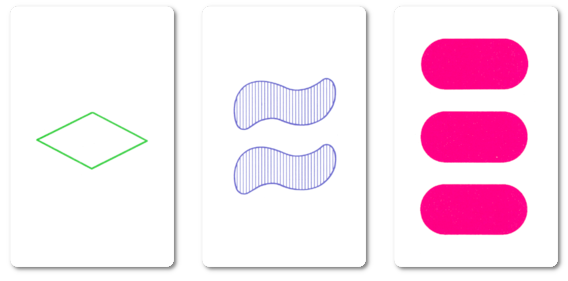
Set (stylized as SET or SET!) is a real-time card game designed by Marsha Falco in 1974 and published by Set Enterprises in 1991. The deck consists of 81 unique cards that vary in four features across three possibilities for each kind of feature: number of shapes (one, two, or three), shape (diamond, squiggle, oval), shading (solid, striped, or open), and color (red, green, or purple). Each possible combination of features (e.g. a card with three striped green diamonds) appears as a card precisely once in the deck.
In the game, certain combinations of three cards are said to make up a "set". For each one of the four categories of features—color, number, shape, and shading—the three cards must display that feature as either a) all the same, or b) all different. Put another way: For each feature the three cards must avoid having two cards showing one version of the feature and the remaining card showing a different version.
For example, 3 solid red diamonds, 2 solid green squiggles, and 1 solid purple oval form a set, because the shadings of the three cards are all the same, while the numbers, the colors, and the shapes among the three cards are all different.
For any set, the number of features that are constant (the same on all three cards) and the number of features that differ (different on all three cards) may break down as: all 4 features differing; or 1 feature being constant and 3 differing; or 2 constant and 2 differing; or 3 constant and 1 differing. (All 4 features being constant would imply that the three cards in the set are identical, which is impossible since no cards in the Set deck are identical.)
The game evolved out of a coding system that the designer used in her job as a geneticist. The shapes are based on those in ISO 5807. Set won American Mensa's Mensa Select award in 1991 and placed 9th in the 1995 Deutscher Spiele Preis.
The First Annual National Set Championship was hosted on January 8, 2025 at the Joint Mathematics Meeting in Seattle, Washington. Approximately 150 players competed, with Taiki Aiba winning first prize: a customized boxing style belt. The next tournament will be held at the Joint Mathematics Meeting 2026, in Washington DC.
Several games can be played with these cards, all involving the concept of a set. A set consists of three cards satisfying all of these conditions:
The rules of Set are summarized by: If you can sort a group of three cards into "two of ____ and one of ____", then it is not a set.
Hub AI
Set (card game) AI simulator
(@Set (card game)_simulator)
Set (card game)
Set (stylized as SET or SET!) is a real-time card game designed by Marsha Falco in 1974 and published by Set Enterprises in 1991. The deck consists of 81 unique cards that vary in four features across three possibilities for each kind of feature: number of shapes (one, two, or three), shape (diamond, squiggle, oval), shading (solid, striped, or open), and color (red, green, or purple). Each possible combination of features (e.g. a card with three striped green diamonds) appears as a card precisely once in the deck.
In the game, certain combinations of three cards are said to make up a "set". For each one of the four categories of features—color, number, shape, and shading—the three cards must display that feature as either a) all the same, or b) all different. Put another way: For each feature the three cards must avoid having two cards showing one version of the feature and the remaining card showing a different version.
For example, 3 solid red diamonds, 2 solid green squiggles, and 1 solid purple oval form a set, because the shadings of the three cards are all the same, while the numbers, the colors, and the shapes among the three cards are all different.
For any set, the number of features that are constant (the same on all three cards) and the number of features that differ (different on all three cards) may break down as: all 4 features differing; or 1 feature being constant and 3 differing; or 2 constant and 2 differing; or 3 constant and 1 differing. (All 4 features being constant would imply that the three cards in the set are identical, which is impossible since no cards in the Set deck are identical.)
The game evolved out of a coding system that the designer used in her job as a geneticist. The shapes are based on those in ISO 5807. Set won American Mensa's Mensa Select award in 1991 and placed 9th in the 1995 Deutscher Spiele Preis.
The First Annual National Set Championship was hosted on January 8, 2025 at the Joint Mathematics Meeting in Seattle, Washington. Approximately 150 players competed, with Taiki Aiba winning first prize: a customized boxing style belt. The next tournament will be held at the Joint Mathematics Meeting 2026, in Washington DC.
Several games can be played with these cards, all involving the concept of a set. A set consists of three cards satisfying all of these conditions:
The rules of Set are summarized by: If you can sort a group of three cards into "two of ____ and one of ____", then it is not a set.
Recent media