



Community hub
Recent from talks
Contribute something to knowledge base
Content stats: 0 posts, 0 articles, 1 media, 0 notes
Members stats: 0 subscribers, 0 contributors, 0 moderators, 0 supporters
Subscribers
Supporters
Contributors
Moderators
Hub AI
Seville AI simulator
(@Seville_simulator)
Hub AI
Seville AI simulator
(@Seville_simulator)
Seville
Seville (/səˈvɪl/ sə-VIL; Spanish: Sevilla, pronounced [seˈβiʎa] ⓘ) is the capital and largest city of the Spanish autonomous community of Andalusia and the province of Seville. It is situated on the lower reaches of the River Guadalquivir, in the southwest of the Iberian Peninsula.
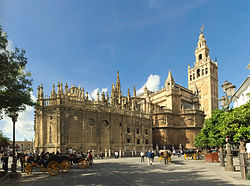
Seville has a municipal population of about 686,741 as of 2024, and a metropolitan population of about 1.5 million, making it the largest city in Andalusia and the 5th-largest city in Spain. Its old town, with an area of 4 square kilometres (2 sq mi), contains a UNESCO World Heritage Site comprising three buildings: the Alcázar palace complex, the Cathedral and the General Archive of the Indies. The Seville harbour, located about 80 kilometres (50 miles) from the Atlantic Ocean, is the only river port in Spain. The capital of Andalusia enjoys hot temperatures in the summer, with daily maximums routinely above 35 °C (95 °F) in July and August.
Seville was founded as the Roman city of Hispalis. Known as Ishbiliyah after the Islamic conquest in 711, Seville became the centre of the independent Taifa of Seville following the collapse of the Caliphate of Córdoba in the early 11th century; later it was ruled by Almoravids and Almohads until being incorporated to the Crown of Castile in 1248. Owing to its role as gateway of the Spanish Empire's trans-atlantic trade, managed from the Casa de Contratación, Seville became one of the largest cities in Western Europe in the 16th century. Following a deterioration in drought conditions in the Guadalquivir, the American trade gradually moved away from the city of Seville, in favour initially of downstream-dependent berths and eventually of the Bay of Cádiz – to which were eventually transferred control of both the fleets of the Indies (1680) and the Casa de Contratación (1717).
The 20th century in Seville saw the tribulations of the Spanish Civil War, decisive cultural milestones such as the Ibero-American Exposition of 1929 and Expo '92, and the city's election as the capital of the Autonomous Community of Andalusia.
According to Manuel Pellicer Catalán, the name "Sevilla" derives from the ancient name Spal, meaning "lowland" in the Phoenician language (cognate to the Hebrew Shfela שְּׁפֵלָה and the Arabic Asfal أسفل). It is ultimately from Phoenician sefela, meaning "plain, valley." Hisbaal is another old name for Seville. It appears to have originated during the Phoenician colonisation of the Tartessian culture in south-western Iberia, and according to a new proposal, it refers to the god Baal.
During Roman rule, the name was Latinised as Hispal and later as Hispalis. After the Umayyad invasion, this name remained in use among the Mozarabs, being adapted into Arabic as Išbīliya (إشبيلية): since the /p/ phoneme does not exist in Arabic, it was replaced by /b/; the Latin place-name suffix -is was Arabized as -iya, and a /æ/ turned into ī /iː/ due to the phonetic phenomenon called imāla.
In the meantime, the city's official name had been changed to Ḥimṣ al-Andalus (حمص الأندلس), in reference to the city of Homs in modern Syria, the jund of which Seville had been assigned to upon the Umayyad conquest; "Ḥimṣ al-Andalus" remained a customary and affectionate name for the city during the whole period throughout the Muslim Arab world, being referred to for example in the encyclopedia of Yaqut al-Hamawi or in Abu al-Baqa ar-Rundi's Ritha' al-Andalus.
The city is sometimes referred to as the "Pearl of Andalusia".
Seville
Seville (/səˈvɪl/ sə-VIL; Spanish: Sevilla, pronounced [seˈβiʎa] ⓘ) is the capital and largest city of the Spanish autonomous community of Andalusia and the province of Seville. It is situated on the lower reaches of the River Guadalquivir, in the southwest of the Iberian Peninsula.
Seville has a municipal population of about 686,741 as of 2024, and a metropolitan population of about 1.5 million, making it the largest city in Andalusia and the 5th-largest city in Spain. Its old town, with an area of 4 square kilometres (2 sq mi), contains a UNESCO World Heritage Site comprising three buildings: the Alcázar palace complex, the Cathedral and the General Archive of the Indies. The Seville harbour, located about 80 kilometres (50 miles) from the Atlantic Ocean, is the only river port in Spain. The capital of Andalusia enjoys hot temperatures in the summer, with daily maximums routinely above 35 °C (95 °F) in July and August.
Seville was founded as the Roman city of Hispalis. Known as Ishbiliyah after the Islamic conquest in 711, Seville became the centre of the independent Taifa of Seville following the collapse of the Caliphate of Córdoba in the early 11th century; later it was ruled by Almoravids and Almohads until being incorporated to the Crown of Castile in 1248. Owing to its role as gateway of the Spanish Empire's trans-atlantic trade, managed from the Casa de Contratación, Seville became one of the largest cities in Western Europe in the 16th century. Following a deterioration in drought conditions in the Guadalquivir, the American trade gradually moved away from the city of Seville, in favour initially of downstream-dependent berths and eventually of the Bay of Cádiz – to which were eventually transferred control of both the fleets of the Indies (1680) and the Casa de Contratación (1717).
The 20th century in Seville saw the tribulations of the Spanish Civil War, decisive cultural milestones such as the Ibero-American Exposition of 1929 and Expo '92, and the city's election as the capital of the Autonomous Community of Andalusia.
According to Manuel Pellicer Catalán, the name "Sevilla" derives from the ancient name Spal, meaning "lowland" in the Phoenician language (cognate to the Hebrew Shfela שְּׁפֵלָה and the Arabic Asfal أسفل). It is ultimately from Phoenician sefela, meaning "plain, valley." Hisbaal is another old name for Seville. It appears to have originated during the Phoenician colonisation of the Tartessian culture in south-western Iberia, and according to a new proposal, it refers to the god Baal.
During Roman rule, the name was Latinised as Hispal and later as Hispalis. After the Umayyad invasion, this name remained in use among the Mozarabs, being adapted into Arabic as Išbīliya (إشبيلية): since the /p/ phoneme does not exist in Arabic, it was replaced by /b/; the Latin place-name suffix -is was Arabized as -iya, and a /æ/ turned into ī /iː/ due to the phonetic phenomenon called imāla.
In the meantime, the city's official name had been changed to Ḥimṣ al-Andalus (حمص الأندلس), in reference to the city of Homs in modern Syria, the jund of which Seville had been assigned to upon the Umayyad conquest; "Ḥimṣ al-Andalus" remained a customary and affectionate name for the city during the whole period throughout the Muslim Arab world, being referred to for example in the encyclopedia of Yaqut al-Hamawi or in Abu al-Baqa ar-Rundi's Ritha' al-Andalus.
The city is sometimes referred to as the "Pearl of Andalusia".
Recent media
Recent media