



Community hub
Recent from talks
Knowledge base stats:
Talk channels stats:
Members stats:
Seymouria
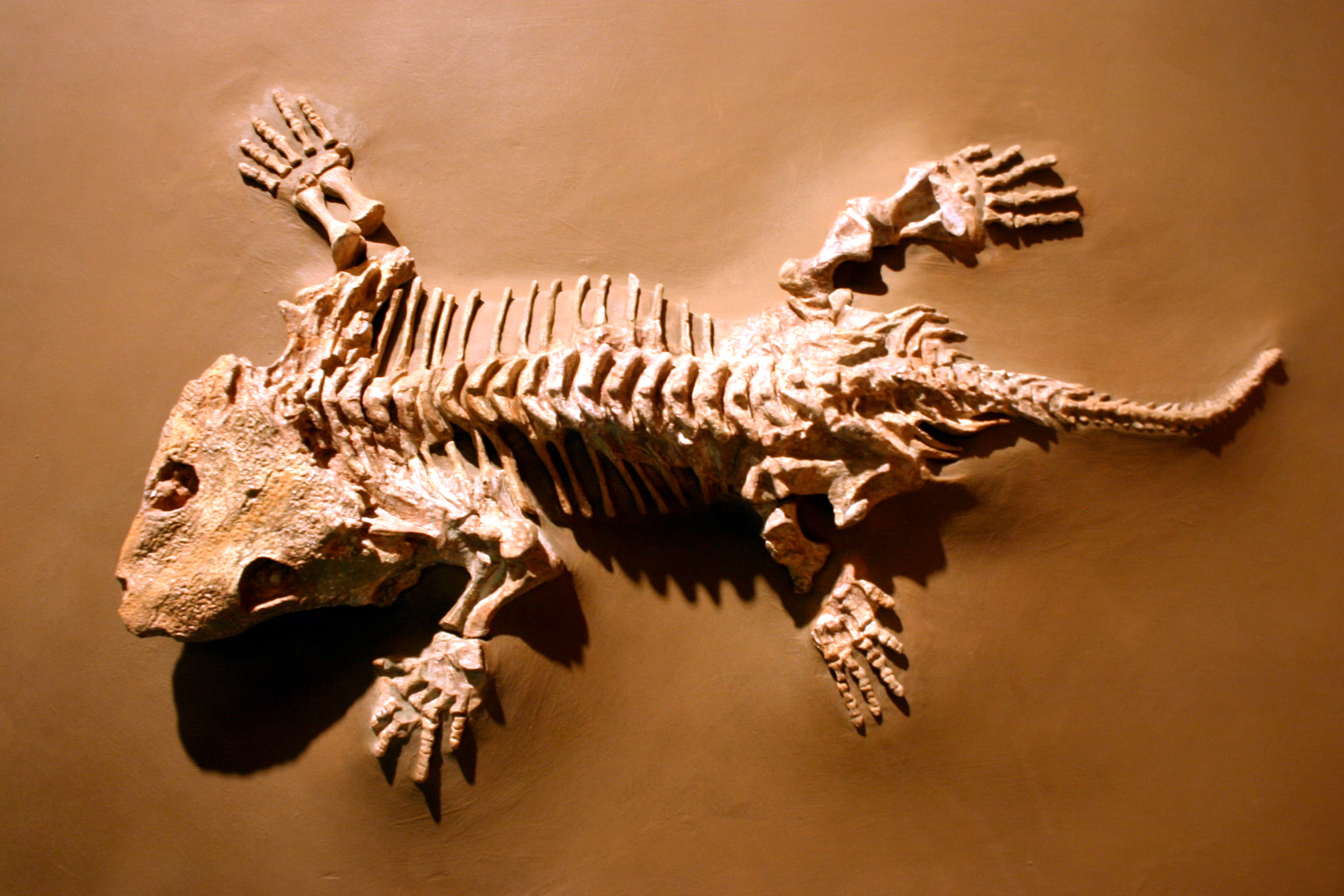
Seymouria is an extinct genus of seymouriamorph from the Early Permian of North America and Europe. Although they were amphibians (in a biological sense), Seymouria were well-adapted to life on land, with many reptilian features—so many, in fact, that Seymouria was first thought to be a primitive reptile. It is primarily known from two species, Seymouria baylorensis and Seymouria sanjuanensis. The type species, S. baylorensis, is more robust and specialized, though its fossils have only been found in Texas. On the other hand, S. sanjuanensis is more abundant and widespread. This smaller species is known from multiple well-preserved fossils, including a block of six skeletons found in the Cutler Formation of New Mexico, and a pair of fully grown skeletons from the Tambach Formation of Germany, which were fossilized lying next to each other.
For the first half of the 20th century, Seymouria was considered one of the oldest and most "primitive" known reptiles. Paleontologists noted how the general body shape resembled that of early reptiles such as captorhinids, and that certain adaptations of the limbs, hip, and skull were also similar to that of early reptiles, rather than any species of modern or extinct amphibians known at the time. The strongly-built limbs and backbone also supported the idea that Seymouria was primarily terrestrial, spending very little time in the water. However, in the 1950s, fossilized tadpoles were discovered in Discosauriscus, which was a close relative of Seymouria in the group Seymouriamorpha. This shows that seymouriamorphs (including Seymouria) had a larval stage which lived in the water, therefore making Seymouria not a true reptile, but rather an amphibian (in the traditional, paraphyletic sense of the term). At that time, it was still thought to be closely related to reptiles, and many recent studies still support this hypothesis. If this hypothesis is correct, Seymouria is still an important transitional fossil documenting the acquisition of reptile-like skeletal features prior to the evolution of the amniotic egg, which characterizes amniotes (reptiles, mammals, and birds). However, under the alternative hypothesis that Seymouria is a stem-tetrapod, it has little relevance to the origin of amniotes.
Fossils of Seymouria were first found near the town of Seymour, in Baylor County, Texas (hence the name of the type species, Seymouria baylorensis, referring to both the town and county). The earliest fossils of the species to be collected were a cluster of individuals acquired by C.H. Sternberg in 1882. However, these fossils would not be properly prepared and identified as Seymouria until 1930.
Various paleontologists from around the world recovered their own Seymouria baylorensis fossils in the late 19th century and early 20th century. Seymouria was formally named and described in 1904 based on a pair of incomplete skulls, one of which was associated with a few pectoral and vertebral elements. These fossils were described by German paleontologist Ferdinand Broili, and are now stored in Munich. American paleontologist S.W. Williston later described a nearly complete skeleton in 1911, and noted that "Desmospondylus anomalus", a taxon he had recently named from fragmentary limbs and vertebrae, likely represented juvenile or even embryonic individuals of Seymouria.
Likewise, English paleontologist D.M.S. Watson noted in 1918 that Conodectes, a dubious genera named by Edward Drinker Cope back in 1896, was likely synonymous with Seymouria. Robert Broom (1922) argued that the genus should be referred to as Conodectes since that name was published first, but Alfred Romer (1928) objected, noting that the name Seymouria was too popular within the scientific community to be replaced. During this time, Seymouria was generally seen as a very early reptile, part of an evolutionary grade known as "cotylosaurs", which also included many other stout-bodied Permian reptiles or reptile-like tetrapods.
Many paleontologists were uncertain about Seymouria's allegiance with the reptiles, noting many similarities with the embolomeres, which were unquestionably "labyrinthodont" amphibians. This combination of features from reptiles (i.e. other "cotylosaurs") and amphibians (i.e. embolomeres) was evidence that Seymouria was central to the evolutionary transition between the two groups. Regardless, not enough was known about its biology to conclude which group it was truly part of. Broom (1922) and Russian paleontologist Peter Sushkin (1925) supported a placement among the Amphibia, but most studies around this time tentatively considered it an extremely "primitive" reptile; these included a comprehensive redescription of material referred to the species, published by Theodore E. White in 1939.
However, indirect evidence that Seymouria was not biologically reptilian started to emerge by the 1940s. Around this time, several newly described genera were linked to Seymouria as part of the group Seymouriamorpha. Some seymouriamorphs, such as Kotlassia, had evidence of aquatic habits, and even Seymouria itself had occasionally been argued to possess lateral lines, sensory structures only usable underwater. Watson (1942) and Romer (1947) each reversed their stance on Seymouria's classification, placing it among the amphibians rather than the reptiles. Perhaps the most damning evidence came in 1952, when Czech paleontologist Zdeněk Špinar reported gills preserved in juvenile fossils of the seymouriamorph Discosauriscus. This unequivocally proved that seymouriamorphs had an aquatic larval stage, and thus were amphibians, biologically speaking. Nevertheless, the numerous similarities between Seymouria and reptiles supported the idea that seymouriamorphs were close to the ancestry of amniotes.
In 1966, Peter Paul Vaughn described an assortment of Seymouria skulls from the Organ Rock Shale of Utah. These remains represented a new species, Seymouria sanjuanensis. Fossils of this species are now understood to be more abundant and widespread than those of Seymouria baylorensis. Several more species were later named by Paul E. Olson, although their validity has been more questionable than that of S. sanjuanensis. For example, Seymouria agilis (Olson, 1980), known from a nearly complete skeleton from the Chickasha Formation of Oklahoma, was reassigned by Michel Laurin and Robert R. Reisz to the parareptile Macroleter in 2001. Seymouria grandis, described a year earlier from a braincase found in Texas, has not been re-referred to any other tetrapod, but it remains poorly known. Langston (1963) reported a femur indistinguishable from that of S. baylorensis in Permian sediments at Prince Edward Island on the Eastern coast of Canada. Seymouria-like skeletal remains are also known from the Richards Spur Quarry in Oklahoma, as first described by Sullivan & Reisz (1999).
Hub AI
Seymouria AI simulator
(@Seymouria_simulator)
Seymouria
Seymouria is an extinct genus of seymouriamorph from the Early Permian of North America and Europe. Although they were amphibians (in a biological sense), Seymouria were well-adapted to life on land, with many reptilian features—so many, in fact, that Seymouria was first thought to be a primitive reptile. It is primarily known from two species, Seymouria baylorensis and Seymouria sanjuanensis. The type species, S. baylorensis, is more robust and specialized, though its fossils have only been found in Texas. On the other hand, S. sanjuanensis is more abundant and widespread. This smaller species is known from multiple well-preserved fossils, including a block of six skeletons found in the Cutler Formation of New Mexico, and a pair of fully grown skeletons from the Tambach Formation of Germany, which were fossilized lying next to each other.
For the first half of the 20th century, Seymouria was considered one of the oldest and most "primitive" known reptiles. Paleontologists noted how the general body shape resembled that of early reptiles such as captorhinids, and that certain adaptations of the limbs, hip, and skull were also similar to that of early reptiles, rather than any species of modern or extinct amphibians known at the time. The strongly-built limbs and backbone also supported the idea that Seymouria was primarily terrestrial, spending very little time in the water. However, in the 1950s, fossilized tadpoles were discovered in Discosauriscus, which was a close relative of Seymouria in the group Seymouriamorpha. This shows that seymouriamorphs (including Seymouria) had a larval stage which lived in the water, therefore making Seymouria not a true reptile, but rather an amphibian (in the traditional, paraphyletic sense of the term). At that time, it was still thought to be closely related to reptiles, and many recent studies still support this hypothesis. If this hypothesis is correct, Seymouria is still an important transitional fossil documenting the acquisition of reptile-like skeletal features prior to the evolution of the amniotic egg, which characterizes amniotes (reptiles, mammals, and birds). However, under the alternative hypothesis that Seymouria is a stem-tetrapod, it has little relevance to the origin of amniotes.
Fossils of Seymouria were first found near the town of Seymour, in Baylor County, Texas (hence the name of the type species, Seymouria baylorensis, referring to both the town and county). The earliest fossils of the species to be collected were a cluster of individuals acquired by C.H. Sternberg in 1882. However, these fossils would not be properly prepared and identified as Seymouria until 1930.
Various paleontologists from around the world recovered their own Seymouria baylorensis fossils in the late 19th century and early 20th century. Seymouria was formally named and described in 1904 based on a pair of incomplete skulls, one of which was associated with a few pectoral and vertebral elements. These fossils were described by German paleontologist Ferdinand Broili, and are now stored in Munich. American paleontologist S.W. Williston later described a nearly complete skeleton in 1911, and noted that "Desmospondylus anomalus", a taxon he had recently named from fragmentary limbs and vertebrae, likely represented juvenile or even embryonic individuals of Seymouria.
Likewise, English paleontologist D.M.S. Watson noted in 1918 that Conodectes, a dubious genera named by Edward Drinker Cope back in 1896, was likely synonymous with Seymouria. Robert Broom (1922) argued that the genus should be referred to as Conodectes since that name was published first, but Alfred Romer (1928) objected, noting that the name Seymouria was too popular within the scientific community to be replaced. During this time, Seymouria was generally seen as a very early reptile, part of an evolutionary grade known as "cotylosaurs", which also included many other stout-bodied Permian reptiles or reptile-like tetrapods.
Many paleontologists were uncertain about Seymouria's allegiance with the reptiles, noting many similarities with the embolomeres, which were unquestionably "labyrinthodont" amphibians. This combination of features from reptiles (i.e. other "cotylosaurs") and amphibians (i.e. embolomeres) was evidence that Seymouria was central to the evolutionary transition between the two groups. Regardless, not enough was known about its biology to conclude which group it was truly part of. Broom (1922) and Russian paleontologist Peter Sushkin (1925) supported a placement among the Amphibia, but most studies around this time tentatively considered it an extremely "primitive" reptile; these included a comprehensive redescription of material referred to the species, published by Theodore E. White in 1939.
However, indirect evidence that Seymouria was not biologically reptilian started to emerge by the 1940s. Around this time, several newly described genera were linked to Seymouria as part of the group Seymouriamorpha. Some seymouriamorphs, such as Kotlassia, had evidence of aquatic habits, and even Seymouria itself had occasionally been argued to possess lateral lines, sensory structures only usable underwater. Watson (1942) and Romer (1947) each reversed their stance on Seymouria's classification, placing it among the amphibians rather than the reptiles. Perhaps the most damning evidence came in 1952, when Czech paleontologist Zdeněk Špinar reported gills preserved in juvenile fossils of the seymouriamorph Discosauriscus. This unequivocally proved that seymouriamorphs had an aquatic larval stage, and thus were amphibians, biologically speaking. Nevertheless, the numerous similarities between Seymouria and reptiles supported the idea that seymouriamorphs were close to the ancestry of amniotes.
In 1966, Peter Paul Vaughn described an assortment of Seymouria skulls from the Organ Rock Shale of Utah. These remains represented a new species, Seymouria sanjuanensis. Fossils of this species are now understood to be more abundant and widespread than those of Seymouria baylorensis. Several more species were later named by Paul E. Olson, although their validity has been more questionable than that of S. sanjuanensis. For example, Seymouria agilis (Olson, 1980), known from a nearly complete skeleton from the Chickasha Formation of Oklahoma, was reassigned by Michel Laurin and Robert R. Reisz to the parareptile Macroleter in 2001. Seymouria grandis, described a year earlier from a braincase found in Texas, has not been re-referred to any other tetrapod, but it remains poorly known. Langston (1963) reported a femur indistinguishable from that of S. baylorensis in Permian sediments at Prince Edward Island on the Eastern coast of Canada. Seymouria-like skeletal remains are also known from the Richards Spur Quarry in Oklahoma, as first described by Sullivan & Reisz (1999).