Hubbry Logo
SkeletonSkeletonMain
Open search
Skeleton
Community hub
Skeleton
logo
8 pages, 0 posts
0 subscribers
Be the first to start a discussion here.
Contribute something
Skeleton
Skeleton
from Wikipedia

Skeleton
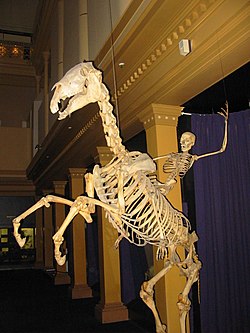
A horse and human skeleton placed in a display at Australian Museum in Sydney
Details
Identifiers
Greekσκελετός
MeSHD012863
Anatomical terminology

A skeleton is the structural frame that supports the body of most animals. There are several types of skeletons, including the exoskeleton, which is a rigid outer shell that holds up an organism's shape; the endoskeleton, a rigid internal frame to which the organs and soft tissues attach; and the hydroskeleton, a flexible internal structure supported by the hydrostatic pressure of body fluids.

Vertebrates are animals with an endoskeleton centered around an axial vertebral column, and their skeletons are typically composed of bones and cartilages. Invertebrates are other animals that lack a vertebral column, and their skeletons vary, including hard-shelled exoskeleton (arthropods and most molluscs), plated internal shells (e.g. cuttlebones in some cephalopods) or rods (e.g. ossicles in echinoderms), hydrostatically supported body cavities (most), and spicules (sponges). Cartilage is a rigid connective tissue that is found in the skeletal systems of vertebrates and invertebrates.

Etymology

[edit]

The term skeleton comes from Ancient Greek σκελετός (skeletós) 'dried up'.[1] Sceleton is an archaic form of the word.[2]

Classification

[edit]

Skeletons can be defined by several attributes. Solid skeletons consist of hard substances, such as bone, cartilage, or cuticle. These can be further divided by location; internal skeletons are endoskeletons, and external skeletons are exoskeletons. Skeletons may also be defined by rigidity, where pliant skeletons are more elastic than rigid skeletons.[3] Fluid or hydrostatic skeletons do not have hard structures like solid skeletons, instead functioning via pressurized fluids. Hydrostatic skeletons are always internal.[4]

Exoskeletons

[edit]
Exoskeleton of an ant

An exoskeleton is an external skeleton that covers the body of an animal, serving as armor to protect an animal from predators. Arthropods have exoskeletons that encase their bodies, and have to undergo periodic moulting or ecdysis as the animals grow. The shells of molluscs are another form of exoskeleton.[4] Exoskeletons provide surfaces for the attachment of muscles, and specialized appendanges of the exoskeleton can assist with movement and defense. In arthropods, the exoskeleton also assists with sensory perception.[5]

An external skeleton can be quite heavy in relation to the overall mass of an animal, so on land, organisms that have an exoskeleton are mostly relatively small. Somewhat larger aquatic animals can support an exoskeleton because weight is less of a consideration underwater. The southern giant clam, a species of extremely large saltwater clam in the Pacific Ocean, has a shell that is massive in both size and weight. Syrinx aruanus is a species of sea snail with a very large shell.

Endoskeletons

[edit]
Endoskeleton of a bat

Endoskeletons are the internal support structure of an animal, composed of mineralized tissues, such as the bone skeletons found in most vertebrates.[6] Endoskeletons are highly specialized and vary significantly between animals.[4] They vary in complexity from functioning purely for support (as in the case of sponges), to serving as an attachment site for muscles and a mechanism for transmitting muscular forces. A true endoskeleton is derived from mesodermal tissue. Endoskeletons occur in chordates, echinoderms, and sponges.

Rigidity

[edit]

Pliant skeletons are capable of movement; thus, when stress is applied to the skeletal structure, it deforms and then regains its original shape. This skeletal structure is used in some invertebrates, for instance in the hinge of bivalve shells or the mesoglea of cnidarians such as jellyfish. Pliant skeletons are beneficial because only muscle contractions are needed to bend the skeleton; upon muscle relaxation, the skeleton will return to its original shape. Cartilage is one material that a pliant skeleton may be composed of, but most pliant skeletons are formed from a mixture of proteins, polysaccharides, and water.[3] For additional structure or protection, pliant skeletons may be supported by rigid skeletons. Organisms that have pliant skeletons typically live in water, which supports body structure in the absence of a rigid skeleton.[7]

Rigid skeletons are not capable of movement when stressed, creating a strong support system most common in terrestrial animals. Such a skeleton type used by animals that live in water are more for protection (such as barnacle and snail shells) or for fast-moving animals that require additional support of musculature needed for swimming through water. Rigid skeletons are formed from materials including chitin (in arthropods), calcium compounds such as calcium carbonate (in stony corals and mollusks) and silicate (for diatoms and radiolarians).

Hydrostatic skeletons

[edit]

Hydrostatic skeletons are flexible cavities within an animal that provide structure through fluid pressure, occurring in some types of soft-bodied organisms, including jellyfish, flatworms, nematodes, and earthworms. The walls of these cavities are made of muscle and connective tissue.[4] In addition to providing structure for an animal's body, hydrostatic skeletons transmit the forces of muscle contraction, allowing an animal to move by alternating contractions and expansions of muscles along the animal's length.[8]

Cytoskeleton

[edit]

The cytoskeleton (cyto- meaning 'cell'[9]) is used to stabilize and preserve the form of the cells. It is a dynamic structure that maintains cell shape, protects the cell, enables cellular motion using structures such as flagella, cilia and lamellipodia, and transport within cells such as the movement of vesicles and organelles, and plays a role in cellular division. The cytoskeleton is not a skeleton in the sense that it provides the structural system for the body of an animal; rather, it serves a similar function at the cellular level.[10]

Vertebrate skeletons

[edit]
Pithecometra: From Thomas Huxley's 1863 Evidence as to Man's Place in Nature, the compared skeletons of apes to humans.

Vertebrate skeletons are endoskeletons, and the main skeletal component is bone.[6] Bones compose a unique skeletal system for each type of animal. Another important component is cartilage which in mammals is found mainly in the joint areas. In other animals, such as the cartilaginous fishes, which include the sharks, the skeleton is composed entirely of cartilage. The segmental pattern of the skeleton is present in all vertebrates, with basic units being repeated, such as in the vertebral column and the ribcage.[11][12]

Bones are rigid organs providing structural support for the body, assistance in movement by opposing muscle contraction, and the forming of a protective wall around internal organs. Bones are primarily made of inorganic minerals, such as hydroxyapatite, while the remainder is made of an organic matrix and water. The hollow tubular structure of bones provide considerable resistance against compression while staying lightweight. Most cells in bones are osteoblasts, osteoclasts, or osteocytes.[13]

Bone tissue is a type of dense connective tissue, a type of mineralized tissue that gives rigidity and a honeycomb-like three-dimensional internal structure. Bones also produce red and white blood cells and serve as calcium and phosphate storage at the cellular level. Other types of tissue found in bones include bone marrow, endosteum and periosteum, nerves, blood vessels and cartilage.

During embryonic development, bones are developed individually from skeletogenic cells in the ectoderm and mesoderm. Most of these cells develop into separate bone, cartilage, and joint cells, and they are then articulated with one another. Specialized skeletal tissues are unique to vertebrates. Cartilage grows more quickly than bone, causing it to be more prominent earlier in an animal's life before it is overtaken by bone.[14] Cartilage is also used in vertebrates to resist stress at points of articulation in the skeleton. Cartilage in vertebrates is usually encased in perichondrium tissue.[15] Ligaments are elastic tissues that connect bones to other bones, and tendons are elastic tissues that connect muscles to bones.[16]

Amphibians and reptiles

[edit]

The skeletons of turtles have evolved to develop a shell from the ribcage, forming an exoskeleton.[17] The skeletons of snakes and caecilians have significantly more vertebrae than other animals. Snakes often have over 300, compared to the 65 that is typical in lizards.[18]

Birds

[edit]

The skeletons of birds are adapted for flight. The bones in bird skeletons are hollow and lightweight to reduce the metabolic cost of flight. Several attributes of the shape and structure of the bones are optimized to endure the physical stress associated with flight, including a round and thin humeral shaft and the fusion of skeletal elements into single ossifications.[19] Because of this, birds usually have a smaller number of bones than other terrestrial vertebrates. Birds also lack teeth or even a true jaw, instead having evolved a beak, which is far more lightweight. The beaks of many baby birds have a projection called an egg tooth, which facilitates their exit from the amniotic egg.

Fish

[edit]

The skeleton, which forms the support structure inside the fish is either made of cartilage as in the Chondrichthyes, or bones as in the Osteichthyes. The main skeletal element is the vertebral column, composed of articulating vertebrae which are lightweight yet strong. The ribs attach to the spine and there are no limbs or limb girdles. They are supported only by the muscles. The main external features of the fish, the fins, are composed of either bony or soft spines called rays which, with the exception of the caudal fin (tail fin), have no direct connection with the spine. They are supported by the muscles which compose the main part of the trunk.

Cartilaginous fish, such as sharks, rays, skates, and chimeras, have skeletons made entirely of cartilage. The lighter weight of cartilage allows these fish to expend less energy when swimming.[4]

Mammals

[edit]

Marine mammals

[edit]
Californian sea lion

To facilitate the movement of marine mammals in water, the hind legs were either lost altogether, as in the whales and manatees, or united in a single tail fin as in the pinnipeds (seals). In the whale, the cervical vertebrae are typically fused, an adaptation trading flexibility for stability during swimming.[20]

Humans

[edit]
Study of Skeletons, c. 1510, by Leonardo da Vinci

The skeleton consists of both fused and individual bones supported and supplemented by ligaments, tendons, muscles and cartilage. It serves as a scaffold which supports organs, anchors muscles, and protects organs such as the brain, lungs, heart and spinal cord.[21] The biggest bone in the body is the femur in the upper leg, and the smallest is the stapes bone in the middle ear. In an adult, the skeleton comprises around 13.1% of the total body weight,[22] and half of this weight is water.

Fused bones include those of the pelvis and the cranium. Not all bones are interconnected directly: There are three bones in each middle ear called the ossicles that articulate only with each other. The hyoid bone, which is located in the neck and serves as the point of attachment for the tongue, does not articulate with any other bones in the body, being supported by muscles and ligaments.

There are 206 bones in the adult human skeleton, although this number depends on whether the pelvic bones (the hip bones on each side) are counted as one or three bones on each side (ilium, ischium, and pubis), whether the coccyx or tail bone is counted as one or four separate bones, and does not count the variable wormian bones between skull sutures. Similarly, the sacrum is usually counted as a single bone, rather than five fused vertebrae. There is also a variable number of small sesamoid bones, commonly found in tendons. The patella or kneecap on each side is an example of a larger sesamoid bone. The patellae are counted in the total, as they are constant. The number of bones varies between individuals and with age – newborn babies have over 270 bones some of which fuse together.[citation needed] These bones are organized into a longitudinal axis, the axial skeleton, to which the appendicular skeleton is attached.[23]

The human skeleton takes 20 years before it is fully developed, and the bones contain marrow, which produces blood cells.

There exist several general differences between the male and female skeletons. The male skeleton, for example, is generally larger and heavier than the female skeleton. In the female skeleton, the bones of the skull are generally less angular. The female skeleton also has wider and shorter breastbone and slimmer wrists. There exist significant differences between the male and female pelvis which are related to the female's pregnancy and childbirth capabilities. The female pelvis is wider and shallower than the male pelvis. Female pelvises also have an enlarged pelvic outlet and a wider and more circular pelvic inlet. The angle between the pubic bones is known to be sharper in males, which results in a more circular, narrower, and near heart-shaped pelvis.[24][25]

Invertebrate skeletons

[edit]

Invertebrates are defined by a lack of vertebral column, and they do not have bone skeletons. Arthropods have exoskeletons and echinoderms have endoskeletons. Some soft-bodied organisms, such as jellyfish and earthworms, have hydrostatic skeletons.[26]

Arthropods

[edit]

The skeletons of arthropods, including insects, crustaceans, and arachnids, are cuticle exoskeletons. They are composed of chitin secreted by the epidermis.[27] The cuticle covers the animal's body and lines several internal organs, including parts of the digestive system. Arthropods molt as they grow through a process of ecdysis, developing a new exoskeleton, digesting part of the previous skeleton, and leaving the remainder behind. An arthropod's skeleton serves many functions, working as an integument to provide a barrier and support the body, providing appendages for movement and defense, and assisting in sensory perception. Some arthropods, such as crustaceans, absorb biominerals like calcium carbonate from the environment to strengthen the cuticle.[5]

Echinoderms

[edit]

The skeletons of echinoderms, such as starfish and sea urchins, are endoskeletons that consist of large, well-developed sclerite plates that adjoin or overlap to cover the animal's body. The skeletons of sea cucumbers are an exception, having a reduced size to assist in feeding and movement. Echinoderm skeletons are composed of stereom, made up of calcite with a monocrystal structure. They also have a significant magnesium content, forming up to 15% of the skeleton's composition. The stereome structure is porous, and the pores fill with connective stromal tissue as the animal ages. Sea urchins have as many as ten variants of stereome structure. Among extant animals, such skeletons are unique to echinoderms, though similar skeletons were used by some Paleozoic animals.[28] The skeletons of echinoderms are mesodermal, as they are mostly encased by soft tissue. Plates of the skeleton may be interlocked or connected through muscles and ligaments. Skeletal elements in echinoderms are highly specialized and take many forms, though they usually retain some form of symmetry. The spines of sea urchins are the largest type of echinoderm skeletal structure.[29]

Molluscs

[edit]

Some molluscs, such as conchs, scallops, and snails, have shells that serve as exoskeletons. They are produced by proteins and minerals secreted from the animal's mantle.[4]

Sponges

[edit]

The skeleton of sponges consists of microscopic calcareous or siliceous spicules. The demosponges include 90% of all species of sponges. Their "skeletons" are made of spicules consisting of fibers of the protein spongin, the mineral silica, or both. Where spicules of silica are present, they have a different shape from those in the otherwise similar glass sponges.[30]

Cartilage

[edit]

Cartilage is a connective skeletal tissue composed of specialized cells called chondrocytes that in an extracellular matrix. This matrix is typically composed of Type II collagen fibers, proteoglycans, and water. There are many types of cartilage, including elastic cartilage, hyaline cartilage, fibrocartilage, and lipohyaline cartilage.[15] Unlike other connective tissues, cartilage does not contain blood vessels. The chondrocytes are supplied by diffusion, helped by the pumping action generated by compression of the articular cartilage or flexion of the elastic cartilage. Thus, compared to other connective tissues, cartilage grows and repairs more slowly.

See also

[edit]

References

[edit]

Bibliography

[edit]
[edit]
Revisions and contributorsEdit on WikipediaRead on Wikipedia
from Grokipedia
A skeleton is a rigid or semi-rigid supportive structure in the body of many animals, providing protection for internal organs, enabling movement, and maintaining shape. Skeletons vary widely across organisms and include endoskeletons (internal, as in vertebrates), exoskeletons (external, as in arthropods), hydrostatic skeletons (fluid-filled, as in annelids), and cytoskeletons (at the cellular level). In vertebrates, the consists primarily of and . The , for example, is the internal framework of bones, cartilage, and ligaments that provides , consisting of 206 bones in adults. These bones enable posture, movement, and protection of soft tissues while serving as a for minerals and a site for hematopoiesis. At birth, the human skeleton includes approximately 270 bones, which fuse during growth to reach the adult count. The is divided into the (80 bones forming the central axis) and the (126 bones for limbs). The includes the (22 bones), vertebral column (26 bones), (25 bones including the ), , and auditory . The includes the pectoral and pelvic girdles and limbs. Bones are metabolically active, with an extracellular matrix rich in and , maintained by osteoblasts, osteocytes, and osteoclasts. Functions include support, organ protection, muscle leverage, mineral homeostasis, and blood cell production. The system undergoes continuous remodeling.

Etymology and Overview

Etymology

The term "skeleton" originates from the word σκελετός (skeletós), the neuter form of an adjective meaning "dried up" or "parched," derived from the verb σκελεῖν (skelleîn), "to dry up," and ultimately from the *skel- or *skele-, denoting withering or drying. In contexts, it referred to a "dried-up body" or , specifically as σκελετὸς σῶμα (skeletós sôma), evoking the preserved bones of a desiccated corpse. This usage highlighted the skeletal remains as the enduring, dehydrated framework after flesh had withered away. The word transitioned into as sceletus or skeletus, retaining its connotation of a bony or dried structure, and appeared in medical and anatomical writings to describe the body's internal framework. By the , it entered modern European languages through scholarly Latin; in English, "skeleton" first appeared around 1570, initially denoting a or dried body before evolving to specifically mean the articulated bones supporting the body in anatomical studies. This adoption aligned with advancing dissections and anatomical illustrations in 16th-century , solidifying its scientific usage. Closely related etymologically in Greek anatomy is ὀστέον (ostéon), meaning "bone," from the *h₃ésth₁- or *ost-, signifying a rigid skeletal element, which forms the basis for terms like "" (study of bones) and connects the of the skeleton to individual bony components. In ancient Greek medical texts, such as those in the (circa 5th–4th century BCE), the skeleton—termed skeletos and denoting the "dried up" bony structure—is described with notable accuracy in treatises on , joints, and fractures, reflecting early systematic observations of the human framework despite limited practices. These references laid foundational linguistic and conceptual groundwork for later .

Definition and General Functions

A skeleton is defined as a rigid or semi-rigid structural framework that provides support, maintains the shape, and offers protection to the soft tissues and internal organs in multicellular organisms, particularly animals./7:_Animal_Structure_and_Function/38:_The_Musculoskeletal_System/38.1:_Types_of_Skeletal_Systems) This framework enables the organism to withstand mechanical stresses and achieve a defined form, contrasting with the more fluid or amorphous structures in less complex life forms. The general functions of the skeleton encompass mechanical support for the body, safeguarding vital organs from , facilitating locomotion by serving as attachment points for muscles, and contributing to mineral homeostasis through the storage and regulated release of essential ions like calcium and , especially in vertebrates where bones act as a dynamic ./7:_Animal_Structure_and_Function/38:_The_Musculoskeletal_System/38.1:_Types_of_Skeletal_Systems) In vertebrates, this mineral storage supports broader physiological processes, including signaling and , by maintaining blood calcium levels. Skeletal systems in multicellular differ from simpler support structures in unicellular organisms or non-animal multicellular forms, where rigidity often relies on cell walls, , or fluid compartments rather than a centralized, often mineralized framework adapted for larger scales and active mobility./7:_Animal_Structure_and_Function/38:_The_Musculoskeletal_System/38.1:_Types_of_Skeletal_Systems) Evolutionarily, the development of such skeletons marked a pivotal for terrestrial life, enabling vertebrates to support increased body mass against , transition from aquatic fins to limbs for complex movement, and expand into diverse habitats while managing mineral demands in calcium-scarce environments.

Classification of Skeletons

Exoskeletons

An is a rigid external skeleton that encases and supports the body of certain , secreted by the underlying epidermal cells to provide structural integrity and protection. Unlike internal skeletons, it forms a continuous covering over the organism's surface, often hardened through sclerotization or mineralization processes. This external framework is prevalent in phyla such as Arthropoda and , where it evolved independently to meet diverse environmental demands. In arthropods, the , known as the , is primarily composed of —a nitrogen-containing —combined with proteins and sometimes minerals like for added rigidity. forms a layered structure with an outer waxy epicuticle for waterproofing, a protein-rich exocuticle for strength, and an endocuticle for flexibility. In contrast, many molluscs possess calcareous exoskeletons made of crystals, either as or , secreted by tissue to form shells that offer robust defense. These compositions enable the exoskeleton to serve as a barrier against mechanical damage and pathogens while facilitating locomotion through jointed appendages in arthropods. Exoskeletons offer key advantages, including superior protection from predators through their tough, impenetrable surface and prevention of in terrestrial habitats via impermeable . However, their rigidity imposes significant limitations on growth, as the non-living structure cannot expand continuously; arthropods must periodically undergo , a hormonally regulated molting where enzymes dissolve the old , allowing the body to swell with fluid and air before the new exoskeleton hardens. This vulnerability during molting increases predation risk and energy demands. In molluscs, growth occurs more incrementally through ongoing mantle secretion, avoiding full shedding but still constraining overall body expansion compared to flexible endoskeletons. Examples include the lightweight, jointed , which supports flight, and the heavy, calcified shells of crabs, adapted for aquatic burrowing, both relying on for size increases across developmental stages.

Endoskeletons

An is an internal support structure composed of hard, mineralized tissue, located within the body and covered by soft tissues such as or . It typically consists of or in vertebrates, while in echinoderms it is formed from . These materials provide rigidity and serve as attachment sites for muscles, enabling leverage for movement and locomotion. Unlike exoskeletons, which necessitate periodic molting to accommodate growth, endoskeletons permit continuous, incremental expansion as the develops. This feature supports scalable body sizes, particularly in larger animals, and allows flexible adaptations to varying mechanical demands without structural disruption. However, being internal, endoskeletons offer less inherent protection against external impacts and injuries compared to external frameworks. Endoskeletons are characteristic of all vertebrates and certain , notably echinoderms, where they are classified as true endoskeletons due to their dermal covering. In these groups, the structure fulfills basic mechanical roles by providing internal rigidity for posture and serving as a framework for muscle action to facilitate support, protection of vital organs, and coordinated motion.

Hydrostatic Skeletons

A is a structural system that utilizes internal to provide support, maintain shape, and facilitate movement in soft-bodied organisms. It consists of a muscular body wall surrounding a fluid-filled cavity, where the incompressible nature of the —typically or coelomic —transmits forces from muscle contractions throughout the structure. This system is prevalent in animals lacking rigid skeletal elements, relying on hydrostatic governed by Pascal's principle to resist deformation. The mechanism operates on the principle of constant volume within the cavity: antagonistic muscle layers enable shape changes without altering overall volume. Circular or transverse muscles contract to decrease the cavity's diameter, thereby elongating the body, while longitudinal muscles shorten the body and expand the diameter; the fluid's high ensures pressure is uniformly distributed. In locomotion, such as , sequential contractions create propagating waves that propel the forward, with the body wall providing the necessary resistance. Examples abound in various phyla, particularly those with , pseudocoelomic, or gastrovascular cavities. In annelids, such as earthworms, the true is divided into segments by septa, allowing localized pressure buildup for peristaltic burrowing through soil. Nematodes utilize a pseudocoelom filled with fluid, paired with longitudinal muscles and a reinforced helical (e.g., at angles around 75° in Ascaris lumbricoides), to generate undulatory bending motions without circular muscles. Cnidarians, like sea anemones, employ their water-filled gastrovascular cavity (coelenteron) enclosed by circular and longitudinal muscles to achieve elongation, shortening, and directional bending for feeding and attachment. Hydrostatic skeletons confer advantages in flexibility and adaptability, enabling efficient navigation through burrows, crevices, or fluid environments by exploiting fluid-mediated force transmission for diverse movements. However, they are limited in providing rigidity for large body sizes or erect postures, as they lack levers for force amplification and require precise neural coordination of body wall muscles, making them less suitable for terrestrial or high-gravity support.

Skeletons in Vertebrates

Fish Skeletons

Fish skeletons are predominantly endoskeletal structures adapted for aquatic environments, consisting of axial elements such as the vertebral column, , and associated supports, alongside appendicular components including fins and their supporting s. The axial forms the central axis of the body, providing structural support and protection for vital organs, while the appendicular facilitates locomotion through water via pectoral and pelvic fins attached to robust s. In most , the pectoral connects directly to the or posterior cranium, whereas the pelvic remains suspended within the body wall without direct axial attachment, enhancing flexibility for maneuvering. Fish are broadly divided into (cartilaginous fishes like and rays) and (bony fishes), each exhibiting distinct skeletal compositions tailored to and swimming efficiency. In , the entire skeleton remains cartilaginous throughout life, lacking true , which results in a lightweight and flexible framework that reduces density for without reliance on additional structures. This cartilaginous composition, often reinforced with calcified prisms in larger species, supports powerful, undulating swimming motions. Conversely, possess ossified bony skeletons formed from both dermal and endochondral origins, integrated with a —a gas-filled organ that fine-tunes by adjusting internal gas volume, allowing efficient hovering and during prolonged swimming. Key adaptations in fish skeletons emphasize hydrodynamic efficiency and propulsion, with streamlined body shapes minimizing drag and fin rays enabling precise thrust generation. The vertebral column often features specialized regions, such as precaudal vertebrae for body support and caudal ones integrated with the tail fin for primary propulsion, while fin rays (lepidotrichia in bony fishes) allow segmented, flexible movements that optimize lift and steering during cruising or burst swimming. These features evolved from ancient jawless fishes (agnathans), which lacked paired fins and jaws; the transition to gnathostomes involved the development of articulated jaws from pharyngeal arches and the emergence of paired fins for enhanced stability and predatory capabilities, marking a pivotal shift toward active aquatic predation. In bony fishes, skeletal growth primarily occurs through , where models in the appendicular and axial elements are progressively replaced by tissue at growth zones, enabling continuous elongation and adaptation to increasing body size. This process, observed in models like , involves hypertrophic chondrocytes in growth plates that facilitate longitudinal expansion, particularly in the vertebral column and fin supports, while maintaining structural integrity under hydrodynamic stresses. Such lifelong distinguishes fish skeletons from those of higher vertebrates, supporting in response to environmental demands.

Amphibian and Reptilian Skeletons

Amphibian skeletons represent a transitional form between aquatic fish-like structures and more rigid terrestrial adaptations, characterized by flexibility and partial cartilaginous composition to accommodate both swimming and limited terrestrial locomotion. In larval stages, such as tadpoles, the skeleton is predominantly cartilaginous, supporting an aquatic lifestyle with minimal ossification to reduce weight and enhance buoyancy. During metamorphosis, endochondral ossification progressively replaces cartilage with bone, particularly in the appendicular skeleton, enabling the development of limbs suited for jumping and short-distance walking. This weak overall ossification persists in adults of many species, like frogs and salamanders, resulting in lightweight, flexible frameworks with webbed digits that aid in propulsion through water or across moist surfaces. The vertebral column often features modifications, such as elongated or notched centra, to allow greater spinal flexibility for undulatory movements reminiscent of fish. The evolutionary shift from fish skeletons to those of amphibians involved the transformation of paired fins into pentadactyl limbs, marking a key adaptation for semi-aquatic to terrestrial environments during the period (approximately 390–360 million years ago). Early tetrapodomorph fish, like , exhibited fin rays supported by robust internal bones that prefigured the , , and of amphibian forelimbs, facilitating weight-bearing on substrates. This transition culminated in the pentadactyl ground state by the period (around 350 million years ago), where amphibians developed five-toed limbs with phalanges for improved stability and grasping, though early forms were polydactyl. These changes reflect an of fin structures for land support, with amphibian girdles and limb bones retaining some flexibility to revert to aquatic behaviors in species like salamanders. Reptilian skeletons, in contrast, are fully ossified and robust, providing strong support for entirely terrestrial lifestyles through reinforced skulls, vertebrae, and limb girdles that distribute body weight effectively. The cranium features a temporal configuration with two fenestrae, enhancing jaw musculature attachment for feeding on diverse prey, while the vertebral column includes specialized regions like cervical, thoracic, and caudal series for mobility and propulsion. In , the and plastron form via fusion of dermal bones with expanded ribs and vertebrae, creating an integrated bony box that originated endoskeletally but incorporates subdermal ossifications for protection. This dermal-endoskeletal fusion encases the trunk, immobilizing the and pelvic girdles while allowing limb retraction. Variations among reptiles highlight adaptations to specific niches, such as limb reduction in and extreme vertebral elongation in snakes. In burrowing like anguids and amphisbaenians, forelimbs and hindlimbs progressively shorten through developmental , reducing drag in soil while retaining a pentadactyl base in less reduced forms. evolved from such limbed lizard ancestors by further reducing limbs to vestiges and increasing vertebral count (up to 400 or more), which diminishes axial regionalization and enhances lateral flexibility for sinuous locomotion. This hyper-elongated skeleton, with ball-and-socket zygapophyses between vertebrae, permits tight coiling and rapid undulation, optimizing movement in confined spaces.

Avian Skeletons

Avian skeletons are endoskeletons characterized by their lightweight construction, featuring thin, that minimize while providing essential for flight. These adaptations evolved to enhance aerodynamic , with extensive fusion of bones to increase rigidity and reduce flexibility in non-essential areas. The overall skeletal in birds is proportionally lower than in many other vertebrates, achieved through a combination of pneumatization and strategic bone fusion, allowing for powerful muscle attachments without excessive weight. A defining feature of avian skeletons is the presence of pneumatized bones, which contain air-filled cavities connected to the respiratory system's , reducing skeletal weight by up to 20-30% in some species while maintaining mechanical strength through internal struts and trabeculae. These pneumatic spaces, such as those in the , , , and vertebrae, facilitate efficient during flight by integrating the skeleton with the avian respiratory system. Pneumatization is most pronounced in flying birds and serves as a key for aerial locomotion, with the invasion of air sacs into tissue occurring post-hatching in many species. Prominent skeletal elements include the keystone-shaped , or wishbone, formed by the fusion of the clavicles, which acts as a spring-like brace to store and release during wing upstrokes and provides anchorage for flight muscles. The coracoids are elongated to form a robust , supporting the articulation of the wings, while the typically features a pronounced for the attachment of large that power downstrokes. In the appendicular skeleton, adaptations such as the keeled and syndactyl feet—where toes are partially fused—enhance propulsion and perching efficiency. Axially, birds exhibit a highly flexible supported by 11 to 25 , enabling extensive head mobility for and without compromising flight stability. The avian skeleton traces its ary origins to theropod dinosaurs, where early postcranial pneumatization and fusions first appeared, gradually refining into the lightweight, flight-optimized structure seen in modern birds. In flightless species, such as ostriches, these adaptations are modified: bones are denser and less pneumatized to support , and the sternal is reduced or absent, reflecting a reversion from flight-related traits.

Mammalian Skeletons

Mammalian skeletons are robust, fully ossified endoskeletons adapted to support endothermic , enabling sustained activity, upright posture in some lineages, and diverse modes of locomotion across terrestrial, arboreal, and aquatic environments. These skeletons consist primarily of tissue, with persisting in certain joints and during development, and are divided into the —which includes the , vertebral column, and —and the , comprising the pectoral and pelvic girdles along with the limbs. The total number of bones varies by species due to fusion and reduction, but the adult provides a with 206 distinct bones, illustrating the typical complexity in . Integrated with the , mammalian is characteristically , featuring specialized types—incisors for nipping, canines for piercing, premolars for shearing, and molars for grinding—to facilitate varied diets from carnivory to herbivory. Locomotor adaptations in mammalian skeletons reflect ecological niches, with modifications to limb structure enhancing efficiency in quadrupedal, bipedal, and gaits. In quadrupedal even-toed ungulates like deer and , the forelimbs feature fused third and fourth metacarpals forming a cannon bone, which stabilizes the limb and distributes weight during grazing and fleeing, while proximal often fuse to reduce flexibility and increase shock absorption. Bipedal , such as humans and apes, exhibit arched feet with a longitudinal arch formed by tarsal and , which acts as a spring mechanism for energy-efficient propulsion and shock dissipation during upright walking. mammals like horses display elongated limb bones, reduced digits to a single , and a straightened digital posture, minimizing rotational inertia and maximizing stride length for high-speed running. Skeletal specializations also support sensory and feeding functions tailored to lifestyles. Aquatic cetaceans have skulls with posteriorly displaced and enlarged nasal passages, culminating in the blowhole for surface respiration, while the surrounding cranial bones are thickened to withstand hydrodynamic pressures and house echolocation structures. Carnivorous mammals, such as felids and canids, possess robust jaws with shortened mandibles, enlarged sagittal crests for powerful temporalis muscles, and reinforced zygomatic arches, enabling high bite forces to subdue and dismember prey. These features underscore the skeleton's role in integrating sensory perception with mechanical efficiency. Postnatal skeletal development in mammals involves rapid , where cartilage models in long bones are progressively replaced by tissue, driven by growth at the epiphyseal plates—cartilaginous zones at ends that facilitate longitudinal expansion. This process accelerates in endotherms to support metabolic demands, with ossification centers appearing early in fetal life and secondary centers forming postnatally in epiphyses. Epiphyseal plates typically close around through and fusion, halting linear growth and yielding a mature, rigid skeleton capable of bearing adult body mass; in humans, this closure occurs between ages 14 and 19, varying by and . Such development ensures structural integrity while allowing initial flexibility for birth and early mobility.

Skeletons in Invertebrates

Arthropod Exoskeletons

Arthropod exoskeletons exhibit a highly segmented structure, with the body divided into tagmata—distinct functional regions such as the head, thorax, and abdomen—formed by the fusion or grouping of multiple segments. Each segment typically consists of hardened plates called sclerites, connected by flexible arthrodial membranes that allow for articulation and movement. This segmentation supports specialized appendages, including chelicerae in arachnids for feeding and prey capture, antennae for sensing, and walking legs adapted for locomotion or swimming. The is primarily composed of , a β-1,4-linked of that forms crystalline nanofibrils (3 nm in diameter) embedded in a protein matrix, comprising 20–40% of the dry weight in . These chitin-protein fibers are arranged in a helicoidal Bouligand across layered structures, including the epicuticle (thin, protein- and lipid-rich outer layer), exocuticle (heavily sclerotized and mineralized), and endocuticle (thicker, less mineralized inner layer). In crustaceans, mineralization with (20–50% dry weight) or calcium phosphates enhances hardness, while proteins with chitin-binding domains provide structural integrity. is achieved through the epicuticle's hydrocarbons and waxy layers, preventing . Molting, or ecdysis, is the process by which arthropods shed their exoskeleton to accommodate growth, regulated by ecdysteroid hormones secreted from prothoracic glands in response to prothoracicotropic hormone (PTTH). Rising ecdysteroid levels trigger apolysis, where the old cuticle separates from the epidermis, and stimulate new cuticle formation; subsequent decline activates ecdysis-triggering hormone (ETH) and eclosion hormone (EH) from neurosecretory cells, coordinating the shedding behavior. During ecdysis, arthropods are vulnerable to predation and environmental stress, as the new soft cuticle hardens via sclerotization influenced by bursicon. Insects undergo lifelong molting cycles, with frequency decreasing after metamorphosis. Variations in exoskeleton structure adapt to diverse lifestyles, such as the heavily sclerotized, mineral-reinforced elytra in beetles for protection against predators, contrasting with the flexible, less mineralized in caterpillars that permits rapid expansion during feeding. Sensory setae—hair-like projections integrated into the —enhance mechanoreception, detecting air currents, vibrations, or chemical cues, with innervation allowing deflection-based signaling. These adaptations highlight the exoskeleton's role in both mechanical support and sensory integration across taxa.

Echinoderm Endoskeletons

Echinoderm endoskeletons are composed of numerous , which are microscopic plates of that form the internal skeletal framework beneath the . These interlock to create structures such as the rigid spherical test in sea urchins or the flexible arms in , providing support while allowing for movement through integration with the . The are embedded in a mutable that enables rapid changes in stiffness, facilitating flexibility in species like asteroids while maintaining structural integrity. Pores in the allow of the to protrude, aiding in locomotion, feeding, and respiration by channeling through the body. A key feature of endoskeletons is their remarkable regenerative capacity, where lost parts, including , can be regrown through the formation of a —a mass of undifferentiated cells derived from dedifferentiated tissues. In , for instance, arm regeneration begins with and development, followed by the proliferation and differentiation of new and associated structures over weeks. This process highlights an evolutionary connection to chordates, as both groups share ancestry, with regeneration offering insights into skeletal repair mechanisms. Variations in endoskeletal structure occur across echinoderm classes, reflecting adaptations to diverse lifestyles. In echinoids like sea urchins, ossicles fuse into a rigid, protective test composed of tightly interlocked plates. Asteroids, such as , feature loosely articulated connected by mutable tissue, enabling arm flexibility for predation and evasion. Holothurians, or sea cucumbers, possess highly reduced skeletons with microscopic, dispersed embedded in soft body walls, prioritizing flexibility over rigidity in their burrowing or elongated forms.

Mollusc Skeletons

Molluscs exhibit a variety of supportive structures, ranging from robust external shells to internal reinforcements, which provide , facilitate locomotion, and support burrowing behaviors. These skeletons are primarily composed of minerals, such as and , secreted by the mantle tissue, and are adapted to diverse aquatic environments. Unlike the embedded, regenerative plates of echinoderms, mollusc skeletons are typically secreted externally or internally as discrete units, enabling against predators and environmental stresses. External shells are prevalent in many molluscs, particularly gastropods and bivalves. In gastropods, the shell forms a spiral coiled around a central axis, offering a protective for the soft body while allowing for torsion in . These spirals, built from layered , provide structural integrity and space for muscle attachment. Bivalves, in contrast, possess two hinged valves connected by a , with powerful adductor muscles that enable rapid closure for defense; the structure, often featuring teeth-like projections, ensures alignment and prevents shearing during movement. In cephalopods like the , the external shell is a chambered spiral that maintains through gas-filled compartments. Internal supportive elements complement or replace external shells in certain groups. Chitons, for instance, feature eight overlapping sclerites along their dorsal surface, composed of fibers that articulate for flexibility and armor against predation. In squids, the —also known as the pen—serves as an internal rod of and protein, providing rigidity to for without the bulk of an external shell. These internal structures allow for streamlined bodies suited to active swimming. Shell formation occurs through the mantle's secretion of in organized layers, with growth proceeding by accretion at the shell margin. The outer periostracum provides an , followed by prismatic or foliated layers, and in many , an inner nacreous layer of tablets bound by proteins for iridescent strength; this process is evident in pearl formation, where irritants trigger additional deposition. The mantle controls mineralization via organic matrices that template crystal orientation, ensuring durability. Adaptations in shell morphology reflect ecological pressures. In nudibranchs, shells are reduced or absent, shifting reliance to chemical defenses like stolen nematocysts from prey cnidarians, enhancing mobility in habitats. Conversely, the shell is thick and heavily chambered, withstanding hydrostatic pressures up to 800 meters depth before implosion risk, aiding survival in deep-sea environments through buoyancy regulation via siphuncle-mediated chamber filling. These variations underscore the evolutionary flexibility of mollusc skeletons in balancing protection and locomotion.

Sponge Skeletons

Sponges, members of the phylum Porifera, possess a simple skeletal framework composed primarily of spicules, which provide minimal structural support to these sessile, filter-feeding organisms lacking true tissues. These spicules are needle-like or anchor-shaped elements secreted by specialized cells called sclerocytes, which form them intracellularly within membrane-bound vesicles known as silicasomes for siliceous types or through precipitation for ones. Sclerocytes migrate through the , the gelatinous matrix between the outer pinacoderm and inner choanoderm layers, depositing spicules to reinforce the body against collapse during water flow. Spicules vary in composition and size, with siliceous spicules made of hydrated silica (SiO₂·nH₂O) predominant in classes Demospongiae and Hexactinellida, while spicules of (CaCO₃) characterize the class Calcarea. They are classified into megascleres, which form the primary supporting framework and can reach lengths of several millimeters, and microscleres, smaller elements (often under 100 μm) that provide additional reinforcement or aid in species identification. Some demosponges also incorporate spongin, a collagenous protein resembling , which forms flexible fibers that bind spicules together, as seen in bath sponges like Spongia officinalis. This combination of and organic components allows the skeleton to balance rigidity and flexibility. The arrangement of spicules in the skeleton typically follows radial or reticulate patterns that align with the aquiferous system, facilitating efficient circulation essential for feeding and respiration. In radial configurations, common in syconoid or leuconoid body plans, spicules radiate from the center or form axial supports in tubular extensions, directing through incurrent and excurrent canals without obstructing flow. Reticulate arrangements create a net-like mesh in the , distributing support evenly while maintaining open channels; for instance, in astrophorid demosponges, this includes both radial body support and axial papillae. These patterns reflect the absence of organized tissues, relying instead on cellular aggregation for structural integrity. As one of the earliest diverging metazoan lineages, sponges exhibit a basal evolutionary position, with molecular phylogenies placing their origin near the dawn of animal multicellularity around 800 million years ago. Fossil evidence includes disarticulated siliceous spicules from the Period (ca. 635–539 Ma) in formations like the Doushantuo in , and potential body fossils such as interpretations, though unambiguous sponge-grade organisms with preserved spicules appear in the early . This record underscores the ancient development of biomineralized skeletons in metazoans, predating more complex frameworks.

Skeletal Materials and Tissues

Bone Tissue

Bone tissue, the primary mineralized in endoskeletons, exhibits a hierarchical structure that balances strength, flexibility, and metabolic function. It consists of two main types: compact (cortical) , which forms the dense outer layer providing mechanical support and protection, and spongy (trabecular) , which creates a porous, lattice-like inner network that reduces weight while facilitating exchange and shock absorption. Compact comprises about 80% of the skeleton and features osteons (Haversian systems), cylindrical units approximately 200–400 μm in diameter and up to several millimeters long, each centered by a housing blood vessels and nerves. Surrounding the canal are concentric lamellae, layered sheets of mineralized matrix 3–7 μm thick, with osteocytes embedded in lacunae connected by canaliculi for and mechanosensing. In contrast, spongy , making up the remaining 20%, has trabeculae—thin rods or plates 50–400 μm thick—organized along stress lines without prominent osteons, allowing higher (up to 75–95%) for metabolic activity. The composition of bone tissue enables its rigidity and resilience, with approximately 60–70% mineral by dry weight, primarily hydroxyapatite crystals with the formula Ca10(PO4)6(OH)2Ca_{10}(PO_4)_6(OH)_2, which provide and hardness. The organic matrix accounts for 20–30% of dry weight, dominated by fibers (about 90% of the organic component) that form a fibrillar scaffold for mineral deposition and impart tensile strength through their staggered, cross-linked arrangement. Non-collagenous proteins like and constitute the remainder, aiding mineralization and . Water comprises roughly 10% of total weight, contributing to hydration and viscoelastic properties, particularly in the organic phase. Bone formation, or , occurs via two distinct processes: , which directly differentiates mesenchymal stem cells into osteoblasts to produce matrix without a cartilage intermediate, primarily forming flat bones such as those of the and ; and , where a model is first laid down and subsequently replaced by , enabling the growth of long bones like the . In both pathways, osteoblasts—derived from mesenchymal progenitors—play a central role by synthesizing and secreting , an unmineralized organic matrix rich in , which then calcifies through deposition facilitated by enzyme activity. Osteoclasts, multinucleated cells from the monocyte-macrophage lineage, are essential for resorption during formation, creating spaces for new deposition and regulating overall architecture through acidic dissolution of mineral and enzymatic degradation of organic components. Throughout life, bone undergoes continuous remodeling to maintain , repair microdamage, and adapt to mechanical demands, involving coordinated cycles of osteoclast-mediated resorption followed by osteoblast-driven formation at basic multicellular units. This process renews about 10% of the skeleton annually in adults. describes how bone architecture adapts to applied stresses: increased mechanical loading stimulates osteoblast activity to deposit denser trabeculae and cortical bone along principal stress trajectories, while reduced loading leads to resorption and weakening, optimizing mass distribution for efficiency. Hormonal regulation is critical, with (PTH) acting on osteoblasts to upregulate expression, thereby activating osteoclasts for calcium mobilization during , and (as ) synergizing with PTH to enhance intestinal calcium absorption and promote osteoblast mineralization, ensuring systemic mineral balance.

Cartilage Tissue

Cartilage is a flexible, avascular that provides structural support in the skeleton, serving as a precursor during embryonic development and persisting in certain adult structures for shock absorption and smooth movement. It consists primarily of chondrocytes embedded within an , which imparts its characteristic resilience and low friction properties. Unlike , cartilage lacks blood vessels and relies on for supply, making it well-suited for low-metabolic-demand roles in load-bearing areas. There are three main types of cartilage in vertebrates, each adapted to specific mechanical needs. , the most common type, features a glassy, homogeneous matrix rich in and proteoglycans, providing smooth surfaces for joint articulation and flexibility in developing bones. contains additional elastic fibers alongside , allowing it to maintain shape under repeated deformation, as seen in the external ear and . , with dense bundles of interspersed with and fewer proteoglycans, offers tensile strength and acts as a transition between and softer tissues, such as in intervertebral discs and pubic symphyses. The composition of cartilage centers on chondrocytes, the resident cells housed in lacunae, which synthesize and maintain the (ECM). The ECM comprises approximately 60-70% fibers that form a fibrillar network for tensile strength, and 20-30% proteoglycans—large molecules like aggrecan with (GAG) chains such as chondroitin and keratan sulfate—that attract water to create a hydrated for compressive resistance. This water-rich matrix, making up 70-85% of the tissue's wet weight, enables cartilage to deform under load and recover its shape, essential for functions like cushioning impacts in joints and supporting respiratory structures. Cartilage fulfills critical roles in skeletal support, including shock absorption to protect underlying bones from compressive forces and facilitating smooth articulation by providing a low-friction surface in synovial joints. Its avascular nature means nutrients and oxygen diffuse from surrounding or , supporting slow but steady metabolic activity suited to stable, non-vascular environments like articular surfaces. In development, forms early from mesodermal condensations via chondrogenesis, acting as a template for where it is gradually replaced by in most skeletal elements. However, it persists lifelong in key sites such as the articular surfaces of long bones, the , and , as well as forming the entire in chondrichthyans like , where mineralized with tesserae provides sufficient rigidity without full bony replacement due to evolutionary retention and functional advantages in aquatic buoyancy.

Other Supportive Structures

In vertebrates, ligaments are dense fibrous connective tissues that connect bones to bones, providing stability to by limiting excessive motion and transmitting mechanical forces during movement. A prominent example is the (ACL) in the , which prevents the from sliding forward relative to the . Tendons, similarly composed of hierarchical bundles, link muscles to bones, serving as mechanical bridges that efficiently transmit contractile forces to enable joint motion and maintain skeletal integrity. Both ligaments and tendons are primarily made of fibers embedded in an with components, allowing them to withstand tensile loads while offering some elasticity for dynamic activities. These structures integrate with bone and cartilage at attachment sites to form continuous load-bearing units, enhancing overall skeletal function. In terms of roles, ligaments primarily ensure joint stability and prevent , whereas tendons facilitate transmission from muscles to the skeleton, with their parallel arrangement optimizing unidirectional stress resistance. In invertebrates, analogous supportive elements provide traction and hydrostatic reinforcement without forming rigid frameworks. Annelid setae, chitinous bristle-like structures protruding from body segments, anchor the worm against substrates during peristaltic locomotion, enabling forward progression by gripping or burrow walls. In cnidarians, the —a gelatinous layer between epithelial tissues—functions as a hydrostatic support, maintaining under internal fluid and allowing rhythmic contractions for in medusae. Composed of , elastin-like fibers, and proteoglycans, the mesoglea exhibits elastic properties that aid in shape recovery after deformation. Overuse of tendons in vertebrates can lead to tendinopathies, characterized by pain, swelling, and reduced load tolerance due to microtears and impaired vascularity from repetitive mechanical stress. Ligaments may similarly suffer from strain injuries under excessive loading, though tendons are more prone to chronic degenerative changes in high-impact activities.

References

Add your contribution
Related Hubs
Contribute something
User Avatar
No comments yet.