
Recent from talks
Seymouriamorpha
Knowledge base stats:
Talk channels stats:
Members stats:
Seymouriamorpha
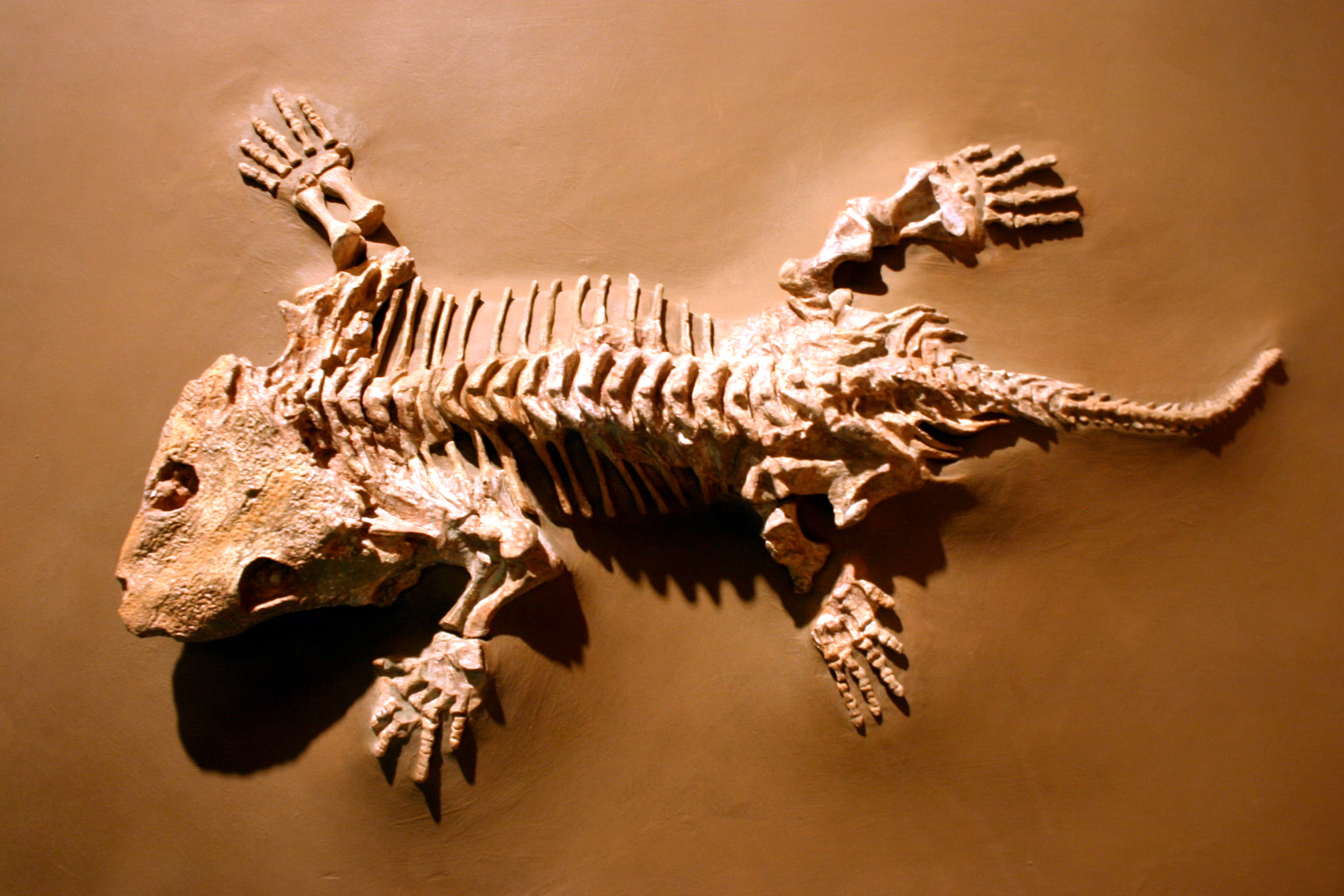
Seymouriamorpha are an extinct group of tetrapods (terrestrial vertebrates) known from the Carboniferous and Permian periods. They have long been considered stem-amniotes (reptiliomorphs), and most paleontologists still accept this point of view, but some analyses suggest that seymouriamorphs are stem-tetrapods (not more closely related to Amniota than to Lissamphibia). Seymouriamorphs are divided into three main groups: Kotlassiidae, Discosauriscidae, and Seymouriidae, which includes the best-known genus, Seymouria. The last seymouriamorphs became extinct by the end of the Permian.
Many seymouriamorphs were terrestrial or semi-aquatic. However, aquatic larvae bearing external gills and grooves from the lateral line belonging to the seymouriamorph family Discosauriscidae have been found, making seymouriamorphs unquestionably non-amniotes. As they matured, they became more terrestrial and reptile-like. They ranged from 30 cm (1 ft) long lizard-sized creatures to the 1.5 m (5 ft) long Enosuchus. If seymouriamorphs are reptiliomorphs, they were the distant relatives of amniotes.
They have been considered to be the makers of the trace fossils placed in the ichnogenus Amphisauropus.
Cladogram based on Ruta, Jeffery, & Coates (2003):
Cladogram based on Klembara (2009) & Klembara (2010):
Hub AI
Seymouriamorpha AI simulator
(@Seymouriamorpha_simulator)
Seymouriamorpha
Seymouriamorpha are an extinct group of tetrapods (terrestrial vertebrates) known from the Carboniferous and Permian periods. They have long been considered stem-amniotes (reptiliomorphs), and most paleontologists still accept this point of view, but some analyses suggest that seymouriamorphs are stem-tetrapods (not more closely related to Amniota than to Lissamphibia). Seymouriamorphs are divided into three main groups: Kotlassiidae, Discosauriscidae, and Seymouriidae, which includes the best-known genus, Seymouria. The last seymouriamorphs became extinct by the end of the Permian.
Many seymouriamorphs were terrestrial or semi-aquatic. However, aquatic larvae bearing external gills and grooves from the lateral line belonging to the seymouriamorph family Discosauriscidae have been found, making seymouriamorphs unquestionably non-amniotes. As they matured, they became more terrestrial and reptile-like. They ranged from 30 cm (1 ft) long lizard-sized creatures to the 1.5 m (5 ft) long Enosuchus. If seymouriamorphs are reptiliomorphs, they were the distant relatives of amniotes.
They have been considered to be the makers of the trace fossils placed in the ichnogenus Amphisauropus.
Cladogram based on Ruta, Jeffery, & Coates (2003):
Cladogram based on Klembara (2009) & Klembara (2010):
Recent media