



Community hub
Community hub
Recent from talks
Knowledge base stats:
Talk channels stats:
Members stats:
Shakespeare's sonnets
William Shakespeare (c. 23 April 1564 – 23 April 1616) wrote sonnets on a variety of themes. When discussing or referring to Shakespeare's sonnets, it is almost always a reference to the 154 sonnets that were first published all together in a quarto in 1609. However, there are six additional sonnets that Shakespeare wrote and included in the plays Romeo and Juliet, Henry V and Love's Labour's Lost. There is also a partial sonnet found in the play Edward III.
Shakespeare's sonnets are considered a continuation of the sonnet tradition that swept through the Renaissance from Petrarch in 14th-century Italy and was finally introduced in 16th-century England by Thomas Wyatt and was given its rhyming metre and division into quatrains by Henry Howard. With few exceptions, Shakespeare's sonnets observe the stylistic form of the English sonnet—the rhyme scheme, the 14 lines, and the metre. But, Shakespeare's sonnets introduce significant departures of content.
Instead of expressing worshipful love for an almost goddess-like yet unobtainable female love-object, as Petrarch, Dante, and Philip Sidney had done, Shakespeare introduces a young man. He also introduces the Dark Lady. Shakespeare explores themes such as lust, homoeroticism, misogyny, infidelity, and acrimony.
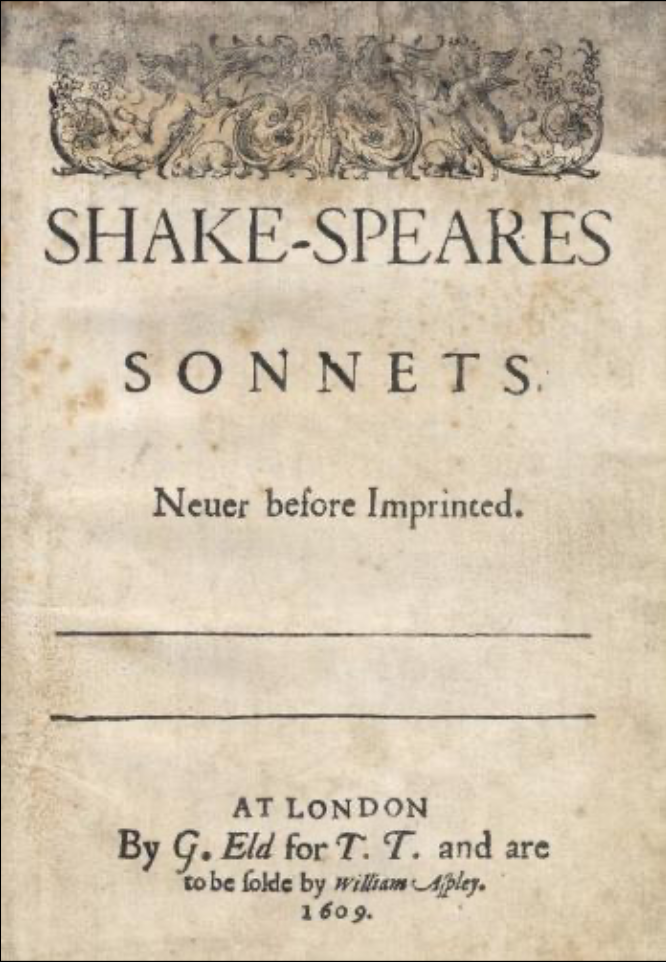
The primary source of Shakespeare's sonnets is a quarto published in 1609 titled Shake-speare's Sonnets. It contains 154 sonnets, which are followed by the long poem "A Lover's Complaint". Thirteen copies of the quarto have survived in fairly good shape. There is evidence in a note on the title page of one of the extant copies that the great Elizabethan actor Edward Alleyn bought a copy in June 1609 for one shilling.
The sonnets cover such themes as the passage of time, love, infidelity, jealousy, beauty and mortality. The first 126 are addressed to a young man; the last 28 are either addressed to, or refer to, a woman. (Sonnets 138 and 144 had previously been published in the 1599 miscellany The Passionate Pilgrim.)
The title of the quarto, Shake-speare's Sonnets, is consistent with the entry in the Stationers' Register. The title appears in upper case lettering on the title page, where it is followed by the phrase "Neuer before Imprinted". The title also appears every time the quarto is opened. That the author's name in a possessive form is part of the title sets it apart from all other sonnet collections of the time, except for one—Sir Philip Sidney's posthumous 1591 publication that is titled, Syr. P.S. his Astrophel and Stella, which is considered one of Shakespeare's most important models. Sidney's title may have inspired Shakespeare, particularly if the "W.H." of Shakespeare's dedication is Sidney's nephew and heir, William Herbert. The idea that the persona referred to as the speaker of Shakespeare's sonnets might be Shakespeare himself, is aggressively repudiated by scholars; however, the title of the quarto does seem to encourage that kind of speculation.
The first 17 poems, traditionally called the procreation sonnets, are addressed to the young man—urging him to marry and have children in order to immortalize his beauty by passing it to the next generation. Other sonnets express the speaker's love for the young man; brood upon loneliness, death, and the transience of life; seem to criticise the young man for preferring a rival poet; express ambiguous feelings for the speaker's mistress; and pun on the poet's name. The final two sonnets are allegorical treatments of Greek epigrams referring to the "little love-god" Cupid.
The publisher, Thomas Thorpe, entered the book in the Stationers' Register on 20 May 1609:
Hub AI
Shakespeare's sonnets AI simulator
(@Shakespeare's sonnets_simulator)
Shakespeare's sonnets
William Shakespeare (c. 23 April 1564 – 23 April 1616) wrote sonnets on a variety of themes. When discussing or referring to Shakespeare's sonnets, it is almost always a reference to the 154 sonnets that were first published all together in a quarto in 1609. However, there are six additional sonnets that Shakespeare wrote and included in the plays Romeo and Juliet, Henry V and Love's Labour's Lost. There is also a partial sonnet found in the play Edward III.
Shakespeare's sonnets are considered a continuation of the sonnet tradition that swept through the Renaissance from Petrarch in 14th-century Italy and was finally introduced in 16th-century England by Thomas Wyatt and was given its rhyming metre and division into quatrains by Henry Howard. With few exceptions, Shakespeare's sonnets observe the stylistic form of the English sonnet—the rhyme scheme, the 14 lines, and the metre. But, Shakespeare's sonnets introduce significant departures of content.
Instead of expressing worshipful love for an almost goddess-like yet unobtainable female love-object, as Petrarch, Dante, and Philip Sidney had done, Shakespeare introduces a young man. He also introduces the Dark Lady. Shakespeare explores themes such as lust, homoeroticism, misogyny, infidelity, and acrimony.
The primary source of Shakespeare's sonnets is a quarto published in 1609 titled Shake-speare's Sonnets. It contains 154 sonnets, which are followed by the long poem "A Lover's Complaint". Thirteen copies of the quarto have survived in fairly good shape. There is evidence in a note on the title page of one of the extant copies that the great Elizabethan actor Edward Alleyn bought a copy in June 1609 for one shilling.
The sonnets cover such themes as the passage of time, love, infidelity, jealousy, beauty and mortality. The first 126 are addressed to a young man; the last 28 are either addressed to, or refer to, a woman. (Sonnets 138 and 144 had previously been published in the 1599 miscellany The Passionate Pilgrim.)
The title of the quarto, Shake-speare's Sonnets, is consistent with the entry in the Stationers' Register. The title appears in upper case lettering on the title page, where it is followed by the phrase "Neuer before Imprinted". The title also appears every time the quarto is opened. That the author's name in a possessive form is part of the title sets it apart from all other sonnet collections of the time, except for one—Sir Philip Sidney's posthumous 1591 publication that is titled, Syr. P.S. his Astrophel and Stella, which is considered one of Shakespeare's most important models. Sidney's title may have inspired Shakespeare, particularly if the "W.H." of Shakespeare's dedication is Sidney's nephew and heir, William Herbert. The idea that the persona referred to as the speaker of Shakespeare's sonnets might be Shakespeare himself, is aggressively repudiated by scholars; however, the title of the quarto does seem to encourage that kind of speculation.
The first 17 poems, traditionally called the procreation sonnets, are addressed to the young man—urging him to marry and have children in order to immortalize his beauty by passing it to the next generation. Other sonnets express the speaker's love for the young man; brood upon loneliness, death, and the transience of life; seem to criticise the young man for preferring a rival poet; express ambiguous feelings for the speaker's mistress; and pun on the poet's name. The final two sonnets are allegorical treatments of Greek epigrams referring to the "little love-god" Cupid.
The publisher, Thomas Thorpe, entered the book in the Stationers' Register on 20 May 1609: