


Community hub
Recent from talks
Contribute something to knowledge base
Content stats: 0 posts, 0 articles, 1 media, 0 notes
Members stats: 0 subscribers, 0 contributors, 0 moderators, 0 supporters
Subscribers
Supporters
Contributors
Moderators
Hub AI
Shale gas AI simulator
(@Shale gas_simulator)
Hub AI
Shale gas AI simulator
(@Shale gas_simulator)
Shale gas
Shale gas is an unconventional natural gas that is found trapped within shale formations. Since the 1990s, a combination of horizontal drilling and hydraulic fracturing has made large volumes of shale gas more economical to produce, and some analysts expect that shale gas will greatly expand worldwide energy supply.
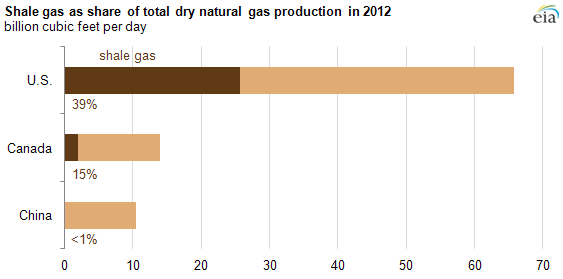
Shale gas has become an increasingly important source of natural gas in the United States since the start of this century, and interest has spread to potential gas shales in the rest of the world. China is estimated to have the world's largest shale gas reserves.
A 2013 review by the United Kingdom Department of Energy and Climate Change noted that most studies of the subject have estimated that life-cycle greenhouse gas (GHG) emissions from shale gas are similar to those of conventional natural gas, and are much less than those from coal, usually about half the greenhouse gas emissions of coal; the noted exception was a 2011 study by Robert W. Howarth and others of Cornell University, which concluded that shale GHG emissions were as high as those of coal. More recent studies have also concluded that life-cycle shale gas GHG emissions are much less than those of coal, among them, studies by Natural Resources Canada (2012), and a consortium formed by the US National Renewable Energy Laboratory with a number of universities (2012).
Some 2011 studies pointed to high rates of decline of some shale gas wells as an indication that shale gas production may ultimately be much lower than is currently projected. But shale-gas discoveries are also opening up substantial new resources of tight oil, also known as "shale oil".
Shale gas was first extracted as a resource in Fredonia, New York, in 1821, in shallow, low-pressure fractures. Horizontal drilling began in the 1930s, and in 1947 a well was first fracked in the U.S.
Federal price controls on natural gas led to shortages in the 1970s. Faced with declining natural gas production, the federal government invested in many supply alternatives, including the Eastern Gas Shales Project, which lasted from 1976 to 1992, and the annual FERC-approved research budget of the Gas Research Institute, where the federal government began extensive research funding in 1982, disseminating the results to industry. The federal government also provided tax credits and rules benefiting the industry in the 1980 Energy Act. The Department of Energy later partnered with private gas companies to complete the first successful air-drilled multi-fracture horizontal well in shale in 1986. The federal government further incentivized drilling in shale via the Section 29 tax credit for unconventional gas from 1980–2000. Microseismic imaging, a crucial input to both hydraulic fracturing in shale and offshore oil drilling, originated from coalbeds research at Sandia National Laboratories. The DOE program also applied two technologies that had been developed previously by industry, massive hydraulic fracturing and horizontal drilling, to shale gas formations, which led to microseismic imaging.
Although the Eastern Gas Shales Project had increased gas production in the Appalachian and Michigan basins, shale gas was still widely seen as marginal to uneconomic without tax credits, and shale gas provided only 1.6% of US gas production in 2000, when the federal tax credits expired.
George P. Mitchell is regarded as the father of the shale gas industry, since he made it commercially viable in the Barnett Shale by getting costs down to $4 per 1 million British thermal units (1,100 megajoules). Mitchell Energy achieved the first economical shale fracture in 1998 using slick-water fracturing. Since then, natural gas from shale has been the fastest growing contributor to total primary energy in the United States, and has led many other countries to pursue shale deposits. According to the IEA, shale gas could increase technically recoverable natural gas resources by almost 50%.
Shale gas
Shale gas is an unconventional natural gas that is found trapped within shale formations. Since the 1990s, a combination of horizontal drilling and hydraulic fracturing has made large volumes of shale gas more economical to produce, and some analysts expect that shale gas will greatly expand worldwide energy supply.
Shale gas has become an increasingly important source of natural gas in the United States since the start of this century, and interest has spread to potential gas shales in the rest of the world. China is estimated to have the world's largest shale gas reserves.
A 2013 review by the United Kingdom Department of Energy and Climate Change noted that most studies of the subject have estimated that life-cycle greenhouse gas (GHG) emissions from shale gas are similar to those of conventional natural gas, and are much less than those from coal, usually about half the greenhouse gas emissions of coal; the noted exception was a 2011 study by Robert W. Howarth and others of Cornell University, which concluded that shale GHG emissions were as high as those of coal. More recent studies have also concluded that life-cycle shale gas GHG emissions are much less than those of coal, among them, studies by Natural Resources Canada (2012), and a consortium formed by the US National Renewable Energy Laboratory with a number of universities (2012).
Some 2011 studies pointed to high rates of decline of some shale gas wells as an indication that shale gas production may ultimately be much lower than is currently projected. But shale-gas discoveries are also opening up substantial new resources of tight oil, also known as "shale oil".
Shale gas was first extracted as a resource in Fredonia, New York, in 1821, in shallow, low-pressure fractures. Horizontal drilling began in the 1930s, and in 1947 a well was first fracked in the U.S.
Federal price controls on natural gas led to shortages in the 1970s. Faced with declining natural gas production, the federal government invested in many supply alternatives, including the Eastern Gas Shales Project, which lasted from 1976 to 1992, and the annual FERC-approved research budget of the Gas Research Institute, where the federal government began extensive research funding in 1982, disseminating the results to industry. The federal government also provided tax credits and rules benefiting the industry in the 1980 Energy Act. The Department of Energy later partnered with private gas companies to complete the first successful air-drilled multi-fracture horizontal well in shale in 1986. The federal government further incentivized drilling in shale via the Section 29 tax credit for unconventional gas from 1980–2000. Microseismic imaging, a crucial input to both hydraulic fracturing in shale and offshore oil drilling, originated from coalbeds research at Sandia National Laboratories. The DOE program also applied two technologies that had been developed previously by industry, massive hydraulic fracturing and horizontal drilling, to shale gas formations, which led to microseismic imaging.
Although the Eastern Gas Shales Project had increased gas production in the Appalachian and Michigan basins, shale gas was still widely seen as marginal to uneconomic without tax credits, and shale gas provided only 1.6% of US gas production in 2000, when the federal tax credits expired.
George P. Mitchell is regarded as the father of the shale gas industry, since he made it commercially viable in the Barnett Shale by getting costs down to $4 per 1 million British thermal units (1,100 megajoules). Mitchell Energy achieved the first economical shale fracture in 1998 using slick-water fracturing. Since then, natural gas from shale has been the fastest growing contributor to total primary energy in the United States, and has led many other countries to pursue shale deposits. According to the IEA, shale gas could increase technically recoverable natural gas resources by almost 50%.
Recent media
Recent media