
Recent from talks
Shale gas in Canada
Knowledge base stats:
Talk channels stats:
Members stats:
Shale gas in Canada
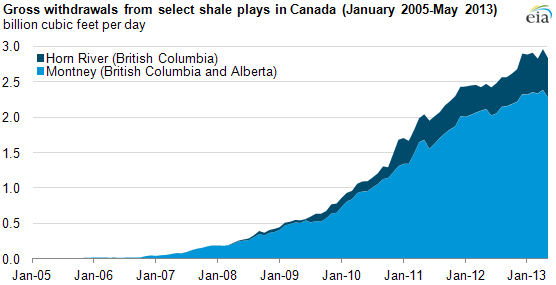
The inclusion of unconventional shale gas with conventional gas reserves has caused a sharp increase in estimated recoverable natural gas in Canada. Until the 1990s success of hydraulic fracturing in the Barnett Shales of north Texas, shale gas was classed as "unconventional reserves" and was considered too expensive to recover. There are a number of prospective shale gas deposits in various stages of exploration and exploitation across the country, from British Columbia to Nova Scotia.
The US Energy Information Administration estimated in 2013 that there were 573 trillion cubic feet (tcf) of technically recoverable natural gas in Canada.
Sir John A. Macdonald had already maintained in an 1880 parliamentary debate that the British North America Act 1867 vested the control of the inland and sea-coast fisheries of Canada in the Dominion government, who incurred all the expense incidental to their protection.
By virtue of the insertion in 1982 of section 92A of the British North America Act 1867, "(1) In each province, the legislature may exclusively make laws in relation to (a) exploration for non-renewable natural resources in the province;..." The geographical limits of the jurisdiction of the provinces had been tested by the Supreme Court of Canada in Reference Re: Offshore Mineral Rights, a 1967 case which involved all of the provinces that border on the ocean. The decision of the court was that the Dominion of Canada has authority over the sea and seabed; and this was later reflected by the insertion of section 92A.
There are three major zones identified in Ontario:
While Ontario in 2010 had 1,200 active oil wells and 1,400 active onshore and offshore natural gas wells, there was no major shale gas production as of early 2011.
In 2012, a campaign against fracking was launched in Ontario.
The Ordovician Utica Shale in Quebec potentially holds 4×10¹² cu ft (110×109 m3) at production rates of 1×10⁶ cu ft (28,000 m3) per day From 2006 through 2009 24 wells, both vertical and horizontal, were drilled to test the Utica. Positive gas flow test results were reported, although none of the wells were producing at the end of 2009. Gastem, one of the Utica shale producers, has announced plans to explore for Utica Shale gas across the border in New York state.
Hub AI
Shale gas in Canada AI simulator
(@Shale gas in Canada_simulator)
Shale gas in Canada
The inclusion of unconventional shale gas with conventional gas reserves has caused a sharp increase in estimated recoverable natural gas in Canada. Until the 1990s success of hydraulic fracturing in the Barnett Shales of north Texas, shale gas was classed as "unconventional reserves" and was considered too expensive to recover. There are a number of prospective shale gas deposits in various stages of exploration and exploitation across the country, from British Columbia to Nova Scotia.
The US Energy Information Administration estimated in 2013 that there were 573 trillion cubic feet (tcf) of technically recoverable natural gas in Canada.
Sir John A. Macdonald had already maintained in an 1880 parliamentary debate that the British North America Act 1867 vested the control of the inland and sea-coast fisheries of Canada in the Dominion government, who incurred all the expense incidental to their protection.
By virtue of the insertion in 1982 of section 92A of the British North America Act 1867, "(1) In each province, the legislature may exclusively make laws in relation to (a) exploration for non-renewable natural resources in the province;..." The geographical limits of the jurisdiction of the provinces had been tested by the Supreme Court of Canada in Reference Re: Offshore Mineral Rights, a 1967 case which involved all of the provinces that border on the ocean. The decision of the court was that the Dominion of Canada has authority over the sea and seabed; and this was later reflected by the insertion of section 92A.
There are three major zones identified in Ontario:
While Ontario in 2010 had 1,200 active oil wells and 1,400 active onshore and offshore natural gas wells, there was no major shale gas production as of early 2011.
In 2012, a campaign against fracking was launched in Ontario.
The Ordovician Utica Shale in Quebec potentially holds 4×10¹² cu ft (110×109 m3) at production rates of 1×10⁶ cu ft (28,000 m3) per day From 2006 through 2009 24 wells, both vertical and horizontal, were drilled to test the Utica. Positive gas flow test results were reported, although none of the wells were producing at the end of 2009. Gastem, one of the Utica shale producers, has announced plans to explore for Utica Shale gas across the border in New York state.
Recent media