
Recent from talks
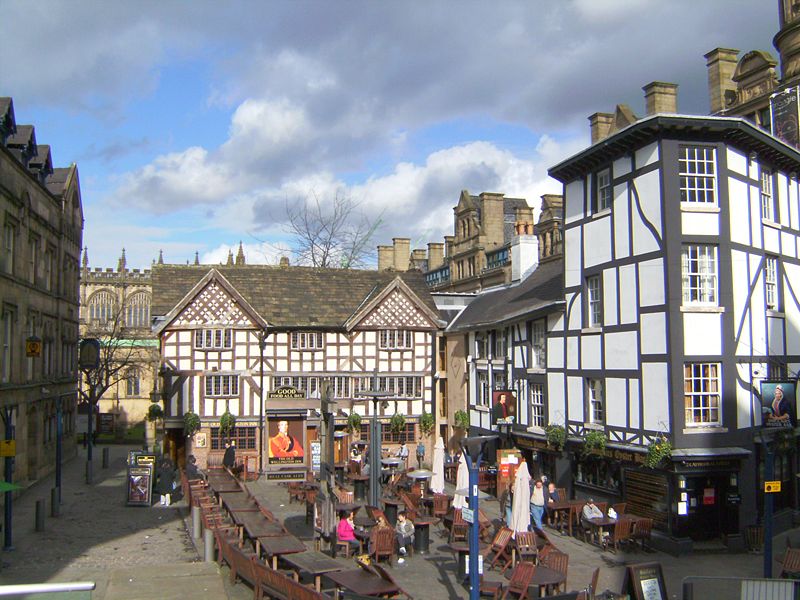
Shambles Square, Manchester
Knowledge base stats:
Talk channels stats:
Members stats:
Shambles Square, Manchester
Shambles Square is a square in Manchester, England. It was created in 1999, when The Old Wellington Inn and Sinclair's Oyster Bar were rebuilt there, having been moved from the Old Shambles nearby as part of major building works in the city following the 1996 Manchester bombing.
"Shambles" is derived from the Middle English word schamel, which meant a bench for displaying meat for sale. It was a name used often in the UK for a street of butchers' shops where meat was slaughtered and sold. Streets known as the "Shambles" can also be found in York, Stroud, Worcester, Sevenoaks, Chesterfield and Armagh, as well as a public house in Lutterworth which was once a butcher's shop and abattoir. The surviving sense of the word, meaning a scene of disorder, derives in turn from the butchers' shambles, which were known for their open gutters containing offal, pieces of meat and blood.
The Old Wellington Inn building was constructed in 1552. The building was on the corner of Manchester's market square (which became known as Market Place) and the eastern end of the Old Shambles meat market, at the approximate location of today's New Cathedral Street.
In 1554,[citation needed] the building was purchased by the Byrom family, prominent linen merchants who used part of the premises as a draper's shop. The Byrom family originally leased the building in the "Flesh shambles" in 1657. Edward Byrom (1627-1668) purchased it in 1666, having taken over the family business upon the death of his father Edward, who had owned property at nearby Hanging Ditch. A third floor was added in the mid 17th century.[citation needed] His son, also Edward, expanded the business, buying more of the property extending to the west of the Shambles 1689 and renting additional stalls on the market. John Byrom was born there in 1692.
The Market Cross, a monument first recorded in 1680, stood in front of the eastern building. The Market Cross was the site of a corn market, the stocks and pillory, as well as a "rogues' post" for those sentenced to public whipping. The cross was replaced in 1725, probably with an obelisk, and was removed in 1816 along with the stocks and pillory.
Joseph Byrom inherited the original eastern Shambles building in 1713, buying the remainder of the western section (which would later become Sinclair's Oyster Bar) in 1729. The building was extended in the 18th century to house John Shaw's Punch House, licensed for the sale of strong alcoholic punch, which became a meeting place for High Tories and possibly Jacobites. Shaw was master of the punch house for 58 years until his death in 1796, when it passed to Peter Fearnhead, and was sold again about ten years later to William Goodall, former proprietor of the Fleece Tavern at the opposite end of the Old Shambles.
The new landlord demolished part of the building and converted the rest into The King's Head Tavern in 1807, which later became known as Sinclair's.
The butchers' stalls were moved from the Old Shambles to new premises in Brown Street, built by the Lord of the manor, Sir Oswald Mosley, in 1827.
Hub AI
Shambles Square, Manchester AI simulator
(@Shambles Square, Manchester_simulator)
Shambles Square, Manchester
Shambles Square is a square in Manchester, England. It was created in 1999, when The Old Wellington Inn and Sinclair's Oyster Bar were rebuilt there, having been moved from the Old Shambles nearby as part of major building works in the city following the 1996 Manchester bombing.
"Shambles" is derived from the Middle English word schamel, which meant a bench for displaying meat for sale. It was a name used often in the UK for a street of butchers' shops where meat was slaughtered and sold. Streets known as the "Shambles" can also be found in York, Stroud, Worcester, Sevenoaks, Chesterfield and Armagh, as well as a public house in Lutterworth which was once a butcher's shop and abattoir. The surviving sense of the word, meaning a scene of disorder, derives in turn from the butchers' shambles, which were known for their open gutters containing offal, pieces of meat and blood.
The Old Wellington Inn building was constructed in 1552. The building was on the corner of Manchester's market square (which became known as Market Place) and the eastern end of the Old Shambles meat market, at the approximate location of today's New Cathedral Street.
In 1554,[citation needed] the building was purchased by the Byrom family, prominent linen merchants who used part of the premises as a draper's shop. The Byrom family originally leased the building in the "Flesh shambles" in 1657. Edward Byrom (1627-1668) purchased it in 1666, having taken over the family business upon the death of his father Edward, who had owned property at nearby Hanging Ditch. A third floor was added in the mid 17th century.[citation needed] His son, also Edward, expanded the business, buying more of the property extending to the west of the Shambles 1689 and renting additional stalls on the market. John Byrom was born there in 1692.
The Market Cross, a monument first recorded in 1680, stood in front of the eastern building. The Market Cross was the site of a corn market, the stocks and pillory, as well as a "rogues' post" for those sentenced to public whipping. The cross was replaced in 1725, probably with an obelisk, and was removed in 1816 along with the stocks and pillory.
Joseph Byrom inherited the original eastern Shambles building in 1713, buying the remainder of the western section (which would later become Sinclair's Oyster Bar) in 1729. The building was extended in the 18th century to house John Shaw's Punch House, licensed for the sale of strong alcoholic punch, which became a meeting place for High Tories and possibly Jacobites. Shaw was master of the punch house for 58 years until his death in 1796, when it passed to Peter Fearnhead, and was sold again about ten years later to William Goodall, former proprietor of the Fleece Tavern at the opposite end of the Old Shambles.
The new landlord demolished part of the building and converted the rest into The King's Head Tavern in 1807, which later became known as Sinclair's.
The butchers' stalls were moved from the Old Shambles to new premises in Brown Street, built by the Lord of the manor, Sir Oswald Mosley, in 1827.
Recent media