Hubbry Logo
PilloryPilloryMain
Open search
Pillory
Community hub
Pillory
logo
8 pages, 0 posts
0 subscribers
Be the first to start a discussion here.
Pillory
Pillory
from Wikipedia

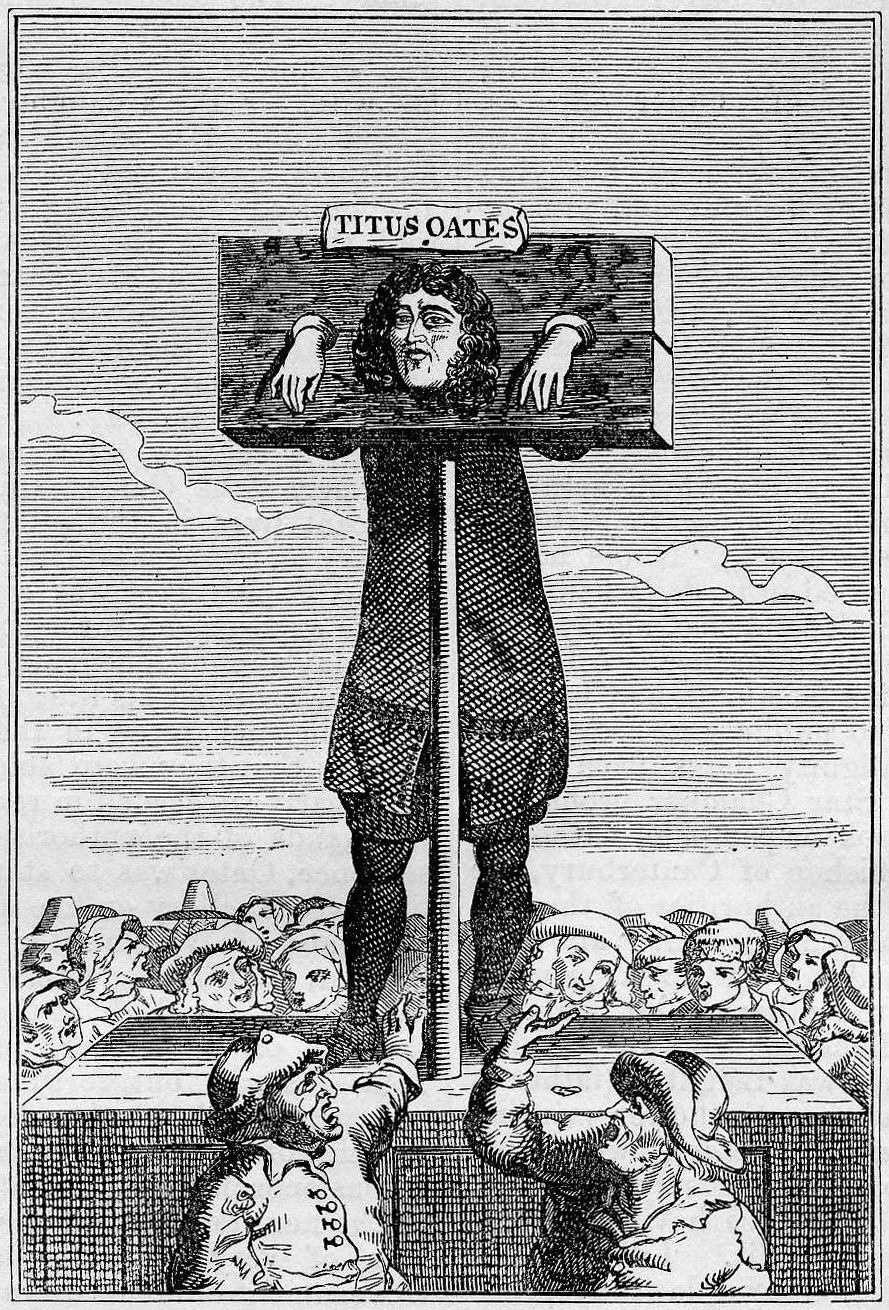
The 17th-century perjurer Titus Oates in a pillory

The pillory is a device made of a wooden or metal framework erected on a post, with holes for securing the head and hands, used during the medieval and renaissance periods for punishment by public humiliation and often further physical abuse.[1] The pillory is related to the stocks.[2]

Etymology

[edit]

The word is documented in English since 1274 (attested in Anglo-Latin from c. 1189), and stems from Old French pellori (1168; modern French pilori, see below), itself from medieval Latin pilloria, of uncertain origin, perhaps a diminutive of Latin pila 'pillar, stone barrier'.[3]

Description

[edit]
Pillory from Sweden, Dalarna Ragion, Nordic Museum, Stockholm.
Pillory from Dalarna Region, Sweden (Nordic Museum, Stockholm)
Stone pillory from the 18th century preserved in situ in Mespelare, Belgium. It is decorated with the coat of arms of the Goubau family, who at the time were the lords of the village.

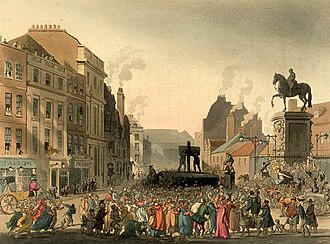
Rather like the lesser punishment called the stocks, the pillory consisted of hinged wooden boards forming holes through which the head or various limbs were inserted; then the boards were locked together to secure the captive. Pillories were set up to hold people in marketplaces, crossroads, and other public places.[2] They were often placed on platforms to increase public visibility of the person; often a placard detailing the crime was placed nearby.

In being forced to bend forward and stick their head and hands out in front of them, offenders in the pillory would have been extremely uncomfortable during their punishment. However, the main purpose in putting criminals in the pillory was to humiliate them publicly. On discovering that the pillory was occupied, people would excitedly gather in the marketplace to taunt, tease and laugh at the offender on display.[citation needed]

Those who gathered to watch the punishment typically wanted to make the offender's experience as unpleasant as possible. In addition to being jeered and mocked, the criminal might be pelted with rotten food, mud, offal, dead animals, and animal excrement. Sometimes people were killed or maimed in the pillory because crowds could get too violent and pelt the offender with stones, bricks and other dangerous objects.[4] However, when Daniel Defoe was sentenced to the pillory in 1703 for seditious libel, he was regarded as a hero by the crowd and was pelted with flowers.[5]

The criminal could also be sentenced to further punishments while in the pillory: humiliation by shaving off some or all hair or regular corporal punishment(s), notably flagellation or even permanent mutilation such as branding or having an ear cut off (cropping), as in the case of John Bastwick.

In Protestant cultures (such as in the Scandinavian countries), the pillory would be the worldly part of a church punishment. The delinquent would therefore first serve the ecclesiastical part of his punishment on the pillory bench in the church itself, and then be handed to the worldly authorities to be bound to the Skampåle (literally: "Shame Pole") for public humiliation.

Uses

[edit]

In 1816, use of the pillory was restricted in England to punishment for perjury or subornation.[2][6] The pillory as penalty was abolished in England and Wales in 1837,[7] after Lord John Russell had said "I shall likewise propose to bring in a Bill to abolish the punishment of the pillory—a punishment which is never inflicted."[8] However, the stocks remained in use, though extremely infrequently, until 1872.[nb 1] The last person to be pilloried in England was Peter James Bossy, who was convicted of "wilful and corrupt perjury" at the Old Bailey Oyer and Terminer in 1830. He was sentenced to seven years penal transportation to Van Diemen's Land, six months in prison at Newgate and one hour in the pillory in the Old Bailey.[10][11]

In France, time in the "pilori" was usually limited to two hours. It was replaced in 1789 by "exposition", and abolished in 1832.[2] Two types of devices were used:

  • The poteau (literally: "post" or "pole") was a simple post, often with a board around only the neck, and was synonymous with the mode of punishment. This was the same as the schandpaal ("shamepole") in Dutch. The carcan, an iron ring around the neck to tie a prisoner to such a post, was the name of a similar punishment that was abolished in 1832. A criminal convicted to serve time in a prison or galleys would, prior to his incarceration, be attached for two to six hours (depending on whether he was convicted to prison or the galleys) to the carcan, with his name, crime and sentence written on a board over his head.
  • A permanent small tower, the upper floor of which had a ring made of wood or iron with holes for the victim's head and arms, which was often on a turntable to expose the condemned to all parts of the crowd.

Like other permanent apparatus for physical punishment, the pillory was often placed prominently and constructed more elaborately than necessary. It served as a symbol of the power of the judicial authorities, and its continual presence was seen as a deterrent, like permanent gallows for authorities endowed with high justice.

The pillory was also in common use in other western countries and colonies, and similar devices were used in other, non-Western cultures. According to one source, the pillory was abolished as a form of punishment in the United States in 1839,[2] but this cannot be entirely true because it was clearly in use in Delaware as recently as 1901.[12][13] Governor Preston Lea finally signed a bill to abolish the pillory in Delaware in March 1905.[14]

Punishment by whipping-post remained on the books in Delaware until 1972, when it became the last state to abolish it.[15] Delaware was the last state to sentence someone to whipping in 1963; however, the sentence was commuted. The last whipping in Delaware was in 1952.[16]

In Portugal today pillory has a different meaning. The Portuguese word is Pelourinho, and there are examples which are monuments of great importance, in a tradition dating back to Roman times, when criminals were chained to them.[17] They are stone columns with carved capitals, and they are usually located on the main square of the town, and/or in front of a major church or palace, or town hall: they symbolize local power and authority. Pelourinhos are considered major local monuments, several clearly bearing the coat of arms of a king or queen. The same is true of its former colonies, notably in Brazil (in its former capital, Salvador, the whole old quarter is known as Pelourinho) and Africa (e.g. Cape Verde's old capital, Cidade Velha), always as symbols of royal power. In Spain, the device was called picota.[18]

Similar humiliation devices

[edit]
Combined pillory and whipping post in New Castle County Jail, Delaware, 1907. The pillory sits in an elevated position to increase its visibility, while the whipping post is at ground level to provide more room for the whipper.

There was a variant (rather of the stocks type), called a barrel pillory, or Spanish mantle, used to punish drunks, which is reported in England and among its troops. It fitted over the entire body, with the head sticking out from a hole in the top. The criminal is put in either an enclosed barrel, forcing him to kneel in his own filth, or an open barrel, also known as "barrel shirt" or "drunkards collar" after the punishable crime, leaving him to roam about town or military camp and be ridiculed and scorned.[19]

Although a pillory, by its physical nature, could double as a whipping post to tie a criminal down for public flagellation (as used to be the case in many German sentences to staupenschlag), the two as such are separate punishments: the pillory is a sentence to public humiliation, whipping is essentially a painful corporal punishment. The combination of the pillory and the whipping post was one of the various punishments the Puritans of the Massachusetts Bay Colony applied to enforce religious and intellectual conformity on the whole community.[20] Sometimes a single structure was built with separate locations for the two punishments, with a whipping post on the lower level and a pillory above (see image at right).

When permanently present in sight of prisoners, whipping posts were thought to act as a deterrent against bad behaviour, especially when each prisoner had been subjected to a "welcome beating" on arrival, as in 18th-century Waldheim in Saxony (12, 18 or 24 whip lashes on the bare posterior tied to a pole in the castle courtyard, or by birch rod over the "bock", a bench in the corner).[citation needed] Still a different penal use of such constructions is to tie the criminal down, possibly after a beating, to expose him for a long time to the elements, usually without food and drink, even to the point of starvation.[citation needed]

Finger-pillories were at one time in common use as instruments of domestic punishment. Two stout pieces of oak, the top being hinged to the bottom or fixed piece, formed when closed a number of holes sufficiently deep to admit the finger to the second joint, holding the hand imprisoned. A finger-pillory is preserved in the parish church of Ashby-de-la-Zouch, Leicestershire.[21]

Notable cases

[edit]

Legacy

[edit]
A pillory at the Medieval Market in Turku, Finland

While the pillory has left common use, the image remains preserved in the figurative use, which has become the dominant one, of the verb "to pillory" (attested in English since 1699),[22] meaning "to expose to public ridicule, scorn and abuse", or more generally to humiliate before witnesses.

Corresponding expressions exist in other languages, e.g., clouer au pilori "to nail to the pillory" in French, mettere alla gogna in Italian, or poner en la picota in Spanish. In Dutch it is aan de schandpaal nagelen (nailing to the pole of shame) or aan de kaak stellen, placing even greater emphasis on the predominantly humiliating character as the Dutch word for pillory, schandpaal, literally meaning "pole of shame".

See also

[edit]

Notes

[edit]

References

[edit]
[edit]
Revisions and contributorsEdit on WikipediaRead on Wikipedia
from Grokipedia
The pillory was an instrument of public prevalent in medieval and , particularly , consisting of a wooden or metal frame mounted on a post or platform with hinged boards featuring holes to secure the offender's head and wrists in a forward-bent posture, thereby immobilizing them for exposure to communal scorn. Employed from at least the 13th century under statutes like those of King Edward I, the pillory targeted offenses such as fraudulent trading, , libel, and seditious writings, with offenders typically confined for one to several hours in prominent marketplaces where passersby could hurl refuse, mud, or stones, often resulting in injury or, in extreme cases, death despite occasional official protections. In colonial America, its application extended to similar moral and economic crimes, frequently augmented by mutilations like ear cropping or branding, as prescribed in provincial laws such as Pennsylvania's statutes against counterfeiting and . By the , concerns over arbitrary mob violence prompted restrictions, limiting its use in to by 1816, with full abolition enacted in 1837 via 7 & 1 Victoria c.23, though isolated applications persisted elsewhere until the early , marking a transition from corporeal shaming to institutionalized penalties.

Etymology and Origins

Linguistic Evolution

The term "pillory" entered Middle English as pilory or pillorie around 1225–1275, denoting a wooden framework for restraining offenders by securing their head and hands. This form derived directly from Old French pilori or pellori, attested by the mid-12th century, which referred to the same punitive device and likely stemmed from Medieval Latin pīlōrium or pillorium, a diminutive or variant form evoking a post or pillar for public exposure. The Latin root traces to pīla, meaning "pillar" or "pile," reflecting the structure's vertical post and horizontal beam, though some derivations propose influence from Old Occitan espilori, possibly linked to "peephole" or viewing aperture for spectators. Uncertainty persists regarding the precise pathway, as no definitive pre-12th-century attestation clarifies whether the term originated as a Romance innovation or adapted an earlier Germanic or Celtic element, but phonological evidence favors a Latin-Romance continuum without significant semantic shift from physical restraint to humiliation until later usage. In English, the noun stabilized by the 13th century via Anglo-French borrowing during Norman influence, appearing in legal records by circa 1330 as a fixed term for judicial instruments in urban squares. Orthographic variations like pyllory persisted into the , gradually standardizing to pillory amid the , which minimally affected its stressed syllable but aligned it with emerging phonology. Semantic extension to verbal use—"to pillory," meaning to subject someone to public ridicule or criticism—emerged by the late , initially in metaphorical contexts decoupled from the physical device, as in literary critiques of moral failings; this figurative sense proliferated in 17th-century print, reflecting Enlightenment-era shifts toward intellectual rather than corporal shaming. By the , with the device's abolition (e.g., in Britain by 1837), the word's primary connotation evolved to non-literal exposure, enduring in as a for reputational attack, uninfluenced by regional dialects but occasionally compounded in historical neologisms like "pillory-post." Cognates persist in , such as French pilori (retained for the device until its 1832 disuse) and Italian pilori, underscoring a shared medieval punitive without divergent evolutionary branches.

Earliest Historical Evidence

The pillory, a restraint device securing the offender's head and hands in a wooden frame for public exposure, finds its earliest documented origins in Anglo-Saxon England under the term healsfang, derived from heals (neck) and fang (to seize or catch). This form of punishment appears in the Anglo-Saxon dooms, a series of legal codes spanning from approximately 560 to 975 AD, where it served as a penalty for minor offenses such as petty theft or breaches of community order, emphasizing public shaming over physical mutilation. These laws prescribed healsfang as an alternative to fines or corporal penalties, reflecting a system prioritizing communal deterrence through visible humiliation in village or market settings. Textual evidence from the period, including illuminated manuscripts and legal compilations, indicates that healsfang involved a portable wooden post or frame erected for restraint, akin to later pillories but adapted to early medieval mobility needs. While precursors resembling stocks—restraining the feet—existed in and for trivial infractions, exposing offenders to public derision without immobilizing the upper body, the pillory's distinctive head-and-hands configuration emerges distinctly in Anglo-Saxon records as a targeted for upright, inescapable exposure. No archaeological remains of Anglo-Saxon pillories survive, but contemporary descriptions in dooms and charters confirm their routine judicial application across shires, predating Norman influences that formalized variants like the French pilori by the . By the late Anglo-Saxon era, around the , healsfang had integrated into broader systems, where local tithings enforced its use for offenses like drunkenness or market fraud, underscoring its role in maintaining social cohesion without resorting to . This early evidence establishes the pillory not as a continental import but as an indigenous English development, with continental parallels, such as the German Pranger first recorded in 1270 and the Scandinavian gapestokk, known from the 12th century as a wooden stock with holes for the head and hands to lock the offender in place for public shaming, often positioned on town squares or in front of churches; linguistic variants included halsjern and at staa paa Pælen, with abolition occurring informally in Denmark around 1832 and by law in Norway on May 17, 1848.

Physical Design and Operation

Construction Materials and Variations

The pillory was predominantly constructed from wood for its frame, consisting of two hinged or sliding boards with semicircular holes to secure the offender's head and wrists, often bolted or locked in place. Iron components, such as hinges, bolts, and reinforcements, were incorporated for durability and secure fastening, as evidenced by 1524 records from , England, detailing expenditures on timber hauling and totaling 5s 3d. The central post or platform supporting the frame was typically wooden but could vary by region and era, with some examples using stone or brick for permanence, particularly in fixed installations attached to buildings or marketplaces. Design variations included capacity for one or two offenders, with larger models accommodating multiple individuals via spoke-like arrangements of stocks radiating from a central post. Some pillories featured a rotating mechanism on the post to expose the offender to the crowd from all angles, while others included raised platforms for visibility or thatched canopies for weather protection. Regional adaptations appeared in versions with carved symbols, such as crosses, on wooden frames used in church contexts from the 17th to 19th centuries. In certain European locales, like medieval , pillories evolved into stone pillars topped with adjustable metal arms holding the wooden restraint, emphasizing permanence over portability. These differences arose from local craftsmanship, evolving repairs, and judicial needs, with simpler ground-fixed models contrasting more elaborate wheeled or elevated structures.

Mechanism of Restraint and Exposure

The pillory operated as a fixed restraint device typically constructed from a vertical wooden anchored to a raised platform, elevating the offender several feet above ground level to maximize . A horizontal frame, often hinged and featuring paired semicircular apertures, was mounted atop or adjacent to the post; the offender's and wrists were aligned within these openings, after which the frame was clamped shut using locks, bolts, or wooden pins, immobilizing the head and hands in a rigid, forward-bent posture that enforced a standing position without support for the body. This configuration causally ensured vulnerability by preventing defensive gestures, evasion, or escape, as the restrained limbs and restricted movement and balance, often inducing physical strain from prolonged upright exposure to and gravity over durations of one to several hours as specified by sentencing. In operation, authorities positioned the device in high-traffic squares or marketplaces, where the elevation and openness facilitated unobstructed viewing from multiple angles; some designs incorporated a swivel mechanism on the post, allowing to expose the offender to encircling crowds without repositioning the structure. Exposure extended beyond mere visibility to enable direct public interaction, as the offender's immobilized form left the body accessible for verbal abuse, spitting, or projectile assaults with refuse, eggs, or stones, amplifying humiliation through crowd participation while deterring sympathy via the inescapability of the restraint. Historical records indicate occasional reinforcements with iron bands or chains for durability against weathering or sabotage, though primary wooden variants predominated for cost and simplicity in local jurisdictions.

Targeted Offenses and Sentencing

The pillory targeted offenses characterized by deceit, moral lapse, or public disorder, emphasizing humiliation over lethal penalty. In , judicial sentences applied it to , , seditious words, , and attempted , alongside minor violations such as drunkenness, , , cheating at trade, and failure to attend church. Colonial American courts extended its use to a wider spectrum reflecting community norms, including , , , , , , wife-beating, , coin clipping, slandering, and selling adulterated goods. In Denmark-Norway, under Christian V's Norske Lov of 1687, the gapestokk punished persistent swearing and blasphemy despite warnings, disturbing church services, various forms of public disorder, and non-payment of minor fines such as those for fornication. It was particularly used in the 18th century for such lesser breaches. Sentences prescribed fixed exposure durations, commonly one to three hours, in prominent locations like market squares or busy thoroughfares such as , where the device was often mounted on a rotatable platform for maximal visibility. The offender's name, , and sentence appeared on a affixed to the pillory, with constables sometimes shielding against mob violence involving projectiles like stones or rotten eggs. Recidivists or aggravated cases faced repeated exposures, such as monthly for 18 months in convictions, or adjunct penalties including whipping, fines, ear cropping, or branding—as in 1771 , where a counterfeiter endured one hour pilloried, ears cropped, and cheeks branded "". In Scandinavian contexts, related punishments like kakstrykning—involving whipping of the offender bound to a post (kak or straffepæl)—could accompany gapestokk exposure or substitute for minor offenses, sometimes combined with branding. Legislative evolution curtailed its scope; an 1816 English statute restricted the pillory to and subornation thereof, abolishing it entirely by 1837 amid concerns over inconsistent enforcement and public disorder. In the United States, federal statutes permitted it until 1839, with retaining the practice until 1905 for certain misdemeanors.

Judicial Procedures Across Jurisdictions

In , judicial procedures for pillory punishment followed conviction in criminal courts such as the for offenses including , , , and , with sentences typically mandating public exposure for one hour in high-traffic locations like or . The offender's head and arms were secured in a wooden frame atop a raised platform, oriented to maximize visibility to crowds, while constables formed a protective ring to mitigate mob violence, though such safeguards often proved inadequate against pelting with stones, eggs, or refuse that could result in severe injury or death. Administration fell to local officials, with the punishment executed immediately or shortly after sentencing, and records indicate 5 to 10 such sentences annually in during the , declining after 1761 due to public disorder risks and restricted to by in 1816 before full abolition in 1837. American colonies largely mirrored English procedures under common law, with local courts or magistrates imposing pillory sentences for similar misdemeanors like cheating, blasphemy, or forgery, often combining exposure—typically one to three hours in town squares—with whipping or fines. In Puritan New England, such as Massachusetts, convictions by county courts for moral crimes led to execution at whipping posts or pillories maintained in every town, emphasizing communal enforcement through public shaming to deter recidivism. Some jurisdictions enacted statutes augmenting humiliation with mutilation; for example, a 1701 Pennsylvania law for seditious libel prescribed one hour in the pillory, cropping and nailing of ears to the device, and 39 lashes, carried out by the sheriff or deputy in the county seat. Federal use persisted until 1839, with Delaware retaining it as the last state until the mid-19th century, though procedures emphasized restraint without routine additional corporal elements post-independence. In , variants like the German Pranger involved lower court sentences for libel or petty moral offenses, chaining the offender to a fixed post, wall, or mast in marketplaces for durations of one to several hours, allowing public or minor pelting under judicial oversight to enforce norms without the mobile wooden frame common in Anglo-American practice. French procedures utilized the carcan, an iron collar affixed around the neck and secured to a post, sentenced by royal or municipal courts for or until abolition in 1832, with exposure limited to urban centers and guarded against excess violence, reflecting centralized monarchical control over public punishments. In Scandinavia, the gapestokk—typically a post with holes or an iron hoop for the neck, placed in town squares or before churches—was imposed by local courts for minor offenses, exposing the offender to public scorn for fixed periods; it persisted into the 19th century, with last use in Norway in 1840 and formal abolition in 1848. These procedures across jurisdictions prioritized visible deterrence through , with execution delegated to local enforcers ensuring the offender's immobility and accessibility to onlookers, though variations in added physical penalties highlighted differing emphases on retribution versus restraint.

Empirical Effectiveness as Deterrent

Historical Data on Recidivism and Social Impact

Historical assessments of the pillory's effect on recidivism are constrained by the absence of systematic tracking in pre-modern judicial systems, with few records quantifying reoffense rates among those punished. English court documents from the 18th century occasionally document repeat sentences to the pillory for offenses like perjury or forgery, implying that public exposure failed to deter some habitual offenders whose social reintegration was already compromised. The punishment's social impact centered on leveraging communal ridicule to enforce norms against deceptive crimes, often targeting market fraud or false testimony prevalent in urban centers like . In smaller, reputation-dependent communities—such as colonial American settlements—analogous shaming practices demonstrably curbed minor transgressions by imposing lasting , with low mobility rates (under 1% annually in mid-17th-century ) amplifying reputational costs. However, in denser English settings, the pillory frequently escalated into mob violence, as seen in the 1732 death of perjurer John Waller from crowd assaults despite official protections, undermining its intended deterrent role and contributing to humanitarian critiques. England's restriction of the pillory to perjury in 1816 and full abolition in 1837 occurred amid rising overall crime rates linked to and , with no direct evidence attributing post-abolition increases in targeted offenses to the punishment's removal. Qualitative accounts portray it as a low-cost mechanism for swift communal , effective against status-sensitive perpetrators but prone to arbitrary excesses that eroded public trust in judicial equity.

Psychological and Causal Mechanisms

The pillory operated primarily through the psychological mechanism of induced , a process distinct from internalized , wherein the offender experienced enforced public degradation that signaled a profound loss of and . This exposure to communal and potential ridicule or exploited humans' evolved sensitivity to and group exclusion, as social animals prioritize avoiding to maintain bonds essential for survival. Empirical analyses of indicate it triggers intense emotional distress, often manifesting as helplessness, rage, or submissive withdrawal, which could condition the individual against by associating deviance with irreversible . Causally, the device's restraint mechanism—fixing the head and hands to prevent evasion—amplified vulnerability, ensuring prolonged visibility that intensified the punitive signal to both the offender and observers. For the punished, this created a direct feedback loop: physical immobility compounded psychological torment, fostering a visceral memory of helplessness that deterred future offenses through anticipated replication of the experience. Historical applications, such as in medieval Europe, relied on this immediacy to enforce norms in tight-knit communities where personal acquaintance heightened the stakes of , though quantitative data remains sparse due to incomplete records. From a deterrence standpoint, the pillory's public nature facilitated among witnesses, who internalized the causal chain linking transgression to social and physical costs, thereby elevating perceived risks of similar . This vicarious mechanism aligns with principles of specific and general deterrence, where the certainty of communal enforcement—rather than mere severity—curbed opportunism by embedding caution via collective vigilance. Peer-reviewed examinations of shaming punishments underscore that such displays reinforce group cohesion by visibly upholding moral boundaries, potentially reducing deviance in homogeneous societies, though efficacy waned in larger, anonymous urban settings where or indifference diluted the effect.

Notable Cases and Incidents

British Examples

One prominent British case involved , convicted of in May 1685 for fabricating the , a supposed Catholic conspiracy against King Charles II. His sentence included life imprisonment, annual whippings from to , and placement in the pillory five times yearly, with initial expositions at and in the where crowds pelted him with eggs and refuse. In 1732, John Waller, a convicted perjurer and who had falsely accused others to evade his own crimes, was pilloried at Seven Dials in London on June 13. The crowd's hostility escalated beyond official intent, as spectators hurled stones and bricks, beating him to death during his exposure; this incident highlighted risks of mob violence overriding judicial restraint. The Vere Street Coterie raid in 1810 targeted a male at the in London's Vere Street, leading to arrests for under existing statutes. On , several convicted men, including proprietor James Cooke, were pilloried near the site, enduring one of the most severe public assaults recorded, with mobs pelting them for over an hour using dead cats, fish entrails, and , causing grievous injuries and underscoring communal enforcement of norms through extralegal means.

Colonial and American Instances

In the British North American colonies, the pillory served as a standard inherited from English , applied to offenses such as , , , , , and cheating at cards or dice. Colonial legislatures codified its use in statutes mirroring metropolitan practices, often combining it with fines, whipping, or ear cropping for aggravated crimes like counterfeiting or , where offenders' ears were severed and affixed to the device to amplify and deter . In Puritan strongholds like , the pillory targeted moral and religious infractions, including reviling ministers or Sabbath-breaking, reflecting the theocratic emphasis on communal enforcement of piety through visible shaming. Following independence, the early American republic retained the pillory in state penal codes, particularly for non-capital misdemeanors and property crimes, as penitentiaries emerged slowly and local jurisdictions favored low-cost public sanctions over incarceration. Usage persisted into the 19th century across states like Pennsylvania and Virginia, where it exposed offenders to crowds in marketplaces or courthouses, though mob violence occasionally escalated the intended restraint into severe injury from thrown objects. By the 1830s, humanitarian reforms and Eighth Amendment interpretations prompted widespread abolition, with most jurisdictions phasing it out in favor of fines or short-term imprisonment; Delaware, however, maintained it until 1905 as an auxiliary penalty for certain felonies, marking the final recorded statutory use in the United States.

Criticisms Leading to Abolition

Documented Abuses and Mob Violence

The pillory's exposure of the offender's head and hands rendered them defenseless against crowd assaults, frequently escalating beyond judicial intent into severe beatings, mutilations, or fatalities, as public sentiment dictated the punishment's brutality rather than fixed legal parameters. Historical records document numerous instances where mobs pelted victims with stones, rotten produce, excrement, and sharper objects, leading to documented injuries including lost eyes, fractured skulls, and death. On June 13, 1732, perjurer John Waller, convicted of falsely accusing to facilitate robbery, was placed in the pillory at , where an enraged crowd pelted him with stones and clubs until he died from the assault. Contemporary accounts describe the mob's fury as retribution for Waller's deceit, which had nearly cost his life and property, underscoring how personal grievances amplified violence. Elizabeth Needham, a notorious procuress convicted of keeping a disorderly house, suffered a fatal pillorying on April 30, 1731, at Park Place in , ; overwhelmed by thrown missiles and physical exhaustion, she died four days later from her injuries. Her case exemplified the peril for those associated with moral offenses, as the crowd's unrestrained aggression turned a one-hour sentence into a lethal ordeal. The 1810 pillorying of the Vere Street Coterie—six men convicted of at a —drew a massive crowd of 2,000 to 4,000 outside , who bombarded the victims with stones, mud, dung, dead animals, and glass bottles, inflicting grievous wounds including broken limbs and gashes requiring medical intervention. Eyewitness reports noted over 50 women actively participating in the pelting, reflecting heightened public outrage toward perceived sexual deviance, which prolonged the men's suffering beyond the prescribed exposure time. These episodes of uncontrolled mob justice, recurrent in 17th- and 18th-century , eroded the pillory's legitimacy by demonstrating its propensity for arbitrary excess over measured retribution.

Philosophical and Humanitarian Objections

Philosophical objections to the pillory derived from Enlightenment critiques of punishment emphasizing rationality, proportionality, and deterrence over retribution or spectacle. , in his 1764 treatise , contended that infamy—a form of public shaming central to the pillory—must be proportionate and applied sparingly to retain its moral force, warning that overuse or excess rendered it ineffective for preventing crime. He further argued against theatrical public punishments, describing severe spectacles as appealing to fanatic crowds but failing to produce lasting deterrence, as they hardened observers rather than associating crime with certain consequences. These principles extended to the pillory's reliance on uncontrolled public opprobrium, which philosophers viewed as philosophically flawed for substituting emotional outrage for measured justice. By the early , such reasoning permeated legal discourse; in the 1815 British debate on the Pillory Abolition Bill, Lord Chief Justice Ellenborough asserted that the punishment had been condemned by nearly all authors on criminal for exacerbating criminal tendencies rather than reforming them. Critics contended it undermined societal virtue by fostering mob passions over rational enforcement, aligning with broader philosophical shifts toward punishments focused on prevention and utility. Humanitarian objections centered on the pillory's capacity for gratuitous suffering and lethality, transcending judicial intent. Exposure left offenders vulnerable to mob violence, with crowds hurling stones, bricks, or excrement, often causing fatal injuries independent of official sentencing. This unpredictability, documented in incidents where perjurers and others perished, rendered the practice incompatible with emerging views of human dignity and controlled penalty. Philanthropists in abolition debates decried it as barbaric, arguing it inflicted unnecessary physical torment—such as prolonged restraint in inclement weather—and enduring psychological degradation without rehabilitative value.

Defenses and Justifications

Arguments for Efficacy in Community Enforcement

The pillory was defended as an effective tool for community enforcement due to its public visibility, which made the immediate consequences of offenses like , , and moral infractions starkly apparent to onlookers, thereby serving as a direct deterrent against similar acts. By exposing the offender to communal scorn, often including public pelting with refuse, the reinforced shared social norms and educated the populace on the reprobation of the , fostering collective vigilance without relying on an expansive state apparatus. Historical penal frameworks positioned the pillory as a calibrated sanction for petty crimes, more dreaded in some instances than execution itself owing to its humiliating permanence in local memory, while avoiding the irreversibility of or . Legal scholars such as John Langbein have noted its preference in early modern codes like the 1532 Carolina for balancing deterrence with proportionality, enabling swift enforcement that preserved community cohesion by signaling that violations of trust—prevalent in trading or —would incur lasting . In colonial settings, the device's role extended to reminding "those inclined toward " of crime's tangible social costs, leveraging tight-knit structures where reintegration hinged on reformed conduct under ongoing . This mechanism arguably amplified enforcement efficacy by devolving partial authority to the , who through observation and participation internalized the causal link between transgression and , potentially curbing more potently than abstract threats in pre-industrial societies.

Potential for Low-Cost Social Order

The pillory functioned as a resource-efficient instrument for upholding social norms, demanding scant infrastructure—a simple post with adjustable wooden boards for securing the offender's head and hands—contrasted against the considerable outlays for constructing prisons, sustaining inmates with food and labor, and deploying guards for prolonged confinement. In pre-modern Europe, non-custodial penalties like the pillory prevailed over imprisonment precisely because they imposed minimal fiscal strain on limited state or communal budgets, allowing routine application to infractions ranging from market fraud to perjury without diverting funds from other public needs. This extended the reach of , enabling communities to police minor and economic deviations that might evade sanction under costlier regimes, thereby preserving order through widespread visibility rather than selective incarceration. The device's public placement amplified deterrence by subjecting offenders to communal and potential ridicule, harnessing social disapproval as a self-sustaining control mechanism that obviated ongoing expenses. Historical accounts portray the pillory as a feared penalty, its immediacy and exposure reinforcing behavioral compliance in eras predating expansive penal systems. Analyses of shaming sanctions underscore their capacity to impose reputational costs that rival formal penalties in efficacy while incurring negligible marginal expenses, potentially curbing via enduring stigma and bystander vigilance. In resource-scarce settings, such as colonial outposts or medieval towns, the pillory's deployment correlated with regulated and , evidencing its role in low-overhead norm maintenance absent modern alternatives.

Comparisons and Analogues

Similar Pre-Modern Devices

The , a wooden framework with holes to secure the ankles of the offender while seated, served as a common alternative to the pillory for in medieval and . Typically employed for minor infractions such as drunkenness, petty theft, or , the device immobilized the legs and exposed the individual to ridicule, including the throwing of rotten produce or refuse by passersby. This punishment persisted in and other regions until the early , emphasizing community enforcement through shaming rather than physical harm, akin to the pillory's focus on visibility and social ostracism. Cucking stools, also known as ducking stools in their water-immersion variant, involved strapping the culprit—often women accused of scolding or gossiping, but sometimes men or dishonest traders—to a mounted on a pole, which was then paraded through town or dunked into water bodies. Originating in by the , the apparatus aimed to silence and humiliate "common scolds" by public exposure and potential drowning risk, with the cucking form prioritizing procession and the ducking adding physical discomfort through repeated submersion. The last recorded use occurred in , , in 1809, when Jenny Pipes was ducked for local disturbances, highlighting the device's role in gender-specific parallel to the pillory's broader application. The , or branks, consisted of an fitted over the head with a or spiked bit inserted into the mouth to punish verbal offenses like or slander, predominantly targeting women in medieval and . Worn publicly while chained or led through streets, it inflicted pain and restricted speech, fostering deterrence via humiliation and physical restraint similar to the pillory's immobilizing exposure. Use by town councils and courts, though not formally legalized, continued into the in some areas, underscoring its function in maintaining communal norms through visible correction. Contemporary non-custodial penalties that invoke public shaming bear resemblance to the pillory's reliance on communal disapproval and stigma to enforce norms without depriving liberty. These modern sanctions prioritize social over incarceration, positing that visibility of wrongdoing deters through reputational harm and community pressure, much as the pillory exposed offenders to ridicule and potential violence from bystanders. Such approaches have seen periodic judicial , where courts impose requirements like holding placards admitting guilt in public spaces or placing advertisements in newspapers detailing the offense. For example, in , a judge sentenced David Wayne Page to hold a reading "I am a bully" outside a , a penalty upheld on appeal as not constituting under the Eighth Amendment. Sex offender registries represent a institutionalized analogue, mandating lifelong or extended public online disclosure of personal details, addresses, and photographs for convicted individuals, enabling widespread community monitoring and exclusion. Enacted federally via the 1996 Megan's Law and expanded under the 2006 Adam Walsh Child Protection and Safety Act, these registries function as digital pillories by perpetuating shame and vigilante risks without custodial confinement, with over 900,000 registrants in the U.S. as of 2023. Critics, including legal scholars, argue this mirrors historical shaming's uncontrolled enforcement, as public access often leads to employment loss, housing denial, and extralegal harassment, echoing pillory-era mob actions. Empirical studies indicate mixed deterrence effects, with some analyses showing no significant reduction in recidivism rates compared to non-public penalties. In jurisdictions outside the U.S., similar mechanisms persist, such as Singapore's public naming of corrupt officials or minor offenders via government gazettes, which leverage cultural emphasis on collective honor to amplify . These practices, while varying in intensity, underscore a causal continuity: shaming exploits innate social drives to maintain order at low fiscal cost, though on long-term efficacy remains contested, with some linking reintegrative shaming to lower reoffending in tight-knit communities versus stigmatizing variants that exacerbate isolation.

Enduring Legacy

Abolition Timelines and Transitions

In , the use of the pillory was progressively restricted due to documented instances of excessive mob violence and fatalities, culminating in legislative abolition. Following parliamentary debates highlighting risks such as the 1780 death of William Smith while pilloried in , the punishment was limited in 1815 to cases of and , excluding its application for other offenses like or moral crimes. The final recorded use occurred on June 24, 1830, when perjurer Peter James Bossy was exposed for one hour at , after which comprehensive abolition followed on June 30, 1837, via the Pillory Abolition Act, aligning with broader Whig penal reforms emphasizing imprisonment over public corporal penalties. Across the , abolition timelines varied by , reflecting slower adoption of reformist sentiments in some areas compared to Britain. Federal statutes permitted the pillory until its removal from naval and codes by 1839, though state-level practices persisted longer; for instance, eliminated it alongside cropping and in 1829 as part of misdemeanor penalty revisions. retained the device longest among states, applying it for crimes like wife-beating and until March 16, 1905, when the state unanimously passed a bill abolishing it, driven by national criticism of its perceived barbarity amid penal modernization. This transition in decoupled the pillory from the whipping post, which remained legal until 1972, shifting emphasis to incarceration and fines for similar offenses. In , pillories were generally phased out by the mid-19th century, paralleling Enlightenment-influenced reforms against public spectacles of humiliation. discontinued the practice in 1832, while most other nations followed suit amid rising advocacy for centralized prisons over decentralized community shaming. These abolitions marked a broader penal transition from visible, participatory punishments reliant on public enforcement—which often devolved into uncontrolled —to institutionalized alternatives like and , intended to enforce deterrence through isolation rather than exposure, though critics noted the new systems' higher costs and potential for hidden abuses.

Cultural and Rhetorical Persistence

The term "pillory" endures in contemporary English as a denoting the act of subjecting someone to ridicule, scorn, or severe , a semantic extension from its historical use as a for exposure to communal derision. This figurative application, attested since the late , reflects the device's core function of amplifying social dishonor through visibility, as articulated in classical economic thought where placement in the pillory was deemed more degrading than due to its emphasis on reputational harm over bodily destruction. In political , the verb appears in descriptions of adversarial attacks, such as reports of opponents "pillorying" figures like Senator during 1999 debates, illustrating its role in framing verbal assaults as quasi-punitive spectacles. Rhetorically, invocations of the pillory persist in analyses of modern shaming practices, particularly in media and digital contexts, where scholars analogize historical public exposure to contemporary mechanisms of . Academic examinations describe regional media's naming and of low-level offenders—such as petty thieves or traffic violators—as a "digital pillory," arguing that this practice revives the pillory's logic of by leveraging mass visibility to enforce norms, often amplifying private failings into enduring public records without safeguards inherent in formal judicial settings. Such analogies highlight causal parallels: just as pre-modern pillories deterred through communal participation and potential mob violence, digital variants exploit networked outrage for similar deterrent effects, though empirical studies note inconsistent behavioral impacts and risks of disproportionate harm to ordinary individuals. This rhetorical legacy underscores debates on non-custodial penalties, where the pillory metaphor critiques or defends informal social enforcement; proponents of community-driven order reference it to for reputational sanctions as low-cost alternatives to incarceration, while critics, drawing on humanitarian precedents, warn of unchecked escalation akin to historical abuses. In and discourse from the onward, the term evokes these tensions, as seen in extended critiques of or "pilloried" as scapegoats, preserving the device's symbolic weight in examinations of power and public judgment.

References

Add your contribution
Related Hubs
User Avatar
No comments yet.