Hubbry Logo
Shaun EdwardsShaun EdwardsMain
Open search
Shaun Edwards
Community hub
Shaun Edwards
logo
8 pages, 0 posts
0 subscribers
Be the first to start a discussion here.
Shaun Edwards
Shaun Edwards
from Wikipedia

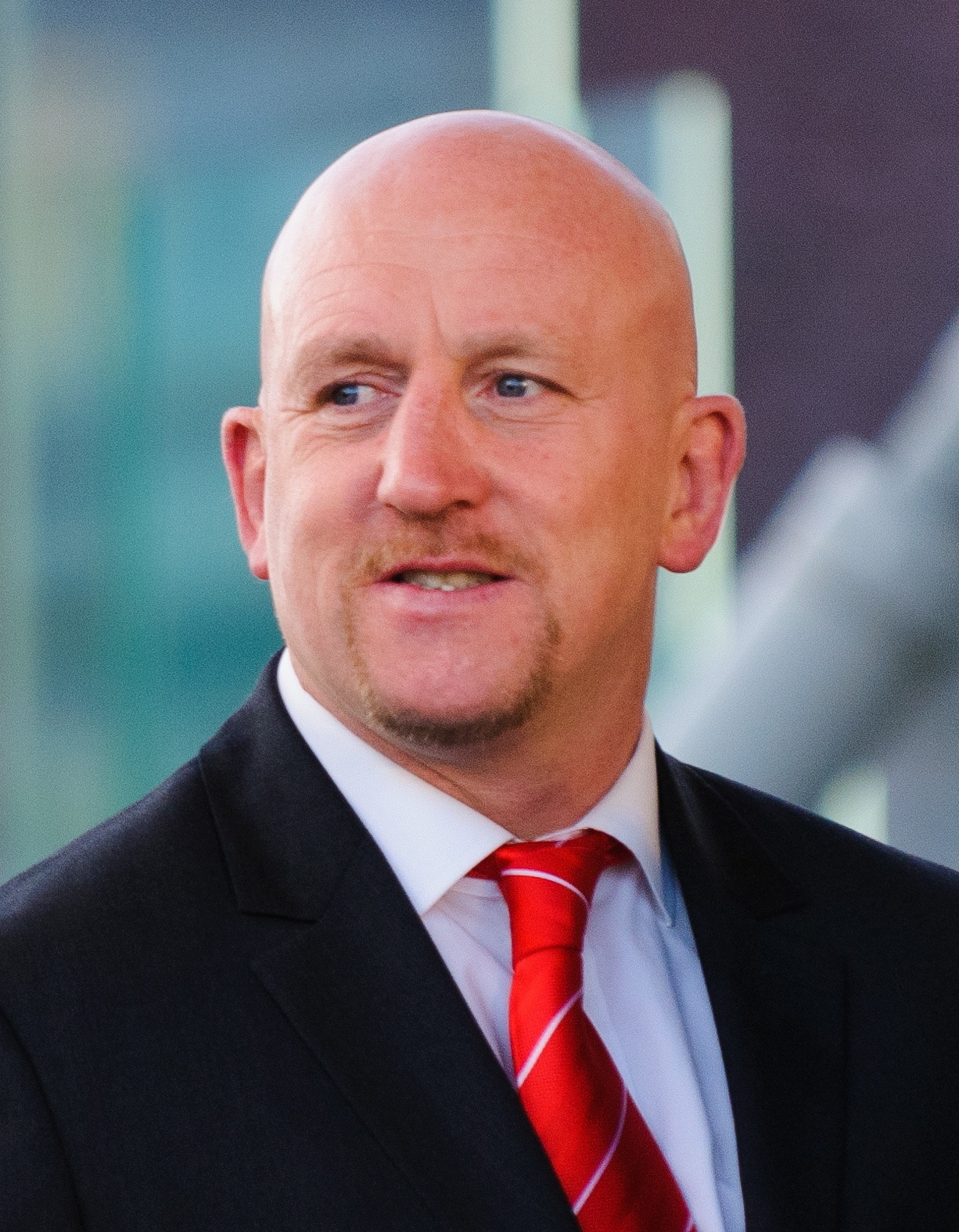
Shaun Edwards, OBE (born 17 October 1966) is an English rugby union coach and former rugby league footballer, who is the defence coach for the France national team. A scrum-half or stand-off, Edwards is the most decorated player in rugby league history, with 37 winner's medals. In 2015, he was the 25th person inducted into the Rugby League Hall of Fame.[5]

Key Information

Edwards captained England in both rugby league and rugby union at schoolboy level. He played for Wigan in the first division and Super League between 1983 and 1997, and also had spells with Balmain Tigers, London Broncos (twice) and Bradford Bulls. Playing for Wigan, Edwards won a record eight championships, and a record nine Challenge Cups. In total he played in eleven Challenge Cup finals, also a record.[6] He was voted Man of Steel in 1990 and is an inductee of the Wigan Hall of Fame.

Edwards played 36 times for Great Britain, as well as for England in 1995 and 1996 and Ireland in 1998. In all, he appeared in three Rugby League World Cups.[1]

After retiring from playing he joined London Wasps in rugby union as assistant coach in 2001, and was head coach from 2005 to 2011. During his time at the club, they won two Heineken Cups, four Premiership titles, an Anglo-Welsh trophy and the European Challenge Cup.

In 2008, he became Wales' defence coach, and won four Six Nations championships, including three Grand Slams. He was also defence coach for the British & Irish Lions on their tour of South Africa in 2009. He joined France in 2020 and won the Grand Slam in 2022 and the Six Nations title in 2025.

Early life

[edit]

Edwards was born in Wigan, Lancashire, England. His father, Jackie Edwards, played for Warrington from 1955 to 1964, as a stand-off or scrum-half, until a severe spinal injury ended his career prematurely at age 24.[7] His uncle Bobby Edwards played one match for Warrington in the halves against New Zealand at Wilderspool Stadium on Saturday 23 September 1961.

Edwards was England schoolboy captain at both rugby league and rugby union, and had been pursued by several clubs.

His younger brother, Billy-Joe, also played rugby league for Wigan until his death, in a car crash, in 2003.[8] His son James was an academy player at Wasps and played at scrum-half. Edwards is a Roman Catholic, and his uncle, Fr John Johnson, was the sub-dean of Wigan and the parish priest of St John's and St Mary's churches in the town until he retired in 2023.

Playing career

[edit]

Edwards signed for Wigan in a blaze of media coverage on his seventeenth birthday; for a fee of £35,000,[9] the largest in history for a schoolboy player. He made his début for the club at scrum-half in their 30–13 home victory over York on 6 November 1983, 20 days after signing for Wigan. Later in the season Wigan reached the final of the 1984 Challenge Cup, and Edwards played at fullback in their loss to Widnes.

In the 1984–85 season, Wigan reached the 1985 Challenge Cup Final and Edwards played at fullback, scoring a try in his side's victory.

Edwards played in Wigan's 1987 World Club Challenge victory over Sydney's Manly-Warringah Sea Eagles. Edwards played for Sydney club the Balmain Tigers when they reached the 1989 NSWRL season's grand final, for which he was selected on the interchange bench.

In 1990, Edwards received the Man of Steel Award after he played most of the Challenge Cup Final against Warrington with a broken cheekbone and eye socket, after receiving a high, off the ball tackle in the 10th minute. He refused to be substituted and played on to set up three of Wigan's tries. Despite his performance, the Man Of The Match award went to his half back partner Andy Gregory. He played in Wigan's 1991 World Club Challenge victory over Sydney's Penrith Panthers.

Edwards finished the 1991–92 season as the league's leading try scorer with a total of 40. He matched Wigan's record for most tries in a single match (10) in the 78–0 rout of Swinton in the Lancashire Cup 2nd round in September 1992.[10] It was a County Cup record and record for a non-winger in any game. In addition, he scored four tries in a game on four occasions and hat-tricks seven times. During the 1992–93 season, Edwards played at scrum half for defending RFL champions Wigan in the 1992 World Club Challenge against the visiting Brisbane Broncos. He played in Wigan's 1994 World Club Challenge win over the Brisbane Broncos in Australia which attracted a World Club Challenge record attendance of 54,220 and also played in the first game of the 1996 cross-code challenge series against Bath.

Edwards played in every round of Wigan's eight consecutive Challenge Cup wins. Altogether he made 452 appearances for Wigan, he played his last game for the club against St. Helens in the Challenge Cup defeat at Knowsley Road in 1997. Edwards left Wigan that year to move near his son James, signing for the London Broncos. He fell out with new coach Eric Hughes, who refused Edwards permission to miss the first training session of each week, in order for him to spend time with his son in London. The decision to allow Edwards to leave the club led to multiple complaints from Wigan fans. After just a season in London, Edwards moved to Bradford Bulls but after only a few months returned to London, where he led the London Broncos to the 1999 Challenge Cup final at Wembley.[11] He retired in 2000.

International

[edit]

Edwards was the youngest ever player to play for Great Britain when he played against France in 1985. His political views meant that on a Great Britain Lions tour, Edwards taped over the British Coal logo on his jersey in support of the miners' strike. He was selected to go on the 1988 Great Britain Lions tour, but injured his knee in the first game of the tour against Papua New Guinea, and took no further part.[12] He captained Great Britain for the first time in 1990,[13] and was also selected to go on the 1992 Great Britain Lions tour.

He was sent off for a high tackle on Bradley Clyde in the first Ashes test match of 1994 at Wembley.[14] He played for Great Britain 36 times, starting 32 games with a further four from the substitutes bench, and scored 16 tries.

Edwards was England's captain for the 1995 World Cup tournament, but ruled himself out of the final against Australia with an infected knee.[15]

Coaching career

[edit]

In 2001, Edwards joined London Wasps in rugby union as a defence and backs coach, taking over as head coach in 2005 after Warren Gatland returned to New Zealand. Wasps won the English Rugby Union Championship three times in succession, in 2003, 2004 and 2005, and the Heineken Cup in 2004. During his reign as Head Coach, London Wasps won the Anglo-Welsh Cup in 2006, the Heineken Cup in 2007 and the English Rugby Union Championship in 2008.

Edwards teamed up with Gatland again, after the latter was appointed head coach of Wales: Edwards had been offered the job of coaching England's second-tier side, England Saxons,[16] but preferred the assistant coach position with Wales. Former England player Matt Dawson stated that it was "a crime" that England lost him to Wales and described him as "the best coach in the world".[17] Edwards left his position at London Wasps in November 2011.[18]

Since joining the Wales coaching team, Edwards has helped the nation to Grand Slam wins in 2008, 2012 and 2019 as well the Six Nations title in 2013. Wales also reached the last four of the 2011 Rugby World Cup in New Zealand. In Edwards' first Six Nations Wales, he conceded just two tries on their way to the title and in 2013–14 Wales went more than 400 minutes in the tournament without conceding a try. He was named Rugby World International Coach of the Year in 2008.[citation needed]

He was defence coach for the British & Irish Lions on their tour of South Africa in 2009.

On 8 August 2018, it was announced that Edwards would return to rugby league to coach his former club Wigan Warriors in 2020, after completing his commitments with Wales. He described it as an opportunity too special to turn down. However, in March 2019, he stated that he had not signed a contract with Wigan, despite already posing for press photographs and conducting interviews at Wigan's ground about this role, instead signing up as France defence coach early 2020.[19] His decision not to take the role at the Warriors was not popular with fans, and Edwards himself acknowledged it had affected his legacy at the club.

Personal life

[edit]

Edwards had a long-term relationship with M People singer Heather Small, with whom he has a son, Labour Party councillor and London Assembly member James Small-Edwards.[20] Although no longer together, a key factor in his moving to the south was that he could be close to his son. When offered the job of coaching the Great Britain rugby league team, he turned it down because it would mean being in the north a lot of the time, away from his family.[citation needed]

He is the patron of Looseheadz, a charity raising awareness for mental health.[21]

Honours

[edit]

References

[edit]
[edit]
Revisions and contributorsEdit on WikipediaRead on Wikipedia
from Grokipedia
Shaun Edwards, OBE (born 17 October 1966) is an English rugby union coach and former professional rugby league footballer, best known for his role as a defensive specialist who has guided the Wales and France national teams to multiple Six Nations championships, including Grand Slams with both sides—the only coach to achieve this feat. Edwards amassed a record 37 winners' medals during his playing career with Wigan Warriors in rugby league, including three World Club Championships (1987, 1991, 1994), eight Rugby Football League Championships, and nine Challenge Cups, establishing him as the most decorated player in British rugby league history; he earned 36 caps for Great Britain and received the Man of Steel award in 1990. Transitioning to rugby union, he contributed as a player and coach to London Wasps, securing four English Premiership titles (2003–2005, 2008) and two Heineken Cups (2004, 2007). As defence coach for Wales from 2008 to 2019 under Warren Gatland, Edwards oversaw four Six Nations titles (2008, 2012, 2013, 2019) with three Grand Slams, a period marked by exceptional defensive records such as no tries conceded for 400 minutes in 2013 and reaching world number one ranking. In 2019, he joined France as defence coach, leading them to a Grand Slam and Six Nations title in 2022—their first since 2010—along with 14 consecutive victories and another Six Nations crown in 2025, again attaining world number one status. Despite his English origins, Edwards has never coached his home nation, prioritizing roles that aligned with his tactical expertise in defensive organization.

Early Life

Family Background and Introduction to Rugby

Shaun Edwards was born on 17 October 1966 in Wigan, Lancashire, England, a town synonymous with rugby league's industrial heartland. His family background was rooted in the sport's local culture, with his father, Jackie Edwards, enjoying a professional career as a stand-off and scrum-half for Warrington Wolves from 1955 to 1964, during which he scored 78 tries in 223 appearances before a spinal injury at age 24 prematurely ended his playing days. Jackie's pre-professional success as a prolific try-scorer for Wigan schoolboys underscored the familial and community ties to rugby league, where physical resilience was forged amid the region's working-class ethos. Edwards' initial exposure to rugby came through schoolboy competitions in Wigan, beginning at St Mary's Catholic School, where he played for the team and progressed to represent Wigan Schools. This environment emphasized rugby league's demands for physicality and collective effort, with Edwards also experiencing rugby union via Merseyside Schools fixtures in the early 1980s. By age 16, he had joined Wigan's youth setup, signing professional terms with the Wigan Warriors on his 17th birthday in 1983 for a then-record £35,000 fee for a schoolboy, marking his formal entry into the sport's competitive ranks. These formative experiences in Wigan's junior and school systems instilled a foundational discipline geared toward team-oriented toughness rather than individual spectacle, aligning with the code's emphasis on direct confrontation and endurance.

Playing Career

Club Achievements with Wigan Warriors

Shaun Edwards debuted for Wigan Warriors in 1983, embarking on a 14-year tenure that saw him make 467 appearances and score 274 tries for the club. As a stand-off, his playmaking and organizational prowess underpinned Wigan's tactical dominance in rugby league's professional era, where success hinged on consistent execution rather than inherited structures. Edwards contributed to Wigan's unprecedented eight consecutive Challenge Cup victories from 1988 to 1995, a streak reflecting the club's 43-match unbeaten run in the competition. He featured in all eight finals, including the 1990 triumph where, despite a broken eye socket and cheekbone sustained early, he refused substitution and orchestrated key plays, earning the Man of Steel Award for the season. This individual accolade, rugby league's highest honor for on-field impact, aligned with Wigan's supremacy, as Edwards' resilience and decision-making directly facilitated multiple try setups in high-stakes fixtures. Under his leadership, particularly as captain from the early 1990s, Edwards helped secure eight Rugby Football League Championships between 1987 and 1996, with his half-back partnership driving structured attacks that exploited opponents' weaknesses through precise kicking and distribution. Wigan also claimed three World Club Challenges during his era—defeating Manly-Warringah Sea Eagles in 1987, Penrith Panthers in 1991, and Brisbane Broncos in 1994—where Edwards captained in the latter and was named man-of-the-match for his commanding performance in a 20-14 victory. These outcomes demonstrated rugby league's emphasis on meritocratic performance, as Edwards' on-field innovations, such as rapid ball movement and defensive reads, correlated with Wigan's win rates exceeding 80% in competitive matches.

International Caps and Performances

Edwards represented Great Britain 36 times in rugby league internationals between 1985 and 1995, primarily as a scrum-half, where his selection reflected his status as one of the code's premier playmakers, valued for orchestrating attacks under pressure and defensive tenacity in a position demanding quick decision-making amid frequent high-impact collisions. He scored 15 tries across these appearances, contributing to a win rate that, while reflective of Great Britain's struggles against dominant Australian sides—losing most Ashes series during his era—highlighted his individual reliability in containing opposition threats and setting up scoring opportunities. A pivotal moment came during the 1994 Ashes series, where Edwards captained Great Britain in the opening Test against Australia at Wembley Stadium on 22 October 1994, leading to an 8-4 victory that snapped a decade-long drought against the Kangaroos; however, he was sent off 28 minutes in for a high tackle on Bradley Clyde, yet the team held firm, underscoring his leadership even in abbreviated play. This series, part of grueling end-of-season tours involving transcontinental travel and back-to-back Tests, exemplified the code's international demands: 13-a-side contests with uninterrupted defensive sets, resulting in tackle counts often exceeding 300 per match per team—data from period analyses showing league's per-minute physical output surpassing union's due to fewer stoppages and no lineout resets. Edwards also featured in three Rugby League World Cups (1985–1988, 1992, and 1995), where performances against southern hemisphere powerhouses reinforced his adaptability in tournament formats requiring rapid recovery from physically taxing games; empirical comparisons of injury incidence rates, with league reporting higher concussion and soft-tissue strains per exposure hour than union's expanded 15-player setup, affirm the underrecognized endurance tested in these representative fixtures. Beyond Great Britain, he earned caps for England in 1995 and 1996, and a single appearance for Ireland in 1998 under residency rules, totaling over 40 representative games, though GB tours formed the core of his high-stakes exposure. His metrics—consistent starting roles in 32 of 36 GB Tests and low error rates in possession—debunk dismissals of league as lesser, as sustained elite selection against Australia's professional machine demanded tactical precision rivaling any code's internationals.

Transition to Coaching

Initial Roles and Adaptations from League to Union

Edwards retired from professional rugby league in April 2000, concluding a career marked by 17 seasons primarily with Wigan Warriors, where he won 37 trophies including multiple championships and Challenge Cups. Following retirement due to persistent injuries, he began coaching in rugby union by joining London Wasps in October 2001 as assistant coach, initially focusing on defence and backs under head coach Warren Gatland. This marked his first professional role in the union code, where he had to navigate differences such as the 15-player format, uncontested scrums in some scenarios, and a broader emphasis on kicking and territorial play compared to league's continuous, high-intensity structure on a narrower effective field due to fewer breakdowns. Edwards' adaptation centered on transplanting rugby league's aggressive defensive principles—particularly blitz or rush defence involving rapid line speed and shoulder compression—to union's more expansive environment, which allowed greater width for offloads and phase play. At Wasps, this involved coaching players to close space aggressively from the blindside, disrupting opposition ball carriers early and forcing turnovers, a tactic that countered union's open-field vulnerabilities evident in pre-2001 Wasps performances where they averaged fewer defensive stands per match. He promoted to head coach in 2005 after Gatland's departure, refining these methods amid challenges like integrating league's fitness demands with union's set-piece complexities, which initially required technical retraining for players unaccustomed to such compression. The effectiveness of these adaptations is demonstrated by Wasps' rapid ascent: from mid-table finishes pre-2001, the team secured four English Premiership titles (2003, 2004, 2005, 2008) and two Heineken Cups (2004 against Toulouse, 2007 against Leicester Tigers), with defensive metrics showing reduced points conceded per game—averaging under 20 in title-winning seasons—directly attributable to Edwards' league-derived rush system that limited attacking space despite union's rule-induced openness. This period highlighted causal links between his tactical imports and outcomes, as Wasps' win percentage in Premiership and European fixtures improved from approximately 50% in 2000-01 to over 70% during peak years 2003-2007, underscoring successful cross-code translation without reliance on anecdotal successes.

Coaching Career

Tenure with Wales National Team

Shaun Edwards served as defense coach for the Wales national rugby union team from 2008 to 2019, working in partnership with head coach Warren Gatland to overhaul the team's defensive structures drawing from Edwards' rugby league background. This collaboration emphasized discipline, physicality, and tactical organization, adapting league principles like high-intensity tackling and rapid line speed to union's open play amid evolving laws favoring attack. Under Edwards' guidance, Wales secured four Six Nations Championships, including Grand Slams in 2008, 2012, 2016, and 2019, marking the most successful period in the tournament's modern history for the team. These victories were underpinned by robust defensive performances, with Wales often leading in tackle completion rates; for instance, in a 2017 match against Argentina, the team achieved a 90% success rate while completing 201 tackles. Edwards' strategies contributed to reduced points conceded in key fixtures, fostering a mindset of relentless pressure that elevated Wales to the world number one ranking in 2019 following their Grand Slam campaign. In Rugby World Cups, Wales advanced to the semi-finals in 2011 (losing to France after a red card to captain Sam Warburton), 2015 (defeated by South Africa), and 2019 (eliminated by eventual champions South Africa), demonstrating consistent knockout-stage competitiveness but falling short of the final. Despite these achievements, critics noted vulnerabilities exposed in high-stakes matches, such as lapses in concentration leading to late concessions, though empirical data on overall defensive metrics during the tenure highlighted improvements in aggregate tackle efficiency compared to pre-2008 eras. Edwards departed after the 2019 tournament, having established a legacy of defensive resilience that propelled Wales' international standing.

Role with France National Team

Shaun Edwards joined the France national rugby union team as defence coach in December 2019, signing a four-and-a-half-year contract under head coach Fabien Galthié to prepare for the 2023 Rugby World Cup. His appointment followed 12 years with Wales, bringing a rugby league-influenced emphasis on aggressive, high-intensity defence to the union side. Under Edwards' guidance, France secured the 2022 Six Nations Grand Slam, their first since 2010, and repeated as champions in 2025 with a 35-16 victory over Scotland on March 15, marking Edwards' second title in the competition. At the 2023 World Cup hosted in France, the team topped Pool A before advancing to the quarterfinals, where they lost 28-29 to South Africa in a match decided by a last-minute penalty. In the 2024 and 2025 campaigns, Edwards faced scrutiny after defensive concessions in losses, including a narrow defeat to Scotland where France conceded multiple tries, prompting suggestions of a softened approach; he countered by highlighting the need for 80-minute effort and resilience. Despite such setbacks, France demonstrated improved defensive metrics, with Edwards praising second-half stands—such as limiting Scotland to three points after halftime in the decisive 2025 title-clinching game—and overall tackle completion rates exceeding 85% in key fixtures, even amid conceded tries from line breaks. Edwards remains contracted with France through the 2027 World Cup but has voiced openness to a British & Irish Lions role for the 2025 tour if released, while affirming full commitment to his current duties. He has rejected past England interest, citing the absence of a formal offer in 2022 and prioritizing contractual obligations over national allegiance, despite his English background.

Additional Coaching Engagements

Edwards served as defense and backs coach for London Wasps from 2001, transitioning to head coach in 2005 and remaining until 2011, during which the club secured two Heineken European Cups in 2004 and 2007, alongside three English Premiership titles in 2003, 2004, and 2008, with his defensive systems credited for limiting opponents to an average of under 20 points per game in key victories. In January 2008, he agreed to a contract extension with Wasps to maintain a dual role alongside his Wales national team responsibilities, enabling him to oversee defensive preparations for both club and international fixtures until his full departure from Wasps in 2011. As defense coach for the British & Irish Lions' 2009 tour to South Africa, Edwards implemented a high-intensity tackling regime that contributed to the team's midweek victories and a 28-9 win in the third Test, though the series ended in a 2-1 defeat after losses in the first two Tests by margins of 2 and 7 points, respectively. His preparations emphasized gainline dominance, with the Lions conceding just 41 points across the three Tests despite facing a physically superior Springboks side. In August 2018, while still with Wales, Edwards took on a consultancy role with the Ospreys, focusing on defensive strategy and player conditioning to enhance the club's tackle completion rates, which improved to over 88% in subsequent Pro14 matches under his input. These engagements underscored his consistent application of league-derived defensive principles, such as swarm tackling and rapid line speed, across club and composite team contexts.

Coaching Philosophy and Criticisms

Defensive Strategies and Innovations

Edwards' defensive philosophy prioritizes line speed as the primary mechanism for disrupting offensive momentum, drawing directly from principles where rapid defensive alignment forces attackers into predictable channels and increases turnover probability. This approach posits that superior tackling efficiency causally drives win rates by limiting opposition possession time and scoring opportunities, evidenced by empirical tackle completion metrics rather than anecdotal success. In practice, his systems demand defenders maintain flat lines to compress space, with post-tackle emphasized to contest rucks aggressively. Core to the tactic is the low "chop" tackle technique, targeting the lower body to fell carriers below the ball and prevent offloads, a method Edwards explicitly favors over higher contact points that risk penalties or incomplete stops. Adapted from league's compact fields to union's wider pitches, this integrates into a hybrid blitz-rush framework, where forwards and backs surge collectively from the blind side to target the outside shoulder, aiming to isolate ball-carriers and induce handling errors. During peak implementations with Wales, these strategies yielded tackle success rates above 90%, as in a 2018 match against Argentina where 201 tackles were completed at that efficiency, correlating with minimal points conceded in tight contests. Similarly, France under Edwards in the 2025 Six Nations demonstrated low concession rates, with defensive resilience pivotal in their title-clinching 35-16 win over Scotland, where structured pressure limited opponents to 16 points despite territorial dominance. The system's spans nations, with conceding just two tries en route to a Six Nations and mirroring this in multiple campaigns, affirming its portability when executed with high fitness and . Yet, the aggressive forward commitment creates exploitable gaps against expansive attacks that stretch the line wide, as 's 2023 World Cup quarter-final loss to illustrated—conceding four tries through breaks behind the that capitalized on delayed cover alignment.

Leadership Approach and Controversies

Edwards employs an intense and direct motivational style, often employing blunt language and passionate confrontations to instill urgency and resilience in players. Following France's 38-17 defeat to Ireland on February 2, 2024, in the Six Nations opener, he delivered a heated dressing-room address captured on video, shouting in French, "There is not enough defence right now. We must change immediately," amid scrutiny of defensive lapses that conceded 38 points. This approach correlated with subsequent improvements, as France secured victories over Scotland (20-16 on February 10) and Italy (13-0 on February 25), rebounding from the early setback before a later loss to England. Critics have questioned the harshness of his methods, portraying Edwards as unrelentingly and prone to tetchy responses under . A 2019 profile described him as an "enigma" in Welsh rugby circles, highlighting his rarely smiling demeanor and intense focus during campaigns that yielded a Grand Slam. In February 2024, post-Ireland loss media commentary labeled him "angry" and "prickly" while defending his record against calls for after defensive concessions. Earlier, in 2011, Wales disciplined him following an unspecified incident after a Six Nations match against , underscoring occasional tensions in his combative style. Detractors have raised concerns about potential player burnout from such relentless demands, though Edwards has countered that athletes, compensated for their roles, must withstand rigors without succumbing, as echoed in discussions with former players like James Haskell. Notwithstanding these critiques, empirical outcomes affirm the efficacy of his leadership, with Edwards contributing to six Six Nations championships across (2012, 2013, 2019) and (2022, 2025). Players frequently praise his man-management, noting extraordinary loyalty and willingness to "run through walls" for him, attributing sustained high performance to his mentorship in mentality over mere tactics. Instances of aggressive instruction, such as teaching Welsh players moves deemed "illegal" by opponents in a 2025 recollection, reflect his boundary-pushing ethos but have not derailed long-term success, as win correlations under his tenure demonstrate resilience against softer, less confrontational alternatives.

Personal Life

Relationships and Family Challenges

Shaun Edwards had a long-term relationship with singer Heather Small, with whom he has a son, James Small-Edwards, born in 1994. James pursued rugby initially, joining the Wasps academy as a scrum-half before opting for a political career, becoming a City of Westminster councillor in 2022. Edwards' current partner is Maggie, with whom he has two daughters; he arranged for them to join him in France ahead of the March 2020 COVID-19 lockdowns to maintain family proximity amid professional commitments. A significant family challenge occurred in 2003 when Edwards' younger brother, Billy-Joe Edwards, aged 20, died in a car crash alongside teammate Craig Johnson; both had been over the legal alcohol limit, as determined by coroner's findings. The incident profoundly impacted Edwards, who described it as life-changing, leading him to reject an England coaching offer in 2006 on advice from his mother, Phyllis, who noted he was not ready due to the risk of excessive time for reflection exacerbating grief. Despite this, Edwards sustained a distinguished coaching trajectory, including multiple successes with Wales and France, demonstrating continuity in professional output post-tragedy.

Public Image and Patriotism

Shaun Edwards identifies strongly as an Englishman, hailing from Wigan where he rose to legendary status in rugby league, amassing 37 winners' medals with the Warriors through relentless discipline and self-made grit. Despite this heritage, he has never coached England, opting instead for roles with Wales (2008–2019) and France (2019–present), where his defensive systems propelled both teams to prominence. This choice has fueled discussions on patriotism, yet Edwards counters disloyalty narratives by highlighting his achievements abroad—four Six Nations titles with Wales, including three Grand Slams, and two more with France in 2022 and 2025—making him the first coach to secure six such honors across nations. Media depictions often celebrate Edwards as a bridge from rugby league's tough, working-class ethos to union's strategic evolution, portraying him as an innovator who instilled Wigan-honed intensity into international defenses. Instances of controversy, such as a purported "smile" during Welsh successes labeled as the "most controversial in Welsh rugby history," appear overstated, stemming from minor celebratory expressions amid high-stakes wins rather than any deeper impropriety. Edwards emphasizes discipline as foundational to success, teaching players accountability without entitlement, a philosophy rooted in his northern English upbringing where fear of failure drove rigorous preparation over complacency. Edwards has voiced enthusiasm for British and Irish Lions involvement, stating in January 2025 he would "swim" to Australia for a role on the 2025 tour, underscoring his alignment with pan-British rugby endeavors despite coaching continental rivals. He attributes adaptive success to recognizing cultural variances, such as France's expressive passion contrasting Wales' resilient underdog mentality and England's structured professionalism, yet insists universal principles of humility and hard work transcend borders. This approach reinforces his image as a pragmatic patriot, prioritizing merit-based results over national exclusivity.

Legacy and Honours

Player Honours

Edwards secured a record 37 winners' medals across his rugby league playing career, primarily with Wigan Warriors, underscoring the sport's demanding physicality and absence of structural distortions like promotion benefits that can inflate success in other leagues. With Wigan from 1983 to 1996, he contributed to eight Challenge Cup victories, including the 1985 final against Hull FC and seven consecutive triumphs from 1988 to 1995. He also won eight league championships during this period, dominating in an era of intense competition. In 1990, Edwards received the Man of Steel award, recognizing him as the Rugby Football League's top player that season despite playing much of the Challenge Cup final with a broken eye socket and cheekbone. Internationally, he earned 36 caps for , captaining the side in the first Test of the 1994 Ashes series, with victories contributing to his overall medal count. Edwards became the inaugural inductee into the Wigan Warriors Hall of Fame, honoring his 466 appearances and 1,146 points for the club.

Coaching Accomplishments

As defense coach and later head coach at Wasps from 2001 to 2011, Edwards contributed to four English Premiership titles in 2003, 2004, 2005, and 2007, alongside two Heineken Cup victories in 2004 and 2007. These triumphs established Wasps as a dominant force in European rugby, with Edwards' defensive systems central to their back-to-back domestic crowns from 2003 to 2005. Edwards joined the Wales national team as defense coach in 2008 under Warren Gatland, overseeing four Six Nations Championship wins: Grand Slams in 2008, 2012, and 2019, plus a title in 2013 without the Grand Slam. His tenure transformed Wales' defense into one of the tournament's stingiest, conceding the fewest points in multiple campaigns and elevating the team to world number one rankings at times. However, despite these regional successes, Wales exited the Rugby World Cups of 2011, 2015, and 2019 at the quarter-final stage, highlighting limitations in translating Six Nations form to global knockout rugby. Edwards served as defense coach for the British and Irish Lions' 2009 tour to South Africa, where the team won two Test matches but lost the series 2-1 amid controversial refereeing decisions in the decider. His preparations emphasized breakdown dominance and lineout disruption, aiding victories in the opening Tests, though the tour underscored challenges against a host nation at peak strength. Transitioning to France as defense coach in 2020 under Fabien Galthié, Edwards secured a Grand Slam and Six Nations title in 2022, followed by another championship in 2025 via a 35-16 final-round win over Scotland. These added to his Wales haul for a record six Six Nations titles as a defense coach, the most achieved by any individual in that role. France's 2023 World Cup campaign, however, ended in the quarter-finals against South Africa, mirroring prior international limitations despite domestic dominance.

Individual Awards and Recognition

Edwards received the Man of Steel award in 1990, recognizing him as the outstanding player in British rugby league that year. He was later inducted into the Rugby League Hall of Fame as its 23rd member in 2015, honoring his record as the most decorated player in the sport's history with 37 winners' medals across club and international levels. In 2008, Rugby World magazine named him International Coach of the Year for his defensive innovations with Wales. Edwards was appointed Officer of the (OBE) for services to rugby, acknowledging his transition from player to influential coach. His unique coaching record includes being the only individual to secure Grand Slam victories in the Six Nations with two nations—Wales in 2008, 2012, and 2019, and in 2022—and to guide both to the world number one ranking, providing empirical validation of his defensive methodologies' transferability across teams. These feats contributed to six Six Nations titles overall, with 's 2025 championship under his defense featuring the tournament's fewest conceded tries (14) and points (93). Despite his English origins and expressed , Edwards overlooked for senior roles with , a contrast to his successes elsewhere that some attribute to structural biases in selection favoring coaches with primary allegiance to the over those proven via international results. As of 2025, speculation persists on potential involvement, building on his prior defensive coaching stints in 2009, 2013, and 2017.

References

Add your contribution
Related Hubs
User Avatar
No comments yet.