Hubbry Logo
ShediacShediacMain
Open search
Shediac
Community hub
Shediac
logo
8 pages, 0 posts
0 subscribers
Be the first to start a discussion here.
Shediac
Shediac
from Wikipedia

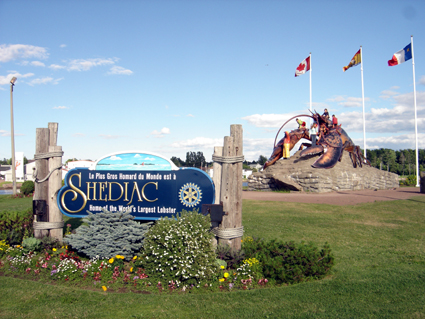
Shediac (official name in both French and English; Shédiac is colloquial French) is a town in Westmorland County, New Brunswick known as the "Lobster Capital of the World". It hosts an annual festival every July which promotes its ties to lobster fishing. At the western entrance to the town is a 90-ton sculpture called The World's Largest Lobster.[2] It is believed that chiac, a well-known Acadian French patois, was named after Shediac.[3]

Key Information

Since its founding it has expanded several times, most recently in 2023, when it annexed all or part of four local service districts.[4][5] Revised census figures have not been released.

Etymology

[edit]

Shediac was originally called La Batture. Its name was later changed to Shediac in reference to its position at the basin of the Shediac River. The name "Shediac" itself is derived from the Mi'kmaq word Esedeiik, which means "which comes from far away", possibly in reference to the Shediac Bay or the current of the Petitcodiac river.[6]

Geography

[edit]

Shediac is situated primarily on Route 133 around Shediac Bay, a sub-basin of the Northumberland Strait.

Its topography is relatively flat and its soil is mostly composed of sedimentary rocks dating from the Pennsylvanian. Shediac enjoys a continental climate.[7]

The town is located southwest and adjacent to the community of Pointe-du-Chêne, once the eastern terminus of the European and North American Railway as well as a stopover for Pan-Am's transatlantic "clipper" air service featuring large seaplanes. Imperial Airways' flying boat service to Foynes in Ireland also used the facilities.

History

[edit]
Lobster sculpture

Hundreds of years ago, the Mi'kmaq encampment of "Es-ed-ei-ik" was one of the major camps in southeast New Brunswick. The Mi'kmaq word Es-ed-ei-ik, which means "running far in", in reference to its position where the coastline turns between running north-south and east-west, eventually transformed into Gédaique.[8][9] Acadians first arrived at Shediac in 1751 as a result of the Acadian Exodus from peninsular Nova Scotia.[10] During the French and Indian War, French officer Charles Deschamps de Boishebert made his headquarters at both Shediac and Cocagne, New Brunswick. In the autumn of 1755, Boishebert established himself on the south shore of Cocagne Bay, a place known as Boishebert's Camp. The following year, Boishebert moved to Miramichi, New Brunswick, specifically to Beaubears Island.[11] After the war, Acadians returned to the region in 1767. Today many francophones use the spelling Shédiac; however, the town's name upon its incorporation did not feature an accented "e", and correspondingly the official geographic name for the community is Shediac.

Shediac Bay Yacht Club

[edit]

Shediac Bay Yacht Club is on the Register of 'Canada's Historic Places' for being the location of a local wharf for nearly a century. The previous Shediac Bay Yacht Club House was designed by Roméo Savoie.[12]

Demographics

[edit]

In the 2021 Census of Population conducted by Statistics Canada, Shediac had a population of 7,535 living in 3,293 of its 3,447 total private dwellings, a change of 13.1% from its 2016 population of 6,664. With a land area of 64 km2 (25 sq mi), it had a population density of 117.7/km2 (304.9/sq mi) in 2021.[1]

Notable people

[edit]

Sister city

[edit]

See also

[edit]

References

[edit]

Bibliography

[edit]

Bordering communities

[edit]
[edit]
Revisions and contributorsEdit on WikipediaRead on Wikipedia
from Grokipedia
Shediac is a coastal town in , , situated on the . Following amalgamation in 2023 with adjacent communities including Pointe-du-Chêne and Scoudouc Road, the town's boundaries expanded significantly. Renowned as the "Lobster Capital of the World," it is celebrated for its prominent industry, which dates back to pioneers like William Blizzard in 1861 and Émile Paturel, and features the iconic Giant Lobster monument unveiled in 1990. The town hosts the annual Shediac , first held in 1949, which attracts visitors with lobster-themed events, concerts, and culinary competitions. As of the July 1, 2024, Statistics Canada estimate, Shediac has a population of 12,265, reflecting ongoing growth in the region. Acadians, who first settled the area between 1798 and 1805 after earlier presences dating to 1749, form a significant part of the population, underscoring the town's strong Acadian cultural heritage. Economically, Shediac thrives on seafood processing and tourism, bolstered by attractions like the expansive sandy Parlee Beach and a charming downtown area offering fresh seafood experiences. Historically, the town played key roles in regional development, including the construction of New Brunswick's first public road in 1816, the opening of the Maritime Provinces' first railway in 1857, and the launch of its first ship in 1817. Incorporated as a town in 1903, Shediac continues to blend its maritime traditions with modern hospitality, drawing visitors to its warm summers and vibrant community events.

Geography

Location and Borders

Shediac is situated in County, southeastern , , along the shores of the in the . Its geographic coordinates are 46°13′17″N 64°32′23″W. The town lies approximately 25 km northeast of , the nearest major urban center, and is readily accessible by road via New Brunswick Route 15 (Shediac Bay Regional Parkway), a connecting to the , and Route 133, which parallels the coastline through the town. As of January 1, 2023, Shediac's municipal boundaries encompass 64.04 km² following the annexation of contiguous unincorporated areas from Shediac Parish under New Brunswick's local governance , incorporating additional coastal lands along Shediac Bay. Shediac's boundaries adjoin several neighboring communities, including Cap-Pelé (now part of the of Cap-Acadie) to the east, Grande-Digue to the southeast, and Scoudouc to the west, as depicted in provincial municipal maps.

Physical Features and Climate

Shediac occupies a flat characterized by low-lying , with an average of approximately 17 meters above . The underlying geology consists primarily of formations, including sandstones from the period, which contribute to the region's stable yet erodible soils. This terrain gently slopes toward the coast, forming part of the broader Acadian Peninsula landscape. The area's key hydrological features include Shediac Bay, a shallow tidal embayment and sub-basin of the , which supports diverse coastal ecosystems. Known for having the warmest saltwater north of , with summer surface temperatures reaching up to 24°C, the attracts and recreational users alike. Prominent coastal elements encompass extensive sandy beaches, such as Parlee Beach, and small islands like Bar Island, which enhance the region's scenic and ecological value. Shediac experiences a classified as Köppen Dfb, featuring cold winters and mild summers influenced by its coastal position. The average annual temperature is about 6.1°C, with highs averaging 24°C and lows reaching -12°C. Annual totals around 1,100 mm, distributed as rain in warmer months and snow in winter, contributing to the area's lush vegetation. The region faces risks from systems, including storm surges that can exacerbate coastal vulnerabilities, as evidenced by events like in 2022. Tidal influences from the shape the bay's dynamics, with semi-diurnal tides averaging 2-3 meters that drive nutrient cycling and sediment movement. Recent coastal changes, including concerns following 2023 activity, have prompted protective measures like marsh restoration to mitigate shoreline loss. The bay's ecosystems boast high , with habitats such as salt marshes and reefs supporting key species, including populations that thrive in the warm, shallow waters.

History

Indigenous and Early Settlement

The territory now known as Shediac was originally part of the traditional lands of the people, who referred to the area as Es-ed-ei-ik, a term meaning "running far in," descriptive of the coastline's inward turn between north-south and east-west orientations. In 1749, constructed a fort, houses, and warehouses in the area to support French military efforts using supplies from Québec, Louisbourg, and . Archaeological evidence from sites such as CbDd-4 near the Shediac River reveals that Mi'kmaq ancestors utilized the region as a seasonal encampment for fishing, hunting, and resource gathering, with continuous human occupation dating back at least to 1000 BCE during the and earlier Archaic traditions. European contact with the area began in the through French exploration of , as part of broader efforts to establish colonial outposts and trade networks along the coast. By the mid-18th century, Acadian families began arriving, with occurring between 1798 and 1805 east of the Scoudouc River, called La Batture due to its oyster beds, after earlier temporary presences. In 1755, during the , the region became a critical refuge when French military officer Charles Deschamps de Boishébert established a base there, sheltering around 600 Acadian refugees who had evaded the initial waves of British from ; Boishébert's group, supported by Mi'kmaq allies, used the site's strategic location for temporary camps over the winter of 1755–56 near present-day Cocagne.

Colonial Era and 19th Century Development

Following the Treaty of Paris in 1763, which ended the Seven Years' War and ceded to Britain, were permitted to return from and to establish new settlements in the region, including around Shediac. Many who had initially fled the 1755 expulsion to temporary camps in Shediac and nearby Cocagne before relocating to areas like Miramichi began recolonizing the Shediac site around 1767, demonstrating resilience amid ongoing British colonial oversight. This return marked the beginning of Acadian reestablishment in the area, focused on small-scale farming and fishing despite land restrictions and competition from incoming British settlers. The influx of Loyalists during the further shaped Shediac's colonial development, with English settlers arriving in the 1780s. In 1785, William Hanington, a from , took possession of a 5,000-acre grant in the Shediac Bay area, including what became Shediac Cape and Gilberts Corner, where some Acadian families already squatted. As one of the first English settlers in southeastern , Hanington promoted regional growth by encouraging petitions for Acadian land grants in low-lying areas and serving in public roles such as from around 1805 to 1833, fostering a mix of Acadian and British communities under British administration. Economic expansion in the early was driven by maritime industries, particularly and processing, which capitalized on Shediac's coastal access and abundant timber. The first shipbuilding yard emerged in the area, with the inaugural vessel launched in 1817 by Bowen Smith using locally hand-carved wood, establishing Shediac as a key site for constructing sailing ships amid British colonial trade demands. Complementing this, New Brunswick's first steam sawmill was built in 1820 near the Scoudouc River, boosting local employment at mills, wharves, and shipyards while supporting through improved timber processing for farming tools and buildings. These developments highlighted Acadian and collaboration in resource-based economies, though British policies prioritized export-oriented growth. The arrival of the railway in 1857 via the European and North American Railway, which connected Shediac to and later integrated into the in 1867, significantly enhanced trade and accessibility under British colonial infrastructure initiatives. This line facilitated the transport of , , and agricultural goods, spurring economic diversification beyond subsistence farming and fishing. By the late , the surrounding Shediac Parish had a population of about 4,800 in 1871, growing to around 6,200 by 1881; upon town incorporation in 1903, the core area had approximately 1,100 residents.

20th Century to Present

In the early , Shediac solidified its role as a key fishing port along New Brunswick's Acadian coast, with the construction of its first in 1910 serving as a vital hub for maritime trade and fisheries for nearly a century. By this period, the community had also developed ferry services to , a , roads, and essential like schools and housing, supporting steady growth in the local economy. The Shediac Bay , incorporated in as a non-profit organization, further enhanced the town's boating heritage by providing moorings and facilities that expanded over subsequent decades. During the mid-20th century, Shediac experienced minimal direct wartime disruptions from , though the Royal Canadian Navy commissioned HMCS Shediac, a , in 1941 to serve in the , honoring the town's maritime significance. Post-war recovery spurred a shift toward , exemplified by the designation of Parlee Beach as a in 1957, transforming the long-private sandy shoreline into a major public attraction that drew visitors seeking warm waters. This development aligned with broader economic diversification from traditional fishing, positioning Shediac as an emerging coastal destination. The late 20th century marked Shediac's embrace of its lobster heritage, with the inaugural Lobster Festival held in 1949 as a community lobster boil that evolved into an annual event celebrating the region's fisheries ties. By the 1990s, the town formalized its identity as the "Lobster Capital of the World" through initiatives like the 1989 construction of the World's Largest Lobster sculpture by the Shediac Rotary Club, a 90-ton concrete monument symbolizing its fishing prominence and boosting tourism. In 2023, municipal amalgamation under New Brunswick's local governance reforms annexed surrounding areas including Pointe-du-Chêne and parts of local service districts, expanding the town's territory and integrating additional communities to foster sustainable growth. Recent years have reflected Shediac's ongoing expansion, with population estimates reaching approximately 8,800 by 2024 amid rapid regional development in southeast . In May 2025, the province announced the site for a new Anglophone East K-12 school on Ohio Road, designed to accommodate 930 students and replace the aging Shediac Cape School, addressing enrollment pressures from with construction slated to begin in 2026 and opening targeted for 2029.

Government and Infrastructure

Municipal Governance

Shediac operates under a municipal council system consisting of a and eight councillors, all elected every four years during provincial municipal elections. The current is Roger Caissie, who was elected in 2022. The council members as of 2025 include John Steeves, Harry McInroy, Joël Després, Roland Cormier, Janice Cormier, Peter Breau, Émile O'Brien, and Germaine Gallant. Since its incorporation in 1903, the town has maintained bilingual operations in English and French to serve its diverse population. The town's administrative headquarters is located at Shediac Town Hall, 290 . Following the 2023 amalgamation, which incorporated the nearby community of Pointe-du-Chêne and parts of four local service districts effective January 1, 2023, the municipal budget has emphasized investments in coastal to address and storm resilience in the expanded territory. The 2024 operating budget totaled $21.58 million, and the 2025 operating budget is $25.3 million, supporting these priorities alongside general administration. Public services in Shediac include weekly with curbside collection of garbage in designated bags and yard waste in green bags every second Wednesday. Policing is provided through the local detachment at 77 Ohio Road, handling non-emergency matters during business hours. The volunteer-based fire department responds to emergencies, complemented by a municipal utility system drawing from seven wells to supply potable to residents.

Education and Public Services

Shediac's education system operates within New Brunswick's bilingual framework, serving both English- and French-speaking students through the for English instruction and the for French instruction. Key educational institutions include Polyvalente Louis-J.-Robichaud, a French-language high serving grades 9 through 12 with an enrollment of 663 students, located at 435 Main Street in Shediac. In the Anglophone sector, Shediac Cape provides education from to grade 8 for 565 students, offering both English and French Immersion programs starting after . These schools address the community's bilingual needs, with French Immersion options promoting language proficiency among English-stream students. To accommodate growing enrollment driven by demographic trends in the region, a new kindergarten-to-grade 12 Anglophone school was approved in 2025, set to replace Shediac Cape School and relieve pressure on nearby facilities like High School. The facility, designed for 930 students, will be constructed on a site along Ohio Road adjacent to Route 15 in Shediac, with construction beginning in summer 2026 and opening planned for January 2029. Public services in Shediac include access to advanced healthcare at the nearby Dr. Georges-L.-Dumont University Hospital Centre in , approximately 25 kilometers away, which provides primary, specialized, and tertiary care as the region's main referral hospital. The , established in and operated bilingually as part of New Brunswick's public library network, offers books, audiobooks, multimedia resources, computers with free internet, and programs supporting and community engagement. Community centers such as the Capitol Theatre in nearby serve Shediac residents through arts initiatives, including the Capitol Theatre Academy's training, summer camps, and workshops in English and French for youth.

Demographics

Shediac's population stood at 6,664 according to the 2016 Census of Population conducted by Statistics Canada. By the 2021 Census, it had grown to 7,535, reflecting a 13.1% increase over the five-year period. This expansion continued post-2021, with the municipality annexing portions of four surrounding local service districts in 2023, incorporating about 61% of the adjacent Shediac Parish population of 5,144 and elevating the total to over 11,000 residents. As of early 2025, estimates indicate a population of approximately 12,265, driven by ongoing net migration gains. In 2021, Shediac's population density was 117.7 people per square kilometre, calculated over the town's land area of 64 square kilometres prior to annexation. The 2023 boundary changes expanded the municipal area significantly, reducing the immediate density but setting the stage for higher figures as development intensifies in newly incorporated rural zones. The age structure from the 2021 Census highlights an aging demographic, with 11.1% of residents under 15 years and 31.2% aged 65 and over, compared to 57.7% in the 15-to-64 working-age group. Key drivers of Shediac's population growth include retirement migration attracted by the coastal lifestyle and amenities, job opportunities in tourism and hospitality, and repatriation among Acadian descendants seeking cultural ties. The community maintains an urban-rural blend, with the pre-annexation town core housing the majority of residents amid expanding suburban and rural peripheries.

Language and Cultural Composition

Shediac's population is predominantly of Acadian , comprising approximately 75% of residents, reflecting the town's historical roots in French colonial settlement. The remaining ethnic composition includes significant English and Irish ancestry, estimated at around 15%, alongside a smaller proportion of First Nations peoples, primarily , making up about 2% of the . Recent immigration has been limited, primarily from and other Atlantic provinces, contributing to the town's cultural continuity rather than introducing large-scale diversity; visible minorities represent 3.5% of the total . These demographic figures are based on the 2021 for the pre-2023 annexation boundaries; updated data for the expanded will be available from the 2026 . The linguistic landscape of Shediac underscores its Acadian character, with French serving as the mother tongue for 62% of residents (4,690 individuals), English for 25% (1,855), and the remainder including non-official languages (5.7%) or multiple mother tongues (3.8%). High levels of bilingualism are prevalent, with 71% of the population able to speak both official languages, aligning with New Brunswick's status as Canada's only officially bilingual . As a bilingual , Shediac provides services in both English and French, though French signage and usage predominate in Acadian neighborhoods, fostering a vibrant Francophone community. Culturally, Shediac embodies strong Acadian traditions, including music, cuisine, and community practices tied to its maritime heritage. Religiously, the population is overwhelmingly Christian, with Roman Catholics forming 68.3% of adherents, followed by smaller Protestant denominations such as (2.2%) and Anglicans (1.4%); about 30% report no religious affiliation. characteristics reflect a stable, family-oriented community, with an average size of 2.1 persons and 59% of dwellings owner-occupied.

Economy

Fishing and Maritime Industries

Shediac's economy is heavily anchored in the lobster fishing industry, earning the town its nickname as the "Lobster Capital of the World." The sector involves over 150 licensed fishers operating primarily in Area 25 of the southern , where favorable bay geography supports productive near-shore harvesting. Annual lobster landings in the broader LFA 25 and adjacent areas exceed 5,000 tonnes, contributing more than $50 million in landed value to the regional , with much of the catch processed locally for export markets. Key processing facilities, such as the Shediac Lobster Shop Ltd., handle the bulk of the harvest, specializing in cold-water Atlantic products for international distribution to markets in the United States, , and . These operations employ local workers in grading, cooking, and packaging, ensuring the fresh catch reaches global consumers efficiently. The industry's scale underscores its role as the economic backbone, with lobster exports from the region driving sustained growth despite market fluctuations. Beyond , Shediac's maritime activities include and in Shediac Bay, where farms cultivate using sustainable methods like suspended culture systems. These operations leverage the bay's nutrient-rich waters to produce high-quality products, supplementing traditional with diversified revenue streams. The town's legacy has transitioned into modern repair and maintenance services, with companies like RAK Marine International Inc. and Marine Services providing hull repairs, engine overhauls, and underwater inspections for fishing vessels and commercial craft. Fisheries and related maritime sectors employ approximately 20% of the local workforce, highlighting their integral contribution to employment and community stability. The industry faces ongoing challenges, including strict quota regulations enforced by to manage stock , which limit individual harvests and adapt to fluctuating recruitment rates. Climate change poses additional pressures, with warming waters in the altering migration patterns and potentially impacting juvenile survival rates. To address these, local fishers participate in initiatives led by the Lobster Council of , which promotes best practices such as v-notch marking for berried females and collaborative research on stock health. These efforts aim to balance economic viability with long-term resource conservation.

Tourism and Hospitality

Shediac's tourism sector thrives on its reputation as the "Lobster Capital of the World," attracting approximately 500,000 visitors annually to its coastal attractions and seafood-centric experiences. The town's warm beaches and iconic landmarks draw families and nature enthusiasts, particularly during the summer months when water temperatures reach up to 24°C (75°F). This influx supports a vibrant visitor economy, with actively promoting Shediac through campaigns highlighting its beaches, lobster heritage, and outdoor activities like boating and hiking. A primary draw is Parlee Beach Provincial Park, recognized as one of North America's finest saltwater beaches and awarded Blue Flag eco-certification for its and environmental management. The park welcomes around 500,000 visitors each year, offering soft sands, shallow warm waters, and amenities such as picnic areas and playgrounds that cater to large crowds. Complementing this natural appeal is , a measuring 11 meters (36 feet) in length, 5 meters (16 feet) in width, and 5 meters (16 feet) in height, weighing 90 tonnes and erected in 1989 as a symbol of the town's fishing legacy. These sites, often photographed by tourists, underscore Shediac's blend of relaxation and novelty, with fresh fishing products like frequently featured in visitor dining options. The hospitality industry in Shediac accommodates this seasonal surge, particularly peaking from July to August, with over 40 hotels, motels, and bed-and-breakfasts providing lodging options ranging from budget stays to upscale resorts. Seafood restaurants, such as La Coast Restaurant et Bar, specialize in local catches including lobster, scallops, and salmon, enhancing the culinary appeal for visitors. Small port facilities support cruise experiences through operators like Shediac Bay Cruises, offering guided boat tours of the bay that include lobster fishing demonstrations and scenic views, accommodating groups on shorter voyages. Tourism generates substantial economic benefits for Shediac, contributing to provincial visitor spending of $2.5 billion in 2024 and supporting tens of thousands of jobs across New Brunswick's and related sectors. In Shediac, the industry sustains local employment through seasonal roles in accommodations, dining, and guided activities, bolstering the town's economy alongside its maritime industries.

Culture and Attractions

Acadian Heritage and Festivals

Shediac's Acadian heritage traces back to the resettlement of Acadian families following the Great Deportation of 1755–1764, when survivors returned to the region and established enduring communities despite historical hardships. Today, Acadians comprise approximately 75% of Shediac's population, preserving customs such as traditional music, dance, and storytelling that reflect their resilient cultural identity. These traditions are vividly expressed through Tintamarre celebrations, noisy parades featuring improvised instruments like pots, pans, and horns, which symbolize Acadian pride and defiance; in Shediac, a family-friendly Tintamarre occurs annually on National Acadian Day, August 15, drawing generations to march and make joyful clamor. The town's cultural life centers on festivals that blend Acadian roots with community festivity. The Shediac Lobster Festival, held each July since 1949, honors Shediac's maritime legacy with parades, lobster feasts, live concerts, and family activities, attracting around 30,000 to 40,000 attendees annually and fostering intergenerational participation in Acadian-inspired events. Efforts to preserve Acadian culture are supported by bilingual policies at the municipal level, ensuring French-language services and signage that sustain linguistic vitality in daily life and public events. Nearby, the Musée acadien at the , just 20 kilometers away, houses extensive collections of artifacts and exhibits on Acadian history, serving as a key resource for education and research.

Landmarks and Recreation

Shediac features several iconic landmarks that highlight its maritime heritage and appeal as a tourist destination. The World's Largest Lobster, a massive concrete and fiberglass sculpture measuring 11 meters long, 5 meters wide, and 5 meters high, stands prominently on Main Street, serving as a symbol of the town's identity as the Lobster Capital of the World. The Shediac Bay Yacht Club, established in 1933 and situated on a historic wharf with elements dating to 1910, offers docking for over 200 vessels and includes a clubhouse designed in 1962 by architect Roméo Savoie, providing facilities for boating enthusiasts. Recreational opportunities in Shediac center on its coastal setting, with Parlee Beach Provincial Park renowned for its fine white sand and the warmest salt water north of , ideal for , picnicking, , and other beach activities; the park holds Blue Flag eco-certification for its environmental standards. Visitors can enjoy Shediac Bay cruises, such as the 1.5-hour scenic tours that explore the bay's waters while offering guided commentary on local history and wildlife. A network of walking and biking trails winds through the area, providing scenic views along the shoreline for and . Golf enthusiasts have access to nearby courses such as South Cove Golf and Lakeside Golf Club that complement Shediac's outdoor offerings. The Capitol Theatre, originally opened as a cinema in and now a venue for live performances including concerts and theater, draws regional audiences for cultural , located just outside Shediac in nearby . Fishing piers and boating marinas, such as the Pointe-du-Chêne Wharf and the facilities at Shediac Bay and Pointe du Chêne , support water sports like for and , , and , with amenities including fuel docks and rentals.

People and Relations

Notable Residents

Shediac has produced or been home to several notable figures in , known for their contributions to Canadian governance and public service. Muriel McQueen Fergusson, born on May 26, 1899, in Shediac, was a pioneering lawyer and senator who became the first woman appointed to the from in 1960 and the first female Speaker of the from 1972 to 1974. She advocated for and social issues throughout her career until her death in 1997. Victor Boudreau, born on May 3, 1970, served as a Liberal for Shediac-Beaubassin-Cap-Pelé from 2004 to 2018, holding cabinet positions including Minister of Health and Minister of Finance. Appointed to the in 2024, he currently serves as Chief Administrative Officer for the Town of Shediac, continuing his long association with the community. Georges-Antoine Belcourt (1803–1874), a Roman Catholic priest and politician, retired to a near Shediac in 1869 after extensive missionary work among and in the and ; he also served as a of the . Edward Joseph "Ed" Doherty, born on May 22, 1949, and a longtime resident of Shediac, was a Liberal for East from 2005 to 2018, where he held roles such as Minister of Service and Minister responsible for Aboriginal Affairs. In the arts and sports, Shediac natives have made marks in literature, professional wrestling, and hockey. Don Hannah, born in Moncton in 1951 and raised in Shediac, is an acclaimed playwright and novelist whose works, including The Wise and Foolish Virgins (1996) and plays like Elasticity (1992), explore Maritime life and identity; he has been writer-in-residence at major Canadian theatres. Emile Duprée (born Emile Goguen; 1936–2023), a Shediac native, was a professional wrestler who competed internationally from the 1950s to the 1980s and founded Grand Prix Wrestling in 1977, promoting events across the Maritimes and mentoring wrestlers including his son. Gord Gallant, born on October 27, 1950, in Shediac, played as a left winger in the World Hockey Association from 1972 to 1979, appearing in 273 games with teams like the Houston Aeros and Indianapolis Racers, accumulating 78 goals and 96 assists. His son, René Duprée (born René Goguen; 1983), another Shediac-born wrestler, gained prominence in WWE from 2003 to 2007 as part of the tag team La Résistance and has continued competing in promotions like All Elite Wrestling and Pro Wrestling Noah into the 2020s. Among other fields, Edna May Williston Best (Sexton; 1880–1923), born in Shediac, was a prominent feminist and social activist who organized women's suffrage efforts in New Brunswick, served as president of the Local Council of Women in Halifax, and contributed to World War I relief work through the Red Cross.

International Ties

Shediac maintains a longstanding sister city partnership with Breaux Bridge, Louisiana, established in 1970 to celebrate shared Acadian and Cajun heritage rooted in French colonial history and the expulsion of Acadians in 1755. This relationship emphasizes cultural and linguistic ties, with both communities promoting bilingualism through joint initiatives that highlight their common French-speaking traditions. The partnership was renewed in 2024, reinforcing commitments to mutual exchanges amid evolving global connections. Annual cultural exchanges include delegations from Shediac attending the Breaux Bridge Crawfish Festival, a major event celebrating and music, while Breaux Bridge representatives participate in Shediac's Lobster Festival to foster goodwill and seafood industry collaboration. These events underscore economic links in the seafood trade, with both towns leveraging their identities as lobster and crawfish capitals to promote sustainable practices and . Such interactions also encourage broader Acadian-Cajun solidarity, including informal networks that extend to Louisiana's collaborations with French municipalities like Rochefort through regional twinning programs. Shediac actively participates in the Acadian World Congress, a quinquennial international gathering of Acadian communities worldwide that commemorates shared history, , and networks. The town hosted the inaugural congress in 1994, drawing thousands to events in Shediac and surrounding areas, and contributed to the 2019 edition's closing ceremonies. These congresses facilitate global dialogues on Acadian identity, with Shediac's involvement highlighting its role as a hub for preserving French heritage and fostering ties across and Europe.

Bordering Communities

Shediac is bordered by the rural community of to the north, which includes areas such as Cocagne, Grande-Digue, and Shediac Bridge-Shediac River. To the south and west lies the town of Cap-Acadie, encompassing communities like Cap-Pelé, Scoudouc, and Grand-Barachois. Further west is the city of . These boundaries reflect the 2023 New Brunswick local governance reform.

References

Add your contribution
Related Hubs
User Avatar
No comments yet.