
Recent from talks
Sheikh Abdullah
Knowledge base stats:
Talk channels stats:
Members stats:
Sheikh Abdullah
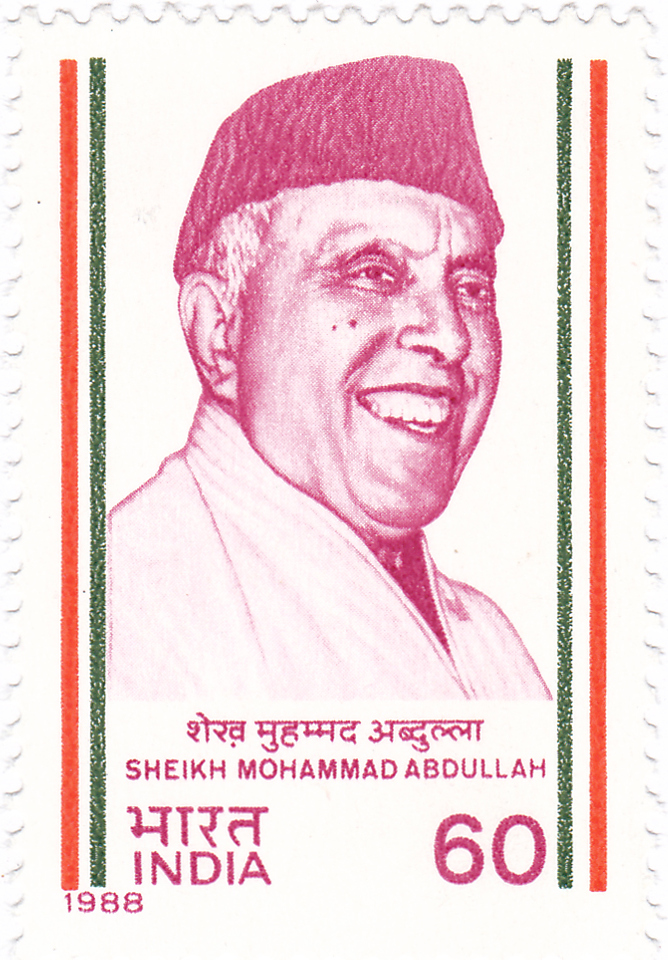
Sheikh Mohammad Abdullah (5 December 1905 – 8 September 1982) was an Indian politician who played a central role in the politics of Jammu and Kashmir. Abdullah was the founding leader and President of the All Jammu and Kashmir Muslim Conference (later renamed Jammu and Kashmir National Conference). He agitated against the rule of the Maharaja Hari Singh and urged self-rule for Kashmir. He is also known as Sher-e-Kashmir ("Lion of Kashmir") and Father of the State of Jammu & Kashmir ("Baba-e-Qaum").
He served as the first elected Prime Minister of the Princely State of Jammu and Kashmir and Jammu & Kashmir as a State and was later jailed by Indian government citing his support to insurgents.[failed verification] He was dismissed from the position of Prime Minister on 8 August 1953 and Bakshi Ghulam Mohammad was appointed the new prime minister. The expressions 'Sadr-i-Riyasat' and 'Prime Minister' were replaced with the terms 'Governor' and 'Chief Minister' in 1965. Sheikh Abdullah again became the Chief Minister of the state following the accord with Indira in 1974 and remained in the top slot till his death on 8 September 1982. His grandson Omar Abdullah currently Jammu Kashmir CM.
Sheikh Abdullah was born on 5 December 1905 in Soura, a suburb on the outskirts of Srinagar in the Vale of Kashmir, two weeks after the death of his father Sheikh Mohammed Ibrahim. As claimed by him in his autobiography Aatish-e-Chinar, his great-grandfather was a Kashmiri Brahmin of the Sapru clan, who converted from Hinduism to Islam after getting influenced by a Sufi preacher. His father had been a middle class manufacturer and trader of Kashmiri shawls. Abdullah was the youngest of six siblings.
He was first admitted to a traditional school or maktab in 1909, when he was four, where he learnt the recitation of the Quran and some basic Persian texts like Gulistan of Sa'di, Bustan and Padshanama. This was followed by a primary school run by the Anjuman Nusrat-ul-Islam, however the low standards of education resulted in Abdullah shifting to the district school at Visrarnaag. After five grades here he shifted to Government High School, Dilawar Bagh. He had to walk the distance of ten miles to school and back on foot, but in his own words, the joy of being allowed to obtain a school education made it seem a light work. He passed his matriculation (standard 12) examination from Punjab University in 1922.
After matriculation he obtained admission in Shri Pratap (S. P.) College, a leading college of Kashmir. His aim was to go into the medical profession at the time. However, circumstances not permitting, he decided to try to study general science at Prince of Wales College in Jammu. He was denied admission. Then he took admission in Islamia College, Lahore and graduated from there. In 1930, he obtained an M.Sc. in Chemistry from Aligarh Muslim University. The political exposure in Lahore and Aligarh would inspire his later life.
As a student at Aligarh Muslim University, he came in contact with and was influenced by persons with liberal and progressive ideas. He became convinced that the feudal system was responsible for the miseries of the Kashmiris and like all progressive nations of the world Kashmir too should have a democratically elected government.
In the 1920s there were a couple of 'reading rooms' in Srinagar which consisted of the educated youth of the area and could only be formed after acquiring the permission of the government. Forming political associations at that time was banned. In 1922, G. A. Ashai set up the Islamia School Old Boys Association (a reading room) with 20 members as part of the leadership, including Sheikh Abdullah. At this time Abdullah was still in college.
Permission to open the Fateh Kadal Reading Room Party was given in 1930 and Sheikh Abdullah became the Secretary of the party. During Abdullah's time the reading room party was located in the house of Mufti Ziauddin. For Abdullah, "the establishment of reading room(s) was an excuse"; rather it was an opportunity to get together to discuss different issues.
Hub AI
Sheikh Abdullah AI simulator
(@Sheikh Abdullah_simulator)
Sheikh Abdullah
Sheikh Mohammad Abdullah (5 December 1905 – 8 September 1982) was an Indian politician who played a central role in the politics of Jammu and Kashmir. Abdullah was the founding leader and President of the All Jammu and Kashmir Muslim Conference (later renamed Jammu and Kashmir National Conference). He agitated against the rule of the Maharaja Hari Singh and urged self-rule for Kashmir. He is also known as Sher-e-Kashmir ("Lion of Kashmir") and Father of the State of Jammu & Kashmir ("Baba-e-Qaum").
He served as the first elected Prime Minister of the Princely State of Jammu and Kashmir and Jammu & Kashmir as a State and was later jailed by Indian government citing his support to insurgents.[failed verification] He was dismissed from the position of Prime Minister on 8 August 1953 and Bakshi Ghulam Mohammad was appointed the new prime minister. The expressions 'Sadr-i-Riyasat' and 'Prime Minister' were replaced with the terms 'Governor' and 'Chief Minister' in 1965. Sheikh Abdullah again became the Chief Minister of the state following the accord with Indira in 1974 and remained in the top slot till his death on 8 September 1982. His grandson Omar Abdullah currently Jammu Kashmir CM.
Sheikh Abdullah was born on 5 December 1905 in Soura, a suburb on the outskirts of Srinagar in the Vale of Kashmir, two weeks after the death of his father Sheikh Mohammed Ibrahim. As claimed by him in his autobiography Aatish-e-Chinar, his great-grandfather was a Kashmiri Brahmin of the Sapru clan, who converted from Hinduism to Islam after getting influenced by a Sufi preacher. His father had been a middle class manufacturer and trader of Kashmiri shawls. Abdullah was the youngest of six siblings.
He was first admitted to a traditional school or maktab in 1909, when he was four, where he learnt the recitation of the Quran and some basic Persian texts like Gulistan of Sa'di, Bustan and Padshanama. This was followed by a primary school run by the Anjuman Nusrat-ul-Islam, however the low standards of education resulted in Abdullah shifting to the district school at Visrarnaag. After five grades here he shifted to Government High School, Dilawar Bagh. He had to walk the distance of ten miles to school and back on foot, but in his own words, the joy of being allowed to obtain a school education made it seem a light work. He passed his matriculation (standard 12) examination from Punjab University in 1922.
After matriculation he obtained admission in Shri Pratap (S. P.) College, a leading college of Kashmir. His aim was to go into the medical profession at the time. However, circumstances not permitting, he decided to try to study general science at Prince of Wales College in Jammu. He was denied admission. Then he took admission in Islamia College, Lahore and graduated from there. In 1930, he obtained an M.Sc. in Chemistry from Aligarh Muslim University. The political exposure in Lahore and Aligarh would inspire his later life.
As a student at Aligarh Muslim University, he came in contact with and was influenced by persons with liberal and progressive ideas. He became convinced that the feudal system was responsible for the miseries of the Kashmiris and like all progressive nations of the world Kashmir too should have a democratically elected government.
In the 1920s there were a couple of 'reading rooms' in Srinagar which consisted of the educated youth of the area and could only be formed after acquiring the permission of the government. Forming political associations at that time was banned. In 1922, G. A. Ashai set up the Islamia School Old Boys Association (a reading room) with 20 members as part of the leadership, including Sheikh Abdullah. At this time Abdullah was still in college.
Permission to open the Fateh Kadal Reading Room Party was given in 1930 and Sheikh Abdullah became the Secretary of the party. During Abdullah's time the reading room party was located in the house of Mufti Ziauddin. For Abdullah, "the establishment of reading room(s) was an excuse"; rather it was an opportunity to get together to discuss different issues.
Recent media