


Community hub
Recent from talks
Contribute something to knowledge base
Content stats: 0 posts, 0 articles, 1 media, 0 notes
Members stats: 0 subscribers, 0 contributors, 0 moderators, 0 supporters
Subscribers
Supporters
Contributors
Moderators
Hub AI
Shepperton branch line AI simulator
(@Shepperton branch line_simulator)
Hub AI
Shepperton branch line AI simulator
(@Shepperton branch line_simulator)
Shepperton branch line
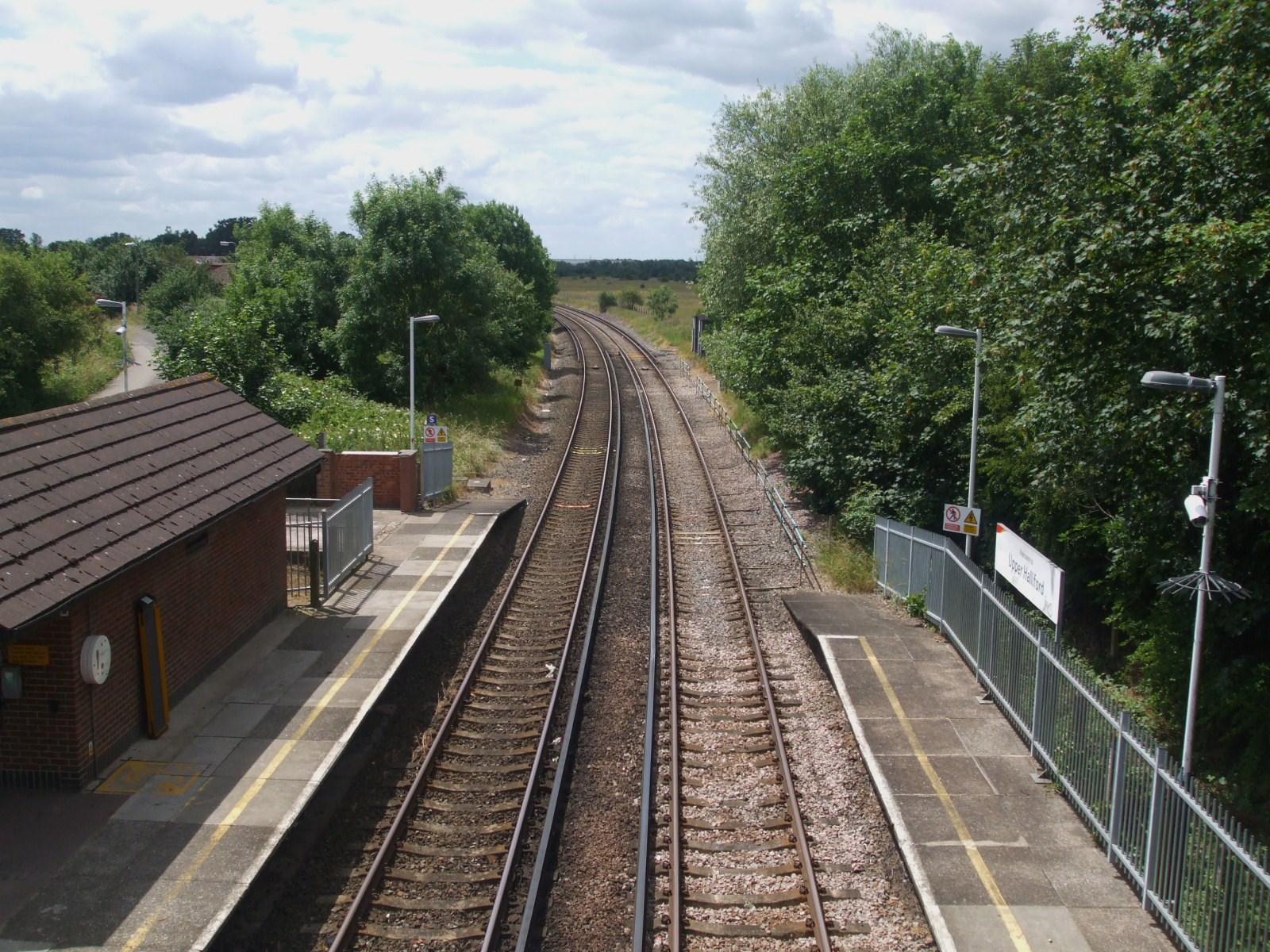
The Shepperton branch line is a 6-mile-51-ch (10.7 km) railway branch line in Surrey and Greater London, England. It runs from its western terminus at Shepperton to a triangular junction with the Kingston loop line east of Fulwell. There are intermediate stations at Upper Halliford, Sunbury and Hampton. The branch also serves a dedicated station at Kempton Park racecourse. All six stations are managed by South Western Railway, which operates all passenger trains. Most services run between Shepperton and London Waterloo via Kingston, but during peak periods some run via Twickenham.
The line was constructed by the Thames Valley Railway company and opened in November 1864. It became part of the London and South Western Railway (LSWR) the following year. The LSWR was responsible for double tracking and electrifying the line using the 750 V DC third-rail system. The replacement of the signalling was completed in June 2019 and train movements have been controlled from Basingstoke rail operating centre since April 2021. The Shepperton branch line is proposed for incorporation into Crossrail 2.
The Shepperton branch line is a railway line in Surrey and Greater London, England. It runs for 6 miles 51 ch (10.7 km) from its terminus at Shepperton station to an at-grade triangular junction with the Kingston loop line around 12.5 mi (20.1 km) down the line from London Waterloo. The maximum speed permitted on the branch is 60 mph (97 km/h). The line is electrified using the 750 V DC third-rail system and, with the exception of Shepperton station, the line is double tracked throughout. Signalling is controlled by Basingstoke rail operating centre and track circuit block is in operation. There is one level crossing on the line, immediately to the west of Hampton station, and a 57 yd (52 m) tunnel, immediately to the west of Fulwell station. The artificial Longford River passes over the line in an aqueduct at Hampton Hill.
The six stations on the branch are managed by South Western Railway, which operates all services. Shepperton has one operational platform, but the other five stations have two platforms each. The buffer stop at Shepperton is 18 miles 73 ch (30.4 km) down the line from London Waterloo, when measured via Twickenham. The off-peak service pattern is two trains per hour in each direction calling at all stations (except Earlsfield) between Shepperton and London Waterloo via Kingston. In the peak periods, there are additional services to Waterloo via Twickenham that do not call at Kempton Park. Off-peak trains from Shepperton typically reach New Malden on the South West Main Line in around 30 minutes and reach London Waterloo from Shepperton in around 55 minutes. Hampton and Fulwell stations are in Zone 6, but the other four stations on the branch are outside the London fare zones.
A railway line serving Shepperton and Sunbury was first proposed in 1861. At the time, the area was rural and the main industry was agriculture. The main motivation for the scheme was to provide a reliable route to London, avoiding Walton Bridge, which had collapsed in 1859 and had not yet been repaired. The Metropolitan and Thames Valley Railway (M&TVR) company was formed and issued its first shares in December 1861. Among the provisional directors of the company were: William Schaw Lindsay, the MP for Sunderland; Sir William Clay; Sir James Duke; Frederick Smith, colonel commandant of the Royal Engineers.
The initial proposal was for a 14 mi (23 km) line linking Shepperton and Sunbury to the Great Western Main Line near Ealing. The western terminus would have been on the north side of the River Thames at Chertsey and the route would also have served Twickenham, Richmond and Isleworth. It would have run along part of the Brentford branch line, which had opened in 1859, and there would also have been spur to Walton Bridge. The line was to have been worked by both the Great Western Railway (GWR) and the London and South Western Railway (LSWR), and was to be laid with dual gauge, meaning that it could accommodate the two companies' trains.
The original intention of the promoters was to work with the GWR to raise capital to finance construction. Instead, the GWR offered to run trains on the line in exchange for half of the gross receipts and to provide assistance in obtaining parliamentary authorisation. The directors of the M&TVR rejected the GWR's offer in March 1862 and approached the LSWR instead. The scope of the initial proposal was dramatically reduced, with the removal of the eastern half of the line. Instead, the easternmost point on the branch would be a junction with LSWR line to Kingston (later the Kingston loop line) around 1.5 mi (2.4 km) south of Twickenham. The promoters dropped the word "Metropolitan" from the company name, which became the "Thames Valley Railway" (TVR). Additionally, the line was to be built to standard gauge only. Many supporters of the M&TVR were unhappy with the reduced scope of the line and refused to continue their association with the renamed company.
A preliminary agreement was made with the LSWR on 1 May 1862. The LSWR was to run train services on the line in exchange for paying the TVR 50% of its gross receipts in addition to a 4% return on the original capital, up to £110,000. Two further alterations to the proposed line took place in mid-1862. Firstly, local opposition from residents forced a diversion to avoid the settlement of Sunbury. The diversion required gradients of up to 1 in 100 to enable it to climb away from the Thames. Secondly, the stretch of line from Shepperton to Chertsey was not included in the original act of parliament, although the stated intention of the TVR directors was to build this section at a later date. Construction of the Shepperton branch line was authorised on 17 July 1862.
Shepperton branch line
The Shepperton branch line is a 6-mile-51-ch (10.7 km) railway branch line in Surrey and Greater London, England. It runs from its western terminus at Shepperton to a triangular junction with the Kingston loop line east of Fulwell. There are intermediate stations at Upper Halliford, Sunbury and Hampton. The branch also serves a dedicated station at Kempton Park racecourse. All six stations are managed by South Western Railway, which operates all passenger trains. Most services run between Shepperton and London Waterloo via Kingston, but during peak periods some run via Twickenham.
The line was constructed by the Thames Valley Railway company and opened in November 1864. It became part of the London and South Western Railway (LSWR) the following year. The LSWR was responsible for double tracking and electrifying the line using the 750 V DC third-rail system. The replacement of the signalling was completed in June 2019 and train movements have been controlled from Basingstoke rail operating centre since April 2021. The Shepperton branch line is proposed for incorporation into Crossrail 2.
The Shepperton branch line is a railway line in Surrey and Greater London, England. It runs for 6 miles 51 ch (10.7 km) from its terminus at Shepperton station to an at-grade triangular junction with the Kingston loop line around 12.5 mi (20.1 km) down the line from London Waterloo. The maximum speed permitted on the branch is 60 mph (97 km/h). The line is electrified using the 750 V DC third-rail system and, with the exception of Shepperton station, the line is double tracked throughout. Signalling is controlled by Basingstoke rail operating centre and track circuit block is in operation. There is one level crossing on the line, immediately to the west of Hampton station, and a 57 yd (52 m) tunnel, immediately to the west of Fulwell station. The artificial Longford River passes over the line in an aqueduct at Hampton Hill.
The six stations on the branch are managed by South Western Railway, which operates all services. Shepperton has one operational platform, but the other five stations have two platforms each. The buffer stop at Shepperton is 18 miles 73 ch (30.4 km) down the line from London Waterloo, when measured via Twickenham. The off-peak service pattern is two trains per hour in each direction calling at all stations (except Earlsfield) between Shepperton and London Waterloo via Kingston. In the peak periods, there are additional services to Waterloo via Twickenham that do not call at Kempton Park. Off-peak trains from Shepperton typically reach New Malden on the South West Main Line in around 30 minutes and reach London Waterloo from Shepperton in around 55 minutes. Hampton and Fulwell stations are in Zone 6, but the other four stations on the branch are outside the London fare zones.
A railway line serving Shepperton and Sunbury was first proposed in 1861. At the time, the area was rural and the main industry was agriculture. The main motivation for the scheme was to provide a reliable route to London, avoiding Walton Bridge, which had collapsed in 1859 and had not yet been repaired. The Metropolitan and Thames Valley Railway (M&TVR) company was formed and issued its first shares in December 1861. Among the provisional directors of the company were: William Schaw Lindsay, the MP for Sunderland; Sir William Clay; Sir James Duke; Frederick Smith, colonel commandant of the Royal Engineers.
The initial proposal was for a 14 mi (23 km) line linking Shepperton and Sunbury to the Great Western Main Line near Ealing. The western terminus would have been on the north side of the River Thames at Chertsey and the route would also have served Twickenham, Richmond and Isleworth. It would have run along part of the Brentford branch line, which had opened in 1859, and there would also have been spur to Walton Bridge. The line was to have been worked by both the Great Western Railway (GWR) and the London and South Western Railway (LSWR), and was to be laid with dual gauge, meaning that it could accommodate the two companies' trains.
The original intention of the promoters was to work with the GWR to raise capital to finance construction. Instead, the GWR offered to run trains on the line in exchange for half of the gross receipts and to provide assistance in obtaining parliamentary authorisation. The directors of the M&TVR rejected the GWR's offer in March 1862 and approached the LSWR instead. The scope of the initial proposal was dramatically reduced, with the removal of the eastern half of the line. Instead, the easternmost point on the branch would be a junction with LSWR line to Kingston (later the Kingston loop line) around 1.5 mi (2.4 km) south of Twickenham. The promoters dropped the word "Metropolitan" from the company name, which became the "Thames Valley Railway" (TVR). Additionally, the line was to be built to standard gauge only. Many supporters of the M&TVR were unhappy with the reduced scope of the line and refused to continue their association with the renamed company.
A preliminary agreement was made with the LSWR on 1 May 1862. The LSWR was to run train services on the line in exchange for paying the TVR 50% of its gross receipts in addition to a 4% return on the original capital, up to £110,000. Two further alterations to the proposed line took place in mid-1862. Firstly, local opposition from residents forced a diversion to avoid the settlement of Sunbury. The diversion required gradients of up to 1 in 100 to enable it to climb away from the Thames. Secondly, the stretch of line from Shepperton to Chertsey was not included in the original act of parliament, although the stated intention of the TVR directors was to build this section at a later date. Construction of the Shepperton branch line was authorised on 17 July 1862.
Recent media
Recent media