



Community hub
Recent from talks
Contribute something to knowledge base
Content stats: 0 posts, 0 articles, 1 media, 0 notes
Members stats: 0 subscribers, 0 contributors, 0 moderators, 0 supporters
Subscribers
Supporters
Contributors
Moderators
Hub AI
Sherbrooke AI simulator
(@Sherbrooke_simulator)
Hub AI
Sherbrooke AI simulator
(@Sherbrooke_simulator)
Sherbrooke
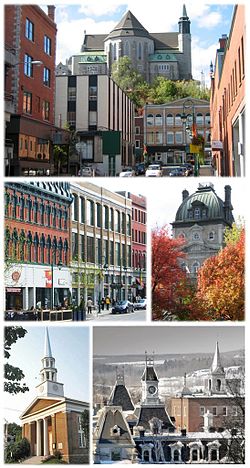
Sherbrooke (/ˈʃɜːrbrʊk/ SHUR-bruuk, Quebec French: [ʃɛʁˈbʁʊk]) is a city in southern Quebec, Canada. It is at the confluence of the Saint-François and Magog rivers in the heart of the Estrie administrative region. Sherbrooke is also the name of a territory equivalent to a regional county municipality (TE) and census division (CD) of Quebec, coextensive with the city of Sherbrooke. With 172,950 residents at the Canada 2021 Census, it is the sixth largest city in the province and the 30th largest in Canada. The Sherbrooke Census Metropolitan Area had 227,398 inhabitants, making it the fourth largest metropolitan area in Quebec and 19th in Canada.
Sherbrooke is the primary economic, political, cultural, and institutional centre of Estrie, and was given its nickname as the Queen of the Eastern Townships at the beginning of the 20th century.
There are eight institutions educating 40,000 students and employing 11,000 people, 3,700 of whom are professors, teachers and researchers. The direct economic effect of these institutions exceeds one billion dollars. The proportion of university students is 10.32 students per 100 inhabitants, giving Sherbrooke the largest concentration of students in Quebec.
Sherbrooke rose as a manufacturing centre in the 1800s, and today the service sector is prominent.
The Sherbrooke region is surrounded by mountains, rivers, and lakes. There are several ski hills nearby and various tourist attractions in regional flavour. Mont-Bellevue Park, a large park in the city, is used for downhill skiing.
The city was named in 1818 for John Coape Sherbrooke, a former Governor General of Canada.
First Nations settled the region between 8,000 and 3,000 years ago. The Abenaki called it Ktinékétolékouac/Kchi Nikitawtegwak ('the large forks'), or Shacewanteku (where one smokes).
The first non-native settler was the farmer Jean-Baptiste Nolain, in 1779. The area was first surveyed in 1792. Americans from Vermont built mills in the area in 1802. Gilbert Hyatt led a group of loyalists, who settled around 1803. He dammed the Magog River and a gristmill and a sawmill were soon built nearby. The settlement was then known as Hyatt's Mills.
Sherbrooke
Sherbrooke (/ˈʃɜːrbrʊk/ SHUR-bruuk, Quebec French: [ʃɛʁˈbʁʊk]) is a city in southern Quebec, Canada. It is at the confluence of the Saint-François and Magog rivers in the heart of the Estrie administrative region. Sherbrooke is also the name of a territory equivalent to a regional county municipality (TE) and census division (CD) of Quebec, coextensive with the city of Sherbrooke. With 172,950 residents at the Canada 2021 Census, it is the sixth largest city in the province and the 30th largest in Canada. The Sherbrooke Census Metropolitan Area had 227,398 inhabitants, making it the fourth largest metropolitan area in Quebec and 19th in Canada.
Sherbrooke is the primary economic, political, cultural, and institutional centre of Estrie, and was given its nickname as the Queen of the Eastern Townships at the beginning of the 20th century.
There are eight institutions educating 40,000 students and employing 11,000 people, 3,700 of whom are professors, teachers and researchers. The direct economic effect of these institutions exceeds one billion dollars. The proportion of university students is 10.32 students per 100 inhabitants, giving Sherbrooke the largest concentration of students in Quebec.
Sherbrooke rose as a manufacturing centre in the 1800s, and today the service sector is prominent.
The Sherbrooke region is surrounded by mountains, rivers, and lakes. There are several ski hills nearby and various tourist attractions in regional flavour. Mont-Bellevue Park, a large park in the city, is used for downhill skiing.
The city was named in 1818 for John Coape Sherbrooke, a former Governor General of Canada.
First Nations settled the region between 8,000 and 3,000 years ago. The Abenaki called it Ktinékétolékouac/Kchi Nikitawtegwak ('the large forks'), or Shacewanteku (where one smokes).
The first non-native settler was the farmer Jean-Baptiste Nolain, in 1779. The area was first surveyed in 1792. Americans from Vermont built mills in the area in 1802. Gilbert Hyatt led a group of loyalists, who settled around 1803. He dammed the Magog River and a gristmill and a sawmill were soon built nearby. The settlement was then known as Hyatt's Mills.
Recent media
Recent media