Hubbry Logo
SherbrookeSherbrookeMain
Open search
Sherbrooke
Community hub
Sherbrooke
logo
8 pages, 0 posts
0 subscribers
Be the first to start a discussion here.
Sherbrooke
Sherbrooke
from Wikipedia

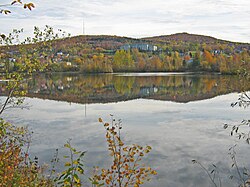
Sherbrooke (/ˈʃɜːrbrʊk/ SHUR-bruuk, Quebec French: [ʃɛʁˈbʁʊk]) is a city in southern Quebec, Canada. It is at the confluence of the Saint-François and Magog rivers in the heart of the Estrie administrative region. Sherbrooke is also the name of a territory equivalent to a regional county municipality (TE) and census division (CD) of Quebec, coextensive with the city of Sherbrooke. With 172,950 residents at the Canada 2021 Census,[4] it is the sixth largest city in the province and the 30th largest in Canada. The Sherbrooke Census Metropolitan Area had 227,398 inhabitants, making it the fourth largest metropolitan area in Quebec and 19th in Canada.

Key Information

Sherbrooke is the primary economic, political, cultural, and institutional centre of Estrie, and was given its nickname as the Queen of the Eastern Townships at the beginning of the 20th century.

There are eight institutions educating 40,000 students and employing 11,000 people, 3,700 of whom are professors, teachers and researchers. The direct economic effect of these institutions exceeds one billion dollars. The proportion of university students is 10.32 students per 100 inhabitants, giving Sherbrooke the largest concentration of students in Quebec.[8]

Sherbrooke rose as a manufacturing centre in the 1800s, and today the service sector is prominent.

The Sherbrooke region is surrounded by mountains, rivers, and lakes. There are several ski hills nearby and various tourist attractions in regional flavour. Mont-Bellevue Park, a large park in the city, is used for downhill skiing.

The city was named in 1818 for John Coape Sherbrooke, a former Governor General of Canada.[9]

History

[edit]

First Nations settled the region between 8,000 and 3,000 years ago.[10] The Abenaki called it Ktinékétolékouac/Kchi Nikitawtegwak ('the large forks'),[11] or Shacewanteku (where one smokes).[2]

Sherbrooke in 1828

The first non-native settler was the farmer Jean-Baptiste Nolain, in 1779.[2] The area was first surveyed in 1792.[12] Americans from Vermont built mills in the area in 1802. Gilbert Hyatt led a group of loyalists, who settled around 1803. He dammed the Magog River and a gristmill and a sawmill were soon built nearby. The settlement was then known as Hyatt's Mills.[13]

The first immigrants from England arrived in 1815.[14] The British American Land Company was formed in 1832[15] to acquire and develop almost 1,100,000 acres (1,719 sq mi; 4,452 km2) of Crown land and other lands in the area. It prioritized speculation over immigration.[16]

In 1852 a railway linked Montreal and Portland, Maine via Sherbrooke. By the 1890s, there were rail connections to Boston, Halifax, and New York City.

Sherbrooke in 1889
Pictorial map of Sherbrooke from 1881, including a list of landmarks

Immigration from the rest of Quebec began in 1850, and by 1871 francophones were in the majority.[14]

By the turn of the 20th century, Sherbrooke was a thriving industrial city, with manufacturing benefiting from locally-produced hydroelectricity. From the 1950s, some the steel and textile industries declined, giving way to government services and education.

Postcard of Dufferin Street, Sherbrooke, between 1903–1913
Dufferin Street, Sherbrooke, between 1903–1913

As part of the 2000–2006 municipal reorganization in Quebec, the city grew considerably on 1 January 2002, when it absorbed Ascot, Bromptonville, Deauville, Fleurimont, Lennoxville, Rock Forest, and Saint-Élie-d'Orford. Part of Stoke was also annexed to the newly expanded Sherbrooke.

In 2012, a local biochemical factory suffered an explosion, which killed 2, and injured 19, some severely. A large toxic cloud enveloped part of the city, raising health concerns.[17][18]

Geography

[edit]

Located at the confluence of the Saint-François (St. Francis) and Magog rivers in the heart of the Eastern Townships and the Estrie administrative region. Sherbrooke is also the name of a territory equivalent to a regional county municipality (TE) and census division (CD) of Quebec, coextensive with the city of Sherbrooke. Its geographical code is 43.[vague]

Climate

[edit]

Sherbrooke has a humid continental climate (Köppen Dfb), with long, cold, and snowy winters, warm summers, and short but crisp springs and autumns. Highs range from −5.8 °C (21.6 °F) in January to 24.6 °C (76.3 °F) in July. In an average year, there are 34 nights at or colder than −20 °C (−4 °F), and 6.5 nights at or colder than −30 °C (−22 °F); 4.1 days will see highs reaching 30 °C (86 °F).[19] Annual snowfall is large, averaging at 287 centimetres (113 in), sometimes falling in May and October. Precipitation is not sparse any time of the year, but is the greatest in summer and fall and at its least from January to April, totalling 1,100 millimetres (43.3 in) annually.

The highest temperature ever recorded in Sherbrooke was 36.7 °C (98 °F) on 1 & 2 July 1931.[20] The coldest temperature ever recorded was −41.2 °C (−42.2 °F) on 15 January 2004.[21]

Climate data for Sherbrooke Airport, 1981−2010 normals, extremes 1900−present
Month Jan Feb Mar Apr May Jun Jul Aug Sep Oct Nov Dec Year
Record high humidex 17.4 17.1 27.0 31.5 38.3 43.9 46.5 43.4 38.7 31.8 26.3 19.0 46.5
Record high °C (°F) 15.0
(59.0)
17.1
(62.8)
25.3
(77.5)
30.0
(86.0)
33.5
(92.3)
35.0
(95.0)
36.7
(98.1)
36.1
(97.0)
34.0
(93.2)
28.3
(82.9)
23.9
(75.0)
17.8
(64.0)
36.7
(98.1)
Mean daily maximum °C (°F) −5.8
(21.6)
−2.8
(27.0)
2.3
(36.1)
10.4
(50.7)
18.3
(64.9)
22.2
(72.0)
24.6
(76.3)
23.7
(74.7)
19.2
(66.6)
12.2
(54.0)
5.1
(41.2)
−2.1
(28.2)
10.6
(51.1)
Daily mean °C (°F) −11.9
(10.6)
−9.4
(15.1)
−3.7
(25.3)
4.5
(40.1)
11.4
(52.5)
15.5
(59.9)
18.2
(64.8)
17.3
(63.1)
12.3
(54.1)
6.3
(43.3)
0.6
(33.1)
−7.3
(18.9)
4.5
(40.1)
Mean daily minimum °C (°F) −17.9
(−0.2)
−15.9
(3.4)
−9.7
(14.5)
−1.4
(29.5)
4.3
(39.7)
8.8
(47.8)
11.7
(53.1)
10.8
(51.4)
6.3
(43.3)
0.5
(32.9)
−4
(25)
−12.4
(9.7)
−1.6
(29.1)
Record low °C (°F) −41.2
(−42.2)
−40
(−40)
−35
(−31)
−21.1
(−6.0)
−6.7
(19.9)
−2.2
(28.0)
0.5
(32.9)
−1.7
(28.9)
−7.4
(18.7)
−15
(5)
−25.5
(−13.9)
−39.4
(−38.9)
−41.2
(−42.2)
Record low wind chill −47.2 −48 −42.4 −29.7 −12.8 −5.4 0.0 −4.7 −8.6 −16.7 −27.9 −48.3 −48.3
Average precipitation mm (inches) 74.3
(2.93)
61.7
(2.43)
71.3
(2.81)
84.0
(3.31)
94.3
(3.71)
108.4
(4.27)
109.5
(4.31)
126.1
(4.96)
94.8
(3.73)
90.4
(3.56)
99.1
(3.90)
86.5
(3.41)
1,100.4
(43.32)
Average rainfall mm (inches) 17.3
(0.68)
16.6
(0.65)
27.6
(1.09)
63.3
(2.49)
94.0
(3.70)
108.4
(4.27)
109.5
(4.31)
126.1
(4.96)
94.7
(3.73)
87.5
(3.44)
70.8
(2.79)
32.0
(1.26)
847.9
(33.38)
Average snowfall cm (inches) 68.2
(26.9)
54.2
(21.3)
48.2
(19.0)
21.2
(8.3)
0.37
(0.15)
0.0
(0.0)
0.0
(0.0)
0.0
(0.0)
0.03
(0.01)
3.2
(1.3)
29.1
(11.5)
62.1
(24.4)
286.5
(112.8)
Average precipitation days (≥ 0.2 mm) 19.7 15.5 16.0 14.9 15.7 15.2 14.0 13.3 12.6 14.0 17.2 19.1 187.1
Average rainy days (≥ 0.2 mm) 3.5 3.3 6.4 12.2 15.1 15.1 13.8 14.5 13.0 13.7 11.5 5.4 127.5
Average snowy days (≥ 0.2 cm) 18.9 14.3 10.9 5.6 0.21 0.0 0.0 0.0 0.07 1.5 8.6 16.2 76.3
Mean monthly sunshine hours 84.5 107.8 137.7 159.8 212.3 234.6 257.0 231.3 165.6 118.9 67.9 67.6 1,844.9
Percentage possible sunshine 29.8 36.9 37.4 39.5 46.1 50.1 54.2 52.9 43.9 34.9 23.7 24.8 39.5
Source: Environment Canada[19][22][23][24][25]
Gordon Street

Neighbourhoods

[edit]

The city includes several neighbourhoods:

  • Le quartier universitaire
  • Le Vieux-Nord
  • Collinsville
  • Secteur Galvin
  • L'Est
  • Ascot
  • Mi-Vallon
  • du Pin-Solitaire
  • Le Petit Canada

Demographics

[edit]

City of Sherbrooke

[edit]
Sherbrooke[26]
YearPop.±%
18714,432—    
18817,227+63.1%
189110,097+39.7%
190111,765+16.5%
191116,405+39.4%
192123,515+43.3%
193128,933+23.0%
194135,965+24.3%
195150,543+40.5%
195658,668+16.1%
196166,554+13.4%
196675,690+13.7%
197180,711+6.6%
197676,804−4.8%
198174,075−3.6%
198674,478+0.5%
199176,429+2.6%
199676,786+0.5%
200175,916−1.1%
2006*147,427+94.2%
2011154,601+4.9%
2016161,323+4.3%
2021172,950+7.2%
(*) Sherbrooke annexed the City of Bromptonville, the City of Fleurimont, the City of Lennoxville, the City of Rock-Forest, the Municipality of Ascot and the Municipality of Deauville.
Sherbrooke (including annexed territories)[27]
YearPop.±%
18718,532—    
188112,410+45.5%
189115,930+28.4%
190118,724+17.5%
191123,865+27.5%
192133,624+40.9%
193139,323+16.9%
194147,614+21.1%
195163,608+33.6%
195672,789+14.4%
196182,939+13.9%
196694,988+14.5%
1971103,083+8.5%
1976111,137+7.8%
1981117,848+6.0%
1986122,282+3.8%
1991131,123+7.2%
1996136,681+4.2%
2001139,388+2.0%
2006147,427+5.8%
2011154,601+4.9%
2016161,323+4.3%
2021172,950+7.2%

In the 2021 Census of Population conducted by Statistics Canada, Sherbrooke had a population of 172,950 living in 80,476 of its 86,019 total private dwellings, a change of 7.2% from its 2016 population of 161,323. With a land area of 353.4 km2 (136.4 sq mi), it had a population density of 489.4/km2 (1,267.5/sq mi) in 2021.[28]

Canada census – Sherbrooke community profile
202120162011
Population172,950 (+7.2% from 2016)161,323 (+4.3% from 2011)154,601 (+4.9% from 2006)
Land area353.40 km2 (136.45 sq mi)353.76 km2 (136.59 sq mi)353.49 km2 (136.48 sq mi)
Population density489.4/km2 (1,268/sq mi)456.0/km2 (1,181/sq mi)437.4/km2 (1,133/sq mi)
Median age41.2 (M: 39.2, F: 42.8)40.5 (M: 38.5, F: 42.5)40.2 (M: 38.0, F: 42.3)
Private dwellings86,019 (total)  80,341 (total)  75,880 (total) 
Median household income$62,400$51,706$46,468
References: 2021[29] 2016[30] 2011[31]

Language

[edit]

As of 2021, 86.4% of Sherbrooke residents spoke French as a first language, while those whose mother tongue was English accounted for 3.9%. The next most common first languages were Spanish (2%), Arabic (1.3%), Dari (0.7%), Serbian (0.3%), Portuguese (0.2%) and Mandarin (0.2%).

Ethnicity

[edit]

As of 2021, approximately 88.7% of Sherbrooke residents were white, while 9.6% were visible minorities and 1.7% were Indigenous. The largest visible minority groups in Sherbrooke were black (3.1%), Latin American (2%), Arab (1.7%), and West Asian (1%).

Panethnic groups in the City of Sherbrooke (2001−2021)
Panethnic
group
2021[32] 2016[33] 2011[34] 2006[35] 2001[36]
Pop. % Pop. % Pop. % Pop. % Pop. %
White[a] 148,235 88.67% 143,110 91.58% 140,695 93.64% 137,040 94.78% 70,625 96.37%
Black 5,215 3.12% 3,515 2.25% 2,530 1.68% 1,780 1.23% 745 1.02%
Middle Eastern[b] 4,530 2.71% 3,235 2.07% 1,825 1.21% 1,410 0.98% 590 0.81%
Latin American 3,410 2.04% 2,705 1.73% 2,110 1.4% 2,005 1.39% 690 0.94%
Indigenous 2,820 1.69% 1,720 1.1% 1,345 0.9% 865 0.6% 140 0.19%
East Asian[c] 965 0.58% 655 0.42% 475 0.32% 620 0.43% 105 0.14%
Southeast Asian[d] 760 0.45% 530 0.34% 605 0.4% 390 0.27% 260 0.35%
South Asian 710 0.42% 450 0.29% 455 0.3% 310 0.21% 85 0.12%
Other/multiracial[e] 540 0.32% 340 0.22% 210 0.14% 170 0.12% 40 0.05%
Total responses 167,180 96.66% 156,260 96.86% 150,255 97.19% 144,595 98.08% 73,285 96.53%
Total population 172,950 100% 161,323 100% 154,601 100% 147,427 100% 75,916 100%
Note: Totals greater than 100% due to multiple origin responses
Ethnic origin (2021)
Ethnic origin Population Percent
Canadian 57,945 34.6
French 43,525 26.0
Québécois 21,100 12.6
Irish 8,400 5.0
North American Aboriginal 7,605 4.5
English 4,570 2.7
Scottish 3,245 1.9
Italian 2,790 1.6
German 2,305 1.3


Sherbrooke CMA

[edit]
Sherbrooke CMA

The Census Metropolitan Area (CMA) comprises the cities of Sherbrooke, Magog and Waterville, the municipalities of Ascot Corner, Compton, Saint-Denis-de-Brompton, Stoke and Val-Joli; the township municipalities of Hatley and Orford; and the village municipality of North Hatley. The population in 2021 was 227,398. The median age was 43.

Approximately 90.5% of the greater Sherbrooke area residents were white, while 7.7% were visible minorities and 1.8% were Aboriginal.[4]

French was mother tongue to 87.3% of residents. The next most common mother tongues were English (4.5%), Spanish (1.6%), Arabic (1.0%) Dari (0.5%), Mandarin (0.2%), Portuguese (0.2%) and Serbian (0.2%).[4]

About 55.7% of the population identified as Catholic in 2021 while 32.2% said they had no religious affiliation, 2.9% were Muslim, 0.5% Anglican, 0.5% Eastern Orthodox, 0.4% Jehovah's Witness and 0.4% Baptist. United Church and Pentecostals made up 0.3% of the population each while buddhist made 0.2%.

Economy

[edit]
Wellington Street North in downtown Sherbrooke

Sherbrooke, which is the economic centre of Estrie, is a significant cultural, industrial, and academic hub in the province. The city is directly served by two railways: the St. Lawrence and Atlantic Railroad and the Canadian Pacific Railway. Sherbrooke is also served by four highways as well as the regional airport named Sherbrooke Airport but located in the nearby city of Cookshire-Eaton. Sherbrooke Airport no longer offers scheduled passenger services as of March 2010.

According to data from the Institut de la statistique du Québec, average personal income per capita in the Census Metropolitan Area (CMA) of Sherbrooke amounted to CA$30,976 in 2010.[37] Estrie's GDP for the same year was $9.59 billion.[38]

The hockey equipment manufacturer Sherwood was founded in Sherbrooke in 1949. The city is also home to the hockey puck manufacturer Inglasco.

Largest employers

As of 2010, the largest employers in Sherbrooke are Université de Sherbrooke (6,000 employees), Centre hospitalier universitaire de Sherbrooke (5,511), Commission scolaire de la Région-de-Sherbrooke (3,050), Centre de santé et de services sociaux – Institut universitaire de gériatrie de Sherbrooke (2,650), City of Sherbrooke (1,913), Desjardins Group (1,713), Cégep de Sherbrooke (800), Centre Jeunesse de l'Estrie (527), Nordia Inc. (500), Canada Post (497), Kruger Inc. - Publication papers business unit (455), Bishop's University (450) and McDonald's (400).[39] These include enterprises operating in Sherbrooke only and having 400 or more employees.

Arts and culture

[edit]
The Sherbrooke War Memorial by George William Hill is a cenotaph erected in 1926 to commemorate the soldiers who were killed during World War I.[40]

In the summer season, several festivals, concerts, and events are held in the city, such as the Fête du Lac des Nations, Sherblues & Folk, and the Festival des traditions du monde. Come winter, the city hosts the Carnaval de Sherbrooke.

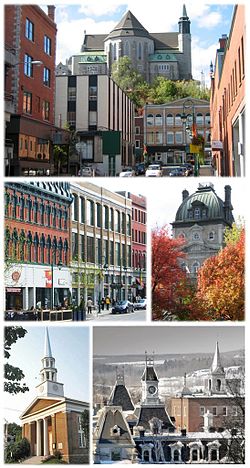
The city has British architectural heritage, as seen in the buildings in Vieux-Nord.[citation needed]

Sherbrooke has the fourth largest theatre in Quebec, the Maurice O'Bready University Cultural Centre of Sherbrooke (Salle Maurice-O’bready du centre culturel de l’Université de Sherbrooke). Music, theatre, and dance shows are staged there. The Centennial Theatre of Bishop's University also hosts music and dance concerts from around the world. The Vieux Clocher, owned by the Université de Sherbrooke, has two stages, the primary being used by various music groups and comedians from around the province. The Théâtre Granada, designated as a historical site by the Canadian government, holds music concerts. It has retained its original architecture since its opening. The Petit Théâtre de Sherbrooke, located downtown, presents musicals and plays for children.[41]

Since 2007, the Centre des arts de la scène Jean-Besré (CASJB), built by the city with the support of the Ministry of Culture and Communications, has assisted in the creation and production of material for the region's artistic community.[42] It serves as the location for training theatre, music, and dance professionals. It contains three rehearsal studios, a production room, a decoration workshop, and a costume workshop, as well as administrative offices for each of its resident companies.

Historical buildings on Dufferin Street

Auditoriums

[edit]
  • Salle Maurice-O'Bready
  • Granada Theatre
  • Centennial Theatre
  • Vieux Clocher
  • Le Petit Théâtre de Sherbrooke
  • Théâtre Léonard Saint-Laurent
  • Salle Alfred-Des Rochers

Libraries

[edit]
  • La bibliothèque municipale Éva-Senécal, the main city library (opened 22 December 1990), is named for Éva Senécal (1905-1988), poet, novelist and journalist.
  • La bibliothèque du secteur de Rock Forest
  • La bibliothèque du secteur de Saint-Élie
  • La bibliothèque Gisèle-Bergeron
  • La bibliothèque de Lennoxville, at the intersection of rue Queen and rue College, near Bishop's University, offers a book lending service in French and English.

Attractions

[edit]
The former Winter Prison

Museums and visitors' centres

[edit]

Parks

[edit]
  • Johnville Bog & Forest Park
  • Forêt jardinée de l'aéroport de Sherbrooke Sherbrooke has parks and greenspaces that encompass a variety of recreational activities. In total, there are 108 in the municipality.[43] Parks Jacques-Cartier, Mont Bellevue, Bois Beckett, Lucien-Blanchard, Central, Quintal, Victoria, and Marais Réal-D.-Carbonneau are among the most popular destinations.
  • Jacques-Cartier Park
    Jacques-Cartier Park
Situated along Lac des Nations, this park is about 1 kilometre (0.62 mi) away from the downtown area and is connected to the lac des Nations promenade. It contains several sports facilities including soccer fields and tennis courts. Several festivals are held here including the Fête du Lac des Nations, the Carnaval de Sherbooke, the festivities for the Fête Nationale and Canada Day.
  • Mont Bellevue Park
    Mounts Bellevue (left) and John-S.-Bourque (right), as seen across the Magog River
This park is the largest in Sherbrooke, with an area of 200 hectares (490 acres). Situated partially on the campus of the Université de Sherbrooke, it is managed by the city and developed by volunteer organization Regroupement du Mont-Bellevue. Within the park are mounts Bellevue and John-S.-Bourque, the former of which has a small ski station. The park is also used for cross-country skiing, snowshoeing, walking, and tubing in winter; as well as hiking, mountain biking, archery, tennis, and jogging in summer. The park contains a total of 30 kilometres (19 mi) of trails and several different types of ecosystems.[44]
  • Bois Beckett Park
This park was established on an old maple grove that belonged to Major Henry Beckett between 1834 and 1870. The property remained in his family until it was acquired by the city in 1963.[45] In 2000, the Ministère de Ressources naturelles et de la Faune recognized the property as an old-growth forest.[46] The oldest tree is said to be 270 years old.[47] The park is maintained, protected and promoted by a volunteer group. Several trails have been built by the city which are open year-round. Within the park, there are several artifacts left behind by Beckett, such as foundations, wells, and farm equipment.
  • Lucien-Blanchard Park
    Armand-Nadeau Pavilion in Jacques-Cartier Park
Situated 3 kilometres (1.9 mi) west of downtown on the bank of the Magog River, this park is open to several outdoor activities such as swimming and beach volleyball. Bicycles, canoes, kayaks, paddle boats, and dragon boats are available for rent. There is an interpretation centre with an emphasis on the reptiles and amphibians of the region as well as a boutique.
  • Central Park
At the heart of the Rock Forest–Saint-Élie–Deauville borough, this park is equipped for soccer, tennis, baseball, beach volleyball, and has a playground and an outdoor pool.
  • Quintal Park
Formerly called Parc Central de Fleurimont, this park is situated in the borough of Fleurimont, and mirrors Central Park of Rock Forest-Saint-Élie-Deauville. In early July, the Pif Classic baseball tournament is held in the park, and in August, it hosts the Festival des Traditions du Monde.
  • Victoria and Sylvie-Daigle Parks
Across Terrill Street from one another, these parks are situated just east of downtown. Inside these parks lie pedestrian trails, Olympic-size soccer fields, a handicap accessible outdoor pool, and a sports complex.[48] This multifunctional facility, called the Centre MultiSport Roland-Dussault, has an artificial turf allowing local teams the opportunity to practise indoor soccer, baseball, football, rugby, and so on. There is a hockey arena.
  • Marais Réal-D.-Carbonneau
    Le Marais Réal-D.-Carbonneau
Located near the Saint-François River, this marsh was developed by CHARMES, a non-profit management corporation that seeks to promote ecotourism in and around Sherbrooke.[49] The park is located on 40 hectares (99 acres) of land and allows visitors access to wooden piers and observation towers, where there are over 50 tree and shrub species and birds.[50]

Sports

[edit]

Baseball

[edit]

The Sherbrooke Expos of the Ligue de Baseball Majeur du Québec, an amateur baseball league, play their home games at Amedée Roy Stadium.

The city also hosted some games of the 2002 World Junior Baseball Championship,[51] and the 2013 Canada Games.[52]

Historically, several professional teams based in Sherbrooke competed in Minor League Baseball or in independent baseball leagues:[53]

Season(s) Team League Classification
1940 Sherbrooke Braves Quebec Provincial League Class B
1946 Sherbrooke Canadians Border League Class C
1947 Sherbrooke Black Sox Quebec Provincial League Independent
1948–1949 Sherbrooke Athletics Provincial League
1950–1951 Class C
1953–1955 Sherbrooke Indians
1972–1973 Sherbrooke Pirates Eastern League Double-A

Ice hockey

[edit]

The Sherbrooke Phoenix is a junior hockey team playing in the Quebec Maritimes Junior Hockey League.

The Sherbrooke Canadiens competed in the American Hockey League from 1984 to 1990.

Government

[edit]
Boroughs and districts of Sherbrooke

Sherbrooke is the seat of the judicial district of Saint-François.[54]

Municipal

[edit]

Local governance is provided by the Sherbrooke City Council. The mayor is Marie-Claude Bibeau.[55]

Under the 2000–2006 municipal reorganization in Quebec, Sherbrooke merged with most of the suburban municipalities in the surrounding area: Rock Forest, Saint-Élie-d'Orford, Deauville, Fleurimont, Bromptonville, Ascot, and Lennoxville. This resulted in the creation of six Boroughs of Sherbrooke: Brompton, Fleurimont, Lennoxville, Mont-Bellevue, Rock Forest–Saint-Élie–Deauville, and Jacques-Cartier. Each of the boroughs is subdivided into electoral districts, with the number varying based on population. For example, there are only two districts in Brompton, which only has 6,314 inhabitants, whereas Fleurimont (pop. 40,824) has five. Sherbrooke has 21 districts total, for which the average population is 7,200 inhabitants.

Borough Population City councillors
Brompton 5,956 3
Fleurimont 41,276 5
Jacques-Cartier 30,229 4
Lennoxville 5,195 3
Mont-Bellevue 33,377 4
Rock Forest–Saint-Élie–Deauville 29,191 4

Federal and provincial

[edit]

Sherbrooke is split into the federal electoral districts of Sherbrooke, represented by Élisabeth Brière of the Liberal party of Canada and Compton—Stanstead, represented by Marie-Claude Bibeau of the Liberals.

Provincially, Sherbrooke is divided into three electoral districts. Sherbrooke is represented by Christine Labrie of the Québec solidaire (QS), Saint-François is represented by Guy Hardy of the PLQ and Richmond is represented by Karine Vallières of the PLQ.

Sherbrooke federal election results[56]
Year Liberal Conservative Bloc Québécois New Democratic Green
2021 37% 31,803 14% 12,239 30% 26,097 12% 10,636 3% 2,347
2019 31% 27,575 11% 9,873 28% 24,967 23% 20,409 5% 4,188
Sherbrooke provincial election results[57]
Year CAQ Liberal QC solidaire Parti Québécois
2018 31% 26,790 22% 19,132 28% 23,722 16% 13,437
2014 19% 15,494 36% 29,608 10% 8,355 32% 26,133

Public safety

[edit]

In 2007, the crime rate was 5,491 per 100,000.[58]

Military

[edit]
Military parade in front of the Sherbrooke Armoury

Sherbrooke does not host any units from the Regular Force with the exception of a recruiting centre, but four Primary Reserve units are stationed in the city:

A Canadian military artifact is preserved at the William Street Armoury: the Sherman tank "Bomb". The tank helped liberate Europe fighting with the Sherbrooke Fusilier Regiment and is the only Canadian tank to have landed on the Normandy beach on D-Day; it fought through to VE Day without being knocked out.[citation needed]

Infrastructure

[edit]

Transportation

[edit]

Transdev Limocar provides bus service to Montreal via Granby and Magog. Formerly, Autobus Jordez linked Sherbrooke to Drummondville and Trois-Rivières, and also to Victoriaville and Quebec City, but since the company lost their licence to operate heavy vehicles,[59] they have sold their licence to Autobus La Québécoise, who now provide the service.

Société de transport de Sherbrooke (STS) provides bus service within the city. It operates 18 bus routes, 10 minibus routes, 7 express routes, 3 taxibus routes, and 3 microbus routes.

The city is located at the eastern terminus of A-10, and directly on the Autoroute Trans-Québécoise (A-55). A-10 provides a direct freeway connection to Montreal and points west, while A-55 connects directly to Trois-Rivières, Shawinigan, and points north, as well as to Interstate 91 to the south (Vermont). A-410 and A-610 are the southern and northern bypass roads, respectively.

The last passenger train for the city was VIA Rail's Montreal – Saint John, New Brunswick Atlantic, which ended service in 1994. There have been recent proposals to provide rail service from Montreal to Boston with a stop in Sherbrooke.[60]

Sherbrooke Airport, in Cookshire-Eaton is just east of the city. There are currently no scheduled flights operating out of the airport.[citation needed] The nearest airports are Montréal–Trudeau International Airport, located 169 km (105 mi) west and Québec City Jean Lesage International Airport, located 213 km (132 mi) north of Sherbrooke.

Public health

[edit]

The suburban Sherbrooke University Hospital ("CHUS"[61] or "Centre Hospitalier Universitaire de Sherbooke) has over 5,200 employees, including 550 doctors. It includes a clinical research facility, the Étienne-Lebel Research Centre.

Education

[edit]

Sherbrooke's educational sector is well-developed, both as part of the city's character and as an important domain of employment, employing about 11,000 people in its colleges and universities. The city has approximately 40,000 postsecondary students, of which about 17,000 are university students.[62]

Postsecondary

[edit]

Sherbrooke has five academic institutions that make up the Sherbrooke University Pole, divided between English and French institutions. University students comprise a total of 10.32% of the city's population, the highest concentration in the province.[62]

The city is home to one French-language university, the Université de Sherbrooke, which alone has more than 31,000 students annually. The programs are split between 8 different faculties, the largest ones being in education, medicine, and management with around 7,900, 5,000 and 4,800 students per year respectively.[63] 3,000 of the university's students are international students, coming from around 100 different countries and territories. About half of the foreign students come from France, as they are exempt from additional tuition fees as part of a student mobility agreement between the Québec and French governments.[64] The university is split into three different campuses: the main campus, the Health campus located in upper Fleurimont, and the campus in Longueuil.[63]

One of the province's three English-language universities, Bishop's University, is also located in Sherbrooke, in the borough of Lennoxville. The school brings in around 3,000 students annually, mainly for undergraduate programs. It is subdivided into three faculties and schools, the Faculty of Arts and Sciences, the School of Education, and the Williams School of Business.[65]

There are three cégeps in Sherbrooke. Two of them are French-language, the Cégep de Sherbrooke and the Séminaire de Sherbrooke, and one is English-language, Champlain College Lennoxville.

Primary and secondary education

[edit]

The city's public primary and secondary schools are run by either the French-language Centre de services scolaire de la Région-de-Sherbrooke or the English-language Eastern Townships School Board. The CSSRS educates around 25,000 students and employs 4,000 teachers, support staff, and administrative staff.[66]

Sherbrooke has a total of six public secondary schools:

Sherbrooke also has four private schools that offer secondary education:

Media

[edit]

See also

[edit]

Notes

[edit]

References

[edit]
[edit]
Revisions and contributorsEdit on WikipediaRead on Wikipedia
from Grokipedia
Sherbrooke is a city in southern Quebec, Canada, located at the confluence of the Saint-François and Magog rivers in the Eastern Townships region, approximately 147 km east of Montreal. Named in 1818 after Sir John Coape Sherbrooke, the British Governor General of British North America from 1816 to 1818, the settlement was incorporated as a city in 1852. As the regional capital of Estrie, Sherbrooke functions as an educational, cultural, and economic hub, with the city proper estimated at 184,303 residents in 2024 and its census metropolitan area encompassing over 238,000 people. The city is home to the Université de Sherbrooke, a prominent French-language research university founded in 1954 with around 31,000 students, known for innovations in fields like business administration and optics, as well as Bishop's University, an English-language liberal arts institution established in 1843. Sherbrooke's economy, historically rooted in manufacturing, has evolved to emphasize services, advanced manufacturing, and high-tech sectors including a photonics and optics innovation cluster, supported by industrial parks and entrepreneurship initiatives. Its defining characteristics include a blend of Francophone and Anglophone heritage, reflecting the Eastern Townships' Loyalist settlement history, alongside natural features like parks and proximity to recreational areas that contribute to its quality of life.

History

Indigenous Presence and Early Settlement

The region encompassing present-day Sherbrooke, within the Eastern Townships of Quebec, exhibits evidence of seasonal Indigenous habitation by Abenaki groups, who utilized the forested areas for hunting game and traversing trade routes along waterways such as the St. Francis and Magog Rivers prior to sustained European contact in the early 17th century. Archaeological findings in the broader Estrie area, including stone tools and isolated artifacts near Lake Memphremagog, indicate human activity dating back millennia, though specific Abenaki sites near Sherbrooke proper primarily reflect transient use rather than permanent villages. These Abenaki populations, part of the Algonquian-speaking Northeastern Woodlands peoples, maintained alliances with French colonial interests during the New France era, facilitating fur trade but not leading to fixed European outposts in the immediate vicinity until later. French explorers, including those under Samuel de Champlain's expeditions, ventured into southern Quebec territories in the 1600s, mapping rivers and noting Indigenous presence, yet the Eastern Townships remained largely unsettled by Europeans due to the seigneury system's focus on the St. Lawrence Valley. Permanent European establishment commenced in the 1790s amid post-American Revolutionary War migrations, with United Empire Loyalists receiving land grants under freehold tenure to promote agricultural development. Gilbert Hyatt, a Loyalist settler, founded the initial community around 1794 at the confluence of the St. Francis and Magog Rivers, establishing a viable settlement that supported early farming and resource extraction. By 1802, Hyatt had constructed a grist mill and sawmill at what became known as Big Forks or Hyatt's Mills, marking the site's economic nucleus and attracting additional British and French Canadian settlers for land clearance and subsistence agriculture. The area's renaming to Sherbrooke occurred in 1818, honoring Sir John Coape Sherbrooke, who served as Governor-in-Chief of British North America from 1816 to 1818 and advocated for regional infrastructure. This early phase emphasized agrarian foundations, with settlers adapting to the fertile Appalachian foothills for crop cultivation and livestock, setting precedents for subsequent expansion without reliance on Indigenous displacement claims lacking direct archaeological corroboration in the core settlement zone.

19th-Century Industrialization

Sherbrooke's early economy relied on lumber milling and agriculture, but shifted toward manufacturing in the mid-19th century, harnessing hydropower from the Magog River and its gorge for mechanized operations. The founding of a cotton mill in 1845 represented an initial foray into textile production and constituted Canada's first joint-stock company incorporation. This development capitalized on local water resources to process raw materials, laying groundwork for expanded industrial activity. Rail connectivity accelerated industrialization when the St. Lawrence and Atlantic Railway reached Sherbrooke in 1852, enabling efficient transport of goods and workers to broader markets. The line's completion spurred construction of sawmills and textile facilities, integrating Sherbrooke into regional trade networks for lumber exports primarily to the United States and Britain. By the 1860s, timber processing had evolved from rafting logs down rivers to sawn lumber production, supporting economic expansion before textiles dominated. The Paton Manufacturing Company established its textile mill in July 1867 along the Magog River, marking a pivotal advancement in Sherbrooke's industrial profile and eventually becoming Canada's largest such facility. This era attracted Irish and British immigrants for railway and mill labor in the 1840s-1850s, followed by influxes of French-Canadian workers from rural Quebec in subsequent decades to staff expanding factories. Agricultural exports, including dairy and grain from surrounding townships, complemented manufacturing booms by providing raw inputs and sustaining population growth tied to rail-accessible markets.

20th-Century Urban Expansion and Mergers

During the mid-20th century, Sherbrooke's urban expansion accelerated through annexations of adjacent territories, enabling the city to accommodate industrial and residential demands while investing in supporting like roads and systems. These expansions, including notable boundary adjustments in the 1960s and 1970s, reflected provincial encouragement for municipal growth to manage postwar population pressures, though they imposed long-term fiscal strains from extended service delivery over larger areas. Sherbrooke's manufacturing sector, rooted in textiles and machinery, contributed to Canada's World War II industrial output by producing essential wartime goods, bolstering the local economy and facilitating postwar recovery. Following the war, a housing boom emerged as part of national trends, with new subdivisions and infrastructure projects funded partly through federal initiatives to support returning veterans and baby boom families; this spurred suburban development but elevated municipal expenditures on maintenance and debt servicing for expanded utilities and roadways, effects persisting into later decades. Quebec's late-20th-century municipal reforms culminated in the forced amalgamation of Sherbrooke with surrounding entities effective January 1, 2002, under the Parti Québécois government's policy to consolidate governance and reduce administrative overlap. The merger incorporated the cities of Rock Forest, Lennoxville, Fleurimont, and Deauville, plus the municipality of Saint-Élie-d'Orford, as stipulated in the April 25, 2000, Order in Council, expanding Sherbrooke's administrative scope and integrating diverse fiscal bases. While proponents argued for cost efficiencies through unified services, empirical reviews of Quebec's reforms indicate frequent long-term fiscal drawbacks, including elevated per capita taxes and debt from standardizing infrastructure investments across former independent entities with varying needs.

Post-2000 Economic Revival and Challenges

Following municipal mergers effective January 1, 2002, Sherbrooke's economy experienced renewed momentum through expanded administrative boundaries and targeted investments in education and innovation, contributing to sustained population and output growth. The city's population increased from 161,323 in 2016 to 172,950 in 2021, a 7.2% rise, with estimates reaching over 181,000 by 2024, reflecting ongoing influxes tied to its status as a student hub. Université de Sherbrooke's expansion, including infrastructure enhancements like the CITÉ program for entrepreneurial innovation, has bolstered local research and business competitiveness, particularly in quantum technologies, where federal and provincial funding exceeded $8 million in 2025 for sector organizations. Concurrently, industrial parks reached near-full occupancy by 2023, attracting manufacturing and tech firms amid Quebec's broader push for regional development. Sherbrooke demonstrated resilience during macroeconomic shocks, with the 2008-2009 recession exerting milder effects than in other Quebec cities due to strengths in stable sectors like education and manufacturing; unemployment peaked lower locally, enabling quicker rebound aligned with Canada's national recovery. The COVID-19 pandemic disrupted GDP across Quebec in 2020, with provincial output contracting sharply, but Sherbrooke benefited from targeted supports like $200,000+ in entrepreneurial aid, facilitating adaptations in service delivery and remote operations. By 2021, the Sherbrooke CMA recorded a 13.0% GDP increase at basic prices, outpacing some peers and contributing to Estrie's regional uptick, per Statistics Canada-aligned data. This growth trajectory, with CMA GDP at CA$8.0 billion in 2016, underscores causal links between innovation zoning—such as Sherbrooke's quantum-focused district established in 2022—and post-crisis expansion, though reliant on public funding streams. Challenges persist amid rapid recovery, notably housing market pressures from population inflows and low inventory. In June 2025, Sherbrooke's average home sale price hit $485,657, up 11% year-over-year, with medians at $430,000 (10% rise), straining affordability in the CMA as demand outpaces supply amid broader Quebec trends. Provincial subsidies, while fueling targeted sectors like quantum and manufacturing via multimillion-dollar grants, have drawn critiques for distorting local markets by favoring select industries over broad tax relief, potentially inflating costs and reducing efficiency; analyses argue reallocating such funds to lower corporate taxes could attract more organic investment without picking winners. Statistics Canada data on CMA GDP contributions highlight how these interventions boosted 2021 growth but mask underlying vulnerabilities to policy shifts, as Quebec's per-capita output lags national averages despite regional gains.

Geography

Location and Physical Features

Sherbrooke is situated in the Eastern Townships region of southern Quebec, Canada, at approximately 45°24′N 71°54′W. The city lies within the northern extension of the Appalachian Mountains, characterized by rolling foothills, parallel hill ranges, and undulating terrain that transitions into fertile valleys. This physiographic setting, part of the Appalachian upland, features elevations rising from river valleys to surrounding plateaus and low mountains, influencing early settlement patterns by providing natural water power and arable land. The urban core of Sherbrooke is bisected by the Magog and Saint-François Rivers, which converge downtown and historically powered mills and factories, fostering 19th-century industrialization. The Sherbrooke Census Metropolitan Area (CMA) encompasses a land area of 1,460 km², dominated by mixed deciduous and coniferous forests covering nearly half the municipal territory, alongside numerous lakes and riverine wetlands. These valleys, enriched by glacial deposits, support agriculture in the broader Eastern Townships, contributing to the regional economy through dairy farming and crop production. Sherbrooke's position, roughly 150 km east of Montreal and 30-50 km north of the U.S. border with Vermont, positions it along natural trade corridors extending into New England markets. This proximity has facilitated cross-border commerce and transportation links, enhancing economic integration while the encircling topography of hills and forests delineates urban expansion and preserves green spaces.

Climate Patterns

Sherbrooke experiences a humid continental climate classified as Dfb under the Köppen system, characterized by cold, snowy winters and warm, humid summers with no dry season. Average January temperatures range from a high of -4.4°C to a low of -14.4°C, while July averages feature highs around 24.4°C and lows of 13.9°C. Annual precipitation totals approximately 1,100–1,300 mm, distributed fairly evenly but peaking in summer months due to convective thunderstorms. Winters dominate from late to early , with average snowfall exceeding 250 cm annually, leading to frequent snow cover averaging 35 cm in mid-winter and disrupting transportation, including road closures and increased maintenance costs for infrastructure. This seasonal snow accumulation supports winter like but strains municipal budgets for plowing and heating, contributing to higher energy demands and occasional economic slowdowns in outdoor-dependent sectors. Spring thaws exacerbate runoff from rivers such as the Saint-François and Magog, heightening risks despite historical reliance on natural drainage. Summers bring milder conditions conducive to agriculture and outdoor recreation, though humidity and occasional heat waves above 30°C can stress urban heat islands and water resources. Recent trends indicate slightly milder winters, with fewer extreme cold snaps since the 1990s, but this has coincided with increased precipitation intensity, elevating spring and summer flooding probabilities—evident in the July 2023 event that prompted evacuations of nearly 300 residents due to overwhelmed riverbanks. Such shifts challenge optimistic views of warming solely enhancing livability, as they amplify infrastructure vulnerabilities without proportional adaptation gains. Notable historical events underscore these patterns' severity; the January 1998 deposited up to 100 mm of ice equivalent across southern , including Sherbrooke, toppling transmission lines, causing widespread power outages lasting weeks, and inflicting billions in regional damages from fallen trees and disrupted services. Recovery efforts highlighted the economic toll, with agricultural losses and emergency responses straining local resources, while adaptation measures like hardened power grids have since mitigated but not eliminated recurrence risks.

Urban Neighbourhoods and Administrative Divisions

Sherbrooke is divided into five arrondissements, or , each governed by a local council that manages services such as , parks, and , allowing for tailored administration while aligning with city-wide policies to improve responsiveness to neighborhood-specific needs. These boroughs—Brompton–Rock Forest–Saint-Élie–Deauville, Fleurimont, Lennoxville, Les Nations, and the central urban core—stem from municipal mergers that consolidated former independent entities into a unified structure. This setup facilitates efficient resource allocation, with borough councils comprising elected members who address local variances in infrastructure maintenance and development approvals. The boroughs exhibit distinct demographic and cultural identities that influence administrative priorities. Lennoxville, for instance, maintains a higher proportion of anglophone residents and bilingual services, preserving its historical English-speaking character amid Quebec's francophone majority. Fleurimont, by contrast, features a more uniformly francophone profile with denser residential clusters. Les Nations and the central core encompass the urban heart, including older districts with legacy infrastructure from early industrial eras, such as aging water systems and road networks requiring targeted upgrades. Population density varies markedly between the compact urban core and expansive suburbs, underscoring patterns of outward expansion. The city proper records about 520 inhabitants per square kilometer, with the core boroughs approaching higher figures due to multi-family housing and commercial nodes, while suburban areas like Brompton–Rock Forest–Saint-Élie–Deauville average lower densities around 200-300 per square kilometer, driven by single-detached homes and green spaces. Recent housing developments in peripheral boroughs, including over 1,000 new units permitted annually in Rock Forest since 2015, reflect this sprawl, supported by extended utility infrastructure to accommodate family-oriented growth. Central zones, however, prioritize infill projects to mitigate strain on existing roads and sewers, highlighting administrative efforts to balance density gradients without over-centralizing decisions.

Demographics

Population Growth and Projections

The population of Sherbrooke experienced significant spikes due to municipal mergers enacted under Quebec's provincial policy in the early , particularly the 2002 amalgamation that incorporated surrounding boroughs such as Brompton, Fleurimont, and Lennoxville, expanding the city's and resident base from approximately 71,000 in the core area prior to the merger to over 140,000 shortly thereafter. These policy-driven consolidations artificially boosted figures by redefining boundaries rather than reflecting organic influxes from births or voluntary migration. Subsequent growth has been more gradual, influenced by regional economic factors like the presence of and proximity to , though constrained by Quebec's restrictive immigration policies favoring larger urban centers. As of the 2021 Canadian Census, Sherbrooke's city proper recorded 172,950 residents, up from 161,323 in 2016, yielding an average annual growth rate of about 1.4% over that period, driven primarily by net internal migration and modest natural increase rather than international inflows. The Sherbrooke Census Metropolitan Area (CMA) stood at 227,398 in 2021, encompassing the city and adjacent municipalities. Estimates for 2025 place the city population at approximately 184,667, reflecting continued moderate expansion outperforming some regional averages amid Quebec's broader downward revisions to long-term forecasts. The CMA is projected to reach around 233,000 by mid-decade, with annual rates stabilizing near 1% based on recent Statistics Canada extrapolations. Demographic aging poses challenges to sustained organic growth, with the median age at 41.2 years in 2021 and 21.3% of the population aged 65 or older, trends aligned with Quebec's province-wide patterns. Fertility rates remain below replacement level, mirroring Quebec's total fertility rate of 1.49 children per woman in 2022—the lowest since 2002—limiting natural increase and underscoring reliance on migration for any net gains. Updated 2025 projections from the Institut de la statistique du Québec anticipate slower expansion for the Sherbrooke region through 2051, with potential stagnation or decline in the absence of policy shifts to bolster internal mobility or family formation incentives, as recent revisions downward reflect subdued birth rates and emigration pressures.

Linguistic Demographics and Policy Enforcement

In the , French was the mother tongue of the vast majority of Sherbrooke residents, with English reported by a small minority concentrated primarily in the Lennoxville . In Lennoxville specifically, 44.5% of residents had English as their mother tongue, falling short of the 50% threshold for automatic bilingual under Quebec's language regime. This linguistic profile reflects broader patterns in the region, where English speakers constitute a declining minority amid a dominant French-speaking . The anglophone population in Sherbrooke and the surrounding has experienced empirical decline since the 1970s, with net out-migration rates accelerating after the enactment of the (Bill 101) in 1977. Between 1991 and 2001 alone, over 7,900 English speakers left the , driven by restrictions on English-language , commercial signage, and public services that reduced economic opportunities and personal mobility for non-Francophones. These policies, intended to bolster French vitality, have causally contributed to demographic shifts by incentivizing relocation to English-dominant provinces, as evidenced by Quebec's overall anglophone drop from 13.3% in 1971 to under 8% by 2021, with similar trends in Sherbrooke. Bill 96, adopted in May 2022 and amending the Charter, intensified enforcement by mandating certificates of French proficiency for certain public interactions and eligibility proofs for English services, often resulting in processing delays of weeks or months for non-Francophones. In Sherbrooke, this prompted the Lennoxville borough council to adopt a resolution in late 2022, reaffirmed in February 2023, to preserve bilingual status despite insufficient eligible residents, averting service disruptions for the local anglophone community. Such requirements have deterred English-speaking professionals from settling or remaining in Quebec, as mandatory French certification for government-facing roles limits labor pool flexibility and elevates administrative barriers, potentially hampering economic dynamism in regions like Sherbrooke reliant on bilingual institutions such as Bishop's University.

Ethnic Composition and Immigration Dynamics

Sherbrooke's population remains predominantly of French-Canadian origin, with approximately 69% reporting "Canadian" as their ethnic or cultural background and over 33% identifying as French in the 2021 census, reflecting historical settlement patterns in the region. The proportion not belonging to a visible minority group constitutes the vast majority, exceeding 90% of residents in private households. Visible minorities, while growing, represent a small but increasing share, driven primarily by immigration from Haiti, Lebanon, and Latin America; the largest groups include Black (5,215 individuals), Latin American (3,410), and Arab (2,900) as of 2021. Indigenous peoples account for roughly 1-2% of the population, aligning with lower urban concentrations compared to Quebec's provincial average of 2.5%. Immigration contributes positively to population growth, with net interprovincial and international inflows supporting an increase from 161,625 residents in 2016 to 172,950 in 2021, though the city's immigrant share stands at about 8.8% (14,745 individuals), below Quebec's 14.6%. Quebec's selective immigration policies, emphasizing French proficiency and cultural compatibility, cap overall inflows and prioritize economic immigrants from Francophone regions, thereby limiting access for skilled non-French speakers and constraining broader diversity expansion. This framework fosters modest economic contributions from newcomers in sectors like manufacturing and services but underscores tensions between integration demands and multicultural expectations elsewhere in Canada. Integration challenges persist, particularly in labor market outcomes, where visible minorities and immigrants experience higher unemployment rates—up to 12% for Canadian-born visible minorities in Quebec—compared to the general population, attributable to credential recognition barriers, skill mismatches, and cultural adaptation pressures rather than overt discrimination alone. Preferential policies favoring established networks over merit-based assimilation exacerbate disparities, as evidenced by elevated joblessness among recent North African and Latin American arrivals (exceeding 30% in early years), hindering full economic participation despite Sherbrooke's demand for skilled labor in innovation and healthcare. These dynamics highlight the need for policies emphasizing causal factors like language acquisition and vocational alignment to mitigate persistent gaps.

Economy

Primary Sectors and Employment

Sherbrooke's primary economic sectors are dominated by services, with retail trade, , and healthcare collectively employing the largest share of the workforce, reflecting market-driven demand in a regional urban center. Manufacturing accounts for approximately 21% of jobs in the region encompassing Sherbrooke, exceeding the provincial average of 12%, driven by competitiveness in specialized production rather than subsidies. Key manufacturing subsectors include advanced textiles, such as technical yarns for industrial applications, and , where firms have sustained viability through in niche markets. The unemployment rate in Sherbrooke was 5.2% as of August 2024, below the Quebec average of 5.7% for the year. Major employers include the Université de Sherbrooke, which supports over 7,000 staff positions in education and related services, bolstering local stability through sustained enrollment and research demands. Healthcare institutions, such as those under the CIUSSS de l'Estrie-CHUS, further anchor employment in the sector, with public-private dynamics enabling consistent hiring tied to demographic needs. Sherbrooke's manufacturing output relies substantially on exports to the United States, which absorb about 85% of Quebec's provincial exports, including photonics components and biotechnology products from regional firms. This trade orientation underscores the sector's resilience, rooted in supply chain efficiencies and proximity to American markets rather than domestic consumption alone.

Innovation Hubs and Knowledge Economy

Sherbrooke's innovation landscape centers on photonics, optics, and quantum technologies, primarily through the Centre d'optique, photonique et lasers (COPL), a Quebec-wide strategic cluster with key operations at Université de Sherbrooke. COPL coordinates research across multiple institutions, including UdeS, to advance optics, photonics, and laser applications, enabling collaborations that translate academic discoveries into industrial outputs. This cluster has driven developments in superconducting quantum circuits and Josephson photonics, with UdeS hosting specialized groups like the Josephson Photonics Group. The Université de Sherbrooke anchors R&D parks such as the Parc Innovation and the Institut interdisciplinaire d'innovation technologique (3IT), established in 2008 as Quebec's first university innovation park. These facilities promote alliances between academic researchers and private entities, focusing on microelectronics, photonics, and digital transformation, with 3IT contributing to advancements in societal-impact technologies over its 15 years of operation. The university's research ecosystem has achieved commercialization of over 50% of its recent patented inventions, including a notable voice transmission chip licensing deal, underscoring the causal role of institutional knowledge generation in cluster productivity rather than external funding alone. Post-2010, Sherbrooke has seen growth in startups and patents tied to AI, materials science, and quantum fields, exemplified by the Institut quantique, a global leader in quantum electrodynamics and superconducting computers. The DistriQ Quantum Innovation Zone, launched around 2020, attracts firms and projects in quantum technologies, building on UdeS's expertise to foster a collaborative environment for spin-offs and high-R&D ventures. These outputs align with broader knowledge economy dynamics, where university-driven clusters generate localized high-value activity, supporting hundreds of companies across 19,374 jobs in IT and advanced manufacturing sectors as of recent assessments.

Growth Drivers and Policy-Induced Constraints

Sherbrooke's economic expansion has been propelled by a robust housing market surge between 2023 and 2025, with average resale prices in the Estrie region rising 11% year-over-year to $485,657 by June 2025 and median prices climbing 10% to $430,000, signaling sustained demand from inbound migration and limited supply. This boom, part of broader Quebec trends where home prices increased 8.1% year-over-year to $532,200 province-wide in September 2025, underscores residential construction and real estate as key growth vectors amid low vacancy rates. Industrial zones, including Sherbrooke's designated parks connected to major infrastructure, face capacity strains from occupancy pressures, with regional manufacturing expansions highlighting infrastructure bottlenecks that limit further scaling despite available land. Quebec's secularism and language policies, notably Bill 21 prohibiting religious symbols for public employees and reinforced French-language requirements under Bill 96, have constrained talent inflows and retention in Sherbrooke, a university hub reliant on diverse skilled labor. Studies reveal that over 50% of surveyed law and education students intend to relocate outside Quebec for employment due to these barriers, which disproportionately affect religious minorities and bilingual professionals, fostering a chilling effect on recruitment in knowledge-intensive fields. Interprovincial migration data corroborates modest outflows, with Quebec recording net losses of several thousand residents annually to anglophone provinces like Ontario and Alberta—peaking at around 257 in select quarters—often citing regulatory hurdles over economic opportunities. These interventions, intended to safeguard linguistic uniformity, empirically risk depleting human capital by alienating potential contributors, as evidenced by stalled career paths and heightened emigration intentions among affected demographics. Municipal fiscal structures exacerbate these constraints through heavy reliance on provincial transfers, which fund a significant share of Sherbrooke's budget for services like infrastructure and social programs, reducing incentives for local efficiency and innovation in revenue generation. Quebec's 2024-2025 budget allocated billions in such transfers to municipalities, yet this centralization—comprising up to 20-30% of local revenues in dependent regions—promotes bureaucratic delays and misaligned priorities, as cities like Sherbrooke defer projects awaiting Quebec approval rather than leveraging property taxes or private partnerships. Critics argue this dependency perpetuates suboptimal allocation, diverting resources from growth-enabling investments amid provincial fiscal pressures, including deficits projected to persist into 2026.

Government and Politics

Municipal Structure and Administration

Sherbrooke employs a mayor-council system of , characteristic of municipalities, whereby holds executive and presides over a city council comprising 14 councillors representing the city's boroughs. The is divided into five boroughs—Brompton, Fleurimont, Lennoxville, –Saint-Élie–Deauville, and Sherbrooke—each with dedicated councils handling local matters such as zoning and community services, while city-wide decisions on budgeting and policy fall to the central council. Évelyne Beaudin has served as since her election on November 7, 2021, leading initiatives focused on and fiscal prudence until the upcoming 2025 municipal elections. The city's operating budget for 2025 totals 476 million Canadian dollars, marking a 55 million dollar increase from the prior year, with substantial portions directed toward infrastructure repairs, public transit enhancements, and debt servicing amid noted concerns over rising indebtedness. This equates to an average property tax hike of 3.27% for residential properties, underscoring pressures from inflation and maintenance backlogs rather than expansive new programs. The 2002 amalgamation, which merged nine predecessor municipalities into the current entity, was intended to yield administrative efficiencies and cost reductions through economies of scale; however, empirical assessments of Quebec's municipal mergers reveal limited realized savings, often offset by higher labor expenses, duplicated bureaucracies, and service delivery challenges in diverse boroughs like Sherbrooke. Citizen engagement mechanisms include public consultations and responsive policy adjustments, exemplified by the 2022 confirmation of bilingual service status for the Lennoxville borough following advocacy from the anglophone community via petitions and resolutions, preserving localized linguistic accommodations without a city-wide referendum. Overall efficiency metrics, such as per-capita spending and service response times, remain constrained by provincial funding dependencies and post-amalgamation integration issues, with no substantial evidence of streamlined operations surpassing pre-merger levels.

Federal and Provincial Representation

In the federal electoral district of Sherbrooke, Liberal Party MP Élisabeth Brière has represented the riding since a 2019 by-election, securing re-election in the 2021 general election and again in the April 2025 federal election with 51.3% of the vote amid a province-wide Liberal resurgence. Historically, the riding showed variable support for federalist parties, with Bloc Québécois peaks in the 1990s and early 2000s reflecting separatist leanings tied to provincial Parti Québécois (PQ) strength, but Bloc vote shares have declined to around 20-25% in recent cycles as Liberal majorities solidified, indicating empirically waning sovereignist momentum locally despite Quebec-wide fluctuations.) At the provincial level, the Sherbrooke riding has diverged from the Coalition Avenir Québec (CAQ)'s post-2018 dominance across Quebec, where the party secured 90 seats in 2022; instead, Québec solidaire (QS) candidate Christine Labrie won in 2018 and retained the seat in the October 2022 election, capturing a plurality amid fragmented opposition votes. Prior to QS gains, the riding alternated between Liberals— including former premier Jean Charest's tenure until his 2012 defeat—and PQ incumbents, with PQ support peaking in the 1970s-1990s sovereignty era but contracting to under 15% in recent polls, mirroring province-wide PQ erosion from 74 seats in 1994 to just 6 today as voters prioritized economic pragmatism over independence. Quebec's 1980 and 1995 referendums, where Sherbrooke-area electors favored "No" by margins exceeding the provincial 59.6% (1980) and 50.6% (1995) outcomes, nonetheless generated persistent uncertainty that empirically hampered local investment; post-referendum data show Quebec's capital formation lagged Canada's average by 10-15% annually through the 2000s, with Estrie region's manufacturing and tech sectors—key to Sherbrooke—experiencing delayed foreign direct investment due to secession risks, as firms like multinational manufacturers cited political volatility in relocation decisions. Federal-provincial tensions manifest in policy clashes, such as Ottawa's bilingual service mandates under the Official Languages Act—ensuring English access in federal offices and funding for anglophone institutions like Sherbrooke's Bishop's University—contrasting with Quebec's post-2018 language reforms under Bill 96, which enforce French primacy in provincial services, business signage, and education, leading to local compliance costs estimated at millions for Estrie firms and occasional federal overrides via notwithstanding clause challenges. These divergences underscore federalism strains, with Sherbrooke's representation channeling constituent pushback against provincial mandates that prioritize linguistic uniformity over federal equity commitments.

Public Safety, Military, and Security Issues

Sherbrooke exhibits one of the lowest violent crime rates among Canadian census metropolitan areas (CMAs), at 102 incidents per 100,000 population from 2019 to 2022, compared to the national high of 675 in Winnipeg. Overall crime severity remains moderate, with the city's Crime Severity Index (CSI) at 56.3 in 2024, reflecting a 5.2% increase from prior years but still below national benchmarks. The Sherbrooke Police Service (SPS) manages local enforcement, including specialized search and rescue teams comprising up to 75 trained members supplemented by military support when needed. No active regular Canadian Armed Forces (CAF) base operates in Sherbrooke following post-Cold War consolidations in Quebec, though the city retains a military legacy through the Sherbrooke Hussars, a bilingual Primary Reserve armoured reconnaissance regiment under 35 Canadian Brigade Group. This unit perpetuates historical regiments like the Sherbrooke Fusilier Regiment from World War II and focuses on training for domestic and expeditionary roles, with ongoing infrastructure upgrades at the Sherbrooke Armouries to support reserve operations. The CAF has contributed to regional security via Operation LENTUS, deploying personnel for flood responses in Quebec, including 2,200 troops in 2017 for widespread inundations affecting southern areas near Sherbrooke along rivers like the Saint-François. Drug-related challenges align with provincial trends, where opioid toxicity deaths and stimulant harms have risen amid a 40% increase in opioid-related mortality since 2018, prompting heightened SPS enforcement alongside provincial initiatives. Nationally, police-reported opioid offences reached 5,996 in 2021 (16 per 100,000 population), with Quebec mirroring this uptick through targeted seizures and community interventions, though Sherbrooke-specific enforcement data underscores localized responses to trafficking and overdoses without disproportionate escalation relative to urban peers.

Infrastructure

Transportation Systems

Sherbrooke's primary transportation arteries include Autoroute 10 (A-10), which spans approximately 148 km from Montreal to Sherbrooke, facilitating efficient freight and commuter access to the Montreal metropolitan area with daily traffic volumes supporting regional commerce. Autoroute 410 (A-410), a 12 km spur connecting A-10 to local routes like Route 108, serves peri-urban traffic but handles lower volumes, primarily aiding intra-city distribution rather than high-capacity throughput. These highways underscore car dependency, with over 80% of Estrie region commuters relying on personal vehicles due to sparse public alternatives beyond urban cores, limiting network efficiency for non-drivers. VIA Rail operates daily intercity services from Sherbrooke station along the Montreal-Quebec City corridor, with trains covering the 150 km to Montreal in about 1.5-2 hours, though ridership remains modest compared to larger hubs, reflecting limited demand outside peak seasons. The city's proximity to the U.S. border—roughly 35 km from Vermont—enhances cross-border logistics via A-10 linking to Interstate 91, supporting trade flows in manufacturing goods without dedicated rail or air freight dominance. Sherbrooke Airport (YSC), located 17 km east-northeast of the city center, functions mainly as a facility with no scheduled commercial flights, restricting it to private charters and occasional , though a announcement outlined plans for a 50-hectare site to assemble large cargo airships targeting oversized loads like wind turbine components. The Société de transport de Sherbrooke (STS) manages bus services across 366 km² serving 170,000 residents via 62 routes and 133 conventional buses, with ridership increasing in 2023 amid post-pandemic recovery but still yielding low per-capita usage indicative of high automobile reliance. Recent subsidies, including $21.5 million in federal-provincial funding for fleet electrification and infrastructure, equate to substantial capital per ride given modest demand, raising questions on cost-benefit as operating deficits persist despite a $34 annual vehicle registration tax funneled to STS, prioritizing expansion over usage-driven efficiency. Bike path networks have expanded to over 300 km citywide, yet they supplement rather than supplant vehicular travel, with data showing sustained car mode shares exceeding 75% for work trips.

Healthcare Facilities and Access

The Centre hospitalier universitaire de Sherbrooke (CHUS), affiliated with the Université de Sherbrooke, serves as the principal healthcare network for the Estrie region, encompassing multiple facilities including Fleurimont Hospital and Hôtel-Dieu de Sherbrooke that provide general, specialized, and subspecialized medical services to over 500,000 residents. These university-linked institutions emphasize research and teaching, supporting advanced care in areas such as oncology, cardiology, and neonatology, while integrating outpatient clinics for conditions like geriatrics and dermatology. Quebec's single-payer system imposes extended wait times for non-emergency specialist access, with provincial data indicating nearly 910,000 residents on lists for consultations as of May 2025, often exceeding 12-20 weeks from referral in practice. Legal restrictions under the and Quebec regulations curtail private alternatives for insured services, confining patients to public queues despite evidence of superior timeliness in parallel private systems elsewhere. The surges from 2020 to 2022 intensified capacity constraints across hospitals, including those in Sherbrooke, prompting patient transfers and care deferrals as intensive care units approached limits during peak waves. Compounding these issues, Sherbrooke faces rising demands from an aging demographic, where the sharp increase in residents aged 75 and older has driven emergency room and strained geriatric resources amid a provincial of specialized physicians.

Environmental Management and Utilities

The City of Sherbrooke operates municipal utilities for drinking water supply and wastewater treatment, sourcing potable water primarily from the Magog River and groundwater aquifers treated at facilities like the J.M.-Jeanson plant. In 2025, Quebec provided over $13 million in grants to renew 3,200 meters of pipes for drinking water, stormwater, and wastewater infrastructure, addressing aging systems prone to leaks and contamination risks. Sewage collection relies on a combined sewer system in older districts, with ongoing separation projects to reduce overflows during heavy rains, though regulatory mandates from Quebec's Environment Ministry enforce treatment standards prioritizing effluent quality over cost-based incentives. River management along the Saint-François and Magog Rivers emphasizes mitigation following major events, including the 2011 spring that submerged low-lying areas and prompted dike reinforcements, and the 2023 where river levels reached 18.5 feet, necessitating hourly monitoring and emergency barriers by municipal teams. Post-2011, a regional Comité Rivière was established for collaborative oversight, integrating hydrological data from Quebec's CEHQ network to forecast flows and enforce zoning restrictions in floodplains, though critics argue provincial mapping underestimates climate variability in events like 2023. These efforts rely on engineered controls rather than market-driven relocation incentives for at-risk properties. Waste management includes curbside collection for recyclables, organics, and residuals, with ecocentres handling bulk items under Quebec's updated 2025 regulations expanding accepted materials like plastics and metals to boost diversion from landfills. Sherbrooke's transfer centre charges fees for commercial , promoting volume-based to encourage reduction, though overall diversion rates lag behind targets due to issues, with Quebec-wide curbside showing gains from stricter sorting but persistent landfilling of low-value materials. Electricity distribution falls under Hydro-Sherbrooke, drawing from Hydro-Québec's grid where constitutes 94% of provincial generation from 41,487 MW of installed capacity, minimizing local emissions but requiring imports of fossil-fuel-based power from the U.S. during peak winter demand to avoid blackouts. during extreme cold incentivizes load shifting, yet reliance on subsidized hydro exports limits competitive pressures for efficiency. Industrial emissions are regulated under Quebec's air quality criteria, with Sherbrooke's monitoring stations reporting average AQI levels in the "good" range (typically 20-50), driven by low PM2.5 concentrations around 5-18 µg/m³ and minimal exceedances of NO2 or O3 thresholds. Local manufacturing, including textiles and machinery, faces emission caps enforced by the Environment Ministry, contributing to stable air quality despite regional wood processing; however, data gaps on non-point sources underscore the limitations of top-down controls versus incentive-based pollution trading. The city's Climate Plan integrates these into broader goals, but empirical trends show regulatory compliance yielding steady rather than optimized outcomes.

Education

Postsecondary Institutions and Research

The , a French-language public founded in 1954, enrolls approximately 32,000 students across undergraduate and graduate programs, with strengths in , , and . Its research platforms emphasize , health sciences, and digital technologies, including quantum photonics and nanofabrication for sensors. Annual activities generate economic spillovers exceeding $1.1 billion through university spin-offs and industry partnerships in the regional photonics cluster, driven by private-sector rather than solely public grants. Bishop's University, an English-language liberal arts institution located in the Lennoxville borough since its 1843 founding, serves about 2,800 students with a focus on , social sciences, and business. Enrollment has declined by around 10% for non-Quebec Canadian students following tuition increases mandated by Quebec's Bill 96, which raised fees from roughly $9,000 to $17,000 annually to promote French-language . This policy has constrained growth at English institutions, contrasting with more stable trends at , where international enrollment reached 3,655 in 2024-2025 despite similar regulatory pressures. Sherbrooke's postsecondary research ecosystem benefits from the Centre d'optique, photonique et laser (COPL), a multi-university cluster fostering spin-offs in quantum technologies and integrated photonics, with survival rates for university-derived firms exceeding 70% after five years. These outputs prioritize applied innovations, such as high-precision magnetometers from Institut Quantique spin-offs, amplifying private investment returns over direct public funding dependencies.

Primary and Secondary Schooling

The primary and secondary education system in Sherbrooke is linguistically segregated, reflecting Quebec's language policies that prioritize French instruction. The Centre de services scolaire de la Région-de-Sherbrooke (CSSRS) administers French-language schooling for the francophone majority, operating 38 primary schools and 4 secondary schools serving approximately 27,000 students across its 47 establishments. In contrast, the Eastern Townships School Board (ETSB) provides English-language education to eligible students—those holding a Certificate of Eligibility based on parental or sibling attendance at English schools—overseeing 20 elementary schools and 3 high schools with smaller enrollment due to eligibility restrictions. This structure limits English options, directing most students to French-dominant schools amid ongoing debates over bilingual access. Quebec's Bill 96, assented in 2022 as Law 14, intensifies these linguistic constraints by suspending new eligibility certificates for English primary and secondary instruction, freezing enrollment at 2021 levels, and emphasizing French as the sole official language, which strains resources in under-enrolled English schools and fuels tensions over minority rights. While not mandating extra French hours in English K-11 programs, the law's broader push for French proficiency—evident in related CEGEP requirements for additional French courses—correlates with immersion program evaluations showing variable impacts on overall test scores, where bilingual exposure can enhance verbal skills but risks diluting subject mastery if schedules are overburdened. Fraser Institute rankings of Quebec secondary schools indicate English institutions often outperform French counterparts in academic metrics, though limited spots may channel non-eligible students into lower-performing French streams, potentially depressing regional outcomes. Vocational training integrates with secondary education to address local economic needs, particularly in Sherbrooke's manufacturing, optics, and industrial sectors; ETSB's Lennoxville Vocational Training Centre offers Diploma of Vocational Studies programs in welding, machining, sales, and secretarial studies, combining practical skills with optional bilingual components. These initiatives aim to reduce dropout risks by linking education to employability, though Quebec's overall secondary dropout rate stands at 16.9%, with English boards like ETSB achieving notably higher Secondary 5 success rates of 97.6% in 2022-2023 compared to provincial averages.

Educational Outcomes and Challenges

Secondary school graduation rates in Sherbrooke align closely with Quebec provincial averages, reaching approximately 92 percent for extended-time completion as of recent cohort data. This high rate reflects effective retention policies but masks underlying performance gaps in core competencies, as evidenced by Quebec's participation in international assessments where provincial students contribute to Canada's overall mathematics score of 497 in PISA 2022—above the OECD average of 472 yet marking a 31-point decline from 2018 levels amid policy emphases on language proficiency over quantitative skills. Quebec's stringent language mandates, including mandatory French immersion from primary levels and restrictions on English-medium instruction under laws like Bill 101, distort resource allocation in Sherbrooke's francophone-majority system, prioritizing linguistic conformity over bilingual proficiency essential for STEM fields. These policies limit exposure to English-dominant global scientific literature—over 90 percent of which is published in English—fostering innovation gaps, as francophone students face barriers in accessing unlocalized research and international collaborations critical for technological advancement. Compounding these issues is notable brain drain among high-achieving graduates from Sherbrooke and broader Quebec, who migrate to English-speaking Ontario or the U.S. due to job-language mismatches; French-only requirements in provincial employment exclude bilingual talent from high-growth sectors like tech, where English fluency correlates with higher innovation output and compensation. Recent data indicate this exodus intensifies post-secondary, with anglophone and bilingual students citing restrictive CEGEP and university French mandates under Bill 96 as key drivers, eroding the local talent pool despite Sherbrooke's strong postsecondary institutions.

Culture and Society

Arts, Culture, and Heritage Sites

Sherbrooke's cultural institutions and heritage sites emphasize its industrial origins, with many repurposed mills and factories now hosting exhibits on local history and natural sciences. The Musée de la nature et des sciences, situated in the 1905 Julius-Kayser silk mill in the historic downtown, features permanent collections of taxidermied wildlife, geological specimens, and interactive science displays, drawing families and school groups to explore regional biodiversity and Appalachian geology. The adjacent Musée d'histoire de Sherbrooke documents the city's evolution from water-powered textile mills along the Magog River in the 1800s to a manufacturing hub, including artifacts from factory worker life and the shift to mechanized production. The Théâtre Granada, designated a National Historic Site of , exemplifies early 20th-century design with its 1929 Moorish Revival interior, accommodating up to 1,590 spectators for concerts, plays, and performances that sustain year-round programming. Heritage preservation extends to sites like the Uplands Cultural and Heritage Centre, a restored 1862 English manor illustrating Anglo-Protestant settlement amid the industrial boom. Annual festivals underscore market-driven appeal, with the Fête du Lac des Nations at Parc Jacques-Cartier attracting over 160,000 attendees in 2024 through free concerts and fireworks, generating economic activity via vendor participation despite variable weather and artist cancellations. These events, alongside museum visits, contribute to the Eastern Townships' 10 million annual tourists, prioritizing paid attendance and local commerce over subsidized initiatives.

Sports Teams and Facilities

The Sherbrooke Phoenix, a junior ice hockey team in the Quebec Maritimes Junior Hockey League (QMJHL), was founded in 2013 and plays home games at the Palais des Sports Léopold-Drolet, a venue accommodating up to 3,500 fans. The team fosters community engagement through youth hockey development, drawing average attendance of over 2,000 per game in recent seasons and contributing to local participation rates in minor hockey leagues exceeding 5,000 registered players aged 4-20 in the Estrie region. The Expos de Sherbrooke compete in the Ligue de Baseball Majeur du Québec, an elite amateur senior baseball circuit, at Stade Amédée-Roy, a historic ballpark operational since 1938 with renovations in 2000 to support 1,500 spectators. This facility hosts both professional-level amateur games and community baseball programs under Baseball Sherbrooke, which registers hundreds of youth players annually across age groups, promoting physical activity and skill-building in a region with limited summer professional sports options. Sherbrooke's subarctic climate, with average winter temperatures below -10°C, enables robust winter sports participation, including cross-country skiing and snowshoeing at sites like Base de plein air André-Nadeau, which maintains 15 km of groomed trails and sees thousands of user visits per season. Amateur leagues in hockey, ultimate frisbee, and kin-ball, coordinated through municipal associations, engage over 10,000 residents yearly in recreational play, enhancing community health metrics such as reduced youth obesity rates via organized physical outlets. The city supports emerging athletic talent through events like RBC Training Ground assessments, held locally since 2018, which have identified athletes from sports including flag football for national funding and Olympic pathways, building on university programs at institutions like Université de Sherbrooke to sustain high-level training legacies.

Media Outlets and Public Discourse

La serves as the principal French-language daily in Sherbrooke and the broader Estrie region, established in 1910 and transitioning to a primarily digital format by the 2020s, with content focusing on , regional events, and politics. Owned as a media outlet by local subscribers since its restructuring amid broader industry consolidations, it maintains a circulation emphasizing community-driven reporting but has faced financial pressures common to regional print media, leading to reduced print frequency post-2020. The English-language Sherbrooke Record, a weekly , caters to the diminishing anglophone , covering municipal issues, local events, and perspectives often underrepresented in dominant French outlets, with editions distributed digitally and in print as of 2025. Radio broadcasting in Sherbrooke includes stations like CKOY-FM (107.7 MHz), offering talk and music formats under Rythme FM branding, while former station CJTS-FM (104.5 MHz) ceased operations in December 2011 due to unviable market conditions following ownership changes by . Community television is provided through MAtv, Videotron's regional channel, which airs volunteer-produced on topics such as municipal affairs and cultural events, accessible to subscribers in Sherbrooke since its integration into Quebecor's network. Post-2020 digital shifts have accelerated the move to online platforms across these outlets, with La Tribune emphasizing app-based delivery and interactive content to adapt to declining print ad revenues amid national trends in . Anglophone media presence has contracted alongside a documented decline in English-speaking residents in Quebec's Eastern Townships, including Sherbrooke, where the proportion fell between 2001 and 2021 due to out-migration and lower birth rates among mother-tongue English speakers. This demographic trend, from approximately 6,720 English mother-tongue speakers in the Sherbrooke area in earlier censuses to reduced viability for dedicated outlets, underscores challenges for publications like The Record in sustaining operations without broader bilingual integration. Sherbrooke's media outlets frequently shape public discourse on language policies, such as the 2022 municipal deliberations over retaining bilingual status in the Lennoxville borough amid Quebec's Bill 96 implementation, which prioritizes French in public services and elicited coverage highlighting tensions between provincial mandates and local anglophone needs. Outlets like La Tribune have covered these debates with a focus on French-language preservation, reflecting broader patterns in Quebec journalism where nationalist ideas—favoring cultural protection over multiculturalism—permeate reporting, as evidenced by historical influences on francophone media rather than uniform ideological alignment. Such coverage often amplifies provincial government positions on language laws without equivalent scrutiny of their impacts on minority communities, contributing to polarized local discussions verifiable through event-specific reporting.

References

Add your contribution
Related Hubs
User Avatar
No comments yet.