
Recent from talks
Shinumo Quartzite
Knowledge base stats:
Talk channels stats:
Members stats:
Shinumo Quartzite
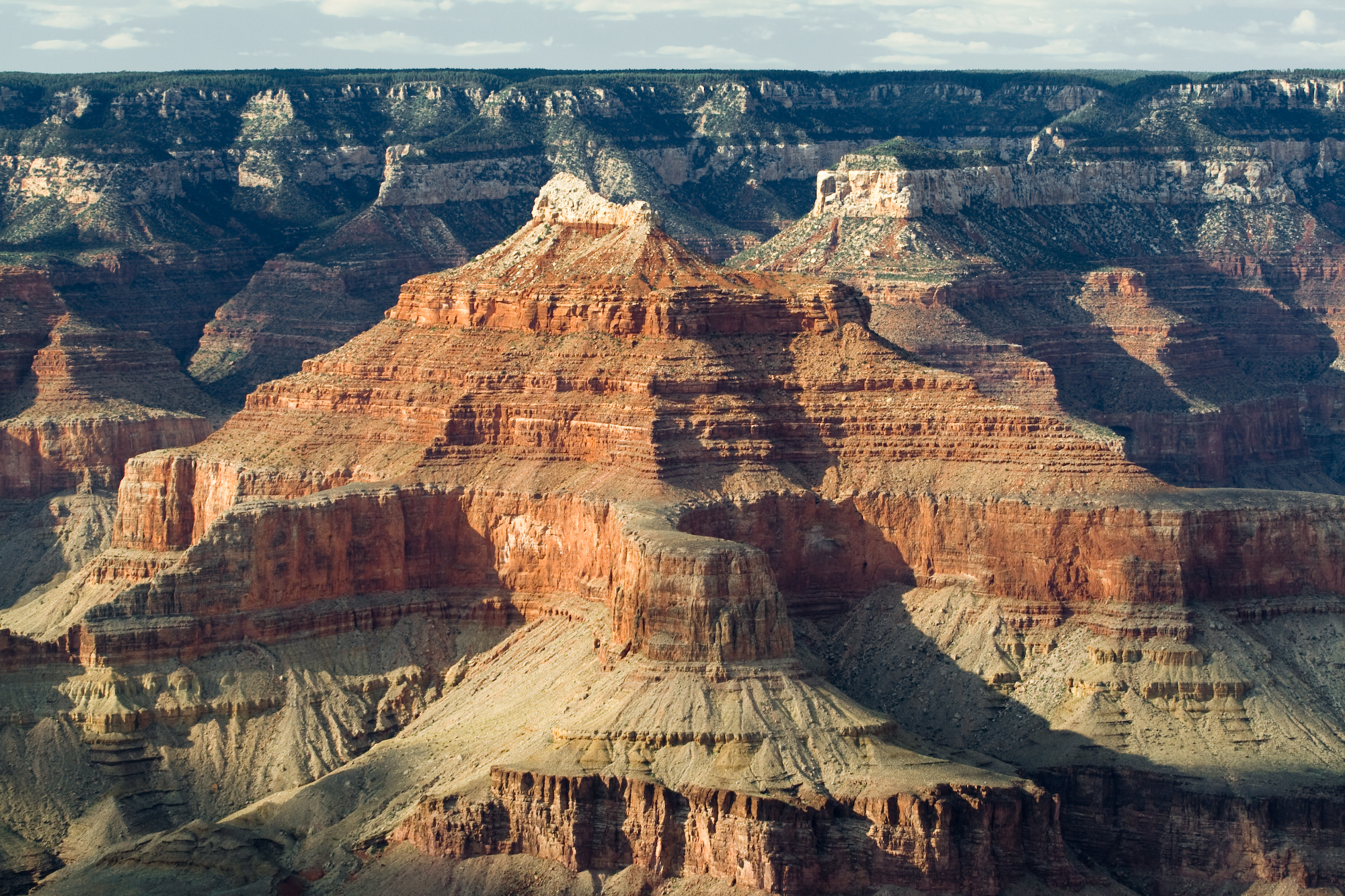
The Shinumo Quartzite also known as the Shinumo Sandstone is a Mesoproterozoic rock formation, which outcrops in the eastern Grand Canyon, Coconino County, Arizona (Northern Arizona). It is the 3rd member of the 5-unit Unkar Group. The Shinumo Quartzite consists of a series of massive, cliff-forming sandstones and sedimentary quartzites. Its cliffs contrast sharply with the stair-stepped topography of typically brightly-colored (orange, red, yellow, etc) strata of the underlying slope-forming Hakatai Shale. Overlying the Shinumo, dark green to black, fissile, slope-forming shales of the Dox Formation create a well-defined notch. It and other formations of the Unkar Group occur as isolated fault-bound remnants along the main stem of the Colorado River and its tributaries in Grand Canyon.
Typically, the Shinumo Quartzite and associated strata of the Unkar Group dip northeast (10°–30°) toward normal faults that dip 60+° toward the southwest. This can be seen at the Palisades fault in the eastern part of the main Unkar Group outcrop area (below East Rim).
The Shinumo Quartzite is a middle member of the Unkar Group. The Unkar Group is about 1,600 to 2,200 m (5,200 to 7,200 ft) thick and composed of, in ascending order, the Bass Formation, Hakatai Shale, Shinumo Quartzite, Dox Formation, and Cardenas Basalt.
The Unkar Group consists of a sequence of sedimentary rocks that accumulated in a variety of environments ranging from fluvial to shallow-marine. Overall, the strata within it are conformable with the exception of a significant disconformity between the Hakatai Shale and Shinumo Quartzite. The Unkar Group is overlain in ascending order by the Nankoweap Formation, about 113 to 150 m (371 to 492 ft) thick; the Chuar Group, about 1,900 m (6,200 ft) thick; and the Sixtymile Formation, about 60 m (200 ft) thick. The Unkar Group, as the base section of the Grand Canyon Supergroup, overlies deeply eroded granites, gneisses, pegmatites, and schists that comprise Vishnu Basement Rocks.
In sharp contrast to argillaceous strata above and below it, the Shinumo Quartzite consists predominately of beds of red, brown or purple sedimentary quartzites that are firmly, to extremely well cemented by silica, and characterized by poorly developed bedding. It also contains beds of massive white, red or purple sandstone and conglomeratic sandstone. One conglomeratic sandstone layer that lies about 21 m (69 ft) above the base of the Shinumo Quartzite near the South Kaibab trail contains jasper pebbles.
Typically, the Shinumo Quartzite has been subdivided into four poorly defined, unnamed members. First, the basal lower member consisting of purplish arkosic conglomeratic sandstone. Unlike the rest of the Shinumo Quartzite, it contains quartzite and granite gravels up to 5 cm (2.0 in) in diameter. As in the case of the Hotauta Conglomerate, the quartzite gravel of the lower member lacks any known equivalents in the Grand Canyon region.
Second, the lower-middle member is composed of purple cross-bedded quartzite, sometimes is subdivided into two units, and overlies the lower member. The purple quartzites of the lower-middle member exhibit crisp, well-defined reduction spots. Third, the upper-middle member is composed of "rusty red" quartzite and overlies the lower-middle member. The "rusty-red" quartzite of the upper-middle member grades downward into the lower-middle member through an interval of interbedded purple and red-brown quartzite. Their colors and cementation appear to be the result of ground or connate water alteration after their deposition.
Finally, the upper member of the Shinumo Quartzite is composed of reddish brown and locally purple sandstone and an overlying well-cemented gray quartzite. The Shinumo Quartzite is characterized as a quartzite, but the gray quartzite within the upper member of the Shinumo Quartzite contains mudstone-rich intervals. In addition, the gray quartzite was subjected to cementation by silica and bleaching that removed its original reddish brown and purple hematite pigments, after its deposition.
Basaltic sills and dikes intrude all formations of the Unkar Group below the Cardenas Lava. The Hakatai Shale, Shinumo Quartzite, and Dox Formation are intruded by these dikes. They can be traced, discontinuously, to within a few meters of the base of the Cardenas Lava.
The Shinumo Quartzite exhibits a variety of sedimentary structures. The sandstones of the lower and lower-middle members exhibit centimeter- to meter-scale planar tabular cross-stratification and trough cross-beds. These cross beds record north-directed paleocurrents along with subordinate bidirectional paleocurrents. The upper-middle member exhibits abundant cross beds, clay galls, and mudcracks. The sandstones of the upper member exhibit trough cross-beds, suggesting a more northerly transport direction. The sandstone and quartzite beds of the upper member exhibit an abundance of complexly contorted, gnarly bedded, fluid expulsion structures and dramatic convolute bedding. The beds that exhibit these soft-sediment deformation structures are meters- to tens-of-meters thick. They are cited as evidence for frequent earthquake activity and fluid migration during the deposition of the Shinumo Quartzite. These deformed beds can be seen at river level in the vicinity of Nevilles Rapid, (List of Colorado River rapids), at river mile 75.
Hub AI
Shinumo Quartzite AI simulator
(@Shinumo Quartzite_simulator)
Shinumo Quartzite
The Shinumo Quartzite also known as the Shinumo Sandstone is a Mesoproterozoic rock formation, which outcrops in the eastern Grand Canyon, Coconino County, Arizona (Northern Arizona). It is the 3rd member of the 5-unit Unkar Group. The Shinumo Quartzite consists of a series of massive, cliff-forming sandstones and sedimentary quartzites. Its cliffs contrast sharply with the stair-stepped topography of typically brightly-colored (orange, red, yellow, etc) strata of the underlying slope-forming Hakatai Shale. Overlying the Shinumo, dark green to black, fissile, slope-forming shales of the Dox Formation create a well-defined notch. It and other formations of the Unkar Group occur as isolated fault-bound remnants along the main stem of the Colorado River and its tributaries in Grand Canyon.
Typically, the Shinumo Quartzite and associated strata of the Unkar Group dip northeast (10°–30°) toward normal faults that dip 60+° toward the southwest. This can be seen at the Palisades fault in the eastern part of the main Unkar Group outcrop area (below East Rim).
The Shinumo Quartzite is a middle member of the Unkar Group. The Unkar Group is about 1,600 to 2,200 m (5,200 to 7,200 ft) thick and composed of, in ascending order, the Bass Formation, Hakatai Shale, Shinumo Quartzite, Dox Formation, and Cardenas Basalt.
The Unkar Group consists of a sequence of sedimentary rocks that accumulated in a variety of environments ranging from fluvial to shallow-marine. Overall, the strata within it are conformable with the exception of a significant disconformity between the Hakatai Shale and Shinumo Quartzite. The Unkar Group is overlain in ascending order by the Nankoweap Formation, about 113 to 150 m (371 to 492 ft) thick; the Chuar Group, about 1,900 m (6,200 ft) thick; and the Sixtymile Formation, about 60 m (200 ft) thick. The Unkar Group, as the base section of the Grand Canyon Supergroup, overlies deeply eroded granites, gneisses, pegmatites, and schists that comprise Vishnu Basement Rocks.
In sharp contrast to argillaceous strata above and below it, the Shinumo Quartzite consists predominately of beds of red, brown or purple sedimentary quartzites that are firmly, to extremely well cemented by silica, and characterized by poorly developed bedding. It also contains beds of massive white, red or purple sandstone and conglomeratic sandstone. One conglomeratic sandstone layer that lies about 21 m (69 ft) above the base of the Shinumo Quartzite near the South Kaibab trail contains jasper pebbles.
Typically, the Shinumo Quartzite has been subdivided into four poorly defined, unnamed members. First, the basal lower member consisting of purplish arkosic conglomeratic sandstone. Unlike the rest of the Shinumo Quartzite, it contains quartzite and granite gravels up to 5 cm (2.0 in) in diameter. As in the case of the Hotauta Conglomerate, the quartzite gravel of the lower member lacks any known equivalents in the Grand Canyon region.
Second, the lower-middle member is composed of purple cross-bedded quartzite, sometimes is subdivided into two units, and overlies the lower member. The purple quartzites of the lower-middle member exhibit crisp, well-defined reduction spots. Third, the upper-middle member is composed of "rusty red" quartzite and overlies the lower-middle member. The "rusty-red" quartzite of the upper-middle member grades downward into the lower-middle member through an interval of interbedded purple and red-brown quartzite. Their colors and cementation appear to be the result of ground or connate water alteration after their deposition.
Finally, the upper member of the Shinumo Quartzite is composed of reddish brown and locally purple sandstone and an overlying well-cemented gray quartzite. The Shinumo Quartzite is characterized as a quartzite, but the gray quartzite within the upper member of the Shinumo Quartzite contains mudstone-rich intervals. In addition, the gray quartzite was subjected to cementation by silica and bleaching that removed its original reddish brown and purple hematite pigments, after its deposition.
Basaltic sills and dikes intrude all formations of the Unkar Group below the Cardenas Lava. The Hakatai Shale, Shinumo Quartzite, and Dox Formation are intruded by these dikes. They can be traced, discontinuously, to within a few meters of the base of the Cardenas Lava.
The Shinumo Quartzite exhibits a variety of sedimentary structures. The sandstones of the lower and lower-middle members exhibit centimeter- to meter-scale planar tabular cross-stratification and trough cross-beds. These cross beds record north-directed paleocurrents along with subordinate bidirectional paleocurrents. The upper-middle member exhibits abundant cross beds, clay galls, and mudcracks. The sandstones of the upper member exhibit trough cross-beds, suggesting a more northerly transport direction. The sandstone and quartzite beds of the upper member exhibit an abundance of complexly contorted, gnarly bedded, fluid expulsion structures and dramatic convolute bedding. The beds that exhibit these soft-sediment deformation structures are meters- to tens-of-meters thick. They are cited as evidence for frequent earthquake activity and fluid migration during the deposition of the Shinumo Quartzite. These deformed beds can be seen at river level in the vicinity of Nevilles Rapid, (List of Colorado River rapids), at river mile 75.
Recent media