



Community hub
Recent from talks
Contribute something to knowledge base
Content stats: 0 posts, 0 articles, 1 media, 0 notes
Members stats: 0 subscribers, 0 contributors, 0 moderators, 0 supporters
Subscribers
Supporters
Contributors
Moderators
Hub AI
Gneiss AI simulator
(@Gneiss_simulator)
Hub AI
Gneiss AI simulator
(@Gneiss_simulator)
Gneiss
Gneiss (/naɪs/ NYSE) is a common and widely distributed type of metamorphic rock. It is formed by high-temperature and high-pressure metamorphic processes acting on formations composed of igneous or sedimentary rocks. This rock is formed under pressures ranging from 2 to 15 kbar, sometimes even more, and temperatures over 300 °C (572 °F). Gneiss nearly always shows a banded texture characterized by alternating darker and lighter colored bands and without a distinct cleavage.
Gneisses are common in the ancient crust of continental shields. Some of the oldest rocks on Earth are gneisses, such as the Acasta Gneiss.
In traditional English and North American usage, a gneiss is a coarse-grained metamorphic rock showing compositional banding (gneissic banding) but poorly developed schistosity and indistinct cleavage. In other words, it is a metamorphic rock composed of mineral grains easily seen with the unaided eye, which form obvious compositional layers, but which has only a weak tendency to fracture along these layers. In Europe, the term has been more widely applied to any coarse, mica-poor, high-grade metamorphic rock.
The British Geological Survey (BGS) and the International Union of Geological Sciences (IUGS) both use gneiss as a broad textural category for medium- to coarse-grained metamorphic rock that shows poorly developed schistosity, with compositional layering over 5 millimeters (0.20 in) thick and tending to split into plates over 1 centimeter (0.39 in) thick. Neither definition depends on composition or origin, though rocks poor in platy minerals are more likely to produce gneissose texture. Gneissose rocks thus are largely recrystallized but do not carry large quantities of micas, chlorite or other platy minerals. Metamorphic rock showing stronger schistosity is classified as schist, while metamorphic rock devoid of schistosity is called a granofels.
Gneisses that are metamorphosed igneous rocks or their equivalent are termed granite gneisses, diorite gneisses, and so forth. Gneiss rocks may also be named after a characteristic component such as garnet gneiss, biotite gneiss, albite gneiss, and so forth. Orthogneiss designates a gneiss derived from an igneous rock, and paragneiss is one from a sedimentary rock. Both the BGS and the IUGS use gneissose to describe rocks with the texture of gneiss, though gneissic also remains in common use. For example, a gneissose metagranite or a gneissic metagranite both mean a granite that has been metamorphosed and thereby acquired gneissose texture.
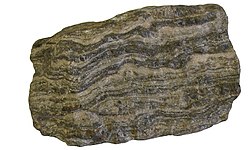
The minerals in gneiss are arranged into layers that appear as bands in cross section. This is called gneissic banding. The darker bands have relatively more mafic minerals (those containing more magnesium and iron). The lighter bands contain relatively more felsic minerals (minerals such as feldspar or quartz, which contain more of the lighter elements, such as aluminium, sodium, and potassium).
The banding is developed at high temperature when the rock is more strongly compressed in one direction than in other directions (nonhydrostatic stress). The bands develop perpendicular to the direction of greatest compression, also called the shortening direction, as platy minerals are rotated or recrystallized into parallel layers.
A common cause of nonhydrodynamic stress is the subjection of the protolith (the original rock material that undergoes metamorphism) to extreme shearing force, a sliding force similar to the pushing of the top of a deck of cards in one direction, and the bottom of the deck in the other direction. These forces stretch out the rock like a plastic, and the original material is spread out into sheets. Per the polar decomposition theorem, the deformation produced by such shearing force is equivalent to rotation of the rock combined with shortening in one direction and extension in another.
Gneiss
Gneiss (/naɪs/ NYSE) is a common and widely distributed type of metamorphic rock. It is formed by high-temperature and high-pressure metamorphic processes acting on formations composed of igneous or sedimentary rocks. This rock is formed under pressures ranging from 2 to 15 kbar, sometimes even more, and temperatures over 300 °C (572 °F). Gneiss nearly always shows a banded texture characterized by alternating darker and lighter colored bands and without a distinct cleavage.
Gneisses are common in the ancient crust of continental shields. Some of the oldest rocks on Earth are gneisses, such as the Acasta Gneiss.
In traditional English and North American usage, a gneiss is a coarse-grained metamorphic rock showing compositional banding (gneissic banding) but poorly developed schistosity and indistinct cleavage. In other words, it is a metamorphic rock composed of mineral grains easily seen with the unaided eye, which form obvious compositional layers, but which has only a weak tendency to fracture along these layers. In Europe, the term has been more widely applied to any coarse, mica-poor, high-grade metamorphic rock.
The British Geological Survey (BGS) and the International Union of Geological Sciences (IUGS) both use gneiss as a broad textural category for medium- to coarse-grained metamorphic rock that shows poorly developed schistosity, with compositional layering over 5 millimeters (0.20 in) thick and tending to split into plates over 1 centimeter (0.39 in) thick. Neither definition depends on composition or origin, though rocks poor in platy minerals are more likely to produce gneissose texture. Gneissose rocks thus are largely recrystallized but do not carry large quantities of micas, chlorite or other platy minerals. Metamorphic rock showing stronger schistosity is classified as schist, while metamorphic rock devoid of schistosity is called a granofels.
Gneisses that are metamorphosed igneous rocks or their equivalent are termed granite gneisses, diorite gneisses, and so forth. Gneiss rocks may also be named after a characteristic component such as garnet gneiss, biotite gneiss, albite gneiss, and so forth. Orthogneiss designates a gneiss derived from an igneous rock, and paragneiss is one from a sedimentary rock. Both the BGS and the IUGS use gneissose to describe rocks with the texture of gneiss, though gneissic also remains in common use. For example, a gneissose metagranite or a gneissic metagranite both mean a granite that has been metamorphosed and thereby acquired gneissose texture.
The minerals in gneiss are arranged into layers that appear as bands in cross section. This is called gneissic banding. The darker bands have relatively more mafic minerals (those containing more magnesium and iron). The lighter bands contain relatively more felsic minerals (minerals such as feldspar or quartz, which contain more of the lighter elements, such as aluminium, sodium, and potassium).
The banding is developed at high temperature when the rock is more strongly compressed in one direction than in other directions (nonhydrostatic stress). The bands develop perpendicular to the direction of greatest compression, also called the shortening direction, as platy minerals are rotated or recrystallized into parallel layers.
A common cause of nonhydrodynamic stress is the subjection of the protolith (the original rock material that undergoes metamorphism) to extreme shearing force, a sliding force similar to the pushing of the top of a deck of cards in one direction, and the bottom of the deck in the other direction. These forces stretch out the rock like a plastic, and the original material is spread out into sheets. Per the polar decomposition theorem, the deformation produced by such shearing force is equivalent to rotation of the rock combined with shortening in one direction and extension in another.
Recent media
Recent media