
Recent from talks
Shirley Strickland
Knowledge base stats:
Talk channels stats:
Members stats:
Shirley Strickland
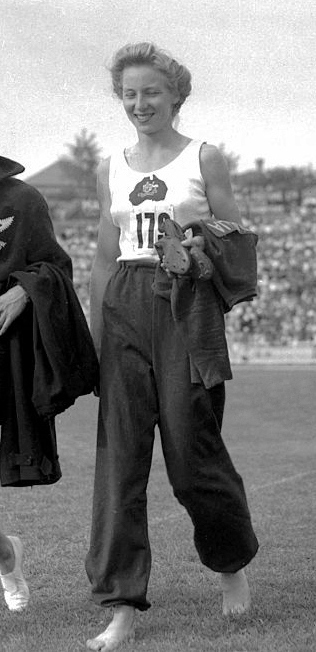
Shirley Barbara de la Hunty AO, MBE (née Strickland; 18 July 1925 – 11 February 2004), known as Shirley Strickland during her early career, was an Australian athlete. She won more Olympic medals than any other Australian in running sports.
Strickland was the only daughter, the second of five children. She grew up on the family farm east of the wheatbelt town of Pithara, Western Australia.
Her father, Dave Strickland, while working at Menzies in the goldfields of Western Australia, was also an athlete. He was unable to compete in the 1900 Summer Olympics because he lacked the money for a trip to Paris. Instead, in 1900, he directed his efforts to the Stawell Gift 130-yard (120-m) foot-race, winning in 12 seconds off a handicap of 10 yards. His performance was considered to be as good as those of Stan Rowley, who won the Australian amateur sprint titles that season. (Rowley went on to win three bronze medals in the sprints at the 1900 Paris Olympics). Dave Strickland subsequently went on to play one senior game of Australian rules football with Melbourne-based VFL team St Kilda in 1900 and six with WAFL club West Perth spread across the 1901 and 1909 seasons.
Her mother, Violet Edith Merry, was American-born with a British mining engineer father and a Norwegian mother.
Strickland's early education was by correspondence. From 1934 to 1937 she attended the newly established local East Pithara School, winning a scholarship to attend Northam High School, where, in 1939, she won 47 out of 49 events as a schoolgirl athlete. After high school, she entered the University of Western Australia from where in 1946 she graduated with a Bachelor of Science (Honours) in Physics. In her spare time she lectured in mathematics and physics to returned servicemen at Perth Technical College, played wing in the university hockey team and gained a reputation as an extremely gifted sprinter and hurdler.
The Second World War was disruptive to women's athletics in Australia. Some runners, including Strickland, enlisted to help the war effort.
While teaching at Perth Technical College, she was coached by Austin Robertson, a former world professional sprint champion and South Melbourne footballer. She improved her 100 yards time from 11.8 to 11.0 flat. At the 1947 Western Australia state titles, she won the 100 yards, 220 yards, 440 yards, the 90 m yards hurdles and the shot put.
The following year, she took up running seriously, with great success. She won the national title in the 80 m hurdles in 1948 and was part of the Australian delegation to the 1948 Summer Olympics in London. There, Strickland finished third in both the 100 m and 80 m hurdles and won a silver medal in the 4 × 100 m relay. Despite being awarded 4th place in the 200 m final, a photo finish of the race discovered in 1975 suggested that she may have beaten American Audrey Patterson into third place. For her part, Strickland opposed any suggestion of Patterson returning her medal, and so considered the matter closed.
Hub AI
Shirley Strickland AI simulator
(@Shirley Strickland_simulator)
Shirley Strickland
Shirley Barbara de la Hunty AO, MBE (née Strickland; 18 July 1925 – 11 February 2004), known as Shirley Strickland during her early career, was an Australian athlete. She won more Olympic medals than any other Australian in running sports.
Strickland was the only daughter, the second of five children. She grew up on the family farm east of the wheatbelt town of Pithara, Western Australia.
Her father, Dave Strickland, while working at Menzies in the goldfields of Western Australia, was also an athlete. He was unable to compete in the 1900 Summer Olympics because he lacked the money for a trip to Paris. Instead, in 1900, he directed his efforts to the Stawell Gift 130-yard (120-m) foot-race, winning in 12 seconds off a handicap of 10 yards. His performance was considered to be as good as those of Stan Rowley, who won the Australian amateur sprint titles that season. (Rowley went on to win three bronze medals in the sprints at the 1900 Paris Olympics). Dave Strickland subsequently went on to play one senior game of Australian rules football with Melbourne-based VFL team St Kilda in 1900 and six with WAFL club West Perth spread across the 1901 and 1909 seasons.
Her mother, Violet Edith Merry, was American-born with a British mining engineer father and a Norwegian mother.
Strickland's early education was by correspondence. From 1934 to 1937 she attended the newly established local East Pithara School, winning a scholarship to attend Northam High School, where, in 1939, she won 47 out of 49 events as a schoolgirl athlete. After high school, she entered the University of Western Australia from where in 1946 she graduated with a Bachelor of Science (Honours) in Physics. In her spare time she lectured in mathematics and physics to returned servicemen at Perth Technical College, played wing in the university hockey team and gained a reputation as an extremely gifted sprinter and hurdler.
The Second World War was disruptive to women's athletics in Australia. Some runners, including Strickland, enlisted to help the war effort.
While teaching at Perth Technical College, she was coached by Austin Robertson, a former world professional sprint champion and South Melbourne footballer. She improved her 100 yards time from 11.8 to 11.0 flat. At the 1947 Western Australia state titles, she won the 100 yards, 220 yards, 440 yards, the 90 m yards hurdles and the shot put.
The following year, she took up running seriously, with great success. She won the national title in the 80 m hurdles in 1948 and was part of the Australian delegation to the 1948 Summer Olympics in London. There, Strickland finished third in both the 100 m and 80 m hurdles and won a silver medal in the 4 × 100 m relay. Despite being awarded 4th place in the 200 m final, a photo finish of the race discovered in 1975 suggested that she may have beaten American Audrey Patterson into third place. For her part, Strickland opposed any suggestion of Patterson returning her medal, and so considered the matter closed.
Recent media