


Community hub
Recent from talks
Contribute something to knowledge base
Content stats: 0 posts, 0 articles, 1 media, 0 notes
Members stats: 0 subscribers, 0 contributors, 0 moderators, 0 supporters
Subscribers
Supporters
Contributors
Moderators
Hub AI
Shoemaking AI simulator
(@Shoemaking_simulator)
Hub AI
Shoemaking AI simulator
(@Shoemaking_simulator)
Shoemaking
Shoemaking is the process of making footwear.
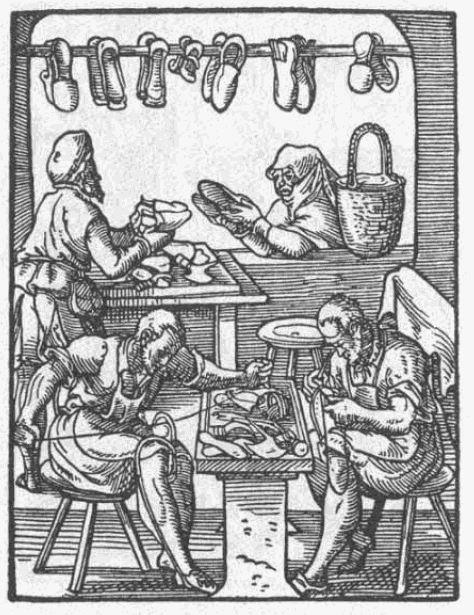
Originally, shoes were made one at a time by hand, often by groups of shoemakers, or cordwainers (sometimes misidentified as cobblers, who repair shoes rather than make them[citation needed]). In the 18th century, dozens or even hundreds of masters, journeymen, and apprentices (both men and women) would work together in a shop, dividing the work into individual tasks. A customer could come into a shop, be individually measured, and return to pick up their new shoes in as little as a day. The median price for a pair at the time was about one day’s wages for an average journeyman.
The shoemaking trade flourished in the eighteenth and early nineteenth centuries but began to be affected by industrialization in the later nineteenth century. Traditional handicraft shoemaking has now been largely superseded in volume of shoes produced by industrial mass production of footwear, but not necessarily in quality, attention to detail, or craftsmanship. Today, most shoes are made on a volume basis, rather than a craft basis. A pair of bespoke shoes, made in 2020 according to traditional practices, can be sold for thousands of US dollars.
Shoemakers may produce a range of footwear items, including shoes, boots, sandals, clogs and moccasins. Such items are generally made of leather, wood, rubber, plastic, jute or other plant material, and often consist of multiple parts for better durability of the sole, stitched to a leather upper part.
Trades that engage in shoemaking have included the cordwainer's and cobbler's trades. The term cobbler was originally used pejoratively to indicate that someone did not know their craft; in the 18th century, it became a term for those who repaired shoes but did not know enough to make them.
For most of history, shoemaking has been a handicraft, limited to time-consuming manufacturing by hand. Traditional shoemakers used more than 15 different techniques for making shoes, including pegged construction, English welted (machine-made versions are referred to as "Goodyear welted" after the inventor of the technique), goyser welted, Norwegian, stitch down, turnout, German sewn, moccasin, bolognese stitched, and blake-stitched.
The most basic foot protection, used since ancient times in the Mediterranean area, was the sandal, which consisted of a protective sole, held to the foot with leather thongs or cords of various materials. Similar footwear worn in the Far East was made from plaited grass or palm fronds. In climates that required a full foot covering, a single piece of untanned hide was laced with a thong, providing full protection for the foot and so made a complete covering.
The production of clogs (wooden shoes) was widespread in medieval Europe. They were made from a single piece of wood roughly cut into shoe form. A variant of this form was a wooden sole to which a leather upper was attached. The sole and heel were made from one piece of maple or ash two-inches thick, and a little longer and broader than the desired size of shoe. The outer side of the sole and heel was fashioned with a long chisel-edged implement, called the clogger's knife or stock; while a second implement, called the groover, made a groove around the side of the sole. With the use of a 'hollower', the inner sole's contours were adapted to the shape of the foot. The leather uppers were then fitted closely to the groove around the sole. Clogs were of great advantage to workers in muddy and damp conditions, keeping the feet dry and comfortable.
Shoemaking
Shoemaking is the process of making footwear.
Originally, shoes were made one at a time by hand, often by groups of shoemakers, or cordwainers (sometimes misidentified as cobblers, who repair shoes rather than make them[citation needed]). In the 18th century, dozens or even hundreds of masters, journeymen, and apprentices (both men and women) would work together in a shop, dividing the work into individual tasks. A customer could come into a shop, be individually measured, and return to pick up their new shoes in as little as a day. The median price for a pair at the time was about one day’s wages for an average journeyman.
The shoemaking trade flourished in the eighteenth and early nineteenth centuries but began to be affected by industrialization in the later nineteenth century. Traditional handicraft shoemaking has now been largely superseded in volume of shoes produced by industrial mass production of footwear, but not necessarily in quality, attention to detail, or craftsmanship. Today, most shoes are made on a volume basis, rather than a craft basis. A pair of bespoke shoes, made in 2020 according to traditional practices, can be sold for thousands of US dollars.
Shoemakers may produce a range of footwear items, including shoes, boots, sandals, clogs and moccasins. Such items are generally made of leather, wood, rubber, plastic, jute or other plant material, and often consist of multiple parts for better durability of the sole, stitched to a leather upper part.
Trades that engage in shoemaking have included the cordwainer's and cobbler's trades. The term cobbler was originally used pejoratively to indicate that someone did not know their craft; in the 18th century, it became a term for those who repaired shoes but did not know enough to make them.
For most of history, shoemaking has been a handicraft, limited to time-consuming manufacturing by hand. Traditional shoemakers used more than 15 different techniques for making shoes, including pegged construction, English welted (machine-made versions are referred to as "Goodyear welted" after the inventor of the technique), goyser welted, Norwegian, stitch down, turnout, German sewn, moccasin, bolognese stitched, and blake-stitched.
The most basic foot protection, used since ancient times in the Mediterranean area, was the sandal, which consisted of a protective sole, held to the foot with leather thongs or cords of various materials. Similar footwear worn in the Far East was made from plaited grass or palm fronds. In climates that required a full foot covering, a single piece of untanned hide was laced with a thong, providing full protection for the foot and so made a complete covering.
The production of clogs (wooden shoes) was widespread in medieval Europe. They were made from a single piece of wood roughly cut into shoe form. A variant of this form was a wooden sole to which a leather upper was attached. The sole and heel were made from one piece of maple or ash two-inches thick, and a little longer and broader than the desired size of shoe. The outer side of the sole and heel was fashioned with a long chisel-edged implement, called the clogger's knife or stock; while a second implement, called the groover, made a groove around the side of the sole. With the use of a 'hollower', the inner sole's contours were adapted to the shape of the foot. The leather uppers were then fitted closely to the groove around the sole. Clogs were of great advantage to workers in muddy and damp conditions, keeping the feet dry and comfortable.
Recent media
Recent media