Hubbry Logo
ClogClogMain
Open search
Clog
Community hub
Clog
logo
8 pages, 0 posts
0 subscribers
Be the first to start a discussion here.
Clog
Clog
from Wikipedia

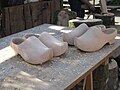
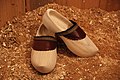
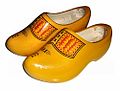
Klompen from the Netherlands

Clogs are a type of footwear that has a thick, rigid sole typically made of wood, although in American English, shoes with rigid soles made of other materials are also called clogs.[1][2]

Traditional clogs remain in use as protective footwear in agriculture and in some factories and mines. Although they are sometimes negatively associated with cheap and folkloric footwear of farmers and the working class, some types are considered fashion wear today, such as Swedish träskor or Japanese geta.

Clogs are also used in several different styles of dance, where an important feature is the sound they produce against the floor. Clog dancing is one of the fundamental roots of tap dancing, but with tap shoes the taps are free to click against each other and produce a different sound from clogs. Many modern brands produce clogs, most famously the American company Crocs.

Typology

[edit]
Wooden soled type English clogs
Overshoes type of clogs (pattens) with leather turnshoes (German), reconstruction of the Middle Ages

The Oxford English Dictionary defines a clog as a "thick piece of wood", and later as a "wooden soled overshoe" and a "shoe with a thick wooden sole".[3]

Welsh traditional clog maker Trefor Owen identified three main varieties of clogs: wooden upper, wooden soled and overshoes.[4]

  • Wooden upper clogs; are made by hollowing out a lump of solid wood to make a combined upper and lower. Two main variants can be seen:
    • whole foot clogs; where the wooden upper covers the whole of the foot to near the ankle, such as the Dutch klomp. They are also known as "wooden shoes". Whole foot clogs can give sufficient protection to be used as safety footwear without additional reinforcements.
    • half open clogs; where the wooden upper extends over the toes or slightly further, such as the Belgian sabots. The upper is similar in outline to a court shoe. Half open clogs may have additional covering or securing straps in some sort of fabric or leather.
  • Wooden soled clogs; use wood for the sole only. Wooden soled clogs come with a variety of uppers:
    • complete uppers made from leather or similar material, such as English clogs. For more protection, they may have steel toecaps and/or steel reinforcing inserts in the undersides of the soles
    • open sandal type fitting. For example, Japanese geta
    • toe peg styles. For example, Indian paduka
  • Overshoes; are wooden soles with straps designed to be worn over other footwear for protection, commonly known as pattens. Patten style clogs are not used anymore. However the derivative galoshes are common worldwide.

These divisions are not fixed: some overshoes look more like whole foot clogs, like Spanish albarca, whilst other wooden soled clogs raise and protect clothing in the way that overshoes do, such as Japanese geta.

The type of upper determines how the clogs are worn. Whole foot clogs need to be close fitting and can be secured by curling the toes. In contrast wooden soled clogs are fastened by laces or buckles on the welt and therefore the toes are relaxed as in shoes. Half open clogs may either be secured like whole foot clogs, or have an additional strap over the top of the foot. Some sandal types, and in particular toe peg styles, are worn more like "flip-flops" and rely on the grip between the big and next toe.

Flexing the foot

[edit]

As they are primarily made from wood, clogs cannot flex under the ball of the foot as softer shoes do. To allow the foot to roll forward most clogs have the bottom of the toe curved up, known as the cast.[5] Some styles of clogs have "feet", such as Spanish albarca. The clog rotates around the front edge of the front "feet". Some Japanese and Indian clogs have "teeth" or very high pegs attached to the soles. The clog can rotate around the front edge of the front "tooth" as the wearer strides forward. Some medieval pattens were in two pieces, heel through to ball and ball to toes. Joining the two was a leather strip forming a hinge, thus allowing the shoe above to flex.[6] Klompen may have a carefully placed ease (space left around the foot), which allows the foot to bend, and the heel to lift within or out of the clog. Thick, springy wool socks provide flexibility in the fit.

History

[edit]
Clogs in a 1400s painting
In this 1883 painting by Fritz von Uhde painted in the Dutch town of Zandvoort, clogs are shown to be the 19th century townspeople's normal footwear.

The use and prevalence of wooden footwear in prehistoric and ancient times is uncertain, owing both to the ambiguity of surviving records and the difficulty of both preserving and recognizing its remains. Used clogs also tended to be repurposed as firewood.[citation needed]

Some ancient Greeks apparently wore kroúpezai (κρούπεζαι) made of wood. These were known to the Romans as sculponeae.[7] Both the Greeks and Romans also made sandals by attaching leather straps to wooden soles in various ways.[7]

The ancient Chinese wore wooden () by at least the Han dynasty, when a form decorated with colorful ribbons and designs was used by women on their wedding days. Under the Jin, a different style shaped the entire shoe from a single piece of wood and, after the Tang, the southern Chinese wore "boot clogs" (, xuējī). Also in Japan and Korea, there are wooden shoes called geta (下駄) and namaksin (나막신).

The oldest wooden footwear so far recovered in Europe was found at Amsterdam and Rotterdam in the Netherlands. These date from c. 1230 and c. 1280[8] and looked very similar to the wooden shoes still worn in the area.[citation needed] By about this era, wooden pattens were being used as overshoes to protect the wearer's hose and indoor shoes when walking outside, particularly in inclement weather. Some shoes then began directly incorporating the wooden platform into their soles, like the Venetian chopines.

Manufacture

[edit]

Since wooden footwear was a hand-made product, the shape of the footwear, as well as its production process showed great local and regional diversity in style. At the beginning of the 20th century machine-made wooden footwear was introduced. After WW2, in particular, wooden shoes became uncommon. They were replaced by more fashionable all-leather and synthetic footwear. At present, only the so-called Swedish clogs (wooden bottom and leather top) is still seen as a trendy fashion item, often as ladies' high-heeled boots. Nevertheless, traditional wooden footwear is still popular in several regions in Europe and in some occupations, for its practical use. Some historic local variations have recently been replaced by uniform national models.[citation needed]

More information on the various methods of manufacture can be found from the gallery below.

[edit]

Presented below are typical clogs from the countries where they are found. Like many folk items, the boundaries of manufacture and use are regional and therefore do not always exactly follow those of modern states. So, in some countries two or more different types can be found. It is also possible that one type can be found in bordering countries. For example, Danish, German, Dutch, Belgian and clogs from Northwest France look quite similar. The links provide access to pages dealing with the different types of clog, their design, origin and manufacture.

Traditional European clogs

[edit]

Traditional Asian clogs

[edit]

Fashion clogs

[edit]
Platform-sandal clog, with cork insole and rubber sole

In the 1970s and 1980s, Swedish clogs became popular fashion accessories for both sexes. They were usually worn without socks and were considered suitable attire for the avant-garde man.

In the 1980s and 1990s, clogs based on Swedish clogs returned in fashion for women. Platform clogs or sandals, often raised as high as 6 or even 8 inches right through between sole and insole, were worn in many western countries. The large mid layer was often made of solid cork, although some were merely of plastic with a cork covering. The sole, more often than not, was made of a light sandy-colored rubber.

In 2007, Dutch designers Viktor & Rolf introduced high heeled Dutch clogs on the catwalk, with their winter collection of 2007/08.[9][10] In 2010, Swedish clogs for women returned again in Chanel's and Louis Vuitton's Spring / Summer 2010 collection.[11]

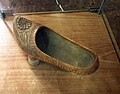
Museums

[edit]
World's biggest clog from one piece of wood, in Enter (Netherlands)

See also

[edit]

References

[edit]

Sources

[edit]
[edit]
Revisions and contributorsEdit on WikipediaRead on Wikipedia
from Grokipedia
A clog is a type of featuring a rigid sole, traditionally carved from a single piece of wood such as , , or poplar, often combined with uppers for the foot enclosure and reinforced with metal strips known as "cokers" to enhance durability. Designed primarily for practicality, clogs elevate the wearer above wet, muddy, or contaminated ground, making them essential for laborers in , factories, and mills. While their form varies by region—such as the fully enclosed Dutch klompen or the open-backed British styles—clogs remain symbols of working-class heritage and have evolved into items of cultural and significance worldwide. The origins of clogs trace back to medieval Europe, with the earliest known examples appearing in the around the early , where they served as protective gear for farmers, artisans, and factory workers navigating marshy terrains and industrial hazards. In Britain, clogs emerged by 1326 in areas like , , influenced by Flemish weavers in the 14th century, with Edward III encouraging their settlement to boost the . These shoes were crafted using simple tools—a , hammer, and chisel—to shape the wood, with production scaling up in the 19th century; for instance, one factory in northern produced over 862,000 pairs of clog soles in 1911 alone. Beyond Europe, similar wooden footwear appeared in ancient civilizations, including Egyptian and Roman platforms, but the modern clog's design solidified in as an affordable, waterproof alternative to shoes. Culturally, clogs hold enduring importance, particularly in the , where they are national symbols hand-carved by specialists called klompenmakers and still used in traditional festivals, farming, and even modern safety contexts like foundries. As of 2023, only about 10 traditional clog makers remain, underscoring efforts to preserve this craft. In Britain, clogs fostered traditions like , a percussive performed with metal-tipped soles to create rhythmic sounds, originating among mill workers in the and persisting in competitive events today. Economically, they were inexpensive—men's clogs cost about 2 shillings and 11 pence in 1900, equivalent to approximately £24 (2024 values)—allowing widespread adoption among the until synthetic alternatives reduced their necessity post-World War II. In contemporary times, clogs have transcended their utilitarian roots, inspiring revivals with brands producing versions in , rubber, and cork for comfort and style, as seen in the spring/summer 2024 trends drawing from their historical silhouettes. Artisanal production continues in places like , , where firms such as Walkleys have crafted clogs since 1946, and in the , where approximately 3 million pairs are made annually, mostly as souvenirs (as of 2023). This evolution underscores clogs' versatility, blending heritage craftsmanship with modern ergonomics to appeal to diverse users from healthcare professionals to enthusiasts.

Types and Variations

Traditional European Clogs

Traditional European clogs, known by various regional names, represent a diverse array of wooden developed primarily for practical use in rural and industrial settings across the . These shoes typically feature a carved wooden sole and sometimes uppers made of or fabric, designed to provide durability and protection in harsh environments. Originating from , they evolved through the 17th and 18th centuries to meet the needs of agricultural and emerging industrial laborers, with regional adaptations reflecting local materials, terrains, and occupations. In the , clogs called klompen are among the most iconic, traditionally carved from softwoods like poplar, , or to allow for hollowing out the interior. These one-piece shoes often have an upturned toe to facilitate drainage in the wet, marshy lowlands, preventing water accumulation during farming or extraction. diggers' klompen featured broader, squarer toes to avoid sinking into soft , while general versions emphasized lightness and comfort for daily rural labor. French sabots, by contrast, are typically lower-cut and less enclosed than Dutch styles, making them suitable for vineyard work and other agricultural tasks in regions like and the . Crafted from or wood, sabots provided essential protection for peasants' feet against and rough from the onward, with their open-backed design allowing quick removal in warm weather. These clogs were associated with rural lower classes and became widespread in farming communities by the . British clogs, particularly the Lancashire style prevalent in northern England, combined wooden soles with leather uppers and were reinforced with iron or brass toe plates to withstand the abrasive factory floors of textile mills. Adopted by Flemish weavers during the Industrial Revolution, these clogs peaked in use from the 1840s to 1920s, offering grip and impact resistance for workers in cotton mills, mines, and ironworks during the Industrial Revolution, particularly from the 19th century. The metal plates not only extended wear but also contributed to the rhythmic sounds that inspired early forms of clog dancing. In , träskor are lightweight clogs carved from or wood, tailored for rural use in forested and agricultural areas of the . Their simple, one-piece construction prioritized mobility for farmers and workers, with a curved sole for stability on uneven ground. These clogs, part of traditional folk attire, emphasized and ease of movement in daily chores. Common design elements across these European variants include soles 2 to 4 inches thick to elevate the foot above mud and wet soil, reducing the risk of blisters and infections in damp conditions. Many incorporated upper straps or bindings for secure fit, while some, such as Belgian clogs, featured painted floral motifs for decorative flair during festivals or as markers of regional identity. Overall, these clogs served critical roles in industries like farming, , and textiles from the , shielding workers from moisture, sharp tools, and heavy machinery.

Traditional Asian Clogs

Traditional Asian clogs represent a distinct category of elevated wooden developed independently across the continent, primarily to elevate the wearer above wet, muddy, or contaminated ground in humid climates, contrasting with the more enclosed European designs adapted for industrial labor. These clogs typically feature open structures with raised platforms or teeth, allowing air circulation and ease of removal, and were integral to daily life, rituals, and social hierarchy in agrarian societies. Their origins trace back to ancient , where wooden clogs known as (屐) were documented as early as the (206 BCE–220 CE), with evidence of use in southern regions by the 6th century during the for practical elevation in rice paddies and urban settings. In , early forms evolved into jiaoxie, open-backed wooden mules favored by urban women during the Tang (618–907 CE) and Song (960–1279 CE) dynasties for their simplicity and ability to keep silk garments clean from street filth. These clogs were crafted from lightweight woods like or , often with low platforms of 2–4 inches to navigate paths without direct ground contact, and secured by cord straps or simply slipped on. By the Ming (1368–1644 CE) and Qing (1644–1912 CE) periods, variations included higher platforms for elite women, symbolizing modesty and status while integrating with flowing robes. Japanese geta exemplify the elevated platform style, consisting of a wooden base with protruding "teeth" (typically two or three) and a hanao thong strap passing between the toes, worn over tabi socks. Originating from Chinese influences in the 6th century and refined during the Heian period (794–1185 CE), geta reached their peak popularity in the Edo period (1603–1868), serving both hygienic purposes by preventing foot immersion in sewage-filled streets and fashionable roles through ornate lacquering and height variations. Standard geta platforms measure 3–5 inches, but specialized okobo for geisha and apprentice maiko feature heights up to 8 inches, made from lightweight paulownia wood for balance during performances, with the elevated design forcing a graceful, shuffling gait that complemented kimono attire. Korean namakshin (or wooden hwa variants) mirror geta in function, with a flat wooden sole raised on two to four teeth for stability in rainy, muddy conditions, often reinforced with metal nails or bands at the edges to prevent splitting during use in dynasty (1392–1910 CE) rice fields. Crafted from basswood or pine for durability and lightness, these clogs typically have platforms of 4–6 inches, secured by fabric straps, and were essential for farmers and commoners to keep hems dry during monsoons. Historical records from the Joseon era highlight their role in everyday , as the elevation avoided direct contact with contaminated soil. In , guốc mộc (wooden clogs) served similar practical needs in tropical wetlands, with thick or platforms of 2–5 inches designed for wading through flooded paddies, rooted in ancient rural traditions, with early references dating to the CE. These open-toed clogs, often strapped with braided or leather, protected feet from leeches and mud while allowing quick drying, and were a staple for both men and women until the mid-20th century. Culturally, they symbolized resilience in agrarian life and were paired with áo dài for festivals, underscoring protection from monsoons as a core function across Asian variants. Across these traditions, materials emphasized lightness and water resistance—paulownia for Japanese geta due to its low density and mold resistance, basswood for Korean namakshin for its softness and affordability, and bamboo for Vietnamese guốc to flex without cracking in humidity. Attachments varied from simple thong cords in geta to nailed reinforcements in namakshin for added stability on uneven terrain. In feudal Japan, tall geta like okobo became status symbols for geisha, elevating their stature literally and figuratively during Edo-period entertainments, while in China and Korea, clogs denoted social class through embellishments like inlays or height, always integrated with traditional attire to preserve cleanliness and decorum.

Modern and Fashion Clogs

In the , clogs experienced a significant revival in Western , transitioning from utilitarian to bohemian-inspired style statements characterized by wooden platforms and colorful uppers, often paired with flared jeans and ethnic prints. This period marked clogs' entry into mainstream leisure wear, influenced by movements and designers experimenting with retro elements. Birkenstock's clog, introduced in 1979, exemplified this shift with its contoured cork footbed and straps, gaining popularity among urban professionals and later in the 1990s scene for its casual versatility. By the 1990s, high-fashion adaptations elevated clogs further, with incorporating exaggerated platform soles inspired by traditional Japanese clogs into her punk-infused runway collections, blending historical references with fetishistic heights up to 12 inches. These designs, often featuring resin or wooden bases with uppers, appealed to subcultures and avant-garde audiences, setting the stage for clogs' commercialization in department stores and youth fashion. Contemporary clogs emphasize and customization, incorporating recycled wood, cork-latex footbeds from renewable sources, and vegan materials like upcycled to align with post-2010s environmental priorities. Brands such as Stegmann produce eco-wool clogs with over 90% renewable components, while has integrated 25% bio-circular content—derived from like cooking oils—into its foam models by 2024, reducing reliance on fossil fuels. Customizable options, including metallic accents and adjustable heels, appear in runway shows, with foam-wood hybrids echoing ' slip-on ease but adding artisanal wooden elements for elevated aesthetics. Key trends include clogs' integration into streetwear and festival attire, such as platform styles at Coachella paired with boho outfits for all-day comfort on uneven terrain. Health-oriented orthopedic variants, like Dansko's slip-resistant models with arch support, dominate nursing wardrobes, endorsed by healthcare professionals for reducing foot fatigue during long shifts. Celebrity endorsements, including Kendall Jenner and Rihanna sporting chunky clogs, have fueled 2020s TikTok-driven popularity of pastel-hued versions, amplifying their casual appeal. As of 2025, trends continue to focus on eco-friendly materials and versatile designs. The global clogs market, propelled by these innovations, reached an estimated $8.69 billion in 2025, reflecting sustained demand for versatile, eco-conscious footwear.

Design and Functionality

Construction Materials

Clogs are primarily constructed from wood, chosen for attributes like durability, lightness, and resistance to environmental factors, with selections varying by region and era. In traditional European clogs, such as French sabots, hardwoods like beech (Fagus sylvatica) are commonly used due to their durability and water resistance after treatment. Beech wood has a density ranging from 0.7 to 0.9 g/cm³, offering stability and shock resistance that supports prolonged wear in demanding conditions. Softwoods like willow (Salix spp.) provide lightweight alternatives, with densities around 0.4 g/cm³, facilitating easy carving while maintaining flexibility for everyday use in designs like Dutch klompen. In traditional Asian clogs, such as Japanese geta, local woods like paulownia (Paulownia tomentosa) are selected for their exceptionally low weight, with densities of 0.24 to 0.3 g/cm³, enabling elevated platforms without excessive burden on the wearer. These materials ensure minimal fatigue during prolonged standing or walking on uneven surfaces. Supplementary materials enhance functionality and comfort. or fabric uppers secure the foot to the wooden sole, as in British clogs where thick straps provide binding and protection. Metal reinforcements, including iron nails or bands embedded in the soles, improve grip on slippery terrains and extend the shoe's lifespan against abrasion. Modern clogs incorporate synthetics like EVA foam for cushioning, often layered beneath or within the sole to absorb impact and improve without compromising the traditional wooden base. Key material properties include controlled moisture absorption; treated woods used in clogs, such as oiled or varnished , limit water uptake to under 10% by weight, reducing risks of swelling or cracking in wet environments. Sourcing practices have evolved historically, with 17th-century European clogs relying on local hardwoods like and from regional forests, while Asian production primarily used locally available woods. In the , sustainable certifications, such as those from the established in 1993, guide wood procurement to mitigate impacts associated with global demand for clog production.

Anatomical Adaptations

Traditional clogs incorporate a curved sole design, often featuring an upward curve at the toe known as the "cast," which enables the foot to roll forward during gait without requiring the rigid wood to bend. This mechanism facilitates natural ankle pivoting and promotes a smoother walking motion, particularly in designs like Dutch klompen where the rocker sole mimics the biomechanics of barefoot progression. Key anatomical features enhance comfort and functionality. The loose interior fit allows space for toe splay and accommodates thick woolen socks, minimizing friction and preventing blisters during prolonged wear on uneven terrain. Elevated heels, typically raised by 3-5 cm, help reduce strain on the foot's arch by altering weight distribution and supporting forward propulsion. While traditional wooden clogs lack perforations, their loose construction permits some air circulation for breathability, keeping feet drier than fully enclosed leather alternatives. Elevated heels, typically raised by 3-5 cm, help reduce strain on the foot's arch by altering weight distribution and supporting forward propulsion. While traditional wooden clogs lack perforations, their loose construction permits some air circulation for breathability, keeping feet drier than fully enclosed leather alternatives. Ergonomically, the inherent rigidity of the wooden sole acts as a natural , distributing impact forces across the foot and reducing stress on joints during labor-intensive activities. Traditional designs, such as those for , provide inherent support through contoured interiors that align the foot's natural shape without added . For specialized uses like dancing, Lancashire clogs include metal reinforcements along the sole to the and , enabling precise, rhythmic steps in heel-and-toe routines without structural failure. Biomechanically, the loose fit induces a forward slide of the foot on push-off, which aids while the raised and rocker curve maintain balance. In modern orthopedic variants developed in the late , removable inserts were introduced to bolster arch support, adapting classic designs for therapeutic use in conditions like .

Historical Development

Origins in

The earliest archaeological evidence of clogs in comes from the , where wooden shoes dating to the 13th century have been preserved in bogs, such as those in the province of . These finds, often made from , represent some of the oldest surviving examples of one-piece wooden in the region and indicate practical use by local communities. Clogs likely evolved from earlier medieval overshoes known as pattens, which were worn across from the to elevate the feet above mud and water, with wooden or cork soles strapped over regular shoes. In the marshy , clogs served primarily as protective footwear for peasants and workers navigating wet farmlands and bogs, offering durability and insulation from the damp terrain. By the , production had become established in areas like , where clog makers catered to agricultural and artisanal needs, though formal organization emerged later. The term "sabot," referring to similar wooden shoes, appears in French contexts by the early , reflecting their adoption among rural laborers in northern and western . During the , clogs gained wider popularity in the amid an agrarian economy, spreading through regional networks to neighboring areas like , where their use expanded rapidly in the late 15th and early 16th centuries. The first clog makers' was founded in the in 1570, regulating craftsmanship and quality. In , documentation of clogs appears in the , coinciding with the establishment of the first makers' association and their adoption in emerging industrial settings like textile mills.

Global Spread and Evolution

During the , European migration facilitated the spread of clogs to , where Dutch and other immigrants introduced wooden footwear traditions adapted for agricultural and industrial labor. In the United States, settlers from the and surrounding regions brought klompen-style clogs, which were used by farmers and workers in rural communities, evolving into practical overshoes for muddy terrains. Cross-continental influences emerged in the through colonial trade and cultural exchange. Industrialization transformed clog production in the late in , shifting from artisanal carving to mechanized processes, enabling greater output for export and domestic use. This era saw clogs evolve from handcrafted items to standardized worker attire, with guilds regulating quality amid rising demand from urban factories. In , clog-making guilds supported production of for both local and international markets. During , wooden clogs saw widespread wartime use across occupied , including the , , and , as leather rationing prompted governments to promote wood-based alternatives for civilians and laborers, conserving resources while maintaining mobility. Post-war years brought a decline in traditional clog use due to synthetic materials and , but a revival occurred in the amid the movement, where clogs symbolized earthy, anti-establishment values. Swedish and Dutch klompen inspired bohemian fashion, with platforms and leather uppers becoming staples at festivals, paired with flowing skirts for comfort and cultural nod to pre-industrial simplicity. In , sabot-making contributed to rural traditions preserved through cultural efforts.

Manufacturing Processes

Traditional Techniques

The traditional techniques for crafting clogs emphasized manual labor and specialized skills, primarily using blocks that were easier to shape than seasoned timber. Artisans began the process by cutting the wood into suitable blocks, often dipping them in to prevent splintering during initial shaping. Using an , large chunks were removed to form the basic outline of the sole, followed by a stock knife or specially shaped clog knife to refine the exterior contours and create a deep notch for the . The interior was then hollowed out with gouges or knives to accommodate the foot, a step that required precision to ensure comfort and durability. For Dutch klompen, this hand-carving phase could be completed by skilled makers in as little as 10 minutes per pair for the rough shaping, though the full detailing and identical pairing demanded greater time and expertise. Assembly varied by clog type: one-piece wooden clogs like basic klompen required no additional attachment, but those with uppers—such as or straps—were secured using wooden pegs driven into pre-drilled holes or hand-stitched along the edges. In designs featuring raised toe curls, such as certain European overshoes, the curls were formed by turning the wood on a simple before integration. Finishing involved smoothing the surfaces by hand-sanding or grinding to achieve even and comfort, with quality checks ensuring balanced soles to prevent uneven wear. The clogs were then treated with boiled , which penetrated the wood to provide and enhance longevity, often applied in multiple coats after an initial drying period of several weeks to allow the wood to season fully. Professionals verified the pair's by weighing and testing the balance before completion. Essential tools included the adze for roughing, crook knives or hooked carving blades for detailed hollowing—known as the sabotier's crook in French traditions—and specialized clog knives with ergonomic handles for prolonged use. These implements were honed daily to maintain sharpness, as dull edges could splinter the soft woods like poplar, willow, or alder commonly used. Skills were passed down through apprentice systems within 18th-century European craft guilds, where young trainees spent years observing and assisting masters, learning to judge wood grain and anticipate shaping challenges. Guild regulations often mandated rigorous training to uphold quality, with apprentices progressing from rough cutting to full carving under supervision. Regional variations highlighted local adaptations in these techniques. In , lathe-turning elements were incorporated into clog production from the onward, allowing for symmetrical soles carved from or blocks, often combined with hand-finishing for rural wear. Japanese geta production focused on hand-sanding the or cedar soles extensively to achieve a smooth, polished surface that ensured quiet, stable movement on floors, with the teeth () carved separately and pegged in place. These methods prioritized functionality and regional wood properties, fostering a deep artisanal heritage before widespread .

Contemporary Production

Contemporary production of clogs emphasizes industrialized techniques that enhance precision, speed, and , building on traditional foundations while prioritizing for global markets. Since the late , mechanized processes have revolutionized , particularly for wooden and hybrid designs. CNC milling, introduced in the , enables automated carving of wooden soles with high accuracy, significantly reducing production time compared to manual methods; for instance, brands like Mohop employ CNC machines to shape blocks into uniform clogs in a fraction of the time required by hand-carving. Injection molding has become standard for plastic and hybrid soles, as seen in ' process where molten Croslite material is injected into molds under high pressure, allowing for rapid cooling and ejection to produce lightweight, durable components. Laser-cutting technology further streamlines upper fabrication, precisely trimming or fabric materials for intricate patterns without waste, as utilized by innovative producers like Mohop for footbed and strap assembly. Innovations in the and beyond have integrated digital tools to address customization and environmental concerns. facilitates rapid prototyping of custom-fit clogs, with companies like adopting it since the late 2000s to create functional models that mimic final product materials, cutting development time to as little as 1.5 days per style and enabling ergonomic testing. Sustainable practices include uppers with natural pigments extracted from plant sources, such as Acacia nilotica bark, which offers eco-friendly coloration for while minimizing chemical runoff in production. leverages CAD simulations to virtually assess fit, stress points, and material performance, ensuring defects are identified pre-manufacturing and supporting consistent output in complex designs. Large-scale operations dominate contemporary output, with factories in and handling substantial volumes for international brands amid rising demand. For example, Crocs suppliers like Deran in these regions produce up to 400,000 pairs monthly, contributing to the global clogs market's projected value of over $9 billion by 2033. Brands such as Sanita incorporate semi-automated assembly in European facilities while maintaining hand-finishing for professional-grade clogs. Post-2005, a notable shift toward eco-materials has occurred, with FSC-certified wood—sourced from responsibly managed forests—gaining prominence in wooden clogs from producers like Plakton and Kurier to reduce impacts. This transition, alongside efficiencies, has lowered costs for factory-produced clogs compared to handmade pairs, broadening accessibility. As of 2025, further advancements include AI-driven optimization in CNC milling for and design iterations, as well as the use of bio-based resins in injection molding to enhance in brands like .

Cultural and Social Impact

Traditional Roles and Symbolism

In pre-modern European societies, clogs served critical occupational roles, particularly for laborers exposed to harsh, wet environments. Farmers in the and Britain relied on wooden-soled clogs to navigate muddy fields and marshy lands, providing durable protection against soil and water that would otherwise soak through . In mining communities, clogs were equally vital; for instance, women working at the surface of 19th-century pits wore clogs for protection near machinery. These practical attributes made clogs indispensable for manual trades, emphasizing their function as tools for survival in agrarian and industrial labor. Across , wooden footwear like geta fulfilled both utilitarian and performative roles, notably in Japanese geisha processions during the (1603–1868). and their apprentices wore elevated geta, whose distinctive clacking sound against the ground announced their presence and signified their elevated social and artistic status within entertainment districts. This auditory element not only aided navigation on uneven streets but also reinforced hierarchical distinctions, as the rhythmic noise evoked refinement and tradition. In , đội guốc—traditional wooden clogs—were integral to rural life, worn by farmers during agricultural activities to traverse flooded rice paddies, symbolizing resilience in wet, tropical conditions. Socially, clogs often denoted class and occasion, with variations in design reflecting societal strata. In 17th-century , plain, unadorned geta were standard for common laborers, while lacquered or intricately decorated versions were reserved for nobility and courtesans, underscoring sumptuary-like customs that linked footwear to rank during the Edo era. Similarly, in 16th-century , broader sumptuary laws under monarchs like Charles IX restricted luxurious attire and accessories to the nobility, preventing lower classes from mimicking elite styles and maintaining visible social boundaries. In Dutch folklore, clogs carried romantic symbolism; a suitor would hand-carve a pair for his intended, often embellished with motifs of love and fertility, and if she wore them the next day, it signaled acceptance of his proposal, blending practical footwear with matrimonial rites. Clogs also integrated into cultural rituals and performances, embedding deeper symbolic meanings. In 19th-century Ireland, céilí gatherings featured rhythmic stomping and step dances with percussive elements that evolved from traditional wooden-soled footwear, fostering community bonds through synchronized movements that celebrated heritage amid social gatherings.

Revival in Arts and Fashion

In the late 20th century, clog dancing experienced a notable revival in American performing arts, particularly through folk festivals in the Appalachian region. Groups like the Green Grass Cloggers, founded in 1971 at East Carolina University in Greenville, North Carolina, played a pivotal role in this resurgence by blending traditional English clog steps with local Appalachian rhythms, Irish jigs, and African influences to create innovative routines that attracted wider audiences. This revival gained momentum in the 1970s, with performances at events like the National Folk Festival, helping to preserve and evolve the form amid a broader interest in folk traditions. Theatrical applications of clogs also saw renewed interest on Broadway stages during the 1980s, often within revues celebrating American heritage. Productions such as the American Dance Machine (revived in 1981) featured segments like the "Clog and Grog Dance" from the 1967 musical Walking Happy, showcasing percussive wooden-soled steps that highlighted clogging's rhythmic vitality. Similarly, Mikhail Baryshnikov's 1980 television special Baryshnikov on Broadway included a dynamic clog performance, bridging with folk elements and exposing the style to mainstream viewers. Clogs reemerged in fashion during the mod subculture in , where platform versions with wooden soles became symbols of youthful rebellion and continental flair, often paired with miniskirts and bold patterns in the city's swinging scene. By the 1990s, amid the movement, floral-painted wooden clogs gained popularity as casual, bohemian accessories, with brands like —introduced in the early 1990s—offering styles that echoed DIY aesthetics and environmental consciousness. In the 2020s, sustainable fashion has further propelled clogs, as designers incorporate eco-friendly wood and vegan materials to promote principles. Media representations have contributed to this cultural reinvention, with clogs appearing in films and music videos that stylize traditional forms for contemporary narratives. In music, 2010s videos occasionally featured stylized geta-inspired clogs, as seen in performances blending Japanese heritage with modern to evoke exotic, rhythmic motifs. Post-2000, workshops in the have revived hand-carving techniques for artistic purposes, producing clogs for installations that explore themes of heritage and craftsmanship, with only about 10 traditional makers remaining to sustain the practice. Global festivals, such as the annual Klompenfeest in Made, —held since the mid-20th century—celebrate this legacy, drawing thousands of attendees for parades and demonstrations that peak in cultural immersion.

Preservation and Collections

Dedicated Museums

Dedicated museums play a vital role in preserving the , craftsmanship, and cultural significance of clogs, offering specialized collections that highlight regional variations and production techniques. These institutions focus on wooden footwear from around the world, providing insights into traditional methods while supporting educational outreach through demonstrations and programs. The Internationaal Klompenmuseum, or International Wooden Shoe , in Eelde, , stands as one of the foremost dedicated spaces, established in 1990 based on the collection of brothers Eiso and Egbert Wietzes, the last traditional clog makers in the region. It houses over 2,800 pairs of clogs and wooden-soled shoes from 43 countries, including examples dating back to the , alongside hundreds of clog-making tools and machinery from seven European countries. The museum features interactive exhibits on carving techniques and regional designs, such as Dutch klompen and similar footwear from and , emphasizing the evolution of wooden shoes as practical and symbolic items. In , the Clog Museum in Val-de-Virieu, , is the only institution entirely devoted to clogs, showcasing a comprehensive array of wooden shoes that were often overlooked in broader collections. Its holdings include tools and examples from 19th-century French production, highlighting regional variants used in and daily life, with displays that demonstrate the intricate hand-carving processes central to sabot-making. Similarly, the Sabot Museum in La Haye-de-Routot, , specializes in French clogs, featuring rare items like smugglers' clogs and watercress-harvesting boots, alongside exhibits on local traditions. The Colne Valley Museum in , , maintains a significant dedicated collection of British clogs, discovered in a 19th-century clog maker's workshop preserved on-site since the museum's founding in 1970. With over 1,000 artifacts, including wooden soles, leather uppers, and tools from the era, it illustrates the role of clogs in northern England's mills and communities. Educational programs at these museums, such as live demonstrations at the Eelde site and hands-on workshops at Colne Valley, engage visitors in traditional techniques, fostering appreciation for this endangered craft. Globally, these and similar institutions collectively preserve thousands of clog artifacts, with ongoing initiatives since 2015 enabling virtual access to collections for and public education, as seen in broader efforts to document .

Notable Artifacts and Exhibitions

One of the most iconic artifacts in the history of clogs is a pair of 13th-century wooden klompen discovered in a peat in the Dutch province of , representing the earliest known examples of Dutch wooden footwear and highlighting their origins as practical protection against wet terrain. These preserved klompen, carved from wood, demonstrate early craftsmanship with simple, hollowed soles and upturned toes to prevent sinking in mud. Another significant find is a rare 15th-century wooden clog unearthed in from a cesspit in , , offering insights into medieval urban life and clog use among commoners; this nearly complete specimen, sized for an adult woman, is one of intact examples from that era and underscores the durability of poplar wood in anaerobic conditions. Rare examples further illustrate the global and symbolic diversity of clogs. A pair of hand-carved wooden clogs recovered from the during , now held in the United States Holocaust Memorial Museum, symbolizes prisoner resilience and improvisation under duress, as inmates fashioned them from scavenged materials to endure harsh conditions. In Asian contexts, ornate lacquered geta from the (1603–1868), such as a pair in the Victoria and Albert Museum's collection decorated with gold hiramaki-e lacquer featuring cranes and pine trees on tatami sides, exemplify elevated status footwear for Japanese elites, with elevated wooden bases designed for mobility on mats and rainy streets. These artifacts, often gilded or inlaid, contrast with utilitarian designs and reflect cultural adaptations of wooden soles across continents. Notable exhibitions have brought these artifacts to wider audiences, emphasizing their cultural significance. The 2015 "Shoes: Pleasure and Pain" exhibition at the in showcased over 200 pairs of , including Dutch klompen, French sabots, and Japanese geta, to explore themes of utility, status, and discomfort in shoe design; it drew more than 250,000 visitors and highlighted clogs' evolution from to statements. More recently, the 2017 "Stepping Out: Shoes in World Cultures" at the Museums featured European clogs alongside global variants, displaying around 100 items to illustrate innovations, with a focus on wooden constructions from the and . Preservation efforts for these artifacts employ specialized techniques to combat wood's vulnerability to decay, , and pests. Climate-controlled storage, maintaining temperatures between 18–22°C and relative at 45–55%, is standard in institutions like the International Wooden Shoe in Eelde, , where over 2,800 pairs are housed to prevent cracking and mold. Advanced methods include for digital replication, a technique used in conservation to create high-resolution models of fragile wooden heritage objects for non-invasive study and virtual exhibitions, as demonstrated in projects by institutions like the of Cultural History in (completed as of 2025) and adaptable to European clog collections for long-term conservation. These approaches ensure that rare pieces, such as the Alkmaar clog, remain accessible for and display without further degradation.

References

Add your contribution
Related Hubs
User Avatar
No comments yet.