



Community hub
Recent from talks
Contribute something to knowledge base
Content stats: 0 posts, 0 articles, 1 media, 0 notes
Members stats: 0 subscribers, 0 contributors, 0 moderators, 0 supporters
Subscribers
Supporters
Contributors
Moderators
Hub AI
Shriram Sharma AI simulator
(@Shriram Sharma_simulator)
Hub AI
Shriram Sharma AI simulator
(@Shriram Sharma_simulator)
Shriram Sharma
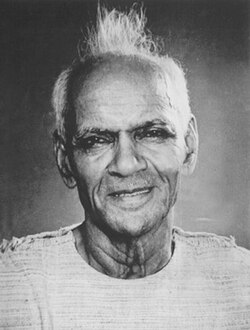
Shriram Sharma Acharya (20 September 1911 - 2 June 1990), also known as Vedmurti Taponishtha Pandit Shriram Sharma Acharya, was a renowned yugrishi who devoted his life to elevating human consciousness, culture, and civilization through the synthesis of science and spirituality. He founded the All World Gayatri Pariwar and the Brahmvarchas Shodh Sansthan (1979).
His spiritual journey commenced at the age of fifteen, during which he completed 24 Mahapurushcharans—each involving the rhythmic recitation (japa) of 2.4 million Gayatri mantras. He subsequently played an active role in India's independence movement. Acharya also proposed the 100-point program of Yug Nirman Yojna (Campaign for Era Transformation) for societal upliftment and reformation of the era.
His endeavors encompassed extensive research on the syncretic relationships between science and spirituality, the revival of Rishi traditions, and the revelation of the philosophy and science underlying the Gayatri Mantra and Yajna. He supervised large-scale Gayatri sadhana and Yajna, interpreted entire Vedic scriptures, and authored over 3,000 books on various aspects of human life. His vision is encapsulated in the phrase, "Hum badlenge, Yug badlega. Hum sudhrenge, Yug sudhrega" ("We will change, the era will change. We will improve, the era will improve"), which continues to inspire successive generations.
Shriram Sharma Acharya, revered as "Gurudev" by his followers, was born in Anwalkheda village in the Agra district of Uttar Pradesh, India, on Ashwin Krishna Trayodashi Vikrami Samvat 1967 (September 20, 1911). He was the son of Pandit Rupkishore Sharma and Dhankunwari Devi. His early concern for the welfare of the underprivileged was evident even in his childhood; for example, as a young boy, he cared for an elderly woman afflicted with leprosy, despite disapproval from his family and society. His spiritual inclination also emerged at an early age. At the age of nine, he was initiated into the Gayatri mantra and underwent the sacred thread ceremony (yajnopavit), performed by Pandit Madan Mohan Malaviya.
At the age of fifteen, on January 18, 1926, during the Vasant Panchami festival, Shriram’s guru, Swami Sarveshwarananda, is said to have manifested in astral form from the flame of a deepak during his Gayatri upasana. This divine encounter revealed his three previous births—Sant Kabir, Samarth Guru Ramdas and Ramakrishna Paramhansa—as well as the objectives of his present life, thereby initiating his spiritual journey. In accordance with his guru’s instructions, he subsequently devoted three decades to intensive spiritual practices, adhering to strict disciplines and performing 24 Mahapurushcharans. His autobiography, “Hamari Vasiyat aur Virasat” (My Life—Its Legacy And Message), reflects his profound surrender to his guru and attributes all his accomplishments to his guru’s grace and guidance.
Troubled by the pain of foreign rule, the young Shriram joined the freedom movement in 1923–24 in response to Mahatma Gandhi’s call. In accordance with his Guru’s instructions, he participated in India's struggle for independence to acquire practical lessons in wisdom, honesty, responsibility, and courage. From 1927 to 1937, he actively volunteered as a freedom fighter and was jailed on several occasions for his involvement in the movement. He also composed revolutionary poems and articles, which were published in the newspaper Sainik under the title "Matta Pralap."
During a freedom movement at Jarkhi, near Anwalkheda, British soldiers attempted to seize the tricolor flag while assaulting him. Despite fainting from the attack, he maintained a firm grip on the flag by holding it between his teeth. His profound devotion to his motherland earned him the nickname "Shriram Matta." Post-independence, Shriram withdrew from active political engagement and devoted himself to the nation’s liberation on moral, intellectual, and cultural fronts, as guided by his Guru.
Shriram Sharma Acharya ascended the Himalayas on four occasions, during which he practiced specific sadhanas and made plans for the future under the guidance of his guru, Swami Sarveshwarananda. His first ascent occurred in 1937, followed by journeys in 1959, 1971, and 1984. These journeys aimed to meet Himalayan sages, seek further guidance, and rejuvenate himself. Notably, the initial journey also served as a test of his endurance, willpower, and perseverance, as set by his guru. He documented these experiences in his writings, recording the purpose of each journey.
Shriram Sharma
Shriram Sharma Acharya (20 September 1911 - 2 June 1990), also known as Vedmurti Taponishtha Pandit Shriram Sharma Acharya, was a renowned yugrishi who devoted his life to elevating human consciousness, culture, and civilization through the synthesis of science and spirituality. He founded the All World Gayatri Pariwar and the Brahmvarchas Shodh Sansthan (1979).
His spiritual journey commenced at the age of fifteen, during which he completed 24 Mahapurushcharans—each involving the rhythmic recitation (japa) of 2.4 million Gayatri mantras. He subsequently played an active role in India's independence movement. Acharya also proposed the 100-point program of Yug Nirman Yojna (Campaign for Era Transformation) for societal upliftment and reformation of the era.
His endeavors encompassed extensive research on the syncretic relationships between science and spirituality, the revival of Rishi traditions, and the revelation of the philosophy and science underlying the Gayatri Mantra and Yajna. He supervised large-scale Gayatri sadhana and Yajna, interpreted entire Vedic scriptures, and authored over 3,000 books on various aspects of human life. His vision is encapsulated in the phrase, "Hum badlenge, Yug badlega. Hum sudhrenge, Yug sudhrega" ("We will change, the era will change. We will improve, the era will improve"), which continues to inspire successive generations.
Shriram Sharma Acharya, revered as "Gurudev" by his followers, was born in Anwalkheda village in the Agra district of Uttar Pradesh, India, on Ashwin Krishna Trayodashi Vikrami Samvat 1967 (September 20, 1911). He was the son of Pandit Rupkishore Sharma and Dhankunwari Devi. His early concern for the welfare of the underprivileged was evident even in his childhood; for example, as a young boy, he cared for an elderly woman afflicted with leprosy, despite disapproval from his family and society. His spiritual inclination also emerged at an early age. At the age of nine, he was initiated into the Gayatri mantra and underwent the sacred thread ceremony (yajnopavit), performed by Pandit Madan Mohan Malaviya.
At the age of fifteen, on January 18, 1926, during the Vasant Panchami festival, Shriram’s guru, Swami Sarveshwarananda, is said to have manifested in astral form from the flame of a deepak during his Gayatri upasana. This divine encounter revealed his three previous births—Sant Kabir, Samarth Guru Ramdas and Ramakrishna Paramhansa—as well as the objectives of his present life, thereby initiating his spiritual journey. In accordance with his guru’s instructions, he subsequently devoted three decades to intensive spiritual practices, adhering to strict disciplines and performing 24 Mahapurushcharans. His autobiography, “Hamari Vasiyat aur Virasat” (My Life—Its Legacy And Message), reflects his profound surrender to his guru and attributes all his accomplishments to his guru’s grace and guidance.
Troubled by the pain of foreign rule, the young Shriram joined the freedom movement in 1923–24 in response to Mahatma Gandhi’s call. In accordance with his Guru’s instructions, he participated in India's struggle for independence to acquire practical lessons in wisdom, honesty, responsibility, and courage. From 1927 to 1937, he actively volunteered as a freedom fighter and was jailed on several occasions for his involvement in the movement. He also composed revolutionary poems and articles, which were published in the newspaper Sainik under the title "Matta Pralap."
During a freedom movement at Jarkhi, near Anwalkheda, British soldiers attempted to seize the tricolor flag while assaulting him. Despite fainting from the attack, he maintained a firm grip on the flag by holding it between his teeth. His profound devotion to his motherland earned him the nickname "Shriram Matta." Post-independence, Shriram withdrew from active political engagement and devoted himself to the nation’s liberation on moral, intellectual, and cultural fronts, as guided by his Guru.
Shriram Sharma Acharya ascended the Himalayas on four occasions, during which he practiced specific sadhanas and made plans for the future under the guidance of his guru, Swami Sarveshwarananda. His first ascent occurred in 1937, followed by journeys in 1959, 1971, and 1984. These journeys aimed to meet Himalayan sages, seek further guidance, and rejuvenate himself. Notably, the initial journey also served as a test of his endurance, willpower, and perseverance, as set by his guru. He documented these experiences in his writings, recording the purpose of each journey.
Recent media
Recent media