



Recent from talks
Knowledge base stats:
Talk channels stats:
Members stats:
Atlantic meridional overturning circulation
The Atlantic meridional overturning circulation (AMOC) is the main ocean current system in the Atlantic Ocean. It is a component of Earth's ocean circulation system and plays an important role in the climate system. The AMOC includes Atlantic currents at the surface and at great depths that are driven by changes in weather, temperature and salinity. Those currents comprise half of the global thermohaline circulation that includes the flow of major ocean currents, the other half being the Southern Ocean overturning circulation.
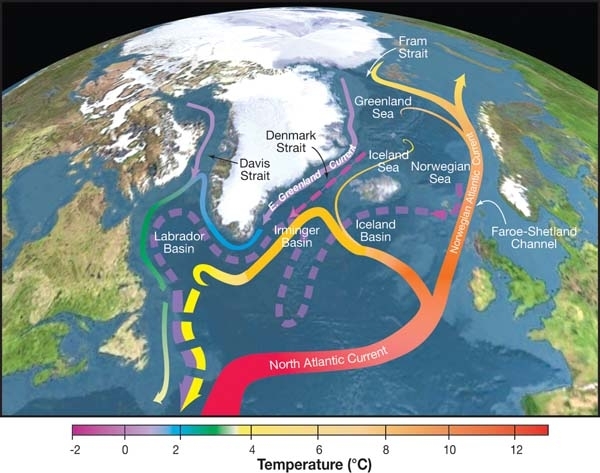
The AMOC is composed of a northward flow of warm, more saline water in the Atlantic's upper layers and a southward, return flow of cold, less salty, deep water. Warm water from the south is more saline ('halocline') because of the higher evaporation rate in the tropical zone. The warm saline water forms the upper layer of the ocean ('thermocline'), but when this layer cools down, the density of the salty water increases, making it sink into the deep. This is an important part of the motor of the AMOC system. The limbs are linked by regions of overturning in the Nordic Seas and the Southern Ocean. Overturning sites are associated with intense exchanges of heat, dissolved oxygen, carbon and other nutrients, and very important for the ocean's ecosystems and its function as a carbon sink. Changes in the strength of the AMOC can affect multiple elements of the climate system.
Climate change may weaken the AMOC through increases in ocean heat content and elevated flows of freshwater from melting ice sheets. Studies using oceanographic reconstructions suggest that as of 2015[update], the AMOC was weaker than before the Industrial Revolution. There is debate over the relative contributions of different factors and it is unclear how much of this weakening is due to climate change or the circulation's natural variability over millennia. Climate models predict the AMOC will further weaken during the 21st century. This weakening would reduce average air temperatures over Scandinavia, Great Britain, and Ireland, because these regions are warmed by the North Atlantic Current. Weakening of the AMOC would also accelerate sea level rise around North America and reduce primary production in the North Atlantic.
Severe weakening of the AMOC may lead to a collapse of the circulation, which would not be easily reversible and thus constitutes one of the tipping points in the climate system. A collapse would substantially lower the average temperature and amount of rain and snowfall in Europe. It may also raise the frequency of extreme weather events and have other severe effects.
The Atlantic meridional overturning circulation (AMOC) is the main current system in the Atlantic Ocean and is also part of the global thermohaline circulation, which connects the world's oceans with a single "conveyor belt" of continuous water exchange. Normally, relatively warm, less-saline water stays on the ocean's surface while deep layers are colder, denser and more-saline, in what is known as ocean stratification. Deep water eventually gains heat and/or loses salinity in an exchange with the mixed ocean layer, and becomes less dense and rises towards the surface. Differences in temperature and salinity exist between ocean layers and between parts of the World Ocean, and together they drive the thermohaline circulation. The Pacific Ocean is less saline than the other oceans because it receives large quantities of fresh rainfall. Its surface water is insufficiently saline to sink lower than several hundred meters, meaning deep ocean water must come from elsewhere.
Ocean water in the North Atlantic is more saline than that in the Pacific, partly because extensive evaporation on the surface concentrates salt within the remaining water and partly because sea ice near the Arctic Circle expels salt as it freezes during winter. Even more importantly, evaporated moisture in the Atlantic is swiftly carried away by atmospheric circulation before it can fall back as rain. Trade winds move this moisture across Central America and to the eastern North Pacific, where it falls as rain. Major mountain ranges such as the Tibetan Plateau, the Rocky Mountains and the Andes prevent any equivalent moisture transport back to the Atlantic.
Due to this process, Atlantic surface water becomes salty and therefore dense, eventually downwelling to form the North Atlantic Deep Water (NADW). NADW formation primarily occurs in the Nordic Seas and involves a complex interplay of regional water masses such as the Denmark Strait Overflow Water (DSOW), Iceland-Scotland Overflow Water (ISOW) and Nordic Seas Overflow Water. Labrador Sea Water may play an important role as well but increasing evidence suggests water in Labrador and Irminger Seas primarily recirculates through the North Atlantic Gyre and has little connection with the rest of the AMOC.
The NADW is not the deepest water layer in the Atlantic Ocean; the Antarctic bottom water (AABW) is always the densest, deepest ocean layer in any basin deeper than 4,000 metres (2.5 mi). As the upper reaches of the AABW flow upwells, it melds into and reinforces the NADW. The formation of the NADW is also the beginning of the lower cell of the circulation. The downwelling that forms the NADW is balanced by an equal amount of upwelling. In the western Atlantic, Ekman transport, the increase in ocean-layer mixing caused by wind activity, results in strong upwelling in the Canary Current and the Benguela Current, which are located on the northwest and southwest coasts of Africa. As of 2014[update], upwelling is substantially stronger around the Canary Current than the Benguela Current, though an opposite pattern existed until the closure of the Central American Seaway during the late Pliocene. In the Eastern Atlantic, significant upwelling occurs only during certain months of the year because this region's deep thermocline means it is more dependent on the state of sea surface temperature than on wind activity. There is also a multi-year upwelling cycle that occurs in synchronization with the El Niño/La Niña cycle.
Hub AI
Atlantic meridional overturning circulation AI simulator
(@Atlantic meridional overturning circulation_simulator)
Atlantic meridional overturning circulation
The Atlantic meridional overturning circulation (AMOC) is the main ocean current system in the Atlantic Ocean. It is a component of Earth's ocean circulation system and plays an important role in the climate system. The AMOC includes Atlantic currents at the surface and at great depths that are driven by changes in weather, temperature and salinity. Those currents comprise half of the global thermohaline circulation that includes the flow of major ocean currents, the other half being the Southern Ocean overturning circulation.
The AMOC is composed of a northward flow of warm, more saline water in the Atlantic's upper layers and a southward, return flow of cold, less salty, deep water. Warm water from the south is more saline ('halocline') because of the higher evaporation rate in the tropical zone. The warm saline water forms the upper layer of the ocean ('thermocline'), but when this layer cools down, the density of the salty water increases, making it sink into the deep. This is an important part of the motor of the AMOC system. The limbs are linked by regions of overturning in the Nordic Seas and the Southern Ocean. Overturning sites are associated with intense exchanges of heat, dissolved oxygen, carbon and other nutrients, and very important for the ocean's ecosystems and its function as a carbon sink. Changes in the strength of the AMOC can affect multiple elements of the climate system.
Climate change may weaken the AMOC through increases in ocean heat content and elevated flows of freshwater from melting ice sheets. Studies using oceanographic reconstructions suggest that as of 2015[update], the AMOC was weaker than before the Industrial Revolution. There is debate over the relative contributions of different factors and it is unclear how much of this weakening is due to climate change or the circulation's natural variability over millennia. Climate models predict the AMOC will further weaken during the 21st century. This weakening would reduce average air temperatures over Scandinavia, Great Britain, and Ireland, because these regions are warmed by the North Atlantic Current. Weakening of the AMOC would also accelerate sea level rise around North America and reduce primary production in the North Atlantic.
Severe weakening of the AMOC may lead to a collapse of the circulation, which would not be easily reversible and thus constitutes one of the tipping points in the climate system. A collapse would substantially lower the average temperature and amount of rain and snowfall in Europe. It may also raise the frequency of extreme weather events and have other severe effects.
The Atlantic meridional overturning circulation (AMOC) is the main current system in the Atlantic Ocean and is also part of the global thermohaline circulation, which connects the world's oceans with a single "conveyor belt" of continuous water exchange. Normally, relatively warm, less-saline water stays on the ocean's surface while deep layers are colder, denser and more-saline, in what is known as ocean stratification. Deep water eventually gains heat and/or loses salinity in an exchange with the mixed ocean layer, and becomes less dense and rises towards the surface. Differences in temperature and salinity exist between ocean layers and between parts of the World Ocean, and together they drive the thermohaline circulation. The Pacific Ocean is less saline than the other oceans because it receives large quantities of fresh rainfall. Its surface water is insufficiently saline to sink lower than several hundred meters, meaning deep ocean water must come from elsewhere.
Ocean water in the North Atlantic is more saline than that in the Pacific, partly because extensive evaporation on the surface concentrates salt within the remaining water and partly because sea ice near the Arctic Circle expels salt as it freezes during winter. Even more importantly, evaporated moisture in the Atlantic is swiftly carried away by atmospheric circulation before it can fall back as rain. Trade winds move this moisture across Central America and to the eastern North Pacific, where it falls as rain. Major mountain ranges such as the Tibetan Plateau, the Rocky Mountains and the Andes prevent any equivalent moisture transport back to the Atlantic.
Due to this process, Atlantic surface water becomes salty and therefore dense, eventually downwelling to form the North Atlantic Deep Water (NADW). NADW formation primarily occurs in the Nordic Seas and involves a complex interplay of regional water masses such as the Denmark Strait Overflow Water (DSOW), Iceland-Scotland Overflow Water (ISOW) and Nordic Seas Overflow Water. Labrador Sea Water may play an important role as well but increasing evidence suggests water in Labrador and Irminger Seas primarily recirculates through the North Atlantic Gyre and has little connection with the rest of the AMOC.
The NADW is not the deepest water layer in the Atlantic Ocean; the Antarctic bottom water (AABW) is always the densest, deepest ocean layer in any basin deeper than 4,000 metres (2.5 mi). As the upper reaches of the AABW flow upwells, it melds into and reinforces the NADW. The formation of the NADW is also the beginning of the lower cell of the circulation. The downwelling that forms the NADW is balanced by an equal amount of upwelling. In the western Atlantic, Ekman transport, the increase in ocean-layer mixing caused by wind activity, results in strong upwelling in the Canary Current and the Benguela Current, which are located on the northwest and southwest coasts of Africa. As of 2014[update], upwelling is substantially stronger around the Canary Current than the Benguela Current, though an opposite pattern existed until the closure of the Central American Seaway during the late Pliocene. In the Eastern Atlantic, significant upwelling occurs only during certain months of the year because this region's deep thermocline means it is more dependent on the state of sea surface temperature than on wind activity. There is also a multi-year upwelling cycle that occurs in synchronization with the El Niño/La Niña cycle.