


Community hub
Recent from talks
Knowledge base stats:
Talk channels stats:
Members stats:
Ocean stratification
Ocean stratification is the natural separation of an ocean's water into horizontal layers by density. This is generally stable stratification, because warm water floats on top of cold water, and heating is mostly from the sun, which reinforces that arrangement. Stratification is reduced by wind-forced mechanical mixing, but reinforced by convection (warm water rising, cold water sinking). Stratification occurs in all ocean basins and also in other water bodies. Stratified layers are a barrier to the mixing of water, which impacts the exchange of heat, carbon, oxygen and other nutrients. The surface mixed layer is the uppermost layer in the ocean and is well mixed by mechanical (wind) and thermal (convection) effects. Climate change is causing the upper ocean stratification to increase.[clarification needed]
Due to upwelling and downwelling, which are both wind-driven, mixing of different layers can occur through the rise of cold nutrient-rich and sinking of warm water, respectively. Generally, layers are based on water density: heavier, and hence denser, water is below the lighter water, representing a stable stratification. For example, the pycnocline is the layer in the ocean where the change in density is largest compared to that of other layers in the ocean. The thickness of the thermocline is not constant everywhere and depends on a variety of variables.[clarification needed]
Between 1960 and 2018, upper ocean stratification increased between 0.7 and 1.2% per decade due to climate change. This means that the differences in density of the layers in the oceans increase, leading to larger mixing barriers and other effects.[clarification needed] In the last few decades,[when?] stratification in all ocean basins has increased due to effects of climate change on oceans. Global upper-ocean stratification has continued its increasing trend in 2022. The southern oceans (south of 30°S) experienced the strongest rate of stratification since 1960, followed by the Pacific, Atlantic, and the Indian Oceans. Increasing stratification is predominantly affected by changes in ocean temperature; salinity only plays a role locally.
The density of water in the ocean, which is defined as mass per unit of volume, has a complicated dependence on temperature (), salinity () and pressure (), which in turn is a function of the density and depth of the overlying water, and is denoted as . The dependence on pressure is not significant, since seawater is almost perfectly incompressible. A change in the temperature of the water impacts on the distance between water parcels directly.[clarification needed] When the temperature of the water increases, the distance between water parcels will increase and hence the density will decrease. Salinity is a measure of the mass of dissolved solids, which consist mainly of salt. Increasing the salinity will increase the density. Just like the pycnocline defines the layer with a fast change in density, similar layers can be defined for a fast change in temperature and salinity: the thermocline and the halocline. Since the density depends on both the temperature and the salinity, the pycno-, thermo-, and haloclines have similar shapes. The difference is that the density increases with depth, whereas the salinity and temperature decrease with depth.


In the ocean, a specific range of temperature and salinity occurs. Using the GODAS Data, a temperature-salinity plot can show the possibilities and occurrences of the different combinations of salinity and potential temperature.
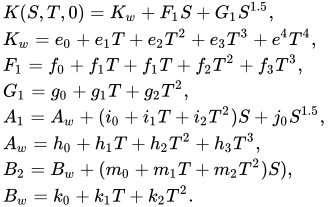
The density of ocean water is described by the UNESCO formula as: The terms in this formula, density when the pressure is zero, , and a term involving the compressibility of water, , are both heavily dependent on the temperature and less dependent on the salinity:
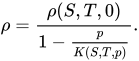



with:andIn these formulas, all of the small letters, and are constants that are defined in Appendix A of a book on Internal Gravity Waves, published in 2015.[clarification needed]



The density depends more on the temperature than on the salinity, as can be deduced from the exact formula and can be shown in plots using the GODAS Data. In the plots regarding surface temperature, salinity and density, it can be seen that locations with the coldest water, at the poles, are also the locations with the highest densities. The regions with the highest salinity, on the other hand, are not the regions with the highest density, meaning that temperature contributes mostly to the density in the oceans. A specific example is the Arabian Sea.
Hub AI
Ocean stratification AI simulator
(@Ocean stratification_simulator)
Ocean stratification
Ocean stratification is the natural separation of an ocean's water into horizontal layers by density. This is generally stable stratification, because warm water floats on top of cold water, and heating is mostly from the sun, which reinforces that arrangement. Stratification is reduced by wind-forced mechanical mixing, but reinforced by convection (warm water rising, cold water sinking). Stratification occurs in all ocean basins and also in other water bodies. Stratified layers are a barrier to the mixing of water, which impacts the exchange of heat, carbon, oxygen and other nutrients. The surface mixed layer is the uppermost layer in the ocean and is well mixed by mechanical (wind) and thermal (convection) effects. Climate change is causing the upper ocean stratification to increase.[clarification needed]
Due to upwelling and downwelling, which are both wind-driven, mixing of different layers can occur through the rise of cold nutrient-rich and sinking of warm water, respectively. Generally, layers are based on water density: heavier, and hence denser, water is below the lighter water, representing a stable stratification. For example, the pycnocline is the layer in the ocean where the change in density is largest compared to that of other layers in the ocean. The thickness of the thermocline is not constant everywhere and depends on a variety of variables.[clarification needed]
Between 1960 and 2018, upper ocean stratification increased between 0.7 and 1.2% per decade due to climate change. This means that the differences in density of the layers in the oceans increase, leading to larger mixing barriers and other effects.[clarification needed] In the last few decades,[when?] stratification in all ocean basins has increased due to effects of climate change on oceans. Global upper-ocean stratification has continued its increasing trend in 2022. The southern oceans (south of 30°S) experienced the strongest rate of stratification since 1960, followed by the Pacific, Atlantic, and the Indian Oceans. Increasing stratification is predominantly affected by changes in ocean temperature; salinity only plays a role locally.
The density of water in the ocean, which is defined as mass per unit of volume, has a complicated dependence on temperature (), salinity () and pressure (), which in turn is a function of the density and depth of the overlying water, and is denoted as . The dependence on pressure is not significant, since seawater is almost perfectly incompressible. A change in the temperature of the water impacts on the distance between water parcels directly.[clarification needed] When the temperature of the water increases, the distance between water parcels will increase and hence the density will decrease. Salinity is a measure of the mass of dissolved solids, which consist mainly of salt. Increasing the salinity will increase the density. Just like the pycnocline defines the layer with a fast change in density, similar layers can be defined for a fast change in temperature and salinity: the thermocline and the halocline. Since the density depends on both the temperature and the salinity, the pycno-, thermo-, and haloclines have similar shapes. The difference is that the density increases with depth, whereas the salinity and temperature decrease with depth.
In the ocean, a specific range of temperature and salinity occurs. Using the GODAS Data, a temperature-salinity plot can show the possibilities and occurrences of the different combinations of salinity and potential temperature.
The density of ocean water is described by the UNESCO formula as: The terms in this formula, density when the pressure is zero, , and a term involving the compressibility of water, , are both heavily dependent on the temperature and less dependent on the salinity:
with:andIn these formulas, all of the small letters, and are constants that are defined in Appendix A of a book on Internal Gravity Waves, published in 2015.[clarification needed]
The density depends more on the temperature than on the salinity, as can be deduced from the exact formula and can be shown in plots using the GODAS Data. In the plots regarding surface temperature, salinity and density, it can be seen that locations with the coldest water, at the poles, are also the locations with the highest densities. The regions with the highest salinity, on the other hand, are not the regions with the highest density, meaning that temperature contributes mostly to the density in the oceans. A specific example is the Arabian Sea.