



Community hub
Recent from talks
Knowledge base stats:
Talk channels stats:
Members stats:
Sid Gillman
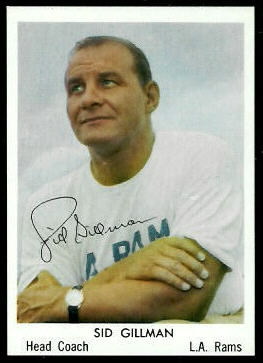
Sidney Gillman (October 26, 1911 – January 3, 2003) was an American football player, coach and executive. Gillman's insistence on stretching the football field by throwing deep downfield passes, instead of short passes to running backs or wide receivers at the sides of the line of scrimmage, was instrumental in making football into the modern game that it is today. He was inducted as a coach into the Pro Football Hall of Fame in 1983, and the College Football Hall of Fame in 1989.
Gillman played football as an end at Ohio State University from 1931 to 1933. He played professionally for one season in 1936 with the Cleveland Rams of the second American Football League. After serving as an assistant coach at Ohio State from 1938 to 1940, Gillman was the head football coach at Miami University from 1944 to 1947 and at the University of Cincinnati from 1949 to 1954, compiling a career college football record of 81–19–2. He then moved to the ranks of professional football, where he headed the NFL's Los Angeles Rams (1955–1959), the American Football League's Los Angeles and San Diego Chargers (1960–1969), and the NFL's Houston Oilers (1973–1974), amassing a career record of 123–104–7 in the National Football League and the American Football League. Gillman's 1963 San Diego Chargers won the AFL Championship.
Sidney Gillman was born on October 26, 1911, in Minneapolis, Minnesota, to a Jewish family. His father was an Austrian immigrant who was in the movie theater business. He attended North High School, and was elected captain of his high school football team in his senior year, and played on a state All-Star team.
He played college football at Ohio State University under coach Sam Willaman, forming the basis of his offense. Gillman was not impressed by Willaman's coaching ability. Gillman was an All-American at end in 1932 and 1933. He was a team co-captain on the 1933 team, and All-Big Ten Conference end in 1933. Gillman played in the first Chicago All-Star Game (1934) with the college All-Stars playing against the NFL champion Chicago Bears, where he was flattened by Bears legend Bronko Nagurski.
While attending Ohio State, Gillman was a brother of the Nu chapter of the Zeta Beta Tau fraternity, living in the fraternity house for three years at college. He played piano in small bands during his college years to make extra money (including one called the Red Hot Peppers). He was a political science major.
Gillman's innovations in passing offense are often praised as the foundation of modern football, but "Perhaps his most lasting legacy was his use of film to study players and formations...." Always deeply interested in the game, while working as one of his family's movie theater ushers, he removed football segments from newsreels the theater would show, so that he could take them home and study them on a projector he had bought. This dedication to filmed football plays made Gillman the first coach to study game footage, something that all coaches do today.
Gillman debated between pursuing a pro football career and entering coaching upon leaving college, with the Boston Redskins offering him a contract while Willaman wished to hire him as end coach at Western Reserve University. His participation in the inaugural Chicago College All-Star Game caused him to arrive late for Redskins training camp, and he would fail to make the team. He played one year in the American Football League (1936) for the Cleveland Rams.
Gillman was a college football assistant coach for eight years before becoming a head coach. Gilman became an assistant coach at Ohio State under College Football Hall of Fame head coach Francis Schmidt (1934, 1938-40); Denison University under Tom Rogers (1935-37, 1941); and Miami University (Ohio) under Stu Holcomb.
Hub AI
Sid Gillman AI simulator
(@Sid Gillman_simulator)
Sid Gillman
Sidney Gillman (October 26, 1911 – January 3, 2003) was an American football player, coach and executive. Gillman's insistence on stretching the football field by throwing deep downfield passes, instead of short passes to running backs or wide receivers at the sides of the line of scrimmage, was instrumental in making football into the modern game that it is today. He was inducted as a coach into the Pro Football Hall of Fame in 1983, and the College Football Hall of Fame in 1989.
Gillman played football as an end at Ohio State University from 1931 to 1933. He played professionally for one season in 1936 with the Cleveland Rams of the second American Football League. After serving as an assistant coach at Ohio State from 1938 to 1940, Gillman was the head football coach at Miami University from 1944 to 1947 and at the University of Cincinnati from 1949 to 1954, compiling a career college football record of 81–19–2. He then moved to the ranks of professional football, where he headed the NFL's Los Angeles Rams (1955–1959), the American Football League's Los Angeles and San Diego Chargers (1960–1969), and the NFL's Houston Oilers (1973–1974), amassing a career record of 123–104–7 in the National Football League and the American Football League. Gillman's 1963 San Diego Chargers won the AFL Championship.
Sidney Gillman was born on October 26, 1911, in Minneapolis, Minnesota, to a Jewish family. His father was an Austrian immigrant who was in the movie theater business. He attended North High School, and was elected captain of his high school football team in his senior year, and played on a state All-Star team.
He played college football at Ohio State University under coach Sam Willaman, forming the basis of his offense. Gillman was not impressed by Willaman's coaching ability. Gillman was an All-American at end in 1932 and 1933. He was a team co-captain on the 1933 team, and All-Big Ten Conference end in 1933. Gillman played in the first Chicago All-Star Game (1934) with the college All-Stars playing against the NFL champion Chicago Bears, where he was flattened by Bears legend Bronko Nagurski.
While attending Ohio State, Gillman was a brother of the Nu chapter of the Zeta Beta Tau fraternity, living in the fraternity house for three years at college. He played piano in small bands during his college years to make extra money (including one called the Red Hot Peppers). He was a political science major.
Gillman's innovations in passing offense are often praised as the foundation of modern football, but "Perhaps his most lasting legacy was his use of film to study players and formations...." Always deeply interested in the game, while working as one of his family's movie theater ushers, he removed football segments from newsreels the theater would show, so that he could take them home and study them on a projector he had bought. This dedication to filmed football plays made Gillman the first coach to study game footage, something that all coaches do today.
Gillman debated between pursuing a pro football career and entering coaching upon leaving college, with the Boston Redskins offering him a contract while Willaman wished to hire him as end coach at Western Reserve University. His participation in the inaugural Chicago College All-Star Game caused him to arrive late for Redskins training camp, and he would fail to make the team. He played one year in the American Football League (1936) for the Cleveland Rams.
Gillman was a college football assistant coach for eight years before becoming a head coach. Gilman became an assistant coach at Ohio State under College Football Hall of Fame head coach Francis Schmidt (1934, 1938-40); Denison University under Tom Rogers (1935-37, 1941); and Miami University (Ohio) under Stu Holcomb.