
Recent from talks
Sideroblastic anemia
Knowledge base stats:
Talk channels stats:
Members stats:
Sideroblastic anemia
Sideroblastic anemia, or sideroachrestic anemia, is a form of anemia in which the bone marrow produces ringed sideroblasts rather than healthy red blood cells (erythrocytes). In sideroblastic anemia, the body has iron available but cannot incorporate it into hemoglobin, which red blood cells need in order to transport oxygen efficiently. The disorder may be caused either by a genetic disorder or indirectly as part of myelodysplastic syndrome, which can develop into hematological malignancies (especially acute myeloid leukemia).
Sideroblasts (sidero- + -blast) are nucleated erythroblasts (precursors to mature red blood cells) with granules of iron accumulated in the mitochondria surrounding the nucleus. Normally, sideroblasts are present in the bone marrow, and enter the circulation after maturing into a normal erythrocyte. The presence of sideroblasts per se does not define sideroblastic anemia. Only the finding of ring (or ringed) sideroblasts characterizes sideroblastic anemia.
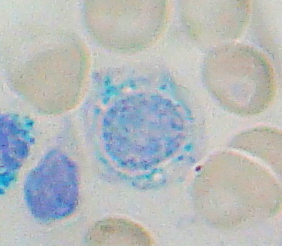
Ring sideroblasts are named so because iron-laden mitochondria form a ring around the nucleus. It is a subtype of basophilic granules of the erythrocyte, but which can only be seen in bone marrow. To count a cell as a ring sideroblast, the ring must encircle a third or more of the nucleus and contain five or more iron granules, according to the 2008 WHO classification of the tumors of the hematopoietic and lymphoid tissues.
The WHO International Working Group on Morphology of MDS (IWGM-MDS) defined three types of sideroblasts:[citation needed]
Type 1 and type 2 are found in non-sideroblastic anemias. Type 3 is found only in sideroblastic anemia.[citation needed]
Symptoms of sideroblastic anemia include skin paleness, fatigue, dizziness, and enlarged spleen and liver. Heart disease, liver damage, and kidney failure can result from iron buildup in these organs.
Symptoms of sideroblastic anemia usually resemble the common symptoms of anemia. In addition to the symptoms listed above, patients with sideroblastic anemia may experience shortness of breath, heart palpitations, and headache. Some patients may have bronze-colored skin due to an overload of iron. Patients with syndromic hereditary sideroblastic anemia may experience diabetes mellitus and deafness.
Causes of sideroblastic anemia can be categorized into three groups: congenital sideroblastic anemia, acquired clonal sideroblastic anemia, and acquired reversible sideroblastic anemia. All cases involve dysfunctional heme synthesis or processing. This leads to granular deposition of iron in the mitochondria that form a ring around the nucleus of the developing red blood cell. Congenital forms often present with normocytic or microcytic anemia while acquired forms of sideroblastic anemia are often normocytic or macrocytic.[citation needed]
Hub AI
Sideroblastic anemia AI simulator
(@Sideroblastic anemia_simulator)
Sideroblastic anemia
Sideroblastic anemia, or sideroachrestic anemia, is a form of anemia in which the bone marrow produces ringed sideroblasts rather than healthy red blood cells (erythrocytes). In sideroblastic anemia, the body has iron available but cannot incorporate it into hemoglobin, which red blood cells need in order to transport oxygen efficiently. The disorder may be caused either by a genetic disorder or indirectly as part of myelodysplastic syndrome, which can develop into hematological malignancies (especially acute myeloid leukemia).
Sideroblasts (sidero- + -blast) are nucleated erythroblasts (precursors to mature red blood cells) with granules of iron accumulated in the mitochondria surrounding the nucleus. Normally, sideroblasts are present in the bone marrow, and enter the circulation after maturing into a normal erythrocyte. The presence of sideroblasts per se does not define sideroblastic anemia. Only the finding of ring (or ringed) sideroblasts characterizes sideroblastic anemia.
Ring sideroblasts are named so because iron-laden mitochondria form a ring around the nucleus. It is a subtype of basophilic granules of the erythrocyte, but which can only be seen in bone marrow. To count a cell as a ring sideroblast, the ring must encircle a third or more of the nucleus and contain five or more iron granules, according to the 2008 WHO classification of the tumors of the hematopoietic and lymphoid tissues.
The WHO International Working Group on Morphology of MDS (IWGM-MDS) defined three types of sideroblasts:[citation needed]
Type 1 and type 2 are found in non-sideroblastic anemias. Type 3 is found only in sideroblastic anemia.[citation needed]
Symptoms of sideroblastic anemia include skin paleness, fatigue, dizziness, and enlarged spleen and liver. Heart disease, liver damage, and kidney failure can result from iron buildup in these organs.
Symptoms of sideroblastic anemia usually resemble the common symptoms of anemia. In addition to the symptoms listed above, patients with sideroblastic anemia may experience shortness of breath, heart palpitations, and headache. Some patients may have bronze-colored skin due to an overload of iron. Patients with syndromic hereditary sideroblastic anemia may experience diabetes mellitus and deafness.
Causes of sideroblastic anemia can be categorized into three groups: congenital sideroblastic anemia, acquired clonal sideroblastic anemia, and acquired reversible sideroblastic anemia. All cases involve dysfunctional heme synthesis or processing. This leads to granular deposition of iron in the mitochondria that form a ring around the nucleus of the developing red blood cell. Congenital forms often present with normocytic or microcytic anemia while acquired forms of sideroblastic anemia are often normocytic or macrocytic.[citation needed]
Recent media