
Recent from talks
Siena Cathedral Pulpit
Knowledge base stats:
Talk channels stats:
Members stats:
Siena Cathedral Pulpit
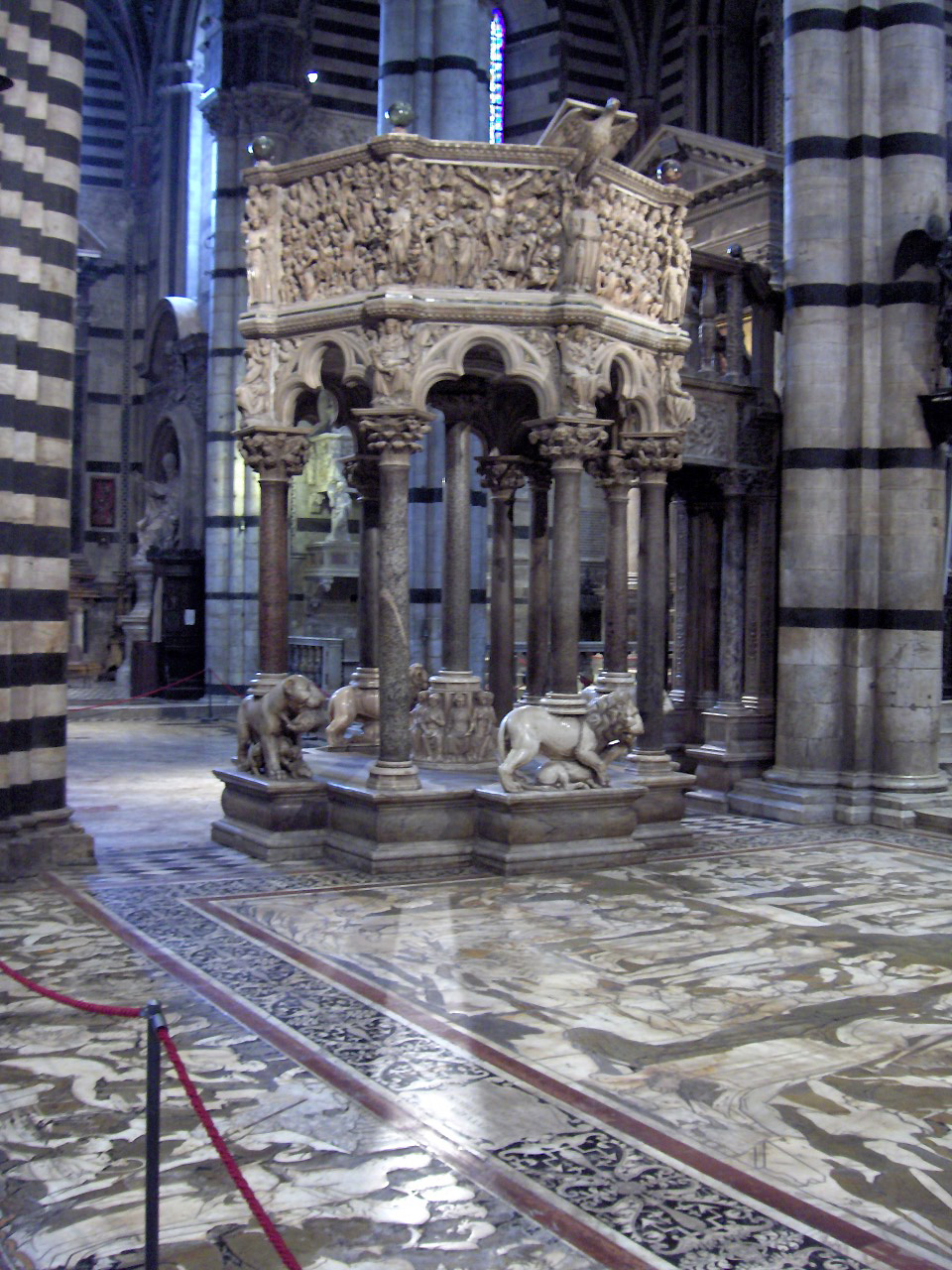
The Siena Cathedral Pulpit is an octagonal structure in Siena Cathedral sculpted by Nicola Pisano and his assistants Arnolfo di Cambio, Lapo di Ricevuto, and Nicolas' son Giovanni Pisano between the fall of 1265 and the fall of 1268. The pulpit, with its seven narrative panels and nine decorative columns carved out of Carrara marble, showcases Nicola Pisano's talent for integrating classical themes into Christian traditions, making both Nicola Pisano and the Siena pulpit forerunners of the classical revival of the Italian Renaissance.
The prosperity of the city of Siena during the thirteenth century led to an increase in civic pride and interest in public works. In 1196, the cathedral masons' guild, the Opera di Santa Maria, was commissioned to construct a new cathedral to take the place of the original structure that was built in the ninth century. Many artists were commissioned to gild the interior and the façade of the new cathedral. For the construction of the pulpit, a contract was drawn up in Pisa on September 29, 1265, between the artist Nicola Pisano and the Cistercian Fra Melano, who was the Master of the cathedral works of Siena.
Nicola had earned fame from his work on the pulpit in the Pisa Baptistery, which he had finished in 1260. This contract stipulated precise clauses such as "the materials, times of work (Nicola was to be absent only for 60 days a year) payment and collaborators." It also stated that there were to be seven panels instead of five such as in Pisa and it also stated that Pisano needed to use the Sienese Carrara marble. "For this labour Nicola, magister lapisorum, would receive eight Pisan soldi per day, his two pupils Arnolfo di Cambio and Lapo would each receive six soldi per day and—should he work—then ... Nicoli was to receive four soldi per day, to be paid to his father."
According to the Siena Cathedral archives, Nicola Pisano was born to Petrus de Apulia between 1200 and 1205 in Apulia. Nicola may have trained in the imperial workshops of Holy Roman Emperor Frederick II who encouraged artists towards the "revival of classical forms" where "the representational traditions of classical art were given new life and spiritual force". Frederick favoured the fusion of the classical and Christian traditions.
Before his commission on the Siena Cathedral Pulpit, Nicola had worked on two griffin heads in Apulia modeled with "light surface undulations, giving a soft chiaroscuro effect" which shows that he was influenced by Roman sculpture early on in his career. Commenting on the inspiration that Roman sarcophagi had on Nicola, Vasari wrote, "Nicola, pondering over the beauty of this work and being greatly pleased therewith, put so much study and diligence into imitating this manner and some other good sculptures that were in these other ancient sarcophagi, that he was judged, after no long time, the best sculptor of his day; there being in Tuscany in those times."
Nicolas' first recorded work was the pulpit inside the Baptistery in Pisa, Italy in 1260. This piece is the forerunner of the Sienese pulpit in multiple ways. One being the "Synthesis of French Gothic and Classical elements and incorporates a programme of great complexity." This Pisan pulpit is also raised up on columns three "resting on plain bases" and three "resting on the backs of lions" This pulpit, like the Sienese one also has rectangular relief panels that contain the Narrative of the life of Christ, but is told in only six sections where as there are eight panels on Siena's pulpit. With the Pisan pulpit we see Nicola hone his classical style.
The pulpit itself is octagonal and it has a central column on a pedestal that is encircled with the carved figures of ‘Philosophy’ and the ‘Seven Liberal Arts’. There are eight outer columns made of granite, porphyry and green marble that are "supported alternately, like the Pisa pulpit on flat bases and lions." On the Panels, there are carved reliefs that "represent a Christological cycle from the Visitation to the Last Judgment. An aspect of these panels is that each one shows more than one subject, whereas, the Last Judgment is told in the space of two reliefs. The panels of this monumental pulpit share the same compression style of the Late Antique and Roman sarcophagi. In between each of the panels on the corner sections Nicola chose to include Christian symbols to help make the story line of the panels to flow more effortlessly. The many figures in each scene with their chiaroscuro effect show a richness of surface, motion and narrative.
Seven scenes of narrative relief on the parapet show parts of the Life of Christ:
Hub AI
Siena Cathedral Pulpit AI simulator
(@Siena Cathedral Pulpit_simulator)
Siena Cathedral Pulpit
The Siena Cathedral Pulpit is an octagonal structure in Siena Cathedral sculpted by Nicola Pisano and his assistants Arnolfo di Cambio, Lapo di Ricevuto, and Nicolas' son Giovanni Pisano between the fall of 1265 and the fall of 1268. The pulpit, with its seven narrative panels and nine decorative columns carved out of Carrara marble, showcases Nicola Pisano's talent for integrating classical themes into Christian traditions, making both Nicola Pisano and the Siena pulpit forerunners of the classical revival of the Italian Renaissance.
The prosperity of the city of Siena during the thirteenth century led to an increase in civic pride and interest in public works. In 1196, the cathedral masons' guild, the Opera di Santa Maria, was commissioned to construct a new cathedral to take the place of the original structure that was built in the ninth century. Many artists were commissioned to gild the interior and the façade of the new cathedral. For the construction of the pulpit, a contract was drawn up in Pisa on September 29, 1265, between the artist Nicola Pisano and the Cistercian Fra Melano, who was the Master of the cathedral works of Siena.
Nicola had earned fame from his work on the pulpit in the Pisa Baptistery, which he had finished in 1260. This contract stipulated precise clauses such as "the materials, times of work (Nicola was to be absent only for 60 days a year) payment and collaborators." It also stated that there were to be seven panels instead of five such as in Pisa and it also stated that Pisano needed to use the Sienese Carrara marble. "For this labour Nicola, magister lapisorum, would receive eight Pisan soldi per day, his two pupils Arnolfo di Cambio and Lapo would each receive six soldi per day and—should he work—then ... Nicoli was to receive four soldi per day, to be paid to his father."
According to the Siena Cathedral archives, Nicola Pisano was born to Petrus de Apulia between 1200 and 1205 in Apulia. Nicola may have trained in the imperial workshops of Holy Roman Emperor Frederick II who encouraged artists towards the "revival of classical forms" where "the representational traditions of classical art were given new life and spiritual force". Frederick favoured the fusion of the classical and Christian traditions.
Before his commission on the Siena Cathedral Pulpit, Nicola had worked on two griffin heads in Apulia modeled with "light surface undulations, giving a soft chiaroscuro effect" which shows that he was influenced by Roman sculpture early on in his career. Commenting on the inspiration that Roman sarcophagi had on Nicola, Vasari wrote, "Nicola, pondering over the beauty of this work and being greatly pleased therewith, put so much study and diligence into imitating this manner and some other good sculptures that were in these other ancient sarcophagi, that he was judged, after no long time, the best sculptor of his day; there being in Tuscany in those times."
Nicolas' first recorded work was the pulpit inside the Baptistery in Pisa, Italy in 1260. This piece is the forerunner of the Sienese pulpit in multiple ways. One being the "Synthesis of French Gothic and Classical elements and incorporates a programme of great complexity." This Pisan pulpit is also raised up on columns three "resting on plain bases" and three "resting on the backs of lions" This pulpit, like the Sienese one also has rectangular relief panels that contain the Narrative of the life of Christ, but is told in only six sections where as there are eight panels on Siena's pulpit. With the Pisan pulpit we see Nicola hone his classical style.
The pulpit itself is octagonal and it has a central column on a pedestal that is encircled with the carved figures of ‘Philosophy’ and the ‘Seven Liberal Arts’. There are eight outer columns made of granite, porphyry and green marble that are "supported alternately, like the Pisa pulpit on flat bases and lions." On the Panels, there are carved reliefs that "represent a Christological cycle from the Visitation to the Last Judgment. An aspect of these panels is that each one shows more than one subject, whereas, the Last Judgment is told in the space of two reliefs. The panels of this monumental pulpit share the same compression style of the Late Antique and Roman sarcophagi. In between each of the panels on the corner sections Nicola chose to include Christian symbols to help make the story line of the panels to flow more effortlessly. The many figures in each scene with their chiaroscuro effect show a richness of surface, motion and narrative.
Seven scenes of narrative relief on the parapet show parts of the Life of Christ:
Recent media