Recent from talks
Contribute something
Nothing was collected or created yet.
Apulia
View on Wikipedia
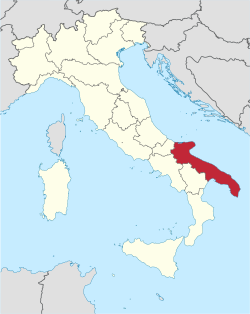
Apulia (/əˈpuːliə/ ə-POO-lee-ə), also known by its Italian name Puglia (Italian: [ˈpuʎʎa]),[4][a] is a region of Italy, located in the southern peninsular section of the country, bordering the Adriatic Sea to the east, the Strait of Otranto and Ionian Sea to the southeast and the Gulf of Taranto to the south. The region comprises 19,345 square kilometers (7,469 sq mi), and has 3,874,166 inhabitants as of 2025.[1] It is bordered by the other Italian regions of Molise to the north, Campania to the west, and Basilicata to the southwest. The regional capital is Bari.
Key Information
In ancient times, more precisely at the beginning of the first millennium BC, the region of Apulia was inhabited by the Iapygians, while during the 8th century BC its coastal areas were populated by ancient Greeks.[5] Later, the region was conquered by the ancient Romans. It was then conquered by the Byzantines, followed by the Normans, the Aragonese and the Spanish. Subsequently, it became part of the Kingdom of the Two Sicilies, to then be annexed to the unified Kingdom of Italy after the Expedition of the Thousand.
Geography
[edit]

Apulia's coastline is longer than that of any other mainland Italian region. In the north, the Gargano promontory extends out into the Adriatic sea like a "sperone" ("spur"), while in the south, the Salento peninsula forms the "tacco" ("heel") of Italy's boot.[6] The highest peak in the region is Monte Cornacchia 1,152 m (3,780 ft) above sea level) within the Daunian Mountains, in the north along the Apennines.
It is home to two national parks, the Alta Murgia National Park and Gargano National Park.[7]
Outside national parks in the North and West, most of Apulia, particularly the Salento peninsula, is geographically flat with only moderate hills.
The climate is typically Mediterranean with hot, dry and sunny summers and mild and rainy winters. Snowfall, especially on the coast is rare but has occurred as recently as January 2019 (following on from snow in March 2018 and January 2017).[8][9] Apulia is among the hottest and driest regions of Italy in summer, with temperatures sometimes reaching and exceeding 40 °C (104 °F) in Lecce and Foggia.
The coastal areas, particularly on the Adriatic Sea and in the southern Salento peninsula, are frequently exposed to winds of varying strengths and directions, strongly affecting local temperatures and conditions, sometimes within the same day. The Northerly Bora wind from the Adriatic Sea can lower temperatures, humidity and moderate summer heat while the Southerly Sirocco wind from North Africa can raise temperatures, and humidity and occasionally drop red dust from the Sahara Desert.[citation needed] On some days in spring and autumn/fall, it can be warm enough to swim in Gallipoli and Porto Cesareo on the Ionian coast while at the same time, cool winds warrant jackets and jumpers/sweaters in Monopoli and Otranto on the Adriatic coast.[citation needed]
The area between Otranto and Santa Maria di Leuca is part of the Regional Natural Coastal Park of "Costa Otranto — Santa Maria di Leuca e Bosco di Tricase" wanted by the Apulia Region in 2008. This territory has numerous natural and historical attractions such as Ciolo, which is a rocky cove.
In 2010 the Ministry of Health declared 98.6% of the Apulian coasts suitable for bathing.[10]
History
[edit]


Antiquity
[edit]Human settlement in Apulia dates back to at least 250,000 years ago, as evidenced by the fossil remains of the Altamura Man, an archaic form of Neanderthal. There are numerous finds from the prehistoric era, including several menhir and dolmen.[11]
Around the 1st millennium BC, the Iapygians settled in the territory with the tribes of the Daunians, the Peucetians and the Messapians, as well as the populations of the Calabri and the Sallentini (both settled in Salento); later, in the Hellenic era, the Magna Graecia colonies were quite numerous, especially in the southern part of the region, including the city of Taras, now Taranto.[12]
During the second Samnite war (326–304 BC), the Roman army, in an attempt to provide relief to Lucera, besieged by the Samnites, suffered a serious defeat in the Battle of the Caudine Forks, in 321 BC. Rome soon understood the strategic importance of Apulia (corresponding only to the central-northern part of present-day Apulia, while the Salento Peninsula was known as Calabria in that period), but the occupation of the region, in the third century BC, was not easy, especially for the resistance of Tarentum and Brundisium. In 216 BC in Cannae the Roman army suffered its worst defeat against Hannibal's Carthage.[13]
Around 7 BC, emperor Augustus divided Roman Italy into regions, one of them being Regio II Apulia et Calabria. Later on, emperor Diocletian (284-305) reorganized Italian regions into provinces, and the newly created Province of Apulia and Calabria was placed under the jurisdiction of the Diocese of Suburbicarian Italy. With the construction of the Appian Way and, in the imperial era, of the Via Traiana along which cities such as Troia, Ordona, Gravina, Canosa, Ruvo and Bitonto prospered. The region occupied leading positions in the production of grain and oil, becoming the largest exporter of olive oil in the East.[14]
Middle Ages and Renaissance period
[edit]
At the Fall of the Western Roman Empire (476), Apulia also went through a prolonged period of unrest and political changes. Under the Ostrogothic rule, the old Roman Province of Apulia and Calabria continued to exist within administrative structures of the Ostrogothic realm. In 535, Byzantine Emperor Justinian I (527-565) launched the re-conquest of Italy, thus initiating the Gothic War, that ended with Byzantine victory (554). Under imperial rule, the Praetorian prefecture of Italy also included the province of Apulia and Calabria (modern Apulia with Salento). Since 569, the invading Lombards tried and partially succeeded to conquer much of the region. Responding to those threats, remaining Byzantine territories in Italy were regrouped into several regions, or eparchies in 580, one of them being Calabria, that was encompassing not only ancient Roman Calabria (Salento), but also remaining parts od Apulia, Lucania and Bruttium, thus laying foundation for the expansion of the term. Already by 584, the entire Italian Prefecture was reorganized into the Exarchate of Ravenna, that was encompassing the enlarged Calabria, but in time much of southern Italy, including parts of Apulia, fell under the rule of Lombard Duchy of Benevento.[15]
During the 9th century, coastal regions of Apulia were briefly occupied by Saracens who established the Emirate of Bari. Saracens were driven out of Apulia during 870s,[16] and the Byzantine rule was imposed again throughout Apulia,[17] with Bari becoming the capital of a distinctive Byzantine province (theme) known as Langobardia (in reference to regions recaptured from Beneventan Lombards), that was by the middle of the 19th century placed under jurisdiction of the newly created Catepanate of Italy.[18][19]
With the advent of the Normans in the 11th century, Taranto became the capital of the Principality of Taranto, which extended across the entire Terra di Otranto.[20]
In 1043, the Norman adventurer William of Hauteville founded the county of Apulia, which in 1059 merged into the vast County of Apulia and Calabria, whose borders progressively extended up to in Principality of Salerno. From 1130 it became part of the Kingdom of Sicily. In the 13th century the name Apulia was used by some authors to indicate the southern part of the Italian peninsula. During the Sicilian domination Apulia achieved great material and civil progress, which reached its peak with Frederick II, who was responsible for the construction of a series of secular and religious buildings, some of high artistic value, including Castel del Monte, near Andria. During this period Foggia became one of his residences. From 1282, following the separation of the island of Sicily from the rest of the south of the peninsula, Apulia was under the rule of the Kingdom of Naples, from that moment the power of the landowners began to take root in the territory.[21]
Early modern period
[edit]From the middle of the 18th century the region of Apulia experienced a period of strong economic prosperity and excellent development of trade and agriculture. Between 1806 and 1815, during the Napoleonic era, provided the modernization of Apulia with the abolition of feudalism and judicial reforms until the return of the Bourbons and the birth of the Kingdom of the Two Sicilies. Liberal movements were formed throughout the region in 1820 with the spread of Freemasonry and Carbonari.[22][23]
With the Kingdom of Italy established in 1861, Apulia was administratively divided into the provinces of Foggia, Bari and Lecce; to these were added in the twentieth century the provinces of Brindisi and Taranto. In the period following the unification of Italy, various brigand gangs arose, especially in Capitanata and Terra di Bari; among the major exponents are Michele Caruso, Antonio Angelo Del Sambro and Giuseppe Schiavone, the latter a faithful lieutenant of the Lucanian brigand leader Carmine Crocco.[24]
Modern period
[edit]With the progressive decline of the latifundium, the ancient Apulian farms, properties of medium agricultural size, also decayed. During fascism, Apulia was affected by numerous land reclamations in vast areas and, following the post-war agrarian reform, the region enjoyed strong agricultural development.[25] In the 1970s and 1980s the economy of the region moved from the primary sector to the tertiary one, with notable development coming from the tourism sector.[26]
Economy
[edit]The region's contribution to Italy's gross value added was around 4.6% in 2000, while its population was 7% of the total. The per capita GDP is low compared to the national average and represents about 68.1% of the EU average.[27]
The share of gross value added by the agricultural and services sectors was above the national average in 2000. The region has industries specialising in particular areas, including food processing and vehicles in Foggia; footwear and textiles in the Barletta province, and wood and furniture in the Murge area to the west.[28]
Between 2007 and 2013 the economy of Apulia expanded more than that of the rest of southern Italy.[29] Such growth, over several decades, is a severe challenge to the hydrogeological system.[30]
Apulia's thriving economy is articulated into numerous sectors boasting several leading companies, but most of them produce materials or components, not finished goods:
- Aerospace (Leonardo, Avio Aero, Sitael, Blackshape)
- Automotive (Bosch,[31] Magneti Marelli, Magna Gertrag, Bridgestone)
- Mechanics (New Holland Construction, Iveco Motori, Isotta Fraschini Motori, MERMEC)
- Furniture (Natuzzi)
- Food and Beverage (De Carlo, Divella, Quarta Caffé)
- Agriculture (Casillo Group, G.C. Partecipazioni)
- Publishing (Laterza, Edizioni Dedalo)
- Tourism (Nicolaus tour)
- Logistics (GTS Rail)
- I.C.T. (Exprivia)
In Taranto, there is the largest metallurgical work ILVA Acciaierie di Taranto (8,200 empl.) in Europe with a full iron and steel production cycle. It will be sold to Arcelor Mittal.[32]
In Brindisi, there is a chemical industrial park with an Eni power station, Eni oil refinery, Syndial chemical factory, and Versalis chemical factory (basic chemistry, intermediates, polyethene, styrenics and elastomers). LyondellBasell polypropylene plant, Sanofi plant (antibiotics). Another Eni oil refinery is located in Taranto.[33]
Unemployment
[edit]The unemployment rate stood at 14.1% in 2020.[34]
| Year | 2006 | 2007 | 2008 | 2009 | 2010 | 2011 | 2012 | 2013 | 2014 | 2015 | 2016 | 2017 | 2018 | 2019 | 2020 |
|---|---|---|---|---|---|---|---|---|---|---|---|---|---|---|---|
| unemployment rate (in %) |
12.6% | 11.1% | 11.6% | 12.6% | 13.5% | 13.2% | 15.7% | 19.7% | 21.5% | 19.7% | 19.4% | 18.8% | 16.1% | 14.8% | 14.1% |
Fishing and aquaculture
[edit]The port of Taranto hosts numerous fishing boats. The fleet is mainly made up of about 80 fishing boats, which do not exceed 10 gross tonnage and which practice trawling, while the remaining small-scale fishing boats operate with gillnets. The sea, rich and generous, is populated by dentex, sea bream, glit-head bream, grouper, redfish, mullet, mussels, sea urchin, anchovies, shrimp and squid. Other significant fishing ports are Manfredonia, Trani, Molfetta, Mola di Bari, Monopoli, Castro, and Gallipoli.
Today Taranto is the world's largest producer of farmed mussels: with 1,300 employees, around 30,000 tons of mussels are processed per year. Mussel farming has characterized the city's economy for centuries, making the mussel the gastronomic symbol of Taranto. It is said that the first mussel gardens in La Spezia, Pula, Olbia and Chioggia were established by mussel farmers who emigrated from this city. The workplace of the Taranto mussel farmers is the boat; every detail of the working method has improved over time.
10 m long structures made of wood or metal, called "pali" (piles), are attached to the seabed, to which ropes and nets are then attached, on which the mussels are grown. The mussels farmed here are particularly tasty and valued because they grow in a special environment, a mixture of salt seawater and karst freshwater. These special environmental conditions of the seas of Taranto are ideal not only for the mussels but also for the fish and crustaceans that find food and shelter between the piles. While there are around 18 submarine freshwater springs, called "Citri", in the Mar Piccolo, there is only one large one in the Mar Grande, which is called "Anello di San Cataldo" in honour of the patron saint of the city.
-
Dentex
-
Sea bream
-
Mussels
Agriculture
[edit]Agriculture plays a prominent economic role in Apulia. It is mainly intensive and modern agriculture that allows the region to be among the first in Italy for the production of many products:
Vegetable growing (lettuce, artichoke, fennel, cabbage, celery, barattiere, borage, sweet potato, caper, portulaca, broccoli rabe) and horticulture (peach, orange, clementine, lemon, kumquat, fig, pomegranate, persimmon, prickly pear) are also developed.
Viticulture
[edit]Vineyards cover 106,715 ha (263,700 acres) in Apulia, which is first place among Italian grape-growing regions. But in the production of quality DOC and DOCG wines, Apulia has only ranked 12th of 20 with 297,667 hl.
There are four DOCG wines:
- Castel del Monte Bombino Nero
- Castel del Monte Nero di Troia Riserva
- Castel del Monte Rosso Riserva
- Primitivo di Manduria Dolce Naturale
Oliviculture
[edit]

There are an estimated 50 to 60 million olive trees in Apulia, and the region accounts for 40% of Italy's olive oil production. There are four specific Protected designations of Origin (PDO) covering the whole region.[35] Olive varieties include: Baresane, Biancolilla, Brandofino (Castiglione), Buscionetto (Biancolilla), Carolea, Cellina di Nardò, Cerasuola (Ogliara), Cerignola (Bella di Cerignola), Cima di Bitonto, Cima di Mola, Coratina,[36] also grown in Corning, California, a 2018 Gold Medal New York International Olive Oil Competition (NYIOOC) winner,[37] Frantoio, Garganica, La Minuta, Leccino, Moresca, Nocellara Etnea, Nocellara Messinese, Ogliarola, Ogliarola Barese, Ogliara Messinese, Ottobratica, Peranzana, Rotondella, Santagatese, Saracena, Tonda Iblea, and Verdello (subspecies of San Benedetto).[38][39]
Xylella fastidiosa disease
[edit]Since 2008–2010, the olive oil industry in Apulia has been under threat from the pathogen Xylella fastidiosa, a disease that inhibits the trees' uptake of water and nutrients. The epicentre of the epidemic is the southeastern part of the region.
Tourism
[edit]Apulia has many small and picturesque villages, 14 of them have been selected by I Borghi più belli d'Italia (English: The most beautiful Villages of Italy),[40] a non-profit private association of small Italian towns of strong historical and artistic interest,[41] that was founded on the initiative of the Tourism Council of the National Association of Italian Municipalities.[42]
Transport
[edit]The region has a good network of roads, but the railway network is less comprehensive, particularly in the south. There are no high-speed lines, but a high-speed line between Naples and Bari is under construction, which should be completed in 2027.[43] The region is crossed northwest to southeast by the A14 highway (Bologna–Taranto), which connects the region's capital, Bari, to Taranto, the second most populous city in the region. The A14 also connects Foggia and points further north along the Adriatic coast to Pescara, Ancona, Rimini and eventually Bologna. The only other highway in the region is the A16 (Naples–Canosa), which crosses the Italian peninsula east–west and links the region with Naples.
There are two international airports, Karol Wojtyła Airport in Bari (IATA: BRI) and Brindisi Airport (IATA: BDS), which serve as the principal logistical hub for the United Nations Global Service Center headquartered in Brindisi. With the approval of a redevelopment project in 2018, the Grottaglie Airfield (IATA: TAR) will host a spaceport for the Italian Space Agency and Virgin Galactic.
Demographics
[edit]| Year | Pop. | ±% |
|---|---|---|
| 1861 | 1,334,619 | — |
| 1871 | 1,440,079 | +7.9% |
| 1881 | 1,608,766 | +11.7% |
| 1901 | 1,986,806 | +23.5% |
| 1911 | 2,195,335 | +10.5% |
| 1921 | 2,365,169 | +7.7% |
| 1931 | 2,508,305 | +6.1% |
| 1936 | 2,642,076 | +5.3% |
| 1951 | 3,220,485 | +21.9% |
| 1961 | 3,421,217 | +6.2% |
| 1971 | 3,582,787 | +4.7% |
| 1981 | 3,871,617 | +8.1% |
| 1991 | 4,031,885 | +4.1% |
| 2001 | 4,020,707 | −0.3% |
| 2011 | 4,052,566 | +0.8% |
| 2021 | 3,922,941 | −3.2% |
| Source: ISTAT[44][45] | ||
Emigration from the region's depressed areas to northern Italy and the rest of Europe was very intense in the years between 1956 and 1971. Subsequently, the trend declined, as economic conditions improved, to the point where there was net immigration in the years between 1982 and 1985. Since 1986, the stagnation in employment has led to a new inversion of the trend caused by a decrease in immigration.[46]
Government and politics
[edit]Since 1 June 2015, former judge and mayor of Bari Michele Emiliano of the Democratic Party has served as President of the Apulian region.[47][48]
Administrative divisions
[edit]
Apulia is divided into six provinces:
| Province | Population |
|---|---|
| Metropolitan City of Bari | 1.221.682 |
| Province of Lecce | 767.231 |
| Province of Foggia | 593.078 |
| Province of Taranto | 553.501 |
| Province of Barletta-Andria-Trani | 377.929 |
| Province of Brindisi | 377.240 |
Culture
[edit]Cuisine
[edit]Important locally produced ingredients include olive oil, artichokes, tomatoes, eggplant, asparagus, and various kinds of seafood. Local specialties include the carosello, a variety of muskmelon which is often consumed when unripe. Apulian Protected designation of origin (PDO) and Protected Geographical indication (PGI) products included cheeses, olive oils, fruits and vegetables, and a type of bread.
Typically Apulian pasta shapes are orecchiette, cavatelli, troccoli, strascinati and pizzarieddi, Popular street foods include panzerotti, sgagliozze (fried polenta), popizze (small fried balls of pizza dough that are sometimes also called pettule), rustici (puff pastries stuffed with tomatoes, béchamel sauce, mozzarella, and black pepper), and focaccia barese (foccaccia with fresh tomatoes and olives).[49] Some popular pastries / desserts include the famous pasticiotto (a flaky shortbread dough filled with custard), chiacchiere, tette della moniche, sannacchiudere and cupeta. A popular snack from Apulia are Taralli.
-
Spaghetti con le cozze (with mussels)
-
Monacelle (land snail species Cantareus apertus)
-
Scapece gallipolina: fried fish preserved in red wine vinegar with bread crumbs and saffron
-
Cazzomarro: baked involtini of lamb entrails
-
Goat chops
-
Lampascioni sott'olio, prepared bulbs of the grape hyacinth Leopoldia comosa preserved in olive oil
Language
[edit]As with the other regions of Italy, the national language (since 1861) is Italian. However, because of its long and varied history, other historical languages have been used in this region for centuries. The local languages of northern and central Apulia (roughly the provinces of Bari, Barletta-Andria-Trani, and Foggia as well as the northwestern parts of the Province of Taranto) are the Apulian Southern Italo-Romance dialects, including Bari dialect and Tarantino dialect. In the southern region of Salento, an extreme Southern Italo-Romance language, the Salentino dialect is widely spoken. There is also an Italiot Greek language found in Salento called Griko, which is still spoken by a few thousand Griko people in some areas.[50] In addition, a rare daughter language of the Franco-Provençal language called Faetar is spoken in the mountain villages of Faeto and Celle di San Vito, in the Province of Foggia. It is sometimes classified as a pair of dialects of Franco-Provençal, Faetar and Cellese.[51] The Arbëreshë dialect of the Albanian language has been spoken by a small community since refugees settled there in the 16th century.[52]
Sports
[edit]Apulia is home to several national football, water polo, volleyball, basketball and tennis clubs.
Across the top three levels of Italian football, the clubs in Apulia include:
- U.S. Lecce playing in Serie A
- S.S.C. Bari playing in Serie B
- Calcio Foggia 1920 playing in Serie C
- S.S. Audace Cerignola playing in Serie C
- S.S. Monopoli 1966 playing in Serie C
See also
[edit]Explanatory notes
[edit]- ^ a b
Local names:
- Barese: Púgghie [ˈpuɟːə]
- Foggiano: Puie
- Tarantino: Puje [ˈpuːjə]
- Salentino: Puia [ˈpuːja]
- Faetar: Poulye [ˈpujə, ˈpuʎə]
- Griko: Απουλία [apuˈli.a]
- Arbëreshë Albanian: Pulia
References
[edit]- ^ a b "Monthly Demographic Balance". ISTAT.
- ^ "Population on 1 January by age, sex and NUTS 2 region", www.ec.europa.eu
- ^ "Sub-national HDI - Area Database - Global Data Lab". hdi.globaldatalab.org. Archived from the original on 23 September 2018. Retrieved 5 March 2023.
- ^ "Puglia travel". Lonely Planet. Retrieved 18 July 2021.
- ^ "Popoli e culture dell'Italia preromana. Gli Iapigi, gli Apuli e i Dauni - Treccani" (in Italian). Treccani. Retrieved 25 March 2024.
- ^ "Introducing Puglia". Lonely Planet. Archived from the original on 1 July 2017. Retrieved 8 July 2017.
- ^ "Holiday guide to Puglia, southern Italy: the best towns, restaurants and hotels". The Guardian. 4 July 2015. Archived from the original on 16 November 2016. Retrieved 15 November 2016.
- ^ Santolo, Alessandra Scotto di (5 January 2019). "Europe weather: Shocking southern Italian beach covered in SNOW". Express.co.uk. Retrieved 20 May 2024.
- ^ Faranda, Davide (4 September 2020). "An attempt to explain recent changes in European snowfall extremes". Weather and Climate Dynamics. 1 (2): 445–458. Bibcode:2020WCD.....1..445F. doi:10.5194/wcd-1-445-2020.
- ^ "Acque di balneazione 2010: Ecco il rapporto del ministero della salute che presenta il nuovo portale. Caserta fanalino di coda". 25 June 2010.
- ^ "Dolmen e Menhir di Puglia". 27 October 2009. Archived from the original on 27 October 2009. Retrieved 12 May 2024.
- ^ "History of Puglia". castellodiugento.com. 24 March 2017. Retrieved 12 May 2024.
- ^ "II GUERRA SANNITICA (326-304 a.c.)". romanoimpero.com. Retrieved 12 May 2024.
- ^ "Spazi geografici della Storia Romana: Apulia et Calabria". 17 May 2008. Archived from the original on 17 May 2008. Retrieved 12 May 2024.
- ^ Cosentino 2021.
- ^ Kreutz 1996, p. 57.
- ^ Kreutz 1996, p. 63.
- ^ Kreutz 1996, pp. 63–66, 68.
- ^ Loud 1999, p. 624–645.
- ^ "Arrivano i Normanni". sullaviadelsalento.it. Retrieved 12 May 2024.
- ^ "Puglia - Treccani" (in Italian). Treccani. Retrieved 12 May 2024.
- ^ "La Puglia ai tempi dei Borboni (1734 - 1861)" (in Italian). Algramà. 6 December 2021. Retrieved 12 May 2024.
- ^ "La Carboneria". triplov.com. Retrieved 12 May 2024.
- ^ "Il Risorgimento in terra di Puglia" (in Italian). Retrieved 12 May 2024.
- ^ "Il Fascismo, il Salento e l'amara disillusione" (in Italian). quotidianodipuglia.it. 27 October 2022. Retrieved 12 May 2024.
- ^ "L'agricoltura della Puglia nel XX secolo - Giuseppe Colombo - Libro - Meridiana Libri - Meridiana Libri. Scenari" (in Italian). ibs.it. Retrieved 12 May 2024.
- ^ "Eurostat". Greenreport. Archived from the original on 24 April 2014. Retrieved 2 August 2010.
- ^ "Puglia - Economy". Portrait of the Regions Eurostat. March 2004. Archived from the original on 21 August 2009. Retrieved 8 July 2017.
- ^ Massimo Monteduro, Pierangelo Buongiorno, Saverio Di Benedetto, Law and Agroecology: A Transdisciplinary Dialogue (2015), p. 176
- ^ Amílcar Soares, Maria João Pereira, Roussos Dimitrakopoulos! geoENV VI – Geostatistics for Environmental Application (2008), p. 191
- ^ "Bosch in Italia" (in Italian).
- ^ "Taranto Steelworks" (in Italian). 5 November 2019.
- ^ "Brindisi Industriale" (in Italian). Archived from the original on 13 May 2021. Retrieved 13 May 2021.
- ^ Eurostat (2022). "Unemployment rate by NUTS 2 regions". Statistics / Eurostat. ITF4 Puglia. doi:10.2908/lfst_r_lfu3rt.
- ^ PDO status Archived 6 July 2018 at the Wayback Machine- Retrieved 6 July 2018
- ^ Coratina olive Archived 6 July 2018 at the Wayback Machine- Retrieved 5 July 2019
- ^ Coratina olives in Ca. Archived 6 July 2018 at the Wayback Machine- Retrieved 5 July 2018
- ^ Apulia region cultivars Archived 6 July 2018 at the Wayback Machine- Retrieved 20180-7-05
- ^ Puglia olive cultivars Archived 6 July 2018 at the Wayback Machine- Retrieved 5 July 2018
- ^ "Puglia" (in Italian). 10 January 2017. Retrieved 1 August 2023.
- ^ "Borghi più belli d'Italia. Le 14 novità 2023, dal Trentino alla Calabria" (in Italian). 16 January 2023. Retrieved 28 July 2023.
- ^ "I Borghi più belli d'Italia, la guida online ai piccoli centri dell'Italia nascosta" (in Italian). Retrieved 3 May 2018.
- ^ "Naples - Bari" (in Italian). Ferrovie Dello Stato Italiane. Retrieved 15 August 2023.
- ^ "Popolazione residente e presente dei comuni. Censimenti dal 1861 al 1971" [Resident and present population of the municipalities. Censuses from 1861 to 1971] (PDF) (in Italian). National Institute of Statistics (Italy) ISTAT. 24 October 1971.
- ^ "Dashboard Permanent census of population and housing". National Institute of Statistics (Italy) ISTAT.
- ^ "Eurostat". c.europa.eu. Archived from the original on 21 July 2011. Retrieved 22 April 2010.
- ^ "Scheda Personale". Sito web Istituzionale della Regione Puglia (in Italian). Archived from the original on 5 September 2015. Retrieved 17 October 2015.
- ^ "BIOGRAFIA" (PDF) (in Italian). CompletaMente.org. Archived from the original (PDF) on 4 March 2016. Retrieved 5 September 2015.
- ^ Paolo (18 August 2022). "A Local's Guide to The Best Food in Puglia". Go Ask A Local. Archived from the original on 15 December 2023.
- ^ "Ethnologue report for language code:ell". Ethnologue. Archived from the original on 28 May 2010. Retrieved 22 April 2010.
- ^ Nagy, Naomi (2011). "A Multilingual Corpus to Explore Variation in Language Contact Situations" (PDF). Rassegna Italiana di Linguistica Applicata. 43 (1–2): 3. Archived from the original (PDF) on 4 February 2017. Retrieved 3 February 2017 – via Computing in the Humanities and Social Sciences.
- ^ "Ethnologue report for language code:aae". Ethnologue. Archived from the original on 2 October 2012. Retrieved 13 July 2016.
Sources
[edit]- Cosentino, Salvatore, ed. (2021). A Companion to Byzantine Italy. Boston-Leiden: Brill.
- Kreutz, Barbara M. (1996). Before the Normans: Southern Italy in the Ninth and Tenth Centuries. Philadelphia: University of Pennsylvania Press.
- Loud, Graham A. (1999). "Southern Italy in the tenth century". New Cambridge Medieval History. Vol. 3. Cambridge: Cambridge University Press. pp. 624–645.
- Peters, Edward; Foulke, William D., eds. (2003) [1907]. Paul the Deacon: History of the Lombards. Philadelphia: University of Pennsylvania Press.
- Wickham, Chris (1981). Early Medieval Italy: Central Power and Local Society, 400-1000. Totowa, NJ: Barnes & Noble.
Further reading
[edit]- Storia della Puglia on Italian Wikipedia
- Seward, Desmond. An Armchair Traveller's History of Apulia (Haus Publishing, 2013)
- Mola, Stefania. Apulia: the Cathedrals (Adda, 2008)
- Francesco Carofiglio, Apulia, a Tourist's Guide to the Culture of Apulia (1988)
- Susanna Gelmetti, Italian Country Cooking: Recipes from Umbria & Apulia (1996), ISBN 1872803229
- Apulia: A Film Tourism Guide (Laterza, 2009, 246 pp)
- Enrico Massetti, Apulia: A Car Trip (2019)
- Tessa Garton, Early Romanesque Sculpture in Apulia (Courtauld Institute, 1984)
- Museums of Apulia: A Guide to Apulian Museums and Archaeological Sites (Edipuglia, 2006)
- T. H. Carpenter, K. M. Lynch, E. G. D. Robinson, The Italic People of Ancient Apulia (Cambridge University Press, 2014)
- Ashby, Thomas (1911). . In Chisholm, Hugh (ed.). Encyclopædia Britannica. Vol. 2 (11th ed.). Cambridge University Press. pp. 235–236.
- Roy Domenico (2002). "Apulia". Regions of Italy: a Reference Guide to History and Culture. Greenwood. ISBN 0313307334.
External links
[edit]- Official website (in Italian)
- Lovelli, Giampiero (11 September 2013). "La Puglia bizantina". Impero Romano d'Oriente 330-1453 la sua storia (in Italian). Retrieved 12 May 2024.
Apulia
View on GrokipediaApulia (Italian: Puglia) is an administrative region located in southeastern Italy, forming the "heel" of the Italian Peninsula. The region covers an area of approximately 19,541 square kilometers and has a population of 3,890,661 inhabitants as of 2024, yielding a population density of 199.1 people per square kilometer.[1] Its capital and largest city is Bari, and it is subdivided into six provinces: Bari, Barletta-Andria-Trani, Brindisi, Foggia, Lecce, and Taranto.[2] Geographically, Apulia stretches over 400 kilometers from the Fortore River in the north to Cape Santa Maria di Leuca in the south, bordered by the Adriatic Sea to the east, the Ionian Sea to the west, and the regions of Molise, Campania, and Basilicata. The terrain includes extensive coastal plains, the mountainous Gargano Peninsula and promontory in the north, central karst plateaus such as the Murge, and the flat Salento Peninsula in the southeast, which features white sandy beaches and limestone cliffs. This diverse landscape supports a Mediterranean climate conducive to agriculture, with over 60 million olive trees contributing to Italy's leading position in olive oil production.[3] The economy of Apulia emphasizes agriculture—producing olives, grapes, wheat, and vegetables—alongside manufacturing, food processing, and services, with tourism emerging as a key growth driver due to the region's coastlines, historical architecture, and UNESCO sites like the trulli of Alberobello and Castel del Monte. In 2022, the region accounted for 4.3% of Italy's national GDP, reflecting robust expansion with a 6.1% growth rate from 2019 to 2023, outpacing other southern Italian regions, and employment increases of 26,000 jobs in 2023 alongside exports reaching 10.155 billion euros.[4][5][6] Historically, Apulia has been inhabited since prehistoric times, serving as a crossroads for ancient Italic tribes like the Apuli, Greek colonists, Romans, Byzantines, Normans, and later Spanish and Bourbon rulers, leaving a legacy of archaeological sites, Baroque architecture in Lecce, and fortified towns.[7]
Geography
Location and topography
Apulia occupies the southeastern extremity of the Italian peninsula, forming the "heel" of its boot-like shape, and spans an area of 19,358 square kilometers.[8] The region borders the Adriatic Sea along its entire eastern coast, the Ionian Sea to the southeast, Molise to the north, Campania to the northwest, and Basilicata to the southwest, with no land connection to other regions in the south.[9] Its coastline measures approximately 800 kilometers, divided between the two seas, facilitating maritime influences on local climate and economy.[3] The topography consists primarily of plains covering about 53% of the land, low hills occupying 45%, and minimal mountainous areas at 1.5%.[10] The northern Daunian sub-Apennines and Gargano Promontory provide the region's most pronounced relief, with Monte Cornacchia as the highest elevation at 1,152 meters above sea level.[10] Central Apulia features the Murge plateau, a karstic limestone upland with elevations generally between 200 and 600 meters, characterized by sinkholes, poljes, and underground drainage systems due to soluble Cretaceous limestones.[11] The southern Salento peninsula and Tavoliere plain in the north are largely flat alluvial and coastal lowlands, with thin soils over limestone bedrock prone to erosion and desertification risks. Coastal morphology varies, with sandy beaches and dunes predominating on the Adriatic side, while the Ionian coast includes cliffs and rocky outcrops near the Murge escarpment.[12] Major rivers like the Fortore and Ofanto are short and seasonal, draining into the Adriatic, reflecting the region's subdued hydrology shaped by karst infiltration rather than surface runoff.[3] Overall, Apulia's geomorphology stems from tectonic stability on the Adriatic foreland, with minimal seismic activity compared to peninsular Italy, though subsidence and coastal retreat occur in low-lying areas.[13]Climate and natural environment
Apulia experiences a Mediterranean climate characterized by hot, dry summers and mild, wet winters, with significant regional variations influenced by its coastal and inland topography. Annual average temperatures range from 15°C in inland areas like Gravina in Puglia to 17.4°C in coastal Brindisi, with July highs reaching 27–31°C and January lows around 4–11°C. Precipitation averages 500–600 mm per year, concentrated between October and March, with November being the wettest month at approximately 99 mm; coastal zones receive slightly more rainfall than the drier interior plateaus.[14][15][16] The region's natural environment features low-lying plains, rolling hills, and karst plateaus, punctuated by the mountainous Gargano promontory in the north and the calcareous Murgia plateau in the northwest. Vegetation includes extensive olive groves, vineyards, and maquis shrubland, with denser forests of oak, beech, and pine limited to the Gargano and Daunia mountains; the Murgia supports xerophilous grasslands adapted to arid conditions. Protected areas encompass Gargano National Park, a biodiversity hotspot with over 2,000 plant species, diverse habitats from wetlands to rocky coasts, and endemic fauna such as the Italian wolf and peregrine falcon, and Alta Murgia National Park, designated a UNESCO Global Geopark in 2024 for its geological karst features and steppe ecosystems.[17][18][19] Human activities have shaped and challenged this environment, particularly through monoculture agriculture that dominates the landscape with approximately 60 million olive trees, many centuries old. Since 2013, the bacterial pathogen Xylella fastidiosa subsp. pauca, transmitted by xylem-feeding insects, has infected southern Apulia, causing olive quick decline syndrome that obstructs vascular tissues, leading to leaf scorch, branch dieback, and tree death; by 2023, it had killed nearly 21 million trees, prompting widespread removal and replanting efforts amid ongoing northward spread. This outbreak, originating from imported plant material, has reduced yields dramatically and altered ecosystems, though containment zones and resistant cultivars offer partial mitigation.[20][21][22]History
Prehistory and antiquity
Archaeological evidence from sites like Grotta Romanelli on the Adriatic coast demonstrates human occupation during the Upper Paleolithic, with engravings, lithic tools, and faunal remains indicating hunter-gatherer activities around 14,000–10,000 years ago.[23] This site, first explored in the early 20th century, represents one of the key Pleistocene localities in the Mediterranean for understanding late Ice Age adaptations in southern Italy.[24] Transitioning to the Neolithic period (ca. 5600–5300 BC), Grotta Scaloria in the Tavoliere plain served as both a habitation and ritual cave, yielding ceramics, stone tools, bone artifacts, and evidence of symbolic practices such as water-related rituals, highlighting early agricultural communities in southeast Apulia.[25] The Bronze Age (ca. 2200–900 BC) featured increased settlement density, fortified villages, and megalithic monuments like dolmens and menhirs in areas such as the Itria Valley, signaling emerging social complexity and land use intensification.[26] By the Iron Age (ca. 1000–500 BC), Apulia was dominated by the Iapygian peoples, comprising three main tribal groups: the Daunians in the north (around modern Foggia), Peucetians in the central area (Bari province), and Messapians in the south (Salento peninsula).[27] These groups shared the Messapic language, of Paleo-Balkan origin, and developed distinct material cultures, including Daunian limestone stelae with incised figures used in funerary contexts from the 7th–6th centuries BC.[27] Genetic analyses of Iron Age remains from northern Apulian sites like Ordona and Salapia reveal a heterogeneous population with autochthonous Neolithic ancestry augmented by Steppe-related and Balkan (Illyrian-like) components, supporting models of local continuity with migrations rather than wholesale replacement.[27] The Iapygians engaged in agriculture, pastoralism, and trade across the Adriatic, resisting full Hellenization while adopting some ceramic and architectural influences.[27] Greek colonization intensified interactions from the 8th century BC, with Taras (Taranto) founded in 706 BC by Dorian Spartans—specifically Partheniae, illegitimate sons of Spartan helots—as the only Spartan colony in the west, rapidly growing into a commercial and military power in Magna Graecia.[28] Taranto's expansion provoked conflicts with Iapygian tribes, including major battles in the 5th–4th centuries BC where indigenous forces inflicted heavy casualties on Greek settlers.[29] Roman intervention escalated during the Pyrrhic War (280–275 BC), when King Pyrrhus of Epirus aided Taranto against Rome; following his departure, Roman forces under consul Manius Curius Dentatus compelled Taranto's surrender in 272 BC through siege and betrayal by Greek mercenaries, marking the subjugation of the Iapygian interior.[30] Apulia was then integrated as part of Roman Italia, with infrastructure like the Via Appia (constructed 312 BC) linking Rome to Taranto and Brundisium, fostering agricultural exports of grain and olives; the region supplied troops and endured devastation during Hannibal's invasion, notably at the Battle of Cannae in 216 BC.[31] Roman colonization introduced villas and urban refoundings, gradually Latinizing the area while preserving some indigenous elements until the Imperial era.[32]Medieval and Renaissance periods
Following the collapse of the Western Roman Empire in the 5th century, Apulia fell under Ostrogothic control before transitioning to Byzantine oversight after Emperor Justinian I's reconquest in 535–554 AD, with coastal areas like Bari serving as key administrative and commercial centers under the Theme of Longobardia.[33] Inland regions experienced Lombard incursions from 568 AD onward, establishing duchies such as Benevento and Spoleto that fragmented control, though Byzantine forces retained dominance over Apulia's ports and exerted influence through local Lombard law adaptations until the 11th century.[34] The Norman conquest began in the late 10th century with mercenaries exploiting Byzantine-Lombard conflicts, culminating in Robert Guiscard's capture of Bari in 1071, which expelled the last Byzantine catepan and unified Apulia under Norman rule as the County of Apulia by 1080.[35] Roger's descendants integrated Apulia into the Kingdom of Sicily in 1130, fostering feudal structures, castle construction like those at Bari and Trani, and multicultural governance blending Norman, Byzantine, and Arab elements, which stabilized the region amid papal-imperial disputes.[36] Swabian Hohenstaufen rule commenced in 1194 under Henry VI, but peaked under Frederick II (r. 1198–1250 as King of Sicily), who centralized administration from Apulia, constructed symbolic octagonal fortresses like Castel del Monte around 1240 to assert imperial authority, and relocated approximately 20,000 Sicilian Muslims to the Lucera colony in northern Apulia by the 1220s for agricultural and military purposes.[37] Frederick's policies promoted proto-humanistic scholarship and legal reforms, such as the 1231 Constitutions of Melfi, influencing Apulian jurisprudence, though his excommunication and conflicts with the papacy led to Hohenstaufen decline after his death, with the dynasty's Lucera Muslims dispersed by Charles I of Anjou in 1300.[38] Angevin French rule from 1266 introduced heavier taxation and feudal burdens, sparking revolts, until the 1282 Sicilian Vespers separated Sicily under Aragon, leaving Apulia within the Kingdom of Naples.[39] During the Renaissance, Apulia's integration into the Aragonese Kingdom of Naples from 1442 onward brought limited cultural efflorescence compared to Naples itself, with viceregal oversight emphasizing agricultural exports like olive oil and grain amid feudal latifundia systems that perpetuated rural underdevelopment.[33] Aragonese kings like Alfonso I (r. 1442–1458) patronized humanism and architecture in the capital, indirectly influencing Apulian ports such as Bari through trade revival and fortified expansions, but the region's economy remained agrarian, with Renaissance artistic impacts evident in scattered palazzi and churches rather than widespread urban renewal.[40] Spanish Habsburg succession in 1504 shifted focus to defensive Habsburg-Valois wars, stalling local innovation until Baroque transitions.[41]Early modern to unification
Apulia, integrated into the Spanish viceroyalty of the Kingdom of Naples after the dynastic union of Aragon and Castile, saw King Ferdinand V fortify ports including Otranto, Bari, and Taranto against Ottoman threats circa 1500.[42] The region endured catastrophic population loss from the plague outbreak of 1656, exacerbating rural vulnerabilities under persistent feudal structures.[43] Spanish Habsburg administration endured until the 1713 Treaty of Utrecht ceded Naples, encompassing Apulia, to Austrian Habsburg rule.[44] This interlude ended in 1734 when Charles of Bourbon, leveraging the War of the Polish Succession, invaded and seized the kingdom from Austrian forces, ascending as Charles VII (later Charles III of Spain) and founding the Bourbon dynasty.[45] Early Bourbon governance introduced fiscal measures like the 1740–1741 catasto onciario, a property census aimed at rationalizing taxation amid entrenched baronial privileges.[46] Economically, Apulia anchored the kingdom's agrarian output, with olive oil exports surging—particularly to France by the late 18th century, where regional ports handled 8–9% of Marseille's arrivals—and cooperative farming patterns bolstering grain and oil production despite market dependencies.[47] Post-1739 institutions such as the Supremo Magistrato del Commercio sought to modernize agriculture and trade orientation toward Europe, though feudal latifundia and monopolies constrained growth.[47] Social stratification deepened, as wealth concentration among the top decile rose steadily from the 16th to 18th centuries in this low-growth periphery.[48] Napoleonic disruptions briefly yielded the Neapolitan Republic in 1799 before Bourbon restoration, culminating in the 1816 formation of the Kingdom of the Two Sicilies under Ferdinand I.[44] The regime's fiscal strains and Bourbon absolutism eroded legitimacy by the mid-19th century. In 1860, Giuseppe Garibaldi's Expedition of the Thousand toppled the kingdom after conquering Sicily and Naples, prompting King Francis II's flight and October plebiscites annexing Apulia to the Sardinian monarchy.[49] The Kingdom of Italy was declared on March 17, 1861, yet Apulia witnessed brigandage uprisings through 1865, wherein rural bands—fueled by grievances over land policies, taxation, and military drafts—resisted Piedmontese centralization, entrenching regional alienation.[49]Modern era and post-war developments
Following the unification of Italy in 1861, Apulia—previously part of the Kingdom of the Two Sicilies—faced widespread resistance to the new Piedmontese-imposed institutions, manifesting in brigandage particularly in the Capitanata (modern Foggia province) and Terra di Bari areas.[50] This unrest, peaking between 1861 and 1865, involved dispersed bands rejecting central authority amid economic hardship and cultural differences, resulting in thousands of clashes with royal troops across southern Italy.[49] Chronic poverty in the agrarian economy fueled mass emigration from Apulia to Europe and the Americas, with southern regions contributing the majority of Italy's 13 million overseas migrants between 1880 and 1915, exacerbating depopulation and stunting local growth.[51] In the early 20th century, Apulia remained predominantly agricultural, with latifundia systems dominating land use and limiting productivity. Under Benito Mussolini's Fascist regime from 1922 to 1943, the region saw targeted agricultural development through land reclamation (bonifica) projects aimed at increasing arable land and output, supported by local landowners who backed Fascist suppression of socialist movements and unions.[52] These efforts, part of broader national policies like the 1928 Mussolini Law, focused on irrigation and drainage but yielded mixed results due to uneven implementation and the regime's prioritization of autarky over sustainable yields. During World War II, Apulia's strategic Adriatic ports made it a target; on December 2, 1943, German Luftwaffe bombers raided Bari, sinking 17 Allied ships, killing over 1,000 people, and releasing mustard gas from a secret cargo, causing long-term health impacts and disrupting logistics in the region.[53] The area avoided major ground combat after Italy's 1943 armistice but suffered infrastructure damage and economic strain from wartime requisitions. Post-war reconstruction began with the 1950 agrarian reform (Law 841), which redistributed over 700,000 hectares in southern zones including Apulia-Lucania-Basilicata, assigning plots to landless peasants amid acute poverty and enabling early land assignments due to high demand.[54] Complementary investments via the Cassa per il Mezzogiorno (1950–1992) poured billions into Apulia's irrigation networks, roads, and electrification, boosting agricultural productivity—wheat and olive yields rose significantly by the 1960s—while fostering initial industrialization in ports like Taranto.[55] These interventions narrowed some gaps with northern Italy but failed to fully overcome structural inefficiencies, as per-hectare outputs remained lower than in the north.[43] By the 1970s, Apulia transitioned from agriculture toward services and light industry following regional autonomy in 1970, though persistent southern disparities limited convergence; GDP per capita hovered at 60–70% of the national average through the 1980s.[56] The 1990s onward marked diversification into tourism and agro-industry, leveraging coastal assets and EU structural funds, with visitor numbers exceeding 10 million annually by the 2010s, driving recent growth rates above the national mean despite vulnerabilities like organized crime influences on investment.[52][43]Demographics
Population trends and distribution
As of December 31, 2023, Apulia's resident population totaled 3,890,661, reflecting a 0.4% decline from 2022.[57] [58] By mid-2025, this figure had further decreased to 3,866,443, with an estimated 3,874,166 for the full year amid an average annual contraction of 0.42% from 2021 to 2025.[59] [60] The region's population grew steadily post-World War II, reaching a peak near 4.05 million in the early 2010s, but has since trended downward due to persistently low fertility rates below replacement level (1.16 children per woman in 2024) and a negative natural balance where deaths outpace births.[61] [62] This demographic contraction stems primarily from structural factors: a birth rate of 6.6 per 1,000 inhabitants (sixth highest among Italian regions) contrasted against a death rate of 11.1 per 1,000, yielding a natural decrease partially mitigated by net migration of 0.2 per 1,000, driven by inbound foreign immigration exceeding outbound flows of native residents, particularly youth seeking opportunities northward.[63] [64] The population's aging profile exacerbates the trend, with an average age of 46.7 years in 2024 and a rising share of residents over 65, consistent with broader southern Italian patterns of emigration-fueled depopulation in rural interiors.[65] [66] Population distribution is markedly uneven across Apulia's 19,541 km², yielding an overall density of 199 inhabitants per km², with concentrations along the Adriatic coast and fertile plains where economic activity clusters, versus sparser settlement in the inland Gargano promontory and Murgia plateau.[1] [60] Urbanization centers on provincial capitals and mid-sized cities—Bari (over 320,000 residents) as the dominant hub, followed by Taranto, Lecce, and Foggia—while the countryside features a dispersed pattern of small towns and agricultural hamlets, reflecting historical agrarian settlement rather than large rural agglomerations.[67] Provincial breakdowns highlight this disparity:| Province | Population (latest estimate) | Area (km²) | Density (inh/km²) |
|---|---|---|---|
| Metropolitan City of Bari | 1,218,191 | 3,865 | 315 |
| Lecce | 763,778 | 2,798 | 273 |
| Foggia | 590,304 | 7,008 | 84 |
| Taranto | 561,000 | 2,442 | 230 |
| Brindisi | 382,000 | 1,840 | 208 |
| Barletta-Andria-Trani | 375,000 | 1,542 | 243 |