
Recent from talks
Signed graph
Knowledge base stats:
Talk channels stats:
Members stats:
Signed graph
In the area of graph theory in mathematics, a signed graph is a graph in which each edge has a positive or negative sign.
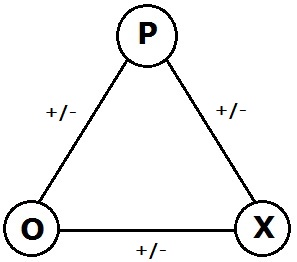
A signed graph is balanced if the product of edge signs around every cycle is positive. The name "signed graph" and the notion of balance appeared first in a mathematical paper of Frank Harary in 1953. Dénes Kőnig had already studied equivalent notions in 1936 under a different terminology but without recognizing the relevance of the sign group. At the Center for Group Dynamics at the University of Michigan, Dorwin Cartwright and Harary generalized Fritz Heider's psychological theory of balance in triangles of sentiments to a psychological theory of balance in signed graphs.
Signed graphs have been rediscovered many times because they come up naturally in many unrelated areas. For instance, they enable one to describe and analyze the geometry of subsets of the classical root systems. They appear in topological graph theory and group theory. They are a natural context for questions about odd and even cycles in graphs. They appear in computing the ground state energy in the non-ferromagnetic Ising model; for this one needs to find a largest balanced edge set in Σ. They have been applied to data classification in correlation clustering.
The sign of a path is the product of the signs of its edges. Thus a path is positive only if there are an even number of negative edges in it (where zero is even). In the mathematical balance theory of Frank Harary, a signed graph is balanced when every cycle is positive. Harary proves that a signed graph is balanced when (1) for every pair of nodes, all paths between them have the same sign, or (2) the vertices partition into a pair of subsets (possibly empty), each containing only positive edges, but connected by negative edges. It generalizes the theorem that an ordinary (unsigned) graph is bipartite if and only if every cycle has even length.
A simple proof uses the method of switching. Switching a signed graph means reversing the signs of all edges between a vertex subset and its complement. To prove Harary's theorem, one shows by induction that Σ can be switched to be all positive if and only if it is balanced.
A weaker theorem, but with a simpler proof, is that if every 3-cycle in a signed complete graph is positive, then the graph is balanced. For the proof, pick an arbitrary node n and place it and all those nodes that are linked to n by a positive edge in one group, called A, and all those linked to n by a negative edge in the other, called B. Since this is a complete graph, every two nodes in A must be friends and every two nodes in B must be friends, otherwise there would be a 3-cycle which was unbalanced. (Since this is a complete graph, any one negative edge would cause an unbalanced 3-cycle.) Likewise, all negative edges must go between the two groups.
The frustration index (early called the line index of balance) of Σ is the smallest number of edges whose deletion, or equivalently whose sign reversal (a theorem of Harary), makes Σ balanced. The reason for the equivalence is that the frustration index equals the smallest number of edges whose negation (or, equivalently, deletion) makes Σ balanced.
A second way of describing the frustration index is that it is the smallest number of edges that cover all negative cycles. This quantity has been called the negative cycle cover number.
Hub AI
Signed graph AI simulator
(@Signed graph_simulator)
Signed graph
In the area of graph theory in mathematics, a signed graph is a graph in which each edge has a positive or negative sign.
A signed graph is balanced if the product of edge signs around every cycle is positive. The name "signed graph" and the notion of balance appeared first in a mathematical paper of Frank Harary in 1953. Dénes Kőnig had already studied equivalent notions in 1936 under a different terminology but without recognizing the relevance of the sign group. At the Center for Group Dynamics at the University of Michigan, Dorwin Cartwright and Harary generalized Fritz Heider's psychological theory of balance in triangles of sentiments to a psychological theory of balance in signed graphs.
Signed graphs have been rediscovered many times because they come up naturally in many unrelated areas. For instance, they enable one to describe and analyze the geometry of subsets of the classical root systems. They appear in topological graph theory and group theory. They are a natural context for questions about odd and even cycles in graphs. They appear in computing the ground state energy in the non-ferromagnetic Ising model; for this one needs to find a largest balanced edge set in Σ. They have been applied to data classification in correlation clustering.
The sign of a path is the product of the signs of its edges. Thus a path is positive only if there are an even number of negative edges in it (where zero is even). In the mathematical balance theory of Frank Harary, a signed graph is balanced when every cycle is positive. Harary proves that a signed graph is balanced when (1) for every pair of nodes, all paths between them have the same sign, or (2) the vertices partition into a pair of subsets (possibly empty), each containing only positive edges, but connected by negative edges. It generalizes the theorem that an ordinary (unsigned) graph is bipartite if and only if every cycle has even length.
A simple proof uses the method of switching. Switching a signed graph means reversing the signs of all edges between a vertex subset and its complement. To prove Harary's theorem, one shows by induction that Σ can be switched to be all positive if and only if it is balanced.
A weaker theorem, but with a simpler proof, is that if every 3-cycle in a signed complete graph is positive, then the graph is balanced. For the proof, pick an arbitrary node n and place it and all those nodes that are linked to n by a positive edge in one group, called A, and all those linked to n by a negative edge in the other, called B. Since this is a complete graph, every two nodes in A must be friends and every two nodes in B must be friends, otherwise there would be a 3-cycle which was unbalanced. (Since this is a complete graph, any one negative edge would cause an unbalanced 3-cycle.) Likewise, all negative edges must go between the two groups.
The frustration index (early called the line index of balance) of Σ is the smallest number of edges whose deletion, or equivalently whose sign reversal (a theorem of Harary), makes Σ balanced. The reason for the equivalence is that the frustration index equals the smallest number of edges whose negation (or, equivalently, deletion) makes Σ balanced.
A second way of describing the frustration index is that it is the smallest number of edges that cover all negative cycles. This quantity has been called the negative cycle cover number.
Recent media