



Community hub
Recent from talks
Knowledge base stats:
Talk channels stats:
Members stats:
Silver Bridge
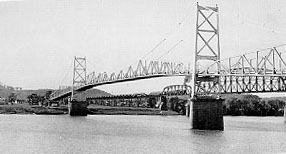
The Silver Bridge was an eyebar-chain suspension bridge built in 1928 that carried U.S. Route 35 over the Ohio River, connecting Point Pleasant, West Virginia, and Gallipolis, Ohio. Officially named the Point Pleasant Bridge, it was popularly known as the Silver Bridge for the color of its aluminum paint.
On December 15, 1967, the Silver Bridge collapsed amid heavy rush-hour traffic, resulting in the deaths of 46 people, two of whom were never found. Investigation of the wreckage soon pointed to the failure of a single eyebar in one of the suspension chains as the primary cause—a finding noted in a preliminary report released within 10 months of the collapse. However, to explain why that eyebar failed—a failure triggered by a flaw just 0.1 inches (2.5 mm) deep, which led to a fracture—required significantly more time and effort to uncover, with the final accident report taking three years to complete. The collapse led to significant changes in the way bridges in the U.S. are inspected and maintained.
The collapsed bridge was replaced by the Silver Memorial Bridge in 1969.
At the time of the Silver Bridge construction, eyebar bridges had been built for about 100 years. Such bridges had usually been constructed from redundant bar links, using rows of four to six bars, sometimes using several such chains in parallel. An example can be seen in the Clifton Suspension Bridge, designed by Isambard Kingdom Brunel having chain eyebars that are redundant in two dimensions; this early suspension bridge is still in service. Other bridges of similar design include the earlier road bridge over the Menai Strait built by Thomas Telford in 1826; the Széchenyi Chain Bridge in Budapest, built in 1839–1849, destroyed in the closing days of World War II by retreating Germans in 1945, and rebuilt identically by 1949, with redundant chains and hangers; and the Three Sisters, three self-anchored suspension bridges in Pittsburgh of similar design and construction period (from 1924 to 1928), each with suspension chains consisting of at least eight eyebars per link.
The eyebars in the Silver Bridge offered little to no redundancy, as each chain link consisted of just two eyebars in parallel. (Each bar was 45–55 feet long and 2 inches thick; bars were joined together at the eyeholes using cylindrical pins 11.5 inches in diameter.) These eyebars were made of a new, higher-strength steel (more than twice the tensile strength of other steels of that era), which meant fewer eyebars per link were needed to achieve the required strength to support the bridge (earlier such bridges often used four or more eyebars per link). However, with only two eyebars per link, the failure of one of them would hugely increase the loading on the other, making failure of a suspension chain—and the collapse of the entire bridge—far more likely. Accident investigators found that "[h]ad there been three or more eyebars per link, there would have been the possibility that the failure of one bar would not have led to disaster."
By comparison, the Brooklyn Bridge used suspension cables made up of thousands of individual wires each to provide the cables a relatively high safety factor of six. Such a cable also has an extremely high level of redundancy, with the failure of a single wire having almost no effect on its overall strength. During the Brooklyn Bridge's construction, it was discovered that some substandard steel wire had been installed in the cables. To compensate, 150 more good steel wires were added to each cable, supplementing each's 5,434 wires. The designer's son, Washington Roebling, decided the safety factor may have been reduced, but remained more than sufficient.
The two towers that supported the two suspension chains rose nearly 131 feet (40 m) from the bridge's main piers. They featured a "rocker" design, which allowed them to tilt slightly at their bases in response to unbalanced loading on the bridge, or to changes in chain length due to temperature change. Prior to their use on the Silver Bridge, rocker towers had been used on a similar bridge in Brazil and, before that, on two large bridges in Europe. Although the rocker towers required the bridge's suspension chains to keep them upright, their ability to tilt allowed the towers to minimize bending stresses—which standard, fixed-base towers must be designed to resist—resulting in a simpler tower design that used less material than fixed towers, and cost significantly less to build.
Early into the collapse investigation, the rocker towers provided a significant clue as to the failure's cause and location. Investigators noticed that both towers had fallen during the collapse, a strong indication that a suspension chain had broken—since neither tower could stand upright without the support of intact chains. (The towers themselves showed no sign of failure.) And the fact that both fell eastward (toward the West Virginia side) clearly indicated a chain break occurring somewhere west of the tower on the western side (i.e., Ohio side) of the bridge. (By contrast, a chain break occurring, say, in the center part of the span would have resulted in the towers falling in opposite directions, away from each other.)
Hub AI
Silver Bridge AI simulator
(@Silver Bridge_simulator)
Silver Bridge
The Silver Bridge was an eyebar-chain suspension bridge built in 1928 that carried U.S. Route 35 over the Ohio River, connecting Point Pleasant, West Virginia, and Gallipolis, Ohio. Officially named the Point Pleasant Bridge, it was popularly known as the Silver Bridge for the color of its aluminum paint.
On December 15, 1967, the Silver Bridge collapsed amid heavy rush-hour traffic, resulting in the deaths of 46 people, two of whom were never found. Investigation of the wreckage soon pointed to the failure of a single eyebar in one of the suspension chains as the primary cause—a finding noted in a preliminary report released within 10 months of the collapse. However, to explain why that eyebar failed—a failure triggered by a flaw just 0.1 inches (2.5 mm) deep, which led to a fracture—required significantly more time and effort to uncover, with the final accident report taking three years to complete. The collapse led to significant changes in the way bridges in the U.S. are inspected and maintained.
The collapsed bridge was replaced by the Silver Memorial Bridge in 1969.
At the time of the Silver Bridge construction, eyebar bridges had been built for about 100 years. Such bridges had usually been constructed from redundant bar links, using rows of four to six bars, sometimes using several such chains in parallel. An example can be seen in the Clifton Suspension Bridge, designed by Isambard Kingdom Brunel having chain eyebars that are redundant in two dimensions; this early suspension bridge is still in service. Other bridges of similar design include the earlier road bridge over the Menai Strait built by Thomas Telford in 1826; the Széchenyi Chain Bridge in Budapest, built in 1839–1849, destroyed in the closing days of World War II by retreating Germans in 1945, and rebuilt identically by 1949, with redundant chains and hangers; and the Three Sisters, three self-anchored suspension bridges in Pittsburgh of similar design and construction period (from 1924 to 1928), each with suspension chains consisting of at least eight eyebars per link.
The eyebars in the Silver Bridge offered little to no redundancy, as each chain link consisted of just two eyebars in parallel. (Each bar was 45–55 feet long and 2 inches thick; bars were joined together at the eyeholes using cylindrical pins 11.5 inches in diameter.) These eyebars were made of a new, higher-strength steel (more than twice the tensile strength of other steels of that era), which meant fewer eyebars per link were needed to achieve the required strength to support the bridge (earlier such bridges often used four or more eyebars per link). However, with only two eyebars per link, the failure of one of them would hugely increase the loading on the other, making failure of a suspension chain—and the collapse of the entire bridge—far more likely. Accident investigators found that "[h]ad there been three or more eyebars per link, there would have been the possibility that the failure of one bar would not have led to disaster."
By comparison, the Brooklyn Bridge used suspension cables made up of thousands of individual wires each to provide the cables a relatively high safety factor of six. Such a cable also has an extremely high level of redundancy, with the failure of a single wire having almost no effect on its overall strength. During the Brooklyn Bridge's construction, it was discovered that some substandard steel wire had been installed in the cables. To compensate, 150 more good steel wires were added to each cable, supplementing each's 5,434 wires. The designer's son, Washington Roebling, decided the safety factor may have been reduced, but remained more than sufficient.
The two towers that supported the two suspension chains rose nearly 131 feet (40 m) from the bridge's main piers. They featured a "rocker" design, which allowed them to tilt slightly at their bases in response to unbalanced loading on the bridge, or to changes in chain length due to temperature change. Prior to their use on the Silver Bridge, rocker towers had been used on a similar bridge in Brazil and, before that, on two large bridges in Europe. Although the rocker towers required the bridge's suspension chains to keep them upright, their ability to tilt allowed the towers to minimize bending stresses—which standard, fixed-base towers must be designed to resist—resulting in a simpler tower design that used less material than fixed towers, and cost significantly less to build.
Early into the collapse investigation, the rocker towers provided a significant clue as to the failure's cause and location. Investigators noticed that both towers had fallen during the collapse, a strong indication that a suspension chain had broken—since neither tower could stand upright without the support of intact chains. (The towers themselves showed no sign of failure.) And the fact that both fell eastward (toward the West Virginia side) clearly indicated a chain break occurring somewhere west of the tower on the western side (i.e., Ohio side) of the bridge. (By contrast, a chain break occurring, say, in the center part of the span would have resulted in the towers falling in opposite directions, away from each other.)