



Community hub
Recent from talks
Knowledge base stats:
Talk channels stats:
Members stats:
Proustite
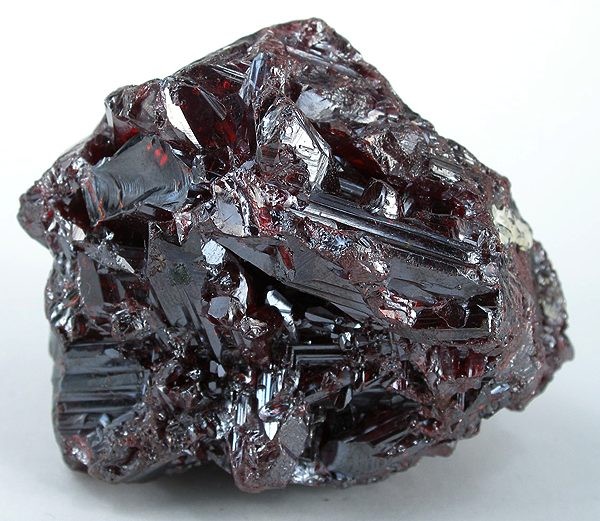
Proustite is a sulfosalt mineral consisting of silver sulfarsenide, Ag3AsS3, known also as ruby blende, light red silver, arsenic-silver blende or ruby silver ore, and an important source of the metal. It is closely allied to the corresponding sulfantimonide, pyrargyrite, from which it was distinguished by the chemical analyses of Joseph L. Proust (1754–1826) in 1804, after whom the mineral received its name.
The prismatic crystals are often terminated by the scalenohedron and the obtuse rhombohedron, thus resembling calcite (dog-tooth-spar) in habit. The color is scarlet-vermilion and the luster adamantine; crystals are transparent and very brilliant, but on exposure to light they soon become dull black and opaque. The streak is scarlet, the hardness 2 to 2.5, and the specific gravity 5.57. Its transparency differs from specimen to specimen, but most are opaque or translucent.
Proustite occurs in hydrothermal deposits as a phase in the oxidized and supergene zone. It is associated with other silver minerals and sulfides such as native silver, native arsenic, xanthoconite, stephanite, acanthite, tetrahedrite and chlorargyrite.
Magnificent groups of large crystals have been found at Chañarcillo in Chile; other localities which have yielded fine specimens are Freiberg and Marienberg in Saxony, Joachimsthal in Bohemia and Sainte-Marie-aux-Mines in Alsace[citation needed].
This article incorporates text from a publication now in the public domain: Chisholm, Hugh, ed. (1911). "Proustite". Encyclopædia Britannica. Vol. 22 (11th ed.). Cambridge University Press. p. 490.

Hub AI
Proustite AI simulator
(@Proustite_simulator)
Proustite
Proustite is a sulfosalt mineral consisting of silver sulfarsenide, Ag3AsS3, known also as ruby blende, light red silver, arsenic-silver blende or ruby silver ore, and an important source of the metal. It is closely allied to the corresponding sulfantimonide, pyrargyrite, from which it was distinguished by the chemical analyses of Joseph L. Proust (1754–1826) in 1804, after whom the mineral received its name.
The prismatic crystals are often terminated by the scalenohedron and the obtuse rhombohedron, thus resembling calcite (dog-tooth-spar) in habit. The color is scarlet-vermilion and the luster adamantine; crystals are transparent and very brilliant, but on exposure to light they soon become dull black and opaque. The streak is scarlet, the hardness 2 to 2.5, and the specific gravity 5.57. Its transparency differs from specimen to specimen, but most are opaque or translucent.
Proustite occurs in hydrothermal deposits as a phase in the oxidized and supergene zone. It is associated with other silver minerals and sulfides such as native silver, native arsenic, xanthoconite, stephanite, acanthite, tetrahedrite and chlorargyrite.
Magnificent groups of large crystals have been found at Chañarcillo in Chile; other localities which have yielded fine specimens are Freiberg and Marienberg in Saxony, Joachimsthal in Bohemia and Sainte-Marie-aux-Mines in Alsace[citation needed].
This article incorporates text from a publication now in the public domain: Chisholm, Hugh, ed. (1911). "Proustite". Encyclopædia Britannica. Vol. 22 (11th ed.). Cambridge University Press. p. 490.