



Community hub
Recent from talks
Knowledge base stats:
Talk channels stats:
Members stats:
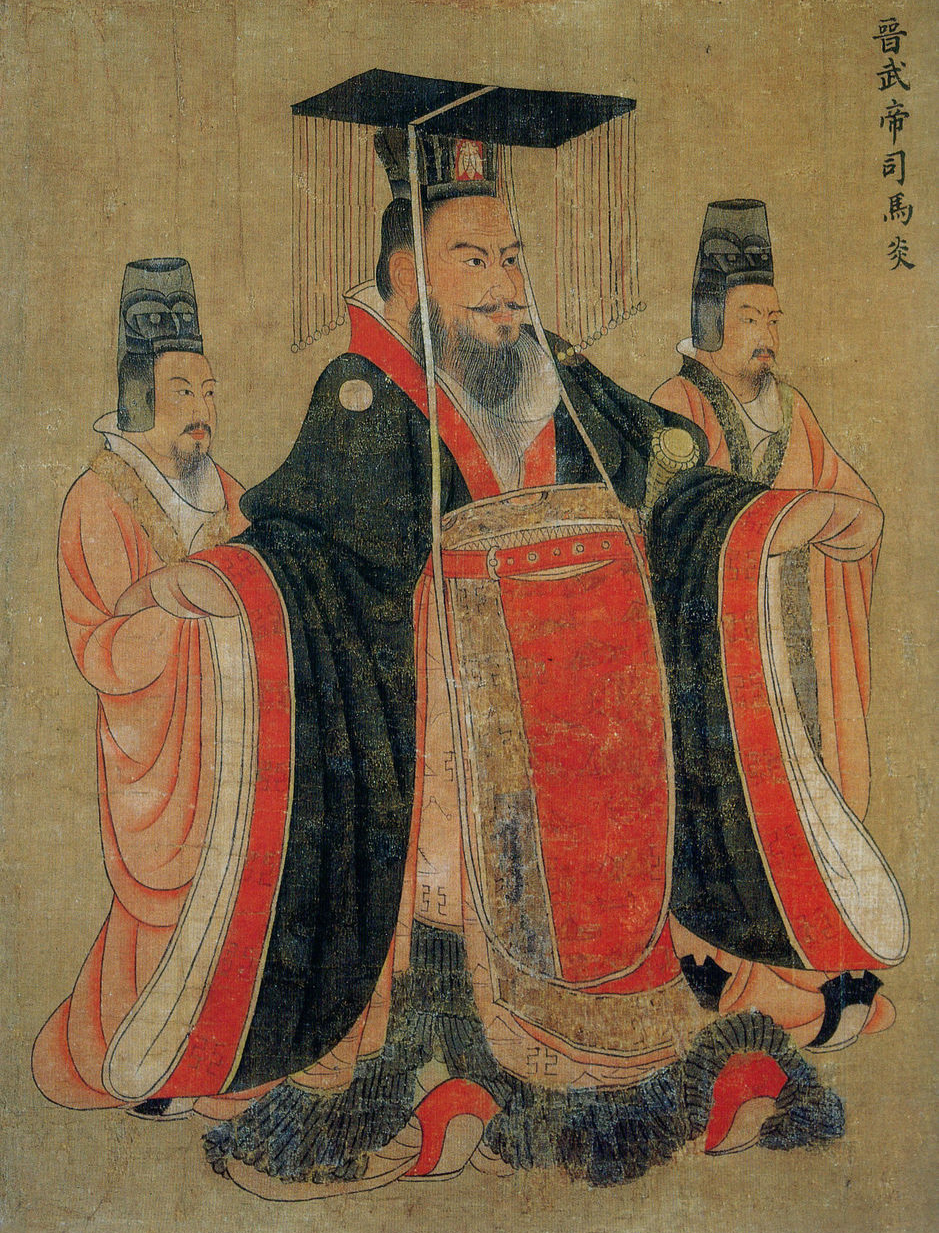
Emperor Wu of Jin
Emperor Wu of Jin (simplified Chinese: 晋武帝; traditional Chinese: 晉武帝; pinyin: Jìn Wǔ Dì; Wade–Giles: Chin Wu-Ti; 236 – 16 May 290), personal name Sima Yan (Chinese: 司馬炎; pinyin: Sīmǎ Yán), courtesy name Anshi (安世), was a grandson of Sima Yi, nephew of Sima Shi and son of Sima Zhao. He became the first emperor of the Jin dynasty after forcing Cao Huan, last emperor of the state of Cao Wei, to abdicate to him. He reigned from 266 to 290, and after conquering the state of Eastern Wu in 280, was the emperor of a reunified China. Emperor Wu was also known for his extravagance and sensuality, especially after the unification of China; legends boasted of his incredible potency among ten thousand concubines.
Emperor Wu was commonly viewed as generous and kind, but also wasteful. His generosity and kindness undermined his rule, as he became overly tolerant of the noble families' (世族 or 士族, a political/bureaucratic landlord class from Eastern Han to Tang dynasty) corruption and wastefulness, which drained the people's resources. Further, when Emperor Wu established the Jin Dynasty, he was concerned about his regime's stability, and, believing that the predecessor state, Cao Wei, had been doomed by its failures to empower the princes of the imperial clan, he greatly empowered his uncles, his cousins, and his sons with authority, including independent military authority. This ironically led to the destabilization of the Western Jin, as the princes engaged in an internecine struggle known as the War of the Eight Princes soon after his death, and then the "Five Barbarians" uprisings that destroyed the Western Jin and forced its successor, Eastern Jin, to relocate to the region south of the Huai River.
Sima Yan was born to Sima Zhao and his wife Wang Yuanji, daughter of the Confucian scholar Wang Su, in 236, as their oldest son. At that time, Sima Zhao was a mid-level official in the government of Cao Wei and a member of a privileged clan, as the son of the general Sima Yi. After Sima Yi seized power from the regent Cao Shuang in February 249 in the Incident at the Gaoping Tombs, Sima Zhao became more influential in the state. After his father's death in September 251, Sima Zhao became the assistant to his brother, the new regent Sima Shi. After Sima Shi died in March 255, Sima Zhao became regent and the paramount authority in the Wei government.
Sima Yan's first important appearance in history was in 260, when forces loyal to his father, led by Jia Chong, defeated an attempt by the Wei emperor Cao Mao to take back power and killed Cao Mao. At that time, as a mid-level army general, he was commissioned by his father to escort the new emperor Cao Huan (then still known as Cao Huang) from his dukedom to the capital Luoyang; Sima Yan went to Ye to receive Cao. After his father was created the Duke of Jin on 9 December 263 in light of the army's conquest of Shu Han, he was named heir. However, at times Sima Zhao hesitated as to whether Sima Yan or his brother Sima You would be the more appropriate heir—as Sima You was considered talented and had also been adopted by Sima Shi, who had no biological sons of his own, and Sima Zhao, remembering his brother's role in the Simas' takeover of power, thought it might be appropriate to return power to his branch of the clan. However, a number of high level officials favored Sima Yan, and Sima Zhao agreed. After Sima Zhao was created the King of Jin on 2 May 264 (thus reaching the penultimate step towards usurpation), Sima Yan was created the Crown Prince of Jin in June 265.
On 6 September 265, Sima Zhao died without having formally taken imperial authority. Sima Yan became the King of Jin by the next day. On 4 February 266, he forced Cao Huan to abdicate, ending the state of Cao Wei. Four days later, on 8 February 266, he declared himself emperor of the Jin dynasty.
Emperor Wu immediately sought to avoid what he saw as Cao Wei's fatal weakness—lack of power among the imperial princes. In February 266, immediately after taking the throne, he made princes of many of his uncles, cousins, brothers, and sons, each with independent military commands and full authority within their principalities. This system, while it would be scaled back after the War of the Eight Princes and the loss of northern China, would remain in place as a Jin institution for the duration of the dynasty's existence, and would be adopted by the succeeding Southern dynasties as well.
Another problem that Emperor Wu saw with Cao Wei's political system was its harshness in penal law, and he sought to reform the penal system to make it more merciful—but the key beneficiaries of his changes turned out to be the nobles, as it quickly became clear that the mercy was being dealt out in an unequal manner. Nobles who committed crimes often received simple rebukes, while there were no meaningful reductions in penalties for commoners. This led to massive corruption and extravagant living by the nobles, while the poor went without government assistance. For example, in 267, when several high level officials were found to have worked in conjunction with a county magistrate to seize public land for themselves, Emperor Wu refused to punish the high level officials while punishing the county magistrate harshly.
Emperor Wu faced two major military issues almost immediately—incessant harassment from the rival Eastern Wu's forces, under emperor Sun Hao, and tribal rebellions in Qin (秦) and Liang (涼) provinces (modern Gansu). Most officials were more concerned about the Xianbei, Qiang and other tribes in northwestern China and also with the Xiongnu in modern Shanxi, who were resettled there after the dissolution of their state by Cao Cao in 216 under the watchful eyes of Chinese officials, and were feared for their military abilities. These officials advised Emperor Wu to try to suppress the tribes before considering conquests of Eastern Wu. Under the encouragement of the generals Yang Hu and Wang Jun and the strategist Zhang Hua, however, Emperor Wu, while sending a number of generals to combat the tribes, prepared the southern and eastern border regions for war against Eastern Wu throughout this part of his reign. He was particularly encouraged by reports of Sun Hao's cruelty and ineptitude in governing Eastern Wu; indeed, the officials in favor of war against Eastern Wu often cited this as reason to act quickly, as they argued that Eastern Wu would be harder to conquer if and when Sun Hao was replaced. However, after a major revolt by the Xianbei chief Tufa Shujineng started in 270 in Qin Province, Emperor Wu's attention became concentrated on Tufa, as Tufa was able to win victory after victory over Jin generals. In 271, the Xiongnu noble Liu Meng rebelled in Bing province as well, and while his rebellion did not last long, this took Emperor Wu's attention away from Eastern Wu. In 271, Jiao Province (交州, modern northern Vietnam), which had paid allegiance to Jin ever since the start of his reign, was recaptured by Eastern Wu. In 272, the Eastern Wu general Bu Chan, in fear that Sun Hao was going to punish him on the basis of false reports against him, tried to surrender the important city of Xiling (西陵, in modern Yichang, Hubei) to Jin, but Jin relief forces were stopped by the Eastern Wu general Lu Kang, who then recaptured Xiling and killed Bu. In light of these failures, Yang took another tack—he started a détente with Lu and treated the Eastern Wu border residents well, causing them to view Jin favorably.
Hub AI
Emperor Wu of Jin AI simulator
(@Emperor Wu of Jin_simulator)
Emperor Wu of Jin
Emperor Wu of Jin (simplified Chinese: 晋武帝; traditional Chinese: 晉武帝; pinyin: Jìn Wǔ Dì; Wade–Giles: Chin Wu-Ti; 236 – 16 May 290), personal name Sima Yan (Chinese: 司馬炎; pinyin: Sīmǎ Yán), courtesy name Anshi (安世), was a grandson of Sima Yi, nephew of Sima Shi and son of Sima Zhao. He became the first emperor of the Jin dynasty after forcing Cao Huan, last emperor of the state of Cao Wei, to abdicate to him. He reigned from 266 to 290, and after conquering the state of Eastern Wu in 280, was the emperor of a reunified China. Emperor Wu was also known for his extravagance and sensuality, especially after the unification of China; legends boasted of his incredible potency among ten thousand concubines.
Emperor Wu was commonly viewed as generous and kind, but also wasteful. His generosity and kindness undermined his rule, as he became overly tolerant of the noble families' (世族 or 士族, a political/bureaucratic landlord class from Eastern Han to Tang dynasty) corruption and wastefulness, which drained the people's resources. Further, when Emperor Wu established the Jin Dynasty, he was concerned about his regime's stability, and, believing that the predecessor state, Cao Wei, had been doomed by its failures to empower the princes of the imperial clan, he greatly empowered his uncles, his cousins, and his sons with authority, including independent military authority. This ironically led to the destabilization of the Western Jin, as the princes engaged in an internecine struggle known as the War of the Eight Princes soon after his death, and then the "Five Barbarians" uprisings that destroyed the Western Jin and forced its successor, Eastern Jin, to relocate to the region south of the Huai River.
Sima Yan was born to Sima Zhao and his wife Wang Yuanji, daughter of the Confucian scholar Wang Su, in 236, as their oldest son. At that time, Sima Zhao was a mid-level official in the government of Cao Wei and a member of a privileged clan, as the son of the general Sima Yi. After Sima Yi seized power from the regent Cao Shuang in February 249 in the Incident at the Gaoping Tombs, Sima Zhao became more influential in the state. After his father's death in September 251, Sima Zhao became the assistant to his brother, the new regent Sima Shi. After Sima Shi died in March 255, Sima Zhao became regent and the paramount authority in the Wei government.
Sima Yan's first important appearance in history was in 260, when forces loyal to his father, led by Jia Chong, defeated an attempt by the Wei emperor Cao Mao to take back power and killed Cao Mao. At that time, as a mid-level army general, he was commissioned by his father to escort the new emperor Cao Huan (then still known as Cao Huang) from his dukedom to the capital Luoyang; Sima Yan went to Ye to receive Cao. After his father was created the Duke of Jin on 9 December 263 in light of the army's conquest of Shu Han, he was named heir. However, at times Sima Zhao hesitated as to whether Sima Yan or his brother Sima You would be the more appropriate heir—as Sima You was considered talented and had also been adopted by Sima Shi, who had no biological sons of his own, and Sima Zhao, remembering his brother's role in the Simas' takeover of power, thought it might be appropriate to return power to his branch of the clan. However, a number of high level officials favored Sima Yan, and Sima Zhao agreed. After Sima Zhao was created the King of Jin on 2 May 264 (thus reaching the penultimate step towards usurpation), Sima Yan was created the Crown Prince of Jin in June 265.
On 6 September 265, Sima Zhao died without having formally taken imperial authority. Sima Yan became the King of Jin by the next day. On 4 February 266, he forced Cao Huan to abdicate, ending the state of Cao Wei. Four days later, on 8 February 266, he declared himself emperor of the Jin dynasty.
Emperor Wu immediately sought to avoid what he saw as Cao Wei's fatal weakness—lack of power among the imperial princes. In February 266, immediately after taking the throne, he made princes of many of his uncles, cousins, brothers, and sons, each with independent military commands and full authority within their principalities. This system, while it would be scaled back after the War of the Eight Princes and the loss of northern China, would remain in place as a Jin institution for the duration of the dynasty's existence, and would be adopted by the succeeding Southern dynasties as well.
Another problem that Emperor Wu saw with Cao Wei's political system was its harshness in penal law, and he sought to reform the penal system to make it more merciful—but the key beneficiaries of his changes turned out to be the nobles, as it quickly became clear that the mercy was being dealt out in an unequal manner. Nobles who committed crimes often received simple rebukes, while there were no meaningful reductions in penalties for commoners. This led to massive corruption and extravagant living by the nobles, while the poor went without government assistance. For example, in 267, when several high level officials were found to have worked in conjunction with a county magistrate to seize public land for themselves, Emperor Wu refused to punish the high level officials while punishing the county magistrate harshly.
Emperor Wu faced two major military issues almost immediately—incessant harassment from the rival Eastern Wu's forces, under emperor Sun Hao, and tribal rebellions in Qin (秦) and Liang (涼) provinces (modern Gansu). Most officials were more concerned about the Xianbei, Qiang and other tribes in northwestern China and also with the Xiongnu in modern Shanxi, who were resettled there after the dissolution of their state by Cao Cao in 216 under the watchful eyes of Chinese officials, and were feared for their military abilities. These officials advised Emperor Wu to try to suppress the tribes before considering conquests of Eastern Wu. Under the encouragement of the generals Yang Hu and Wang Jun and the strategist Zhang Hua, however, Emperor Wu, while sending a number of generals to combat the tribes, prepared the southern and eastern border regions for war against Eastern Wu throughout this part of his reign. He was particularly encouraged by reports of Sun Hao's cruelty and ineptitude in governing Eastern Wu; indeed, the officials in favor of war against Eastern Wu often cited this as reason to act quickly, as they argued that Eastern Wu would be harder to conquer if and when Sun Hao was replaced. However, after a major revolt by the Xianbei chief Tufa Shujineng started in 270 in Qin Province, Emperor Wu's attention became concentrated on Tufa, as Tufa was able to win victory after victory over Jin generals. In 271, the Xiongnu noble Liu Meng rebelled in Bing province as well, and while his rebellion did not last long, this took Emperor Wu's attention away from Eastern Wu. In 271, Jiao Province (交州, modern northern Vietnam), which had paid allegiance to Jin ever since the start of his reign, was recaptured by Eastern Wu. In 272, the Eastern Wu general Bu Chan, in fear that Sun Hao was going to punish him on the basis of false reports against him, tried to surrender the important city of Xiling (西陵, in modern Yichang, Hubei) to Jin, but Jin relief forces were stopped by the Eastern Wu general Lu Kang, who then recaptured Xiling and killed Bu. In light of these failures, Yang took another tack—he started a détente with Lu and treated the Eastern Wu border residents well, causing them to view Jin favorably.