
Recent from talks
Simple harmonic motion
Knowledge base stats:
Talk channels stats:
Members stats:
Simple harmonic motion
In mechanics and physics, simple harmonic motion (sometimes abbreviated as SHM) is a special type of periodic motion an object experiences by means of a restoring force whose magnitude is directly proportional to the distance of the object from an equilibrium position and acts towards the equilibrium position. It results in an oscillation that is described by a sinusoid which continues indefinitely (if uninhibited by friction or any other dissipation of energy).
Simple harmonic motion can serve as a mathematical model for a variety of motions, but is typified by the oscillation of a mass on a spring when it is subject to the linear elastic restoring force given by Hooke's law. The motion is sinusoidal in time and demonstrates a single resonant frequency. Other phenomena can be modeled by simple harmonic motion, including the motion of a simple pendulum, although for it to be an accurate model, the net force on the object at the end of the pendulum must be proportional to the displacement (and even so, it is only a good approximation when the angle of the swing is small; see small-angle approximation). Simple harmonic motion can also be used to model molecular vibration.
Simple harmonic motion provides a basis for the characterization of more complicated periodic motion through the techniques of Fourier analysis.
The motion of a particle moving along a straight line with an acceleration whose direction is always toward a fixed point on the line and whose magnitude is proportional to the displacement from the fixed point is called simple harmonic motion.
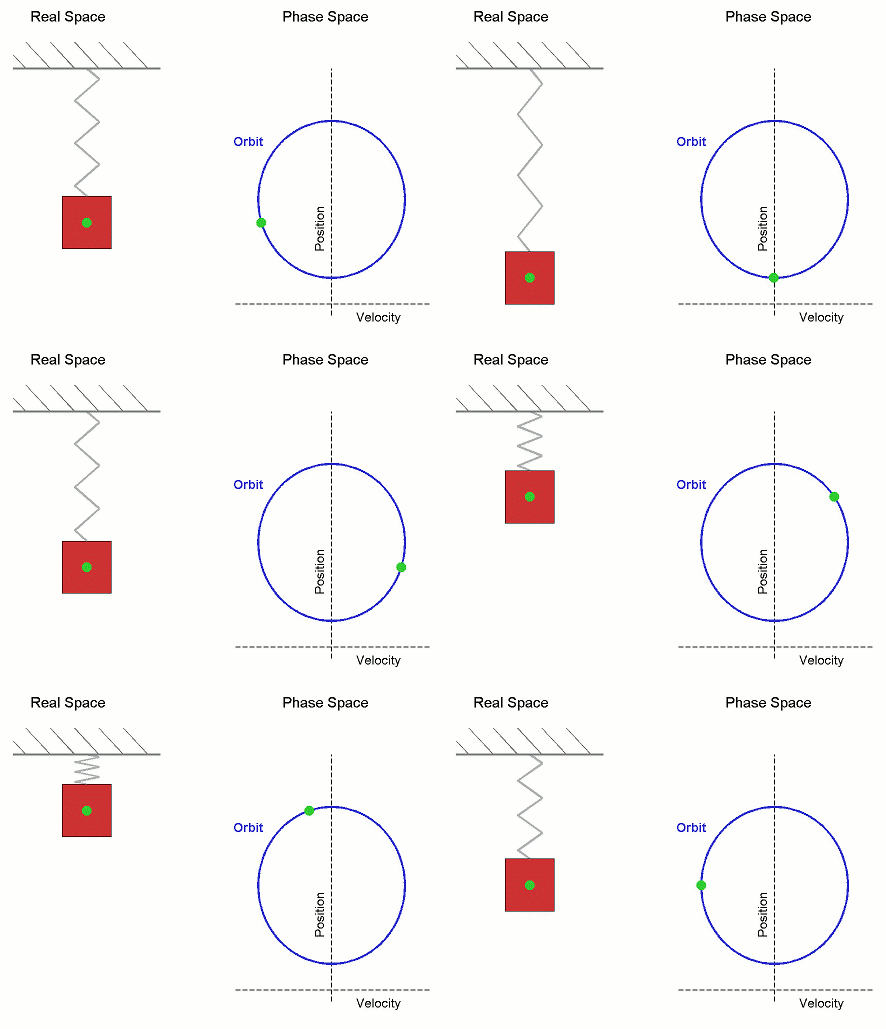
In the diagram, a simple harmonic oscillator, consisting of a weight attached to one end of a spring, is shown. The other end of the spring is connected to a rigid support such as a wall. If the system is left at rest at the equilibrium position then there is no net force acting on the mass. However, if the mass is displaced from the equilibrium position, the spring exerts a restoring elastic force that obeys Hooke's law.
Mathematically, where F is the restoring elastic force exerted by the spring (in SI units: N), k is the spring constant (N·m−1), and x is the displacement from the equilibrium position (in metres).

For any simple mechanical harmonic oscillator:
Once the mass is displaced from its equilibrium position, it experiences a net restoring force. As a result, it accelerates and starts going back to the equilibrium position. When the mass moves closer to the equilibrium position, the restoring force decreases. At the equilibrium position, the net restoring force vanishes. However, at x = 0, the mass has momentum because of the acceleration that the restoring force has imparted. Therefore, the mass continues past the equilibrium position, compressing the spring. A net restoring force then slows it down until its velocity reaches zero, whereupon it is accelerated back to the equilibrium position again.
Hub AI
Simple harmonic motion AI simulator
(@Simple harmonic motion_simulator)
Simple harmonic motion
In mechanics and physics, simple harmonic motion (sometimes abbreviated as SHM) is a special type of periodic motion an object experiences by means of a restoring force whose magnitude is directly proportional to the distance of the object from an equilibrium position and acts towards the equilibrium position. It results in an oscillation that is described by a sinusoid which continues indefinitely (if uninhibited by friction or any other dissipation of energy).
Simple harmonic motion can serve as a mathematical model for a variety of motions, but is typified by the oscillation of a mass on a spring when it is subject to the linear elastic restoring force given by Hooke's law. The motion is sinusoidal in time and demonstrates a single resonant frequency. Other phenomena can be modeled by simple harmonic motion, including the motion of a simple pendulum, although for it to be an accurate model, the net force on the object at the end of the pendulum must be proportional to the displacement (and even so, it is only a good approximation when the angle of the swing is small; see small-angle approximation). Simple harmonic motion can also be used to model molecular vibration.
Simple harmonic motion provides a basis for the characterization of more complicated periodic motion through the techniques of Fourier analysis.
The motion of a particle moving along a straight line with an acceleration whose direction is always toward a fixed point on the line and whose magnitude is proportional to the displacement from the fixed point is called simple harmonic motion.
In the diagram, a simple harmonic oscillator, consisting of a weight attached to one end of a spring, is shown. The other end of the spring is connected to a rigid support such as a wall. If the system is left at rest at the equilibrium position then there is no net force acting on the mass. However, if the mass is displaced from the equilibrium position, the spring exerts a restoring elastic force that obeys Hooke's law.
Mathematically, where F is the restoring elastic force exerted by the spring (in SI units: N), k is the spring constant (N·m−1), and x is the displacement from the equilibrium position (in metres).
For any simple mechanical harmonic oscillator:
Once the mass is displaced from its equilibrium position, it experiences a net restoring force. As a result, it accelerates and starts going back to the equilibrium position. When the mass moves closer to the equilibrium position, the restoring force decreases. At the equilibrium position, the net restoring force vanishes. However, at x = 0, the mass has momentum because of the acceleration that the restoring force has imparted. Therefore, the mass continues past the equilibrium position, compressing the spring. A net restoring force then slows it down until its velocity reaches zero, whereupon it is accelerated back to the equilibrium position again.
Recent media