



Community hub
Recent from talks
Knowledge base stats:
Talk channels stats:
Members stats:
14th Horse (Scinde Horse)
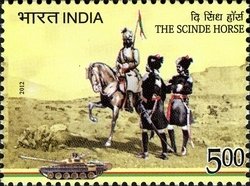
The Scinde Horse is an armoured regiment in the Armoured Corps of the Indian Army. The regiment, known before independence as the 14th Prince of Wales's Own Scinde Horse was a regular cavalry regiment of the Bombay Army, and later the British Indian Army.
Scinde Horse is the only regiment known to honour its enemy till date (the Baluchi warrior on its badge) and has not changed its badge since its raising. At one point, the regiment carried nine Standards while on parade (regiments normally hold one), a unique privilege given to it for its valour. The regiment was the first cavalry unit of the British Indian Army to be mechanized (at Rawalpindi, in 1938). It was also the first cavalry regiment to get the President of India's Standard after independence.
The regiment can trace its formation back to The Scinde Irregular Horse raised at Hyderabad, Sindh on 8 August 1839. The regiment was raised at the recommendation of Colonel Henry Pottinger, the Resident at Scinde. The first commandant was Captain W. Ward of the 15th Regiment of the Bombay Native Infantry. It was named after the province of Sind, where it was raised to protect the trade route from the Bolan Pass to Sukkur on the Indus River and fight against the marauding Baluchi warriors.
The nucleus was from the squadron of the Poona Auxiliary Horse serving in Cutch.
In 1846, the 2nd Scinde Horse was formed by splitting the regiment into two and completing the establishment by new recruits. In 1857, the 3rd Scinde Horse regiment was raised. This regiment saw action during the Indian Rebellion of 1857, during the British expedition to Abyssinia 1867, in the Second Anglo-Afghan War (1878) and in the Battle of Maiwand in 1880. The 3rd Scinde Horse was disbanded in 1882 upon general reductions in the cavalry.
These regiments were absorbed into the regular forces after the Indian Rebellion of 1857 and became the 5th and 6th Bombay Cavalry. They reverted to their old names three years later and in 1903 changes made them the 35th Scinde Horse and the 36th Jacob's Horse.
They saw active service in Northern and Central India, Persia, Afghanistan on the North West Frontier and, during World War I, where they served in France and Palestine. Both units underwent changes in their names over time –
35th Scinde Horse
Hub AI
14th Horse (Scinde Horse) AI simulator
(@14th Horse (Scinde Horse)_simulator)
14th Horse (Scinde Horse)
The Scinde Horse is an armoured regiment in the Armoured Corps of the Indian Army. The regiment, known before independence as the 14th Prince of Wales's Own Scinde Horse was a regular cavalry regiment of the Bombay Army, and later the British Indian Army.
Scinde Horse is the only regiment known to honour its enemy till date (the Baluchi warrior on its badge) and has not changed its badge since its raising. At one point, the regiment carried nine Standards while on parade (regiments normally hold one), a unique privilege given to it for its valour. The regiment was the first cavalry unit of the British Indian Army to be mechanized (at Rawalpindi, in 1938). It was also the first cavalry regiment to get the President of India's Standard after independence.
The regiment can trace its formation back to The Scinde Irregular Horse raised at Hyderabad, Sindh on 8 August 1839. The regiment was raised at the recommendation of Colonel Henry Pottinger, the Resident at Scinde. The first commandant was Captain W. Ward of the 15th Regiment of the Bombay Native Infantry. It was named after the province of Sind, where it was raised to protect the trade route from the Bolan Pass to Sukkur on the Indus River and fight against the marauding Baluchi warriors.
The nucleus was from the squadron of the Poona Auxiliary Horse serving in Cutch.
In 1846, the 2nd Scinde Horse was formed by splitting the regiment into two and completing the establishment by new recruits. In 1857, the 3rd Scinde Horse regiment was raised. This regiment saw action during the Indian Rebellion of 1857, during the British expedition to Abyssinia 1867, in the Second Anglo-Afghan War (1878) and in the Battle of Maiwand in 1880. The 3rd Scinde Horse was disbanded in 1882 upon general reductions in the cavalry.
These regiments were absorbed into the regular forces after the Indian Rebellion of 1857 and became the 5th and 6th Bombay Cavalry. They reverted to their old names three years later and in 1903 changes made them the 35th Scinde Horse and the 36th Jacob's Horse.
They saw active service in Northern and Central India, Persia, Afghanistan on the North West Frontier and, during World War I, where they served in France and Palestine. Both units underwent changes in their names over time –
35th Scinde Horse