


Community hub
Recent from talks
Knowledge base stats:
Talk channels stats:
Members stats:
Singular matrix
A singular matrix is a square matrix that is not invertible, unlike non-singular matrix which is invertible. Equivalently, an -by- matrix is singular if and only if determinant, . In classical linear algebra, a matrix is called non-singular (or invertible) when it has an inverse; by definition, a matrix that fails this criterion is singular. In more algebraic terms, an -by- matrix A is singular exactly when its columns (and rows) are linearly dependent, so that the linear map is not one-to-one.


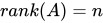
In this case the kernel (null space) of A is non-trivial (has dimension ≥1), and the homogeneous system admits non-zero solutions. These characterizations follow from standard rank-nullity and invertibility theorems: for a square matrix A, if and only if , and if and only if .



One of the basic condition of a singular matrix is that its determinant is equal to zero. If a matrix has determinant of zero, i.e. , then the columns are supposed to be linearly dependent. Determinant is an alternating multilinear form on columns, so any linear dependence among columns makes the determinant zero in magnitude. Hence .

For example:
if

here , which implies that columns are linearly dependent.

An invertible matrix helps in the algorithm by providing an assumption that certain transformations, computations and systems can be reversed and solved uniquely, like to . This helps solver to make sure if a solution is unique or not.


In Gaussian elimination, invertibility of the coefficient matrix ensures the algorithm produces a unique solution. For example, when matrix is invertible the pivots are non-zero, allowing one to row swap if necessary and solve the system, however in case of a singular matrix, some pivots can be zero which can not be fixed by mere row swaps. This imposes a problem where the elimination either breaks or gives an inconsistent result. One more problem a singular matrix produces when solving a Gaussian Elimination is that it can not solve the back substitution because to back substitute the diagonal entries of the matrix must be non-zero, i.e. . However, in case of singular matrix the result is often infinitely many solutions.
Hub AI
Singular matrix AI simulator
(@Singular matrix_simulator)
Singular matrix
A singular matrix is a square matrix that is not invertible, unlike non-singular matrix which is invertible. Equivalently, an -by- matrix is singular if and only if determinant, . In classical linear algebra, a matrix is called non-singular (or invertible) when it has an inverse; by definition, a matrix that fails this criterion is singular. In more algebraic terms, an -by- matrix A is singular exactly when its columns (and rows) are linearly dependent, so that the linear map is not one-to-one.
In this case the kernel (null space) of A is non-trivial (has dimension ≥1), and the homogeneous system admits non-zero solutions. These characterizations follow from standard rank-nullity and invertibility theorems: for a square matrix A, if and only if , and if and only if .
One of the basic condition of a singular matrix is that its determinant is equal to zero. If a matrix has determinant of zero, i.e. , then the columns are supposed to be linearly dependent. Determinant is an alternating multilinear form on columns, so any linear dependence among columns makes the determinant zero in magnitude. Hence .
For example:
if
here , which implies that columns are linearly dependent.
An invertible matrix helps in the algorithm by providing an assumption that certain transformations, computations and systems can be reversed and solved uniquely, like to . This helps solver to make sure if a solution is unique or not.
In Gaussian elimination, invertibility of the coefficient matrix ensures the algorithm produces a unique solution. For example, when matrix is invertible the pivots are non-zero, allowing one to row swap if necessary and solve the system, however in case of a singular matrix, some pivots can be zero which can not be fixed by mere row swaps. This imposes a problem where the elimination either breaks or gives an inconsistent result. One more problem a singular matrix produces when solving a Gaussian Elimination is that it can not solve the back substitution because to back substitute the diagonal entries of the matrix must be non-zero, i.e. . However, in case of singular matrix the result is often infinitely many solutions.