
Recent from talks
Skewes's number
Knowledge base stats:
Talk channels stats:
Members stats:
Skewes's number
In number theory, Skewes's number is the smallest natural number for which the prime-counting function exceeds the logarithmic integral function It is named for the South African mathematician Stanley Skewes who first computed an upper bound on its value.


The exact value of Skewes's number is still not known, but it is known that there is a crossing between and near It is not known whether this is the smallest crossing.



The name is sometimes also applied to either of the large number bounds which Skewes found.
Although nobody has ever found a value of for which Skewes's research supervisor J.E. Littlewood had proved in Littlewood (1914) that there is such a number (and so, a first such number); and indeed found that the sign of the difference changes infinitely many times. Littlewood's proof did not, however, exhibit a concrete such number , nor did it even give any bounds on the value.


Skewes's task was to make Littlewood's existence proof effective: exhibit some concrete upper bound for the first sign change. According to Georg Kreisel, this was not considered obvious even in principle at the time.
Skewes (1933) proved that, assuming that the Riemann hypothesis is true, there exists a number violating below
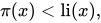
Without assuming the Riemann hypothesis, Skewes (1955) later proved that there exists a value of below
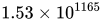
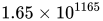
These upper bounds have since been reduced considerably by using large-scale computer calculations of zeros of the Riemann zeta function. The first estimate for the actual value of a crossover point was given by Lehman (1966), who showed that somewhere between and there are more than consecutive integers with . Without assuming the Riemann hypothesis, H. J. J. te Riele (1987) proved an upper bound of . A better estimate was discovered by Bays & Hudson (2000), who showed there are at least consecutive integers somewhere near this value where . Bays and Hudson found a few much smaller values of where gets close to ; the possibility that there are crossover points near these values does not seem to have been definitely ruled out yet, though computer calculations suggest they are unlikely to exist. Chao & Plymen (2010) gave a small improvement and correction to the result of Bays and Hudson. Saouter & Demichel (2010) found a smaller interval for a crossing, which was slightly improved by Zegowitz (2010). The same source shows that there exists a number violating below . This can be reduced to assuming the Riemann hypothesis. Stoll & Demichel (2011) conducted an analysis with up to 2×10¹¹ complex zeros which gives computational evidence that a crossover may exist near .








Hub AI
Skewes's number AI simulator
(@Skewes's number_simulator)
Skewes's number
In number theory, Skewes's number is the smallest natural number for which the prime-counting function exceeds the logarithmic integral function It is named for the South African mathematician Stanley Skewes who first computed an upper bound on its value.
The exact value of Skewes's number is still not known, but it is known that there is a crossing between and near It is not known whether this is the smallest crossing.
The name is sometimes also applied to either of the large number bounds which Skewes found.
Although nobody has ever found a value of for which Skewes's research supervisor J.E. Littlewood had proved in Littlewood (1914) that there is such a number (and so, a first such number); and indeed found that the sign of the difference changes infinitely many times. Littlewood's proof did not, however, exhibit a concrete such number , nor did it even give any bounds on the value.
Skewes's task was to make Littlewood's existence proof effective: exhibit some concrete upper bound for the first sign change. According to Georg Kreisel, this was not considered obvious even in principle at the time.
Skewes (1933) proved that, assuming that the Riemann hypothesis is true, there exists a number violating below
Without assuming the Riemann hypothesis, Skewes (1955) later proved that there exists a value of below
These upper bounds have since been reduced considerably by using large-scale computer calculations of zeros of the Riemann zeta function. The first estimate for the actual value of a crossover point was given by Lehman (1966), who showed that somewhere between and there are more than consecutive integers with . Without assuming the Riemann hypothesis, H. J. J. te Riele (1987) proved an upper bound of . A better estimate was discovered by Bays & Hudson (2000), who showed there are at least consecutive integers somewhere near this value where . Bays and Hudson found a few much smaller values of where gets close to ; the possibility that there are crossover points near these values does not seem to have been definitely ruled out yet, though computer calculations suggest they are unlikely to exist. Chao & Plymen (2010) gave a small improvement and correction to the result of Bays and Hudson. Saouter & Demichel (2010) found a smaller interval for a crossing, which was slightly improved by Zegowitz (2010). The same source shows that there exists a number violating below . This can be reduced to assuming the Riemann hypothesis. Stoll & Demichel (2011) conducted an analysis with up to 2×10¹¹ complex zeros which gives computational evidence that a crossover may exist near .