
_in_the_complex_plane_from_-2-2i_to_2+2i_with_colors_created_with_Mathematica_13.1_function_ComplexPlot3D.svg/250px-Plot_of_the_logarithmic_integral_function_li(z)_in_the_complex_plane_from_-2-2i_to_2+2i_with_colors_created_with_Mathematica_13.1_function_ComplexPlot3D.svg.png)


_in_the_complex_plane_from_-2-2i_to_2+2i_with_colors_created_with_Mathematica_13.1_function_ComplexPlot3D.svg/2000px-Plot_of_the_logarithmic_integral_function_li(z)_in_the_complex_plane_from_-2-2i_to_2+2i_with_colors_created_with_Mathematica_13.1_function_ComplexPlot3D.svg.png)
Community hub
Recent from talks
Contribute something
Nothing was collected or created yet.
Logarithmic integral function
View on Wikipedia
_in_the_complex_plane_from_-2-2i_to_2%2B2i_with_colors_created_with_Mathematica_13.1_function_ComplexPlot3D.svg)
In mathematics, the logarithmic integral function or integral logarithm li(x) is a special function. It is relevant in problems of physics and has number theoretic significance. In particular, according to the prime number theorem, it is a very good approximation to the prime-counting function, which is defined as the number of prime numbers less than or equal to a given value x.

Integral representation
[edit]The logarithmic integral has an integral representation defined for all positive real numbers x ≠ 1 by the definite integral
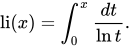
Here, ln denotes the natural logarithm. The function 1/(ln t) has a singularity at t = 1, and the integral for x > 1 is interpreted as a Cauchy principal value,

However, the logarithmic integral can also be taken to be a meromorphic complex-valued function in the complex domain. In this case it is multi-valued with branch points at 0 and 1, and the values between 0 and 1 defined by the above integral are not compatible with the values beyond 1. The complex function is shown in the figure above. The values on the real axis beyond 1 are the same as defined above, but the values between 0 and 1 are offset by iπ so that the absolute value at 0 is π rather than zero. The complex function is also defined (but multi-valued) for numbers with negative real part, but on the negative real axis the values are not real.
Offset logarithmic integral
[edit]The offset logarithmic integral or Eulerian logarithmic integral is defined as

As such, the integral representation has the advantage of avoiding the singularity in the domain of integration.
Equivalently,

Special values
[edit]The function li(x) has a single positive zero; it occurs at x ≈ 1.45136 92348 83381 05028 39684 85892 02744 94930... OEIS: A070769; this number is known as the Ramanujan–Soldner constant.
≈ 1.045163 780117 492784 844588 889194 613136 522615 578151... OEIS: A069284

This is where is the incomplete gamma function. It must be understood as the Cauchy principal value of the function.


Series representation
[edit]The function li(x) is related to the exponential integral Ei(x) via the equation

which is valid for x > 0. This identity provides a series representation of li(x) as

where γ ≈ 0.57721 56649 01532 ... OEIS: A001620 is the Euler–Mascheroni constant. For the complex function the formula is

(without taking the absolute value of u). A more rapidly convergent series by Ramanujan [1] is

Again, for the meromorphic complex function the term must be replaced by


Asymptotic expansion
[edit]The asymptotic behavior both for and for is


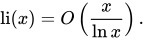
where is the big O notation. The full asymptotic expansion is

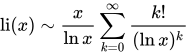
or

This gives the following more accurate asymptotic behaviour:

As an asymptotic expansion, this series is not convergent: it is a reasonable approximation only if the series is truncated at a finite number of terms, and only large values of x are employed. This expansion follows directly from the asymptotic expansion for the exponential integral.
This implies e.g. that we can bracket li as:

for all .

Number theoretic significance
[edit]The logarithmic integral is important in number theory, appearing in estimates of the number of prime numbers less than a given value. For example, the prime number theorem states that:

where denotes the number of primes smaller than or equal to .


Assuming the Riemann hypothesis, we get the even stronger:[2]

In fact, the Riemann hypothesis is equivalent to the statement that:
- for any .


For small , but the difference changes sign an infinite number of times as increases, and the first time that this happens is somewhere between 1019 and 1.4×10316.

See also
[edit]References
[edit]- ^ Weisstein, Eric W. "Logarithmic Integral". MathWorld.
- ^ Abramowitz and Stegun, p. 230, 5.1.20
- Abramowitz, Milton; Stegun, Irene Ann, eds. (1983) [June 1964]. "Chapter 5". Handbook of Mathematical Functions with Formulas, Graphs, and Mathematical Tables. Applied Mathematics Series. Vol. 55 (Ninth reprint with additional corrections of tenth original printing with corrections (December 1972); first ed.). Washington D.C.; New York: United States Department of Commerce, National Bureau of Standards; Dover Publications. p. 228. ISBN 978-0-486-61272-0. LCCN 64-60036. MR 0167642. LCCN 65-12253.
- Temme, N. M. (2010), "Exponential, Logarithmic, Sine, and Cosine Integrals", in Olver, Frank W. J.; Lozier, Daniel M.; Boisvert, Ronald F.; Clark, Charles W. (eds.), NIST Handbook of Mathematical Functions, Cambridge University Press, ISBN 978-0-521-19225-5, MR 2723248.
| International | |
|---|---|
| Other | |

Logarithmic integral function
View on GrokipediaDefinitions and Variants
Principal Logarithmic Integral
The principal logarithmic integral function, denoted , is defined for real , , by the integral where the integrand has a singularity at .[4][3] To handle the singularity at , the integral is interpreted in the sense of the Cauchy principal value. For , This principal value ensures the function is well-defined and continuous except at , where it diverges to as and to as .[4][3][5] For , the principal logarithmic integral is related to the exponential integral function , defined as the Cauchy principal value for , by the identity This connection arises from the substitution , transforming the integral appropriately while respecting the principal branch of the logarithm.[4][3] In the interval , the integral from 0 to avoids the singularity at and is proper, though the integrand approaches 0 from below as since . Consequently, is negative for , with . The function is defined on as a real-valued special function, locally integrable away from the singularity.[3][5]Offset Logarithmic Integral
The offset logarithmic integral, denoted , addresses limitations in the principal logarithmic integral by introducing a constant shift tailored for number-theoretic applications. It is defined for as , where .[3] Equivalently, to handle the singularity at , [3] This offset subtracts the fixed value to remove the discontinuity and non-monotonic behavior of near , yielding a smooth, monotonically increasing function ideal for asymptotic estimates in prime distribution studies. This yields , and the function is smooth and monotonically increasing for .[6] For large , .[3]Representations
Integral Representation
The logarithmic integral function, denoted for real , is fundamentally defined by the Cauchy principal value integral which handles the singularity at where . This principal value ensures the integral is well-defined despite the pole, enabling numerical evaluation through standard quadrature methods that bypass the discontinuity.[3] A useful change of variables transforms this representation into a form involving the exponential integral. Substituting , so and , yields for , where the integral is again understood in the principal value sense across the origin. This substitution directly links to the exponential integral function , defined as for real , via the relation . Integrating the power series expansion of term by term provides an alternative representation derived from the integral form: where is the Euler-Mascheroni constant. This series arises naturally from the integral definition of and converges for .[3] For complex arguments, the logarithmic integral admits an analytic continuation via a contour integral where the path of integration avoids the branch cut of (typically along the negative real axis) and detours around the singularity at using a principal value or indentation.[4] This contour-based definition, consistent with using the principal branch of the logarithm, extends the function to the complex plane except along the cut from 0 to 1 on the positive real axis.Series Representation
The series representation of the logarithmic integral function is derived from its integral form by means of the substitution , which transforms the principal value integral into the exponential integral . Specifically, for , , , where admits the Taylor series expansion around : with denoting the Euler-Mascheroni constant. This expansion is particularly suited for numerical evaluation near (corresponding to small ), as the logarithmic singularity at is isolated in the term, while the power series captures the regular part. The derivation proceeds by expressing and applying repeated integration by parts to the integrand, yielding the singular terms and the convergent power series , which arises from term-by-term integration of the exponential series for .[7] The radius of convergence of the power series is infinite, but for the principal branch in the complex plane, the representation is valid when to avoid encircling additional branch points introduced by the periodicity of the logarithm. For small (away from the branch cut [0,1]), the exponential substitution yields large negative , where direct use of the series is inefficient; instead, the leading asymptotic behavior is as , though the full exponential form remains the primary tool for local computation near the singularity.[7]Properties
Special Values
The principal logarithmic integral function, denoted , exhibits distinct behavior at specific points due to its integral definition involving the singularity at . As , , reflecting the integral's convergence from the lower limit where but the measure is small.[3] Similarly, as from either side, owing to the principal value handling of the pole at , where the contributions from below and above the singularity diverge negatively in the limit.[3] As , , consistent with the function's unbounded growth.[3] Numerical evaluations at key points provide concrete insights into . For instance, at , the principal value is , computed via its relation to the exponential integral .[8] At , , a value central to defining the offset variant , which ensures .[3] A notable connection to the Euler-Mascheroni constant appears in the behavior near the singularity: . This limit arises from the small-argument expansion of the related exponential integral, as , with . While exact closed-form expressions exist for at transcendental points like through the exponential integral, most evaluations at integer or prime arguments lack simple closed forms and rely on numerical computation or series summation. For small integers and primes , such as , values are tabulated in mathematical handbooks and databases for precision up to many decimal places, facilitating applications in analysis.[3]| Point | (approximate) | Notes |
|---|---|---|
| 1.895117816 | Principal value via .[8] | |
| 2 | 1.045163780 | Basis for offset .[3] |