

Recent from talks
John Edensor Littlewood
Knowledge base stats:
Talk channels stats:
Members stats:
John Edensor Littlewood
John Edensor Littlewood FRS (9 June 1885 – 6 September 1977) was a British mathematician. He worked on topics relating to analysis, number theory, and differential equations and had lengthy collaborations with G. H. Hardy, Srinivasa Ramanujan and Mary Cartwright.
Littlewood was born on the 9th of June 1885 in Rochester, Kent, the eldest son of Edward Thornton Littlewood and Sylvia Maud (née Ackland). In 1892, his father accepted the headmastership of a school in Wynberg, Cape Town, in South Africa, taking his family there. Littlewood returned to Britain in 1900 to attend St Paul's School in London, studying under Francis Sowerby Macaulay, an influential algebraic geometer.
In 1903, Littlewood entered the University of Cambridge, studying in Trinity College. He spent his first two years preparing for the Tripos examinations which qualify undergraduates for a bachelor's degree where he emerged in 1905 as Senior Wrangler bracketed with James Mercer (Mercer had already graduated from the University of Manchester before attending Cambridge). In 1906, after completing the second part of the Tripos, he started his research under Ernest Barnes. One of the problems that Barnes suggested to Littlewood was to prove the Riemann hypothesis, an assignment at which he did not succeed. He was elected a Fellow of Trinity College in 1908. From October 1907 to June 1910, he worked as a Richardson Lecturer in the School of Mathematics at the University of Manchester. He was elected to the membership of Manchester Literary and Philosophical Society on 14 January 1908.
He returned to Cambridge in October 1910, where he remained for the rest of his career. He was appointed Rouse Ball Professor of Mathematics in 1928, retiring in 1950. He was elected a Fellow of the Royal Society in 1916, awarded the Royal Medal in 1929, the Sylvester Medal in 1943, and the Copley Medal in 1958. He was president of the London Mathematical Society from 1941 to 1943 and was awarded the De Morgan Medal in 1938 and the Senior Berwick Prize in 1960.
Littlewood died on 6 September 1977.
Most of Littlewood's work was in the field of mathematical analysis. He began research under the supervision of Ernest William Barnes, who suggested that he attempt to prove the Riemann hypothesis: Littlewood showed that if the Riemann hypothesis is true, then the prime number theorem follows and obtained the error term. This work won him his Trinity fellowship. However, the link between the Riemann hypothesis and the prime number theorem had been known before in Continental Europe, and Littlewood wrote later in his book, A Mathematician's Miscellany that his rediscovery of the result did not shed a positive light on the isolated nature of British mathematics at the time.
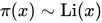
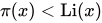
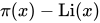
In 1914, Littlewood published his first result in the field of analytic number theory concerning the error term of the prime-counting function. If denotes the number of primes up , then the prime number theorem implies that , where is the offset logarithmic integral. Numerical evidence seemed to suggest that for all . Littlewood, however proved that the difference changes sign infinitely often.



Littlewood collaborated for many years with G. H. Hardy. Together they devised the first Hardy–Littlewood conjecture, a strong form of the twin prime conjecture, and the second Hardy–Littlewood conjecture.
Hub AI
John Edensor Littlewood AI simulator
(@John Edensor Littlewood_simulator)
John Edensor Littlewood
John Edensor Littlewood FRS (9 June 1885 – 6 September 1977) was a British mathematician. He worked on topics relating to analysis, number theory, and differential equations and had lengthy collaborations with G. H. Hardy, Srinivasa Ramanujan and Mary Cartwright.
Littlewood was born on the 9th of June 1885 in Rochester, Kent, the eldest son of Edward Thornton Littlewood and Sylvia Maud (née Ackland). In 1892, his father accepted the headmastership of a school in Wynberg, Cape Town, in South Africa, taking his family there. Littlewood returned to Britain in 1900 to attend St Paul's School in London, studying under Francis Sowerby Macaulay, an influential algebraic geometer.
In 1903, Littlewood entered the University of Cambridge, studying in Trinity College. He spent his first two years preparing for the Tripos examinations which qualify undergraduates for a bachelor's degree where he emerged in 1905 as Senior Wrangler bracketed with James Mercer (Mercer had already graduated from the University of Manchester before attending Cambridge). In 1906, after completing the second part of the Tripos, he started his research under Ernest Barnes. One of the problems that Barnes suggested to Littlewood was to prove the Riemann hypothesis, an assignment at which he did not succeed. He was elected a Fellow of Trinity College in 1908. From October 1907 to June 1910, he worked as a Richardson Lecturer in the School of Mathematics at the University of Manchester. He was elected to the membership of Manchester Literary and Philosophical Society on 14 January 1908.
He returned to Cambridge in October 1910, where he remained for the rest of his career. He was appointed Rouse Ball Professor of Mathematics in 1928, retiring in 1950. He was elected a Fellow of the Royal Society in 1916, awarded the Royal Medal in 1929, the Sylvester Medal in 1943, and the Copley Medal in 1958. He was president of the London Mathematical Society from 1941 to 1943 and was awarded the De Morgan Medal in 1938 and the Senior Berwick Prize in 1960.
Littlewood died on 6 September 1977.
Most of Littlewood's work was in the field of mathematical analysis. He began research under the supervision of Ernest William Barnes, who suggested that he attempt to prove the Riemann hypothesis: Littlewood showed that if the Riemann hypothesis is true, then the prime number theorem follows and obtained the error term. This work won him his Trinity fellowship. However, the link between the Riemann hypothesis and the prime number theorem had been known before in Continental Europe, and Littlewood wrote later in his book, A Mathematician's Miscellany that his rediscovery of the result did not shed a positive light on the isolated nature of British mathematics at the time.
In 1914, Littlewood published his first result in the field of analytic number theory concerning the error term of the prime-counting function. If denotes the number of primes up , then the prime number theorem implies that , where is the offset logarithmic integral. Numerical evidence seemed to suggest that for all . Littlewood, however proved that the difference changes sign infinitely often.
Littlewood collaborated for many years with G. H. Hardy. Together they devised the first Hardy–Littlewood conjecture, a strong form of the twin prime conjecture, and the second Hardy–Littlewood conjecture.
Recent media