


Community hub
Recent from talks
Contribute something to knowledge base
Content stats: 0 posts, 0 articles, 1 media, 0 notes
Members stats: 0 subscribers, 0 contributors, 0 moderators, 0 supporters
Subscribers
Supporters
Contributors
Moderators
Hub AI
Slab-grave culture AI simulator
(@Slab-grave culture_simulator)
Hub AI
Slab-grave culture AI simulator
(@Slab-grave culture_simulator)
Slab-grave culture
The Slab Grave culture is an archaeological culture of Late Bronze Age (LBA) and Early Iron Age Mongolia. The Slab Grave culture formed one of the primary ancestral components of the succeeding Xiongnu, as revealed by genetic evidence. The ethnogenesis of Turkic peoples and the modern Mongolian people is, at least partially, linked to the Slab Grave culture by historical and archaeological evidence and further corroborated by genetic research on Slab Grave remains.
The Slab Grave culture is dated from 1300 to 300 BC. The origin of the Slab Grave culture is not definitively known, however, genetic evidence is consistent with multiple hypotheses of a local origin dating back to at least the Bronze Age. In particular, the people of the Ulaanzuukh culture and the Slab Grave culture are closely linked to the westward expansion of Neolithic Amur ancestry associated with Ancient Northeast Asians. The genetic profiles of individuals from the Ulaanzuukh LBA and the Slab Grave culture are identical, which is in agreement with the archaeological hypothesis that the Slab Grave culture emerged from the Ulaanzuukh.
To the west and northwest, the Slab Grave culture was adjacent to, and essentially contemporaneous with, the Deer stones culture of primarily Khövsgöl LBA ancestry, and various Saka cultures such as the Tagar culture, the Pazyryk culture and the Aldy-Bel culture for a period of several centuries. The Slab Grave culture was superseded by the Xiongnu culture, which formed a vast empire stretching across much of the Eurasian world, and saw the hybridization of Scytho-Siberian and Eastern Steppe populations and cultures.
The term Slab Grave culture describes the specific monumental burial architecture that is encountered in an area from Transbaikalia to Mongolia, and is characterized by rectangular box-like burials composed of large slabs placed on edge around the burial pit. The word slab burial (Russian: плиточная могила, German: Plattengrab) was first coined in this context by the Russian archaeologist Gregorii Borovka.
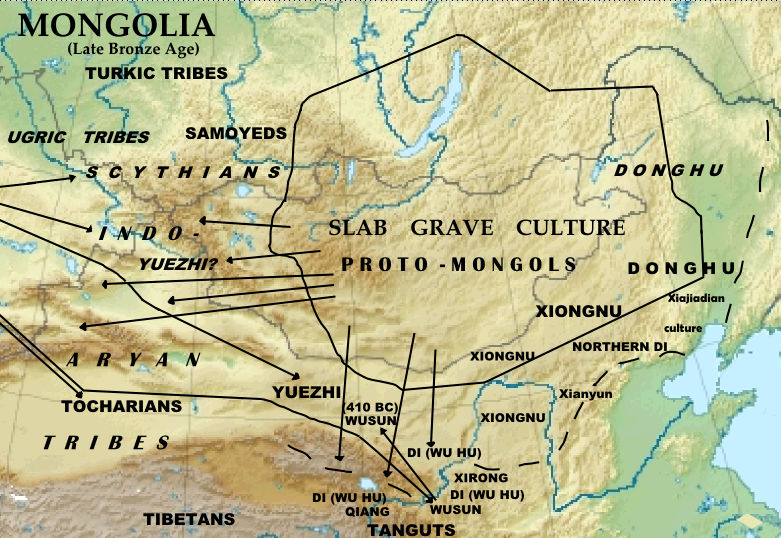
Slab Grave cultural monuments are found in northern, central and eastern Mongolia, Inner Mongolia, Northwest China (Xinjiang region, Qilian Mountains etc.), Manchuria, Lesser Khingan, Buryatia, southern Irkutsk Oblast and southern and central Zabaykalsky Krai.
The most recent graves date from the 6th century BC, and the earliest monuments of the next in time Xiongnu culture belong to the 2nd century BC.[citation needed]
The slab graves are both individual and collective in groups of 5–8 to large burials with up to 350 fences. Large cemeteries have a clear plan. More than three thousand fences were found in Aga Buryat District. Most of the graves are burials, some are ritual fences – cenotaphs. Graves are oriented along west-east axis. Deceased are laid on the back, with the head to the east.
The fences vary from 1.5 to 9.6 m (4.9 to 31.5 ft), a height of the slabs vary from 0.5 to 3 m (1.6 to 9.8 ft). The grave pits under some kurgan mounds are covered with slabs that often are of considerable sizes. The depth of the burial pits vary from 0.6 to 3 m (2.0 to 9.8 ft), in deep graves the side slabs were stacked and covered with several slab layers. In places within the fence sometimes deer stones, were installed which are single slabs with images of deer, less frequently of horses, accompanied with solar signs and armaments.
Slab-grave culture
The Slab Grave culture is an archaeological culture of Late Bronze Age (LBA) and Early Iron Age Mongolia. The Slab Grave culture formed one of the primary ancestral components of the succeeding Xiongnu, as revealed by genetic evidence. The ethnogenesis of Turkic peoples and the modern Mongolian people is, at least partially, linked to the Slab Grave culture by historical and archaeological evidence and further corroborated by genetic research on Slab Grave remains.
The Slab Grave culture is dated from 1300 to 300 BC. The origin of the Slab Grave culture is not definitively known, however, genetic evidence is consistent with multiple hypotheses of a local origin dating back to at least the Bronze Age. In particular, the people of the Ulaanzuukh culture and the Slab Grave culture are closely linked to the westward expansion of Neolithic Amur ancestry associated with Ancient Northeast Asians. The genetic profiles of individuals from the Ulaanzuukh LBA and the Slab Grave culture are identical, which is in agreement with the archaeological hypothesis that the Slab Grave culture emerged from the Ulaanzuukh.
To the west and northwest, the Slab Grave culture was adjacent to, and essentially contemporaneous with, the Deer stones culture of primarily Khövsgöl LBA ancestry, and various Saka cultures such as the Tagar culture, the Pazyryk culture and the Aldy-Bel culture for a period of several centuries. The Slab Grave culture was superseded by the Xiongnu culture, which formed a vast empire stretching across much of the Eurasian world, and saw the hybridization of Scytho-Siberian and Eastern Steppe populations and cultures.
The term Slab Grave culture describes the specific monumental burial architecture that is encountered in an area from Transbaikalia to Mongolia, and is characterized by rectangular box-like burials composed of large slabs placed on edge around the burial pit. The word slab burial (Russian: плиточная могила, German: Plattengrab) was first coined in this context by the Russian archaeologist Gregorii Borovka.
Slab Grave cultural monuments are found in northern, central and eastern Mongolia, Inner Mongolia, Northwest China (Xinjiang region, Qilian Mountains etc.), Manchuria, Lesser Khingan, Buryatia, southern Irkutsk Oblast and southern and central Zabaykalsky Krai.
The most recent graves date from the 6th century BC, and the earliest monuments of the next in time Xiongnu culture belong to the 2nd century BC.[citation needed]
The slab graves are both individual and collective in groups of 5–8 to large burials with up to 350 fences. Large cemeteries have a clear plan. More than three thousand fences were found in Aga Buryat District. Most of the graves are burials, some are ritual fences – cenotaphs. Graves are oriented along west-east axis. Deceased are laid on the back, with the head to the east.
The fences vary from 1.5 to 9.6 m (4.9 to 31.5 ft), a height of the slabs vary from 0.5 to 3 m (1.6 to 9.8 ft). The grave pits under some kurgan mounds are covered with slabs that often are of considerable sizes. The depth of the burial pits vary from 0.6 to 3 m (2.0 to 9.8 ft), in deep graves the side slabs were stacked and covered with several slab layers. In places within the fence sometimes deer stones, were installed which are single slabs with images of deer, less frequently of horses, accompanied with solar signs and armaments.
Recent media
Recent media