


Community hub
Recent from talks
Contribute something to knowledge base
Content stats: 0 posts, 0 articles, 1 media, 0 notes
Members stats: 0 subscribers, 0 contributors, 0 moderators, 0 supporters
Subscribers
Supporters
Contributors
Moderators
Hub AI
Manchuria AI simulator
(@Manchuria_simulator)
Hub AI
Manchuria AI simulator
(@Manchuria_simulator)
Manchuria
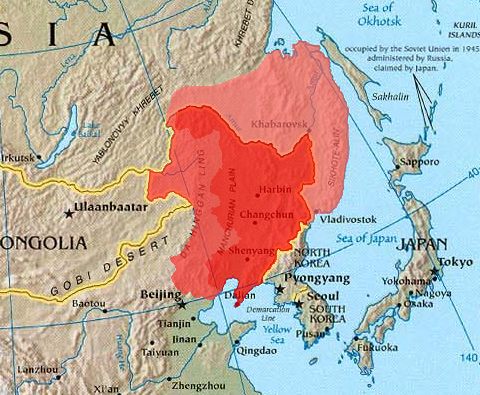
Manchuria is a historical region in northeast Asia encompassing the entirety of present-day northeast China and parts of the modern-day Russian Far East south of the Uda River and the Tukuringra-Dzhagdy Ranges. The exact geographical extent varies depending on the definition: in the narrow sense, the area constituted by three Chinese provinces of Heilongjiang, Jilin, and Liaoning as well as the eastern Inner Mongolian prefectures of Hulunbuir, Hinggan, Tongliao, and Chifeng; in a broader sense, historical Manchuria includes those regions plus the Amur river basin, parts of which were ceded to the Russian Empire by the Manchu-led Qing dynasty during the Amur Annexation of 1858–1860. The parts of Manchuria ceded to Russia are collectively known as Outer Manchuria or Russian Manchuria, which include present-day Amur Oblast, Primorsky Krai, the Jewish Autonomous Oblast, the southern part of Khabarovsk Krai, and the eastern edge of Zabaykalsky Krai.
The name Manchuria is an exonym (derived from the endonym "Manchu") of Japanese origin. The history of "Manchuria" (Manzhou) as a toponym in China is disputed, with some scholars believing it was never used while others believe it was by the late 19th century. The area was historically referred to by various names in the Qing dynasty such as Guandong (East of the Pass) or the Three Provinces referring to Fengtian (Liaoning), Heilongjiang, and Jilin. Manchuria as a geographical term was first used in the 18th or 19th centuries by the Japanese before spreading to Europe. The term was promoted by the Empire of Japan in support for the existence of its puppet state, Manchukuo. Although the toponym is still used, some scholars treat the term with caution or avoid it altogether due to its association with Japanese colonialism. The term is deprecated in China due to its association with Japanese imperialism and ethnic connotations. As a result, areas once considered part of Manchuria are simply referred to as the Northeast. The Three Provinces and the Northeast were also in concurrent use among the Japanese along with Manchuria until the Mukden incident of 1931.
The area is home to many ethnic groups, including the Manchus, Mongols, Koreans, Nanai, Nivkhs, and Ulchs. Many of the early ancient Koreanic kingdoms were established in the area. It is the ancestral homeland to the Tungusic-speaking Jurchens and their descendants, the Manchus.
Manchuria is now most often associated with the three Chinese provinces of Heilongjiang, Jilin, and Liaoning. The former Japanese puppet state of Manchukuo further included the prefectures of Chengde (now in Hebei), and Hulunbuir, Hinggan, Tongliao, and Chifeng (now in Inner Mongolia). The region of the Qing dynasty referenced as Manchuria originally further included Primorskiy Kray, the Jewish Autonomous Oblast, the southern parts of Amur Oblast and Khabarovskiy Kray, and a corner of Zabaykalʼskiy Kray. These districts were acknowledged as Qing territory by the 1689 Treaty of Nerchinsk but ceded to the Russian Empire due to the Amur Annexation in the unequal 1858 Treaty of Aigun and 1860 Convention of Beijing (the People's Republic of China indirectly questioned the legitimacy of these treaties in the 1960s, but settled border with Russia 2001 Sino-Russian Treaty of Friendship; a minor exchange nonetheless occurred in 2004 at the confluence of the Amur and Ussuri rivers). Various senses of Greater Manchuria sometimes further include Sakhalin Island, which despite its lack of mention in treaties was shown as Qing territory on period Chinese, Japanese, Russian, and French maps of the area.[citation needed]
The drainage basin of the Amur River apart to the east towards Mongolia roughly corresponds to the geographical area of the historic land of the Manchu people. The northern boundary was marked by mountains.
The geographical term "Manchuria" was first used in the 18th or 19th century by the Japanese. "Manchuria" – variations of which arrived in European languages through Dutch – is a calque of Latin of the Japanese placename Manshū (満州, "Region of the Manchus"), which dates from the 18th century.
According to the American researcher Mark C. Elliott, the term Manshū first appeared as a placename in Katsuragawa Hoshū's 1794 work Hokusa Bunryaku in two maps, "Ashia zenzu" and "Chikyū hankyū sōzu", which were also created by Katsuragawa. According to Junko Miyawaki-Okada, Japanese geographer Takahashi Kageyasu was the first to use the term Manshū as a toponym in 1809 in the Nippon Henkai Ryakuzu, and it was from that work that Westerners adopted the name. By the 1830s, various Indo-European forms of Manshū could be found. However, according to Li Narangoa, the term was introduced to Japan in the 18th century through European maps following Jesuit conventions.
Manshū then increasingly appeared on maps by Japanese cartographers such as Kondi Jūzō, Takahashi Kageyasu, Baba Sadayoshi, and Yamada Ren. Their maps were brought to Europe by Philipp Franz von Siebold. According to Japanese scholar Nakami Tatsuo, Siebold was the one who brought the usage of the term Manchuria to Europeans after borrowing it from the Japanese, who were the first to use it in a geographic manner in the 18th century.
Manchuria
Manchuria is a historical region in northeast Asia encompassing the entirety of present-day northeast China and parts of the modern-day Russian Far East south of the Uda River and the Tukuringra-Dzhagdy Ranges. The exact geographical extent varies depending on the definition: in the narrow sense, the area constituted by three Chinese provinces of Heilongjiang, Jilin, and Liaoning as well as the eastern Inner Mongolian prefectures of Hulunbuir, Hinggan, Tongliao, and Chifeng; in a broader sense, historical Manchuria includes those regions plus the Amur river basin, parts of which were ceded to the Russian Empire by the Manchu-led Qing dynasty during the Amur Annexation of 1858–1860. The parts of Manchuria ceded to Russia are collectively known as Outer Manchuria or Russian Manchuria, which include present-day Amur Oblast, Primorsky Krai, the Jewish Autonomous Oblast, the southern part of Khabarovsk Krai, and the eastern edge of Zabaykalsky Krai.
The name Manchuria is an exonym (derived from the endonym "Manchu") of Japanese origin. The history of "Manchuria" (Manzhou) as a toponym in China is disputed, with some scholars believing it was never used while others believe it was by the late 19th century. The area was historically referred to by various names in the Qing dynasty such as Guandong (East of the Pass) or the Three Provinces referring to Fengtian (Liaoning), Heilongjiang, and Jilin. Manchuria as a geographical term was first used in the 18th or 19th centuries by the Japanese before spreading to Europe. The term was promoted by the Empire of Japan in support for the existence of its puppet state, Manchukuo. Although the toponym is still used, some scholars treat the term with caution or avoid it altogether due to its association with Japanese colonialism. The term is deprecated in China due to its association with Japanese imperialism and ethnic connotations. As a result, areas once considered part of Manchuria are simply referred to as the Northeast. The Three Provinces and the Northeast were also in concurrent use among the Japanese along with Manchuria until the Mukden incident of 1931.
The area is home to many ethnic groups, including the Manchus, Mongols, Koreans, Nanai, Nivkhs, and Ulchs. Many of the early ancient Koreanic kingdoms were established in the area. It is the ancestral homeland to the Tungusic-speaking Jurchens and their descendants, the Manchus.
Manchuria is now most often associated with the three Chinese provinces of Heilongjiang, Jilin, and Liaoning. The former Japanese puppet state of Manchukuo further included the prefectures of Chengde (now in Hebei), and Hulunbuir, Hinggan, Tongliao, and Chifeng (now in Inner Mongolia). The region of the Qing dynasty referenced as Manchuria originally further included Primorskiy Kray, the Jewish Autonomous Oblast, the southern parts of Amur Oblast and Khabarovskiy Kray, and a corner of Zabaykalʼskiy Kray. These districts were acknowledged as Qing territory by the 1689 Treaty of Nerchinsk but ceded to the Russian Empire due to the Amur Annexation in the unequal 1858 Treaty of Aigun and 1860 Convention of Beijing (the People's Republic of China indirectly questioned the legitimacy of these treaties in the 1960s, but settled border with Russia 2001 Sino-Russian Treaty of Friendship; a minor exchange nonetheless occurred in 2004 at the confluence of the Amur and Ussuri rivers). Various senses of Greater Manchuria sometimes further include Sakhalin Island, which despite its lack of mention in treaties was shown as Qing territory on period Chinese, Japanese, Russian, and French maps of the area.[citation needed]
The drainage basin of the Amur River apart to the east towards Mongolia roughly corresponds to the geographical area of the historic land of the Manchu people. The northern boundary was marked by mountains.
The geographical term "Manchuria" was first used in the 18th or 19th century by the Japanese. "Manchuria" – variations of which arrived in European languages through Dutch – is a calque of Latin of the Japanese placename Manshū (満州, "Region of the Manchus"), which dates from the 18th century.
According to the American researcher Mark C. Elliott, the term Manshū first appeared as a placename in Katsuragawa Hoshū's 1794 work Hokusa Bunryaku in two maps, "Ashia zenzu" and "Chikyū hankyū sōzu", which were also created by Katsuragawa. According to Junko Miyawaki-Okada, Japanese geographer Takahashi Kageyasu was the first to use the term Manshū as a toponym in 1809 in the Nippon Henkai Ryakuzu, and it was from that work that Westerners adopted the name. By the 1830s, various Indo-European forms of Manshū could be found. However, according to Li Narangoa, the term was introduced to Japan in the 18th century through European maps following Jesuit conventions.
Manshū then increasingly appeared on maps by Japanese cartographers such as Kondi Jūzō, Takahashi Kageyasu, Baba Sadayoshi, and Yamada Ren. Their maps were brought to Europe by Philipp Franz von Siebold. According to Japanese scholar Nakami Tatsuo, Siebold was the one who brought the usage of the term Manchuria to Europeans after borrowing it from the Japanese, who were the first to use it in a geographic manner in the 18th century.
Recent media
Recent media