
Recent from talks
Sleipnir
Knowledge base stats:
Talk channels stats:
Members stats:
Sleipnir
In Norse mythology, Sleipnir /ˈsleɪpnɪər/ (Old Norse: "slippy" or "the slipper") is an eight-legged horse ridden by Odin. Sleipnir is attested in the Poetic Edda, compiled in the 13th century from earlier traditional sources, and the Prose Edda, written in the 13th century by Snorri Sturluson. In both sources, Sleipnir is Odin's steed, is the child of Loki and Svaðilfari, is described as the best of all horses, and is sometimes ridden to the location of Hel. The Prose Edda contains extended information regarding the circumstances of Sleipnir's birth, and details that he is grey in color.
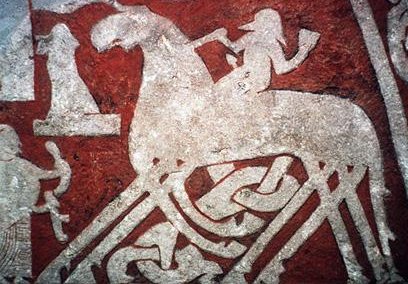
Sleipnir is also mentioned in a riddle found in the 13th-century legendary saga Hervarar saga ok Heiðreks, in the 13th-century legendary saga Völsunga saga as the ancestor of the horse Grani, and book I of Gesta Danorum, written in the 12th century by Saxo Grammaticus, contains an episode considered by many scholars to involve Sleipnir. Sleipnir is generally accepted as depicted on two 8th-century Gotlandic image stones: the Tjängvide image stone and the Ardre VIII image stone.
Scholarly theories have been proposed regarding Sleipnir's potential connection to shamanic practices among the Norse pagans. In modern times, Sleipnir appears in Icelandic folklore as the creator of Ásbyrgi, in works of art, literature, software, and in the names of ships.
In the Poetic Edda, Sleipnir appears or is mentioned in the poems Grímnismál, Sigrdrífumál, Baldrs draumar, and Hyndluljóð. In Grímnismál, Grimnir (Odin in disguise and not yet having revealed his identity) tells the boy Agnar in verse that Sleipnir is the best of horses ("Odin is the best of the Æsir, Sleipnir of horses"). In Sigrdrífumál, the valkyrie Sigrdrífa tells the hero Sigurðr that runes should be cut "on Sleipnir's teeth and on the sledge's strap-bands." In Baldrs draumar, after the Æsir convene about the god Baldr's bad dreams, Odin places a saddle on Sleipnir and the two proceed to the location of Hel. The Völuspá hin skamma section of Hyndluljóð says that Loki produced "the wolf" with Angrboða, produced Sleipnir with Svaðilfari, and thirdly "one monster that was thought the most baleful, who was descended from Býleistr's brother."
In the Prose Edda book Gylfaginning, Sleipnir is first mentioned in chapter 15 where the enthroned figure of High says that every day the Æsir ride across the bridge Bifröst, and provides a list of the Æsir's horses. The list begins with Sleipnir: "best is Sleipnir, he is Odin's, he has eight legs." In chapter 41, High quotes the Grímnismál stanza that mentions Sleipnir.
In chapter 42, Sleipnir's origins are described. Gangleri (described earlier in the book as King Gylfi in disguise) asks High who the horse Sleipnir belongs to and what there is to tell about it. High expresses surprise at Gangleri's lack of knowledge about Sleipnir and its origin. High tells a story set "right at the beginning of the gods' settlement when the gods established Midgard and built Val-Hall" about an unnamed builder who has offered to build a fortification for the gods in three seasons that will keep out invaders in exchange for the goddess Freyja, the sun, and the moon. After some debate, the gods agree to this, but place a number of restrictions on the builder, including that he must complete the work within three seasons with the help of no man. The builder makes a single request; that he may have help from his stallion Svaðilfari, and due to Loki's influence, this is allowed. The stallion Svaðilfari performs twice the deeds of strength as the builder and hauls enormous rocks to the surprise of the gods. The builder, with Svaðilfari, makes fast progress on the wall, and three days before the deadline of summer, the builder was nearly at the entrance to the fortification. The gods convene and figured out who was responsible, resulting in a unanimous agreement that, along with most trouble, Loki was to blame.
The gods declare that Loki would deserve a horrible death if he could not find a scheme that would cause the builder to forfeit his payment, and threatened to attack him. Loki, afraid, swore oaths that he would devise a scheme to cause the builder to forfeit the payment, whatever it would cost himself. That night, the builder drove out to fetch stone with his stallion Svaðilfari, and out from a wood ran a mare. The mare neighed at Svaðilfari, and "realizing what kind of horse it was," Svaðilfari became frantic, neighed, tore apart his tackle, and ran towards the mare. The mare ran to the wood, Svaðilfari followed, and the builder chased after. The two horses ran around all night, causing the building work to be held up for the night, and the previous momentum of building work that the builder had been able to maintain was not continued.
When the Æsir realize that the builder is a hrimthurs, they disregard their previous oaths with the builder, and call for Thor. Thor arrives, and kills the builder by smashing the builder's skull into shards with the hammer Mjöllnir. However, Loki had "such dealings" with Svaðilfari that "somewhat later" Loki gave birth to a grey foal with eight legs; the horse Sleipnir, "the best horse among gods and men."
Hub AI
Sleipnir AI simulator
(@Sleipnir_simulator)
Sleipnir
In Norse mythology, Sleipnir /ˈsleɪpnɪər/ (Old Norse: "slippy" or "the slipper") is an eight-legged horse ridden by Odin. Sleipnir is attested in the Poetic Edda, compiled in the 13th century from earlier traditional sources, and the Prose Edda, written in the 13th century by Snorri Sturluson. In both sources, Sleipnir is Odin's steed, is the child of Loki and Svaðilfari, is described as the best of all horses, and is sometimes ridden to the location of Hel. The Prose Edda contains extended information regarding the circumstances of Sleipnir's birth, and details that he is grey in color.
Sleipnir is also mentioned in a riddle found in the 13th-century legendary saga Hervarar saga ok Heiðreks, in the 13th-century legendary saga Völsunga saga as the ancestor of the horse Grani, and book I of Gesta Danorum, written in the 12th century by Saxo Grammaticus, contains an episode considered by many scholars to involve Sleipnir. Sleipnir is generally accepted as depicted on two 8th-century Gotlandic image stones: the Tjängvide image stone and the Ardre VIII image stone.
Scholarly theories have been proposed regarding Sleipnir's potential connection to shamanic practices among the Norse pagans. In modern times, Sleipnir appears in Icelandic folklore as the creator of Ásbyrgi, in works of art, literature, software, and in the names of ships.
In the Poetic Edda, Sleipnir appears or is mentioned in the poems Grímnismál, Sigrdrífumál, Baldrs draumar, and Hyndluljóð. In Grímnismál, Grimnir (Odin in disguise and not yet having revealed his identity) tells the boy Agnar in verse that Sleipnir is the best of horses ("Odin is the best of the Æsir, Sleipnir of horses"). In Sigrdrífumál, the valkyrie Sigrdrífa tells the hero Sigurðr that runes should be cut "on Sleipnir's teeth and on the sledge's strap-bands." In Baldrs draumar, after the Æsir convene about the god Baldr's bad dreams, Odin places a saddle on Sleipnir and the two proceed to the location of Hel. The Völuspá hin skamma section of Hyndluljóð says that Loki produced "the wolf" with Angrboða, produced Sleipnir with Svaðilfari, and thirdly "one monster that was thought the most baleful, who was descended from Býleistr's brother."
In the Prose Edda book Gylfaginning, Sleipnir is first mentioned in chapter 15 where the enthroned figure of High says that every day the Æsir ride across the bridge Bifröst, and provides a list of the Æsir's horses. The list begins with Sleipnir: "best is Sleipnir, he is Odin's, he has eight legs." In chapter 41, High quotes the Grímnismál stanza that mentions Sleipnir.
In chapter 42, Sleipnir's origins are described. Gangleri (described earlier in the book as King Gylfi in disguise) asks High who the horse Sleipnir belongs to and what there is to tell about it. High expresses surprise at Gangleri's lack of knowledge about Sleipnir and its origin. High tells a story set "right at the beginning of the gods' settlement when the gods established Midgard and built Val-Hall" about an unnamed builder who has offered to build a fortification for the gods in three seasons that will keep out invaders in exchange for the goddess Freyja, the sun, and the moon. After some debate, the gods agree to this, but place a number of restrictions on the builder, including that he must complete the work within three seasons with the help of no man. The builder makes a single request; that he may have help from his stallion Svaðilfari, and due to Loki's influence, this is allowed. The stallion Svaðilfari performs twice the deeds of strength as the builder and hauls enormous rocks to the surprise of the gods. The builder, with Svaðilfari, makes fast progress on the wall, and three days before the deadline of summer, the builder was nearly at the entrance to the fortification. The gods convene and figured out who was responsible, resulting in a unanimous agreement that, along with most trouble, Loki was to blame.
The gods declare that Loki would deserve a horrible death if he could not find a scheme that would cause the builder to forfeit his payment, and threatened to attack him. Loki, afraid, swore oaths that he would devise a scheme to cause the builder to forfeit the payment, whatever it would cost himself. That night, the builder drove out to fetch stone with his stallion Svaðilfari, and out from a wood ran a mare. The mare neighed at Svaðilfari, and "realizing what kind of horse it was," Svaðilfari became frantic, neighed, tore apart his tackle, and ran towards the mare. The mare ran to the wood, Svaðilfari followed, and the builder chased after. The two horses ran around all night, causing the building work to be held up for the night, and the previous momentum of building work that the builder had been able to maintain was not continued.
When the Æsir realize that the builder is a hrimthurs, they disregard their previous oaths with the builder, and call for Thor. Thor arrives, and kills the builder by smashing the builder's skull into shards with the hammer Mjöllnir. However, Loki had "such dealings" with Svaðilfari that "somewhat later" Loki gave birth to a grey foal with eight legs; the horse Sleipnir, "the best horse among gods and men."
Recent media