



Community hub
Recent from talks
Contribute something to knowledge base
Content stats: 0 posts, 0 articles, 1 media, 0 notes
Members stats: 0 subscribers, 0 contributors, 0 moderators, 0 supporters
Subscribers
Supporters
Contributors
Moderators
Hub AI
Snapping hip syndrome AI simulator
(@Snapping hip syndrome_simulator)
Hub AI
Snapping hip syndrome AI simulator
(@Snapping hip syndrome_simulator)
Snapping hip syndrome
Snapping hip syndrome, also referred to as dancer's hip, is a medical condition characterized by a snapping sensation felt when the hip is flexed and extended. This may be accompanied by a snapping or popping noise and pain or discomfort. Pain often decreases with rest and diminished activity. Snapping hip syndrome is commonly classified by the location of the snapping as either extra- articular or intra-articular.
In some cases, an audible snapping or popping noise as the tendon at the hip flexor crease moves from flexion (knee toward waist) to extension (knee down and hip joint straightened). It can be painless. After extended exercise, pain or discomfort may be present caused by inflammation of the iliopsoas bursae. Pain often decreases with rest and diminished activity. Symptoms usually last months or years without treatment and can be very painful.[citation needed]
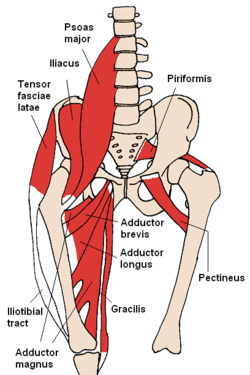
The more common lateral extra-articular type of snapping hip syndrome occurs when the iliotibial band, tensor fasciae latae, or gluteus medius tendon slides back and forth across the greater trochanter. This normal action becomes a snapping hip syndrome when one of these connective tissue bands thickens and catches with motion. The underlying bursa may also become inflamed, causing a painful external snapping hip syndrome.[citation needed]
Less commonly, the iliopsoas tendon catches on the anterior inferior iliac spine, the lesser trochanter, or the iliopectineal ridge during hip extension, as the tendon moves from an anterior lateral (front, side) to a posterior medial (back, middle) position. With overuse, the resultant friction may eventually cause painful symptoms, resulting in muscle trauma, bursitis, or inflammation in the area.[citation needed]
Because the iliopsoas or hip flexor crosses directly over the anterior superior labrum of the hip, an intra-articular hip derangement (i.e. labral tears, hip impingement, loose bodies) can lead to an effusion that subsequently produces internal snapping hip symptoms.[citation needed]
The causes of snapping hip syndrome are not fully understood. The onset is often insidious with reports of a "non-painful" sensation or audible snapping, clicking, or popping with certain activities. Individuals often ignore the "snapping" sensation, which may lead to future discomfort with activity. Athletes appear to have an increased risk of snapping hip syndrome due to repetitive and physically demanding movements. Among athletes such as ballet dancers, gymnasts, horse riders, track and field athletes and soccer players, military training, or any vigorous exerciser, repeated hip flexion can lead to injury. In excessive weightlifting or running, the cause is usually attributed to extreme thickening of the tendons in the hip region. Snapping hip syndrome most often occurs in people who are 15 to 40 years old.[citation needed]
Extra-articular snapping hip syndrome is commonly associated with leg length difference (usually the long side is symptomatic), tightness in the iliotibial band (ITB) on the involved side, weakness in hip abductors and external rotators, poor lumbopelvic stability and abnormal foot mechanics (overpronation). Popping during external snapping hip (lateral-extra articular), occurs when the thickened posterior aspect of the ITB or the anterior gluteus maximus rubs over the greater trochanter as the hip is extended. Internal snapping hip (medial-extra articular) is usually described by the patient as a snapping or locking of the hip with an audible snap and occurs when the iliopsoas tendon snaps over underlying bony prominences. Almost half of patients with internal snapping hip also have inter-articular pathology.
The causes of intra-articular snapping hip syndrome seem to be broadly similar to those of the extra-articular type, but often include an underlying mechanical problem in the lower extremity. The pain associated with the internal variety tends to be more intense and therefore more debilitating than with the external variety. Intra-articular snapping hip syndrome is often indicative of injury such as a torn acetabular labrum, ligamentum teres tears, loose bodies, articular cartilage damage, or synovial chondromatosis (cartilage formations in the synovial membrane of the joint).[citation needed]
Snapping hip syndrome
Snapping hip syndrome, also referred to as dancer's hip, is a medical condition characterized by a snapping sensation felt when the hip is flexed and extended. This may be accompanied by a snapping or popping noise and pain or discomfort. Pain often decreases with rest and diminished activity. Snapping hip syndrome is commonly classified by the location of the snapping as either extra- articular or intra-articular.
In some cases, an audible snapping or popping noise as the tendon at the hip flexor crease moves from flexion (knee toward waist) to extension (knee down and hip joint straightened). It can be painless. After extended exercise, pain or discomfort may be present caused by inflammation of the iliopsoas bursae. Pain often decreases with rest and diminished activity. Symptoms usually last months or years without treatment and can be very painful.[citation needed]
The more common lateral extra-articular type of snapping hip syndrome occurs when the iliotibial band, tensor fasciae latae, or gluteus medius tendon slides back and forth across the greater trochanter. This normal action becomes a snapping hip syndrome when one of these connective tissue bands thickens and catches with motion. The underlying bursa may also become inflamed, causing a painful external snapping hip syndrome.[citation needed]
Less commonly, the iliopsoas tendon catches on the anterior inferior iliac spine, the lesser trochanter, or the iliopectineal ridge during hip extension, as the tendon moves from an anterior lateral (front, side) to a posterior medial (back, middle) position. With overuse, the resultant friction may eventually cause painful symptoms, resulting in muscle trauma, bursitis, or inflammation in the area.[citation needed]
Because the iliopsoas or hip flexor crosses directly over the anterior superior labrum of the hip, an intra-articular hip derangement (i.e. labral tears, hip impingement, loose bodies) can lead to an effusion that subsequently produces internal snapping hip symptoms.[citation needed]
The causes of snapping hip syndrome are not fully understood. The onset is often insidious with reports of a "non-painful" sensation or audible snapping, clicking, or popping with certain activities. Individuals often ignore the "snapping" sensation, which may lead to future discomfort with activity. Athletes appear to have an increased risk of snapping hip syndrome due to repetitive and physically demanding movements. Among athletes such as ballet dancers, gymnasts, horse riders, track and field athletes and soccer players, military training, or any vigorous exerciser, repeated hip flexion can lead to injury. In excessive weightlifting or running, the cause is usually attributed to extreme thickening of the tendons in the hip region. Snapping hip syndrome most often occurs in people who are 15 to 40 years old.[citation needed]
Extra-articular snapping hip syndrome is commonly associated with leg length difference (usually the long side is symptomatic), tightness in the iliotibial band (ITB) on the involved side, weakness in hip abductors and external rotators, poor lumbopelvic stability and abnormal foot mechanics (overpronation). Popping during external snapping hip (lateral-extra articular), occurs when the thickened posterior aspect of the ITB or the anterior gluteus maximus rubs over the greater trochanter as the hip is extended. Internal snapping hip (medial-extra articular) is usually described by the patient as a snapping or locking of the hip with an audible snap and occurs when the iliopsoas tendon snaps over underlying bony prominences. Almost half of patients with internal snapping hip also have inter-articular pathology.
The causes of intra-articular snapping hip syndrome seem to be broadly similar to those of the extra-articular type, but often include an underlying mechanical problem in the lower extremity. The pain associated with the internal variety tends to be more intense and therefore more debilitating than with the external variety. Intra-articular snapping hip syndrome is often indicative of injury such as a torn acetabular labrum, ligamentum teres tears, loose bodies, articular cartilage damage, or synovial chondromatosis (cartilage formations in the synovial membrane of the joint).[citation needed]
Recent media
Recent media