Hubbry Logo
Lesser trochanterLesser trochanterMain
Open search
Lesser trochanter
Community hub
Lesser trochanter
logo
8 pages, 0 posts
0 subscribers
Be the first to start a discussion here.
Lesser trochanter
Lesser trochanter
from Wikipedia
Lesser trochanter
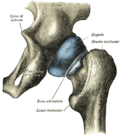
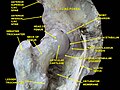
Left hip-joint, opened by removing the floor of the acetabulum from within the pelvis.
Upper extremity of right femur viewed from behind and above.
Details
InsertionsPsoas major, iliacus
Identifiers
Latintrochanter minor
TA98A02.5.04.007
TA21366
FMA32853
Anatomical terms of bone

In human anatomy, the lesser trochanter is a conical, posteromedial, bony projection from the shaft of the femur. It serves as the principal insertion site of the iliopsoas muscle.[1]

Structure

[edit]

The lesser trochanter is a conical posteromedial projection of the shaft of the femur, projecting from the posteroinferior aspect of its junction with the femoral neck.[1]

The summit and anterior surface of the lesser trochanter are rough, whereas its posterior surface is smooth.[1]

From its apex three well-marked borders extend:[2]

  • two of these are above
  • the inferior border is continuous with the middle division of the linea aspera

Attachments

[edit]

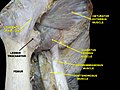
The summit of the lesser trochanter gives insertion to the tendon of the psoas major muscle and the iliacus muscle;[3] the lesser trochanter represents the principal attachment of the iliopsoas.[1]

Anatomical relations

[edit]

The intertrochanteric crest (which demarcates the junction of the femoral shaft and neck posteriorly) extends between the lesser trochanter and the greater trochanter on the posterior surface of the femur.[1]

Clinical significance

[edit]
Lesser trochanter avulsion fracture

The lesser trochanter can be involved in an avulsion fracture.[4]

Other animals

[edit]

Paleontology

[edit]

The position of the lesser trochanter close to the head of the femur is one of the defining characteristics of the Prozostrodontia, which is the clade of cynodonts including mammals and their closest non-mammaliform relatives. It was erected as a node-based taxon as the least inclusive clade containing Prozostrodon brasiliensis, Tritylodon langaevus, Pachygenelus monus, and Mus musculus (the house mouse).[5]

All living mammals have a lesser trochanter, whose size, shape, and position is distinctive to their species.

Additional images

[edit]

See also

[edit]

References

[edit]
[edit]
Revisions and contributorsEdit on WikipediaRead on Wikipedia
from Grokipedia
The lesser trochanter is a small, conical bony prominence located on the posteromedial aspect of the proximal , projecting inferiorly from the junction of the and shaft. It features a rough apex and anterior surface for muscular attachment, contrasted by a smoother posterior surface, and is connected to the by the intertrochanteric crest posteriorly and the intertrochanteric line anteriorly. Smaller and less prominent than its counterpart, the , it serves primarily as the insertion point for the tendon of the muscle, formed by the psoas major and iliacus muscles. The tendon inserts onto the lesser , securing its attachment and enabling powerful flexion, a critical movement for activities such as walking, running, and . This structure contributes to the overall stability and biomechanics of the joint, with the lesser acting as an anchor that transmits forces from the to the during contraction. Developmentally, the lesser begins ossifying between ages 7 and 9, fusing to the by 14–17 years in females and 16–19 years in males, ensuring structural integrity during growth. Clinically, the lesser trochanter is significant in orthopedic procedures, serving as a key landmark for the cut in arthroplasty, typically positioned 10–15 mm superiorly to avoid complications. It is also prone to avulsion fractures from forceful contraction, particularly in adolescents or athletes, which may require surgical stabilization such as cerclage wiring to prevent further propagation. Additionally, its proximity to the —passing medial and deep to it—necessitates careful consideration during posterior surgical approaches to the .

Anatomy

Gross structure

The lesser trochanter is a conical, posteromedial bony projection arising from the proximal at the junction of the shaft and neck. It is positioned inferior to the and posterior to the neck-shaft junction, contributing to the overall contour of the proximal femoral region. This structure serves as a key landmark in the posteromedial aspect of the bone. Typically measuring 1-1.5 cm in height, the lesser trochanter features a roughened anterior summit and a smooth posterior surface. Its borders are defined by three ridges extending from the apex: the lateral ridge blends into the linea aspera on the posterior femoral shaft, while the medial border forms part of the intertrochanteric line connecting it to the greater trochanter anteriorly. The posterior aspect aligns with the intertrochanteric crest, providing a smooth transition to adjacent bony features.

Muscle attachments

The lesser trochanter serves as the primary insertion site for the iliopsoas tendon, formed by the confluence of the psoas major and iliacus muscles. This common tendon approaches the anteriorly, passing over the before attaching to the posterior-medial aspect of the lesser trochanter. The psoas major tendon, being thicker, inserts primarily onto the summit and medial aspect of the lesser trochanter, providing a broad base for attachment. In contrast, the iliacus tendon, which is narrower, attaches to the lateral and more distal portions of the . The rough summit of the lesser trochanter enhances tendon grip through its irregular bony surface. Anatomical variations may include secondary attachments of minor fibers from the pectineus or adductor brevis muscles to the lesser , observed in cadaveric dissections. Such variants occur in a subset of individuals and can influence local dynamics. The tendon is separated from the lesser trochanter and adjacent capsule by the iliopectineal , the largest bursa in the body, which facilitates smooth gliding and may become inflamed under repetitive stress. This bursal structure communicates with the joint in approximately 15% of cases, potentially allowing exchange.

Anatomical relations

The lesser trochanter is positioned on the posteromedial aspect of the proximal , just inferior to the , and maintains specific spatial relationships with adjacent bony and structures that influence stability and movement. Superiorly, it connects to the via the intertrochanteric crest on the posterior surface and the intertrochanteric line on the anterior surface, forming a ridge that demarcates the junction between the and shaft. These connections provide a structural bridge between the two trochanters, supporting ligamentous and muscular attachments in the proximal . Medially, the lesser trochanter borders the pectineal line and the spiral line, both of which originate near its base and extend distally along the femoral shaft toward the , contributing to the overall contour of the medial femoral surface. Posteriorly, it overlies the , which attaches along the intertrochanteric crest, and the obturator externus tendon, which passes beneath it toward the trochanteric fossa. Anteriorly, the structure lies in close proximity to the origin of the muscle on the medial and is positioned lateral to the iliopectineal eminence of the , facilitating interactions within the anterior compartment. Ligamentously, the lesser trochanter forms part of the proximal attachment site for the hip joint capsule, with the anchoring indirectly via its broad insertion along the intertrochanteric line, enhancing anterior stability of the hip. For contextual proximity, the muscle group inserts directly onto the lesser trochanter, underscoring its role in bridging pelvic and femoral anatomy.

Development and ossification

The lesser trochanter originates during embryonic development from mesenchymal s within the , forming part of the proximal femoral anlage around the 6th to 7th week of . This becomes visible as a distinct structure by Carnegie stage 23 (approximately 7-8 weeks, corresponding to a of about 26-30 mm), marking the early of the posteroinferior femoral prominence. By the 8th week, primary of the femoral begins, but the lesser trochanter remains cartilaginous, contributing to the overall shaping of the proximal through progressive chondrogenesis and endochondral processes. Ossification of the lesser trochanter occurs as a secondary center, typically appearing between 12 and 14 years of age during , driven by the traction forces from the attached . As a traction apophysis, its development and are influenced by mechanical stress from the muscle pull, which promotes bone modeling according to principles of . This center fuses with the femoral shaft by 16 to 18 years, completing the integration into the mature proximal femur structure. Growth variations in the lesser trochanter are observed, with increased size and prominence often noted in athletes due to enhanced mechanical loading on the during repetitive activities. Sex differences also exist, with females generally exhibiting a smaller lesser trochanter compared to males, potentially related to overall pelvic and femoral morphology differences that emerge during . Pathological development of the lesser trochanter is uncommon, with congenital absence being extremely rare and typically associated with broader femoral dysplasias such as , where the may be hypoplastic or entirely absent due to disrupted proximal femoral anlage formation.

Vascular and neural supply

The arterial supply to the lesser trochanter is primarily provided by branches of the (MCFA), a branch of the , with the deep branch of the MCFA contributing via the around the base of the trochanters. This anastomosis also involves the , , and first perforating artery, ensuring robust perfusion to the proximal including the lesser trochanter. A minor contribution comes from the acetabular branch of the obturator artery, which anastomoses with MCFA branches near the lesser trochanter's medial aspect. Venous drainage of the lesser trochanter follows the arterial pattern, with accompanying veins draining into tributaries of the . These veins converge with the and ultimately join the , facilitating return of deoxygenated blood from the proximal . Neural innervation to the lesser trochanter is predominantly sensory, supplied by periosteal branches of the (L2-L4 roots), which provide nociceptive and proprioceptive input to the bone's surface. There is no direct motor innervation to the bone itself, though the supplies the muscle attaching to the lesser trochanter, with roots from L1-L3. Lymphatic drainage from the lesser trochanter follows deep pathways of the proximal lower limb, converging into the before progressing to the external iliac nodes.

Function

Role in hip flexion

The lesser trochanter serves as the primary insertion site for the muscle, acting as a that facilitates powerful hip flexion through contraction of this primary flexor. The , comprising the psoas major and iliacus, converges into a that attaches to the anterior aspect of the lesser trochanter, enabling the thigh to flex at the joint up to approximately 120 degrees of motion. This attachment allows the muscle to exert force directly on the proximal , initiating and powering the forward movement of the relative to the . The posteromedial position of the lesser trochanter provides a for generating flexion , with the moment arm enhanced by the separate insertions of its components, resulting in up to 37% larger effective arms and 69% greater compared to traditional models. This configuration not only amplifies the force for flexion but also assists in stabilizing the within the during dynamic activities like , where the maintains positioning. Kinematically, the lesser trochanter's role via iliopsoas attachment is crucial for initiating the swing phase of walking, accelerating the thigh forward to propel the body. It coordinates with abdominal muscles to support posture by stabilizing the lumbar spine and pelvis, ensuring efficient trunk alignment during locomotion. However, its involvement is limited to flexion and minor external rotation, with negligible contributions to hip extension or abduction.

Biomechanical considerations

The muscle, inserting on the lesser trochanter, contributes to hip joint forces during dynamic hip flexion, which can reach 3 to 5 times body weight in peak activities like running. This loading arises from the muscle's primary role in accelerating the forward, countering gravitational and inertial forces, and results in tensile stress concentrated at the trochanteric insertion site. Such forces contribute to the lesser trochanter experiencing primarily pulling stresses, which are amplified during rapid movements where iliopsoas activation peaks to stabilize the and propel the limb. Stress distribution analyses, including finite element modeling, reveal peak at the tendon-bone interface of the lesser , particularly under repetitive loading as in sprinting or . These models demonstrate that chronic traction from the induces axial bending strains extending from the to the adjacent , with highest concentrations at the insertion point due to the tendon's oblique pull. During sprinting, this interface endures elevated shear and tensile strains, potentially leading to microdamage accumulation without overt failure. Biomechanical efficiency in flexion depends on angles, with tension limiting motion to approximately 90 degrees when the is fully extended, which minimizes antagonism and influences loading patterns transmitted through the lesser trochanter. In this configuration, the operates at a favorable , facilitating efficient transfer to the . Age-related changes significantly impact lesser trochanter , with reductions accelerating after age 50, and approximately 16% of total lifetime loss occurring between ages 50 and 64, mostly in cortical , leading to further declines thereafter and elevating under equivalent loads. This diminution, primarily in cortical , compromises the 's ability to withstand tensile forces from the , with increasing 100- to 1000-fold over 60 years of aging due to diminished structural integrity. Lower Hounsfield unit densities at the lesser (e.g., below 83.5 HU) further correlate with heightened vulnerability to load-induced failure in older individuals.

Clinical significance

Injuries and fractures

Avulsion fractures of the lesser trochanter are rare injuries, accounting for less than 1% of all pediatric injuries and 1.8% to 3% of pelvic avulsion fractures, with a higher incidence among athletes and dancers involved in activities requiring explosive flexion.30177-X/fulltext) These fractures most commonly occur in adolescents aged 13 to 17 years during sudden, forceful eccentric contraction of the muscle, often in sports such as soccer, track, or gymnastics, leading to traction at the apophysis. The injury exploits the relative weakness of the apophysis compared to the tendinous attachment during this developmental stage. Avulsion fractures are classified based on displacement: type I (nondisplaced), type II (displacement less than 2 cm), and type III (displacement greater than 2 cm without ). Patients typically present with acute pain, inability to bear weight, and a limp following the traumatic event. Stress fractures of the lesser are even rarer, primarily affecting long-distance runners during high-volume training, and manifest as insidious onset of or anterior pain exacerbated by . , particularly MRI, reveals marrow , , or cortical fractures in the region, with one study noting such injuries in 20% of athletes evaluated for lower extremity stress reactions. These injuries may be linked to or mimic other pediatric hip pathologies involving physeal weakness, such as or Legg-Calvé-Perthes disease, necessitating careful in adolescents with hip pain.

Surgical and diagnostic relevance

The lesser is evaluated using plain radiography as the initial modality to assess for avulsion fractures and measure displacement, with s providing clear visualization of bony fragments and their position relative to the femoral shaft. (MRI) serves as the most sensitive modality for detecting lesser avulsions, particularly in identifying soft-tissue involvement, , and non-displaced fractures that may be occult on . Diagnostic assessment of conditions affecting the lesser trochanter often includes the to evaluate iliopsoas tightness, where the patient lies and flexes one while allowing the contralateral leg to extend; inability to fully extend indicates at the iliopsoas insertion on the lesser trochanter. For iliopsoas , ultrasound-guided injection of corticosteroids and local anesthetics into the provides both diagnostic confirmation through pain relief and therapeutic benefit, with studies showing sustained >50% pain reduction in up to 90% of patients post- at one-year follow-up. Surgical interventions for lesser trochanter avulsions typically involve open or arthroscopic reduction and for displacements exceeding 2 cm to prevent and restore biomechanics, using screws or wires to secure the fragment. In cases of iliopsoas , arthroscopic release of the at the lesser trochanter level is performed to alleviate snapping or impingement, often via an extra-articular approach to minimize complications like tendon retraction. Postoperative outcomes following surgical fixation of lesser trochanter avulsions demonstrate high success rates, with patients returning to at an average of 3-4 months and overall return-to-preinjury activity in 83-95% of adolescent athletes. Complications such as are infrequent after operative management, occurring in fewer than 10% of cases, though conservative approaches may yield higher rates of asymptomatic in displaced injuries.

Comparative and evolutionary anatomy

In non-human mammals

In non-human mammals, the lesser trochanter exhibits notable variations in form adapted to locomotor demands. In cursorial species such as horses (Equus caballus), it facilitates enhanced hip flexion during high-speed running, serving as the primary insertion site for the iliopsoas muscle complex, including psoas major and iliacus. Conversely, in brachiating primates like gibbons (Hylobates spp.), the lesser trochanter tends to be relatively reduced and shorter, reflecting diminished emphasis on hindlimb power for propulsion in favor of forelimb-dominated locomotion, with shorter moment arms for hip flexors compared to quadrupedal great apes. Muscle attachments to the lesser trochanter are predominantly the group across most mammals, enabling flexion essential for limb protraction. In carnivores such as dogs (Canis familiaris), it remains a prominent medial process primarily for iliopsoas insertion, positioned near deep hip muscles to support agile terrestrial movement, though additional minor attachments like pectineus may contribute in some species. Relative to overall length, the lesser trochanter tends to be larger and more proximally extended in quadrupedal mammals compared to bipedal or semi-arboreal forms, optimizing leverage for gaits. Functionally, the lesser trochanter supports specialized adaptations in various taxa. In lagomorphs like rabbits (Oryctolagus cuniculus) and hares (Lepus europaeus), its role as the iliopsoas insertion point aids powerful hip flexion for bounding and saltatory gaits, enabling rapid acceleration and jumping with forces up to 38 N from psoas major alone. In contrast, aquatic mammals such as modern whales (Cetacea) have vestigial hindlimbs where the femur is drastically reduced, rendering the lesser trochanter minimal or absent, a legacy of evolutionary loss of terrestrial propulsion in fully aquatic lifestyles.

Evolutionary history and paleontology

The lesser trochanter emerges as a distinct femoral feature in therapsids during the Permian period (approximately 299–252 million years ago), marking a key adaptation in the evolution toward the mammalian lineage within the Synapsida. This structure becomes a diagnostic synapomorphy for the , a group of advanced non-mammaliaform cynodonts that includes mammaliaforms and their closest relatives, such as tritylodontids and brasilodontids, emerging in the . In these early forms, the lesser is characterized by a medially oriented projection separated from the by a notch, facilitating enhanced flexion and supporting more efficient limb positioning compared to basal synapsids. During therapsid evolution, particularly in cynodonts and advanced forms like probainognathians, the lesser trochanter enlarged significantly, correlating with the transition toward a more upright posture and parasagittal limb movement. This enlargement, observed in taxa such as Thrinaxodon and Prozostrodon, provided a robust attachment site for hip flexor muscles like the iliopsoas, enabling greater locomotor versatility and foreshadowing mammalian erect gait. Recent studies (as of 2024) indicate a late acquisition of erect hindlimb posture in the mammalian stem lineage, with the lesser trochanter playing a role in this transition. In contrast, within avian evolution, the lesser trochanter reduced and merged with the greater trochanter to form a continuous trochanteric crest, an adaptation suited to the specialized flight-related hindlimb mechanics in birds, as seen in Early Cretaceous avialans. Paleontologically, the lesser trochanter serves as a marker to distinguish cynodonts from earlier therapsids, with its medial orientation and proximal placement defining derived clades like . Variations in its size and position among dinosaurs, such as independent development of a prominent lesser trochanter in theropods and ornithischians, indicate shifts toward locomotion and increased femoral leverage for speed and stability. Key fossil evidence includes the lesser trochanter in femora from the , contributing to bipedal locomotion. Notably, the lesser trochanter is absent in many reptiles, such as basal sauropsids, highlighting its specificity to the synapsid-mammalian lineage.

References

Add your contribution
Related Hubs
User Avatar
No comments yet.