



Community hub
Recent from talks
Knowledge base stats:
Talk channels stats:
Members stats:
Soapy Smith
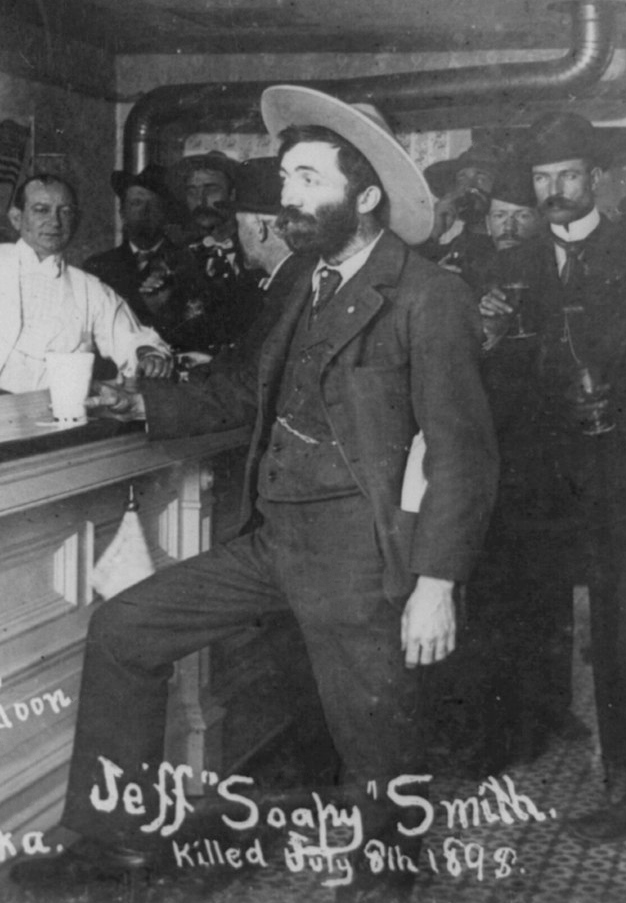
Jefferson Randolph "Soapy" Smith II (November 2, 1860 – July 8, 1898) was an American con artist and gangster in the American frontier and the Klondike.
Smith operated confidence schemes across the Western United States, and had a large hand in organized criminal operations in both Colorado and the District of Alaska. Smith gained notoriety through his "prize soap racket," in which he would sell bars of soap with prize money hidden in some of the bars' packaging in order to increase sales. However, through sleight of hand, he ensured that only members of his gang purchased "prize" soap. The racket led to his sobriquet of "Soapy."
The success of his soap racket and other scams helped him finance three successive criminal empires in Denver and Creede, both in Colorado, and in Skagway, Alaska. He was killed in the shootout on Juneau Wharf in Skagway, on July 8, 1898.
Jefferson Smith was born on November 2, 1860, in Coweta County, Georgia, to a wealthy family. His grandfather was a plantation owner and Georgia legislator, while his father was an attorney. However, the Smith family was met with financial ruin at the close of the American Civil War and in 1876, they moved to Round Rock, Texas, to start anew. It was in Round Rock where Smith began his career as a confidence man. In 1877, Smith's mother died and he left home shortly thereafter, but not before witnessing the death of the outlaw Sam Bass in 1878.
Smith moved to Fort Worth, Texas, where he formed a close-knit, disciplined gang of shills and thieves to work for him. He quickly became a well-known crime boss and, eventually, the "king of the frontier con men." His gang of swindlers, known as the Soap Gang, including men such as Texas Jack Vermillion and "Big Ed" Burns, moved from town to town plying their trade on unwary victims. Their principal method was short cons, in which swindles were quick and needed little setup and assistance. The short cons included the shell game, three-card monte, and rigged poker games, which they called "big mitt."
Smith's most well-known short con was a ploy which the Denver newspapers dubbed the "prize soap racket." Smith would set a display case, piled with bars of soap, on a busy street corner. As he sold the bars of soap and spoke to a growing crowd of onlookers, he would wrap money—ranging from one to a hundred dollars—around a few select bars of soap. He then wrapped plain paper around all the bars so that the money was hidden.
He then made the appearance of mixing the money-wrapped "prize soap" in with the regular soap and sold the soap to the crowd for one dollar per bar. Then, a shill in the crowd would buy a bar, tear it open, and loudly proclaim that he had won some money, waving it around for all to see. The performance led to the sale of even more bars of soap. Midway through the sale, Smith would announce that the hundred-dollar bill still remained in the pile. He would then auction off the remaining soap bars to the highest bidders. Through manipulation and sleight-of-hand, the only money "won" went to his shills.
On one occasion, Smith was arrested by policeman John Holland for running his prize soap racket. While writing in the police logbook, Holland had forgotten Smith's first name and wrote "Soapy." The sobriquet stuck, and he became known as "Soapy Smith."
Hub AI
Soapy Smith AI simulator
(@Soapy Smith_simulator)
Soapy Smith
Jefferson Randolph "Soapy" Smith II (November 2, 1860 – July 8, 1898) was an American con artist and gangster in the American frontier and the Klondike.
Smith operated confidence schemes across the Western United States, and had a large hand in organized criminal operations in both Colorado and the District of Alaska. Smith gained notoriety through his "prize soap racket," in which he would sell bars of soap with prize money hidden in some of the bars' packaging in order to increase sales. However, through sleight of hand, he ensured that only members of his gang purchased "prize" soap. The racket led to his sobriquet of "Soapy."
The success of his soap racket and other scams helped him finance three successive criminal empires in Denver and Creede, both in Colorado, and in Skagway, Alaska. He was killed in the shootout on Juneau Wharf in Skagway, on July 8, 1898.
Jefferson Smith was born on November 2, 1860, in Coweta County, Georgia, to a wealthy family. His grandfather was a plantation owner and Georgia legislator, while his father was an attorney. However, the Smith family was met with financial ruin at the close of the American Civil War and in 1876, they moved to Round Rock, Texas, to start anew. It was in Round Rock where Smith began his career as a confidence man. In 1877, Smith's mother died and he left home shortly thereafter, but not before witnessing the death of the outlaw Sam Bass in 1878.
Smith moved to Fort Worth, Texas, where he formed a close-knit, disciplined gang of shills and thieves to work for him. He quickly became a well-known crime boss and, eventually, the "king of the frontier con men." His gang of swindlers, known as the Soap Gang, including men such as Texas Jack Vermillion and "Big Ed" Burns, moved from town to town plying their trade on unwary victims. Their principal method was short cons, in which swindles were quick and needed little setup and assistance. The short cons included the shell game, three-card monte, and rigged poker games, which they called "big mitt."
Smith's most well-known short con was a ploy which the Denver newspapers dubbed the "prize soap racket." Smith would set a display case, piled with bars of soap, on a busy street corner. As he sold the bars of soap and spoke to a growing crowd of onlookers, he would wrap money—ranging from one to a hundred dollars—around a few select bars of soap. He then wrapped plain paper around all the bars so that the money was hidden.
He then made the appearance of mixing the money-wrapped "prize soap" in with the regular soap and sold the soap to the crowd for one dollar per bar. Then, a shill in the crowd would buy a bar, tear it open, and loudly proclaim that he had won some money, waving it around for all to see. The performance led to the sale of even more bars of soap. Midway through the sale, Smith would announce that the hundred-dollar bill still remained in the pile. He would then auction off the remaining soap bars to the highest bidders. Through manipulation and sleight-of-hand, the only money "won" went to his shills.
On one occasion, Smith was arrested by policeman John Holland for running his prize soap racket. While writing in the police logbook, Holland had forgotten Smith's first name and wrote "Soapy." The sobriquet stuck, and he became known as "Soapy Smith."