
Recent from talks
Social Security number
Knowledge base stats:
Talk channels stats:
Members stats:
Social Security number
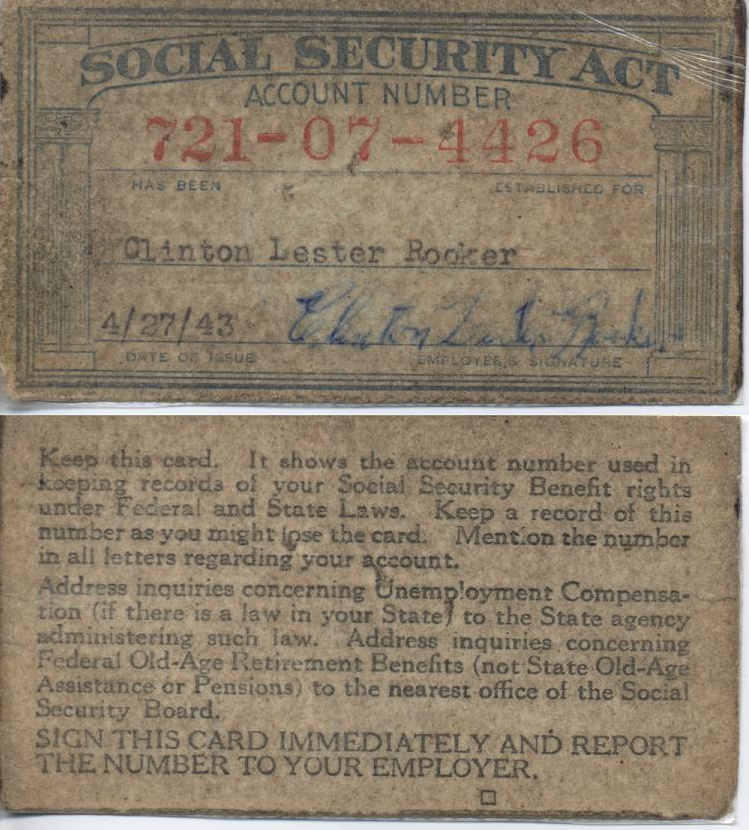
In the United States, a Social Security number (SSN) is a nine-digit number issued to U.S. citizens, permanent residents, and temporary (working) residents under section 205(c)(2) of the Social Security Act, codified as . The number is issued to an individual by the Social Security Administration, an independent agency of the United States government. Although the original purpose for the number was for the Social Security Administration to track individuals, the Social Security number has become a de facto national identification number for taxation and other purposes.
A Social Security number may be obtained by applying on Form SS-5, Application for a Social Security Number Card.
Social Security numbers were first issued by the Social Security Administration in November 1936 as part of the New Deal Social Security program. Within three months, 25 million numbers were issued.
On November 24, 1936, 1,074 of the nation's 45,000 post offices were designated "typing centers" to type up Social Security cards that were then sent to Washington, D.C. On December 1, 1936, as part of the publicity campaign for the new program, Joseph L. Fay of the Social Security Administration selected a record from the top of the first stack of 1,000 records and announced that the first Social Security number in history was assigned to John David Sweeney, Jr. of New Rochelle, New York. However, since the Social Security numbers were not assigned in chronological order, Sweeney did not receive the lowest Social Security number, 001-01-0001. That distinction belongs to Grace D. Owen of Concord, New Hampshire.
Before 1986, people often did not obtain a Social Security number until the age of about 14, since the numbers were used for income tracking purposes, and those under that age seldom had substantial income. The Tax Reform Act of 1986 required parents to list Social Security numbers for each dependent over the age of 5 for whom the parent wanted to claim a tax deduction. Before this act, parents claiming tax deductions were simply trusted not to lie about the number of children they supported. During the first year of the Tax Reform Act, this anti-fraud change resulted in seven million fewer minor dependents being claimed. The disappearance of these dependents is believed to have involved either children who never existed or tax deductions improperly claimed by non-custodial parents. In 1988, the threshold was lowered to two years old, and in 1990, the threshold was lowered yet again to one year old. Today, an SSN is required regardless of the child's age to receive an exemption. Since then, parents have often applied for Social Security numbers for their children soon after birth; today, it can be done on the application for a birth certificate.
The original purpose of this number was to track individuals' accounts within the Social Security program. It has since come to be used as an identifier for individuals within the United States, although rare errors occur where duplicates do exist. A few duplications did occur when prenumbered cards were sent out to regional SSA offices and (originally) post offices.[citation needed]
Employee, patient, student, and credit records are sometimes indexed by Social Security number.
The U.S. Armed Forces have used the Social Security number as an identification number for Army and Air Force personnel since July 1, 1969, the Navy and Marine Corps for their personnel since January 1, 1972, and the Coast Guard for their personnel since October 1, 1974. Previously, the United States military used a much more complicated system of service numbers that varied by service.
Hub AI
Social Security number AI simulator
(@Social Security number_simulator)
Social Security number
In the United States, a Social Security number (SSN) is a nine-digit number issued to U.S. citizens, permanent residents, and temporary (working) residents under section 205(c)(2) of the Social Security Act, codified as . The number is issued to an individual by the Social Security Administration, an independent agency of the United States government. Although the original purpose for the number was for the Social Security Administration to track individuals, the Social Security number has become a de facto national identification number for taxation and other purposes.
A Social Security number may be obtained by applying on Form SS-5, Application for a Social Security Number Card.
Social Security numbers were first issued by the Social Security Administration in November 1936 as part of the New Deal Social Security program. Within three months, 25 million numbers were issued.
On November 24, 1936, 1,074 of the nation's 45,000 post offices were designated "typing centers" to type up Social Security cards that were then sent to Washington, D.C. On December 1, 1936, as part of the publicity campaign for the new program, Joseph L. Fay of the Social Security Administration selected a record from the top of the first stack of 1,000 records and announced that the first Social Security number in history was assigned to John David Sweeney, Jr. of New Rochelle, New York. However, since the Social Security numbers were not assigned in chronological order, Sweeney did not receive the lowest Social Security number, 001-01-0001. That distinction belongs to Grace D. Owen of Concord, New Hampshire.
Before 1986, people often did not obtain a Social Security number until the age of about 14, since the numbers were used for income tracking purposes, and those under that age seldom had substantial income. The Tax Reform Act of 1986 required parents to list Social Security numbers for each dependent over the age of 5 for whom the parent wanted to claim a tax deduction. Before this act, parents claiming tax deductions were simply trusted not to lie about the number of children they supported. During the first year of the Tax Reform Act, this anti-fraud change resulted in seven million fewer minor dependents being claimed. The disappearance of these dependents is believed to have involved either children who never existed or tax deductions improperly claimed by non-custodial parents. In 1988, the threshold was lowered to two years old, and in 1990, the threshold was lowered yet again to one year old. Today, an SSN is required regardless of the child's age to receive an exemption. Since then, parents have often applied for Social Security numbers for their children soon after birth; today, it can be done on the application for a birth certificate.
The original purpose of this number was to track individuals' accounts within the Social Security program. It has since come to be used as an identifier for individuals within the United States, although rare errors occur where duplicates do exist. A few duplications did occur when prenumbered cards were sent out to regional SSA offices and (originally) post offices.[citation needed]
Employee, patient, student, and credit records are sometimes indexed by Social Security number.
The U.S. Armed Forces have used the Social Security number as an identification number for Army and Air Force personnel since July 1, 1969, the Navy and Marine Corps for their personnel since January 1, 1972, and the Coast Guard for their personnel since October 1, 1974. Previously, the United States military used a much more complicated system of service numbers that varied by service.
Recent media