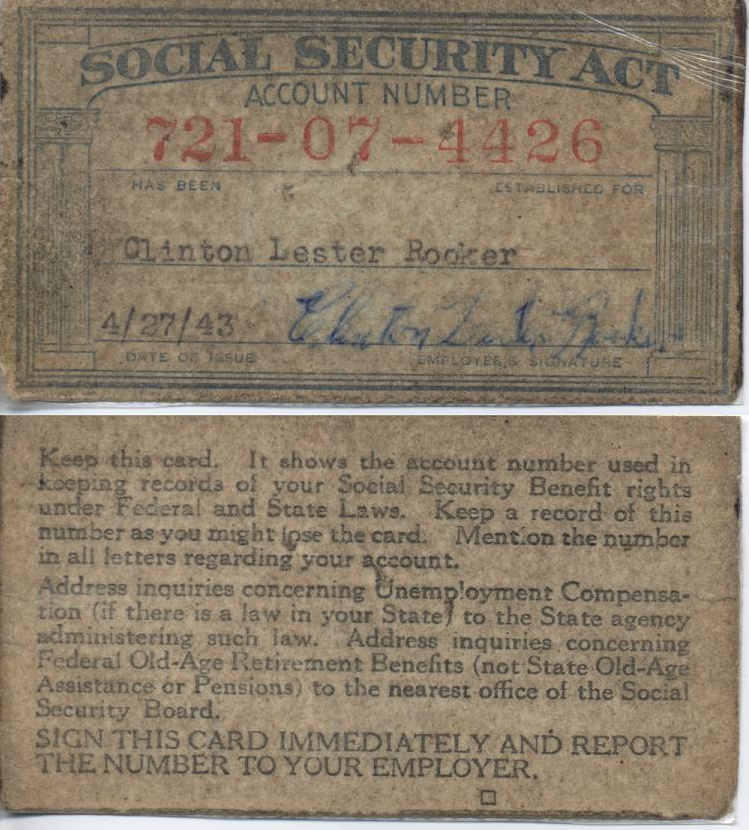

Social Security number
View on Wikipedia A Social Security card issued by the Railroad Retirement Board in 1943 | |
| Acronym | SSN |
|---|---|
| Organization | Social Security Administration |
| Introduced | November 24, 1936 |
| No. of digits | 9 |
In the United States, a Social Security number (SSN) is a nine-digit number issued to U.S. citizens, permanent residents, and temporary (working) residents under section 205(c)(2) of the Social Security Act, codified as . The number is issued to an individual by the Social Security Administration, an independent agency of the United States government. Although the original purpose for the number was for the Social Security Administration to track individuals,[1] the Social Security number has become a de facto national identification number for taxation and other purposes.[2]
A Social Security number may be obtained by applying on Form SS-5, Application for a Social Security Number Card.[3]
History
[edit]Social Security numbers were first issued by the Social Security Administration in November 1936 as part of the New Deal Social Security program. Within three months, 25 million numbers were issued.[4]
On November 24, 1936, 1,074 of the nation's 45,000 post offices were designated "typing centers" to type up Social Security cards that were then sent to Washington, D.C. On December 1, 1936, as part of the publicity campaign for the new program, Joseph L. Fay of the Social Security Administration selected a record from the top of the first stack of 1,000 records and announced that the first Social Security number in history was assigned to John David Sweeney, Jr. of New Rochelle, New York. However, since the Social Security numbers were not assigned in chronological order, Sweeney did not receive the lowest Social Security number, 001-01-0001. That distinction belongs to Grace D. Owen of Concord, New Hampshire.[5][6]
Before 1986, people often did not obtain a Social Security number until the age of about 14,[7] since the numbers were used for income tracking purposes, and those under that age seldom had substantial income.[8] The Tax Reform Act of 1986 required parents to list Social Security numbers for each dependent over the age of 5 for whom the parent wanted to claim a tax deduction.[9] Before this act, parents claiming tax deductions were simply trusted not to lie about the number of children they supported. During the first year of the Tax Reform Act, this anti-fraud change resulted in seven million fewer minor dependents being claimed. The disappearance of these dependents is believed to have involved either children who never existed or tax deductions improperly claimed by non-custodial parents.[10] In 1988, the threshold was lowered to two years old, and in 1990, the threshold was lowered yet again to one year old.[11] Today, an SSN is required regardless of the child's age to receive an exemption.[12] Since then, parents have often applied for Social Security numbers for their children soon after birth; today, it can be done on the application for a birth certificate.[13]
Purpose and use
[edit]The original purpose of this number was to track individuals' accounts within the Social Security program. It has since come to be used as an identifier for individuals within the United States, although rare errors occur where duplicates do exist. A few duplications did occur when prenumbered cards were sent out to regional SSA offices and (originally) post offices.[citation needed]
Employee, patient, student, and credit records are sometimes indexed by Social Security number.
The U.S. Armed Forces have used the Social Security number as an identification number for Army and Air Force personnel since July 1, 1969, the Navy and Marine Corps for their personnel since January 1, 1972, and the Coast Guard for their personnel since October 1, 1974.[14] Previously, the United States military used a much more complicated system of service numbers that varied by service.
Beginning in June 2011, the DOD began removing the Social Security number from military identification cards, replacing them with a unique DOD identification number, formally known as the EDIPI.[15]
Non-universal status
[edit]
Social Security was originally a universal tax, but when Medicare was passed in 1965, objecting religious groups in existence prior to 1951 were allowed to opt out of the system.[16] Because of this, not every American is part of the Social Security program, and not everyone has a number. However, a Social Security number is required for parents to claim their children as dependents for federal income tax purposes,[13] and the Internal Revenue Service requires all corporations to obtain SSNs (or alternative identifying numbers) from their employees, as described below. The Old Order Amish have fought to prevent universal Social Security by overturning rules such as a requirement to provide a Social Security number for a hunting license.[17]
Social Security cards printed from January 1946 until January 1972 expressly stated that people should not use the number and card for identification.[18] Since nearly everyone in the United States now has an SSN, it became convenient to use it anyway and the message was removed.[19]
Since then, Social Security numbers have become de facto national identification numbers.[2] Although some people do not have an SSN assigned to them, it is becoming increasingly difficult to engage in legitimate financial activities such as applying for a loan or a bank account without one.[20] While the government cannot require an individual to disclose their SSN without a legal basis, companies may refuse to provide service to an individual who does not provide an SSN.[21][22] The card on which an SSN is issued is still not suitable for primary identification as it has no photograph, no physical description, and no birth date. Instead, a driver's license or state ID card is used as an identification for adults.
Use required for federal tax purposes
[edit].jpg)
Internal Revenue Code section 6109(d) provides: "The social security account number issued to an individual for purposes of section 205(c)(2)(A) of the Social Security Act [codified as ] shall, except as shall otherwise be specified under regulations of the Secretary [of the Treasury or his delegate], be used as the identifying number for such individual for purposes of this title [the Internal Revenue Code, title 26 of the United States Code]."[23]
The Internal Revenue Code also provides, when required by regulations prescribed by the secretary of the treasury or their delegate:
- Inclusion in returns: Any person required under the authority of this title to make a return, statement, or other document shall include in such return, statement, or other document such identifying number as may be prescribed for securing proper identification of such person.
- Furnishing number to other persons: Any person with respect to whom a return, statement, or other document is required under the authority of this title to be made by another person or whose identifying number is required to be shown on a return of another person shall furnish to such other person such identifying number as may be prescribed for securing their proper identification.[24]
According to U.S. Treasury regulations, any person who, after October 31, 1962, works as an employee for wages subject to Social Security taxes, Medicare taxes, or U.S. federal income tax withholdings is required to apply for "an account number" using Form SS-5.[25] As of March 2025, automatic issuance of SSNs via the Enumeration Beyond Entry (EBE) program has been discontinued. Applicants must now attend in-person appointments at SSA offices to receive their SSNs, regardless of selection during USCIS form submission.[26]
A taxpayer who is not eligible to have a Social Security Number (SSN) must obtain a Taxpayer Identification Number (TIN).
Types of Social Security cards
[edit]Four different classifications of Social Security cards are issued. Such cards are issued by geographic location (SSN Area Number) to:
- persons of natural birth within the territorial boundaries of any one of the member States of the United States of America;
- persons who become U.S. citizens by oath, or birth within the exclusive legislative or territorial jurisdiction of the U.S. government;
- persons who become U.S. permanent residents;
- persons with certain restrictions.
There are two restricted types of Social Security cards:
- One reads "not valid for employment." Such cards cannot be used as proof of work authorization, and are not acceptable as a List C document on the I-9 form.
- The other reads "valid for work only with DHS authorization", or the older, "valid for work only with INS authorization." These cards are issued to people who have temporary work authorization in the U.S. from the Department of Homeland Security[27] -- the nation's border agency. They can satisfy the I-9 requirement, if they are accompanied by a work authorization card.
The cards commonly display the cardholder's name and number.
Note: As of 2025, individuals must request their SSN in person at a Social Security Administration office, even if they applied for one through USCIS forms like I-765 or N-400. Automatic issuance (Enumeration Beyond Entry) is no longer supported.[28]
In 2004 Congress passed The Intelligence Reform and Terrorism Prevention Act; parts of which mandated that the Social Security Administration redesign the SSN card to prevent forgery. From April 2006 through August 2007, the SSA and Government Printing Office (GPO) employees were assigned to redesign the Social Security number card to the specifications of the Interagency Task Force created by the commissioner of Social Security in consultation with the secretary of Homeland Security.
The new SSN card design utilizes both covert and overt security features created by the SSA and GPO design teams.
Suspension of the Enumeration Beyond Entry (EBE) Program
[edit]In March 2025, the Social Security Administration (SSA) quietly suspended the Enumeration Beyond Entry (EBE) program, which previously enabled automatic issuance of SSNs to applicants for work authorization (Form I-765) or naturalization (Form N-400). Under EBE, applicants would receive their SSNs via mail without needing to visit SSA offices.
With this suspension, individuals must now schedule in-person appointments at SSA offices to obtain an SSN—even if they selected the SSN option on USCIS forms. This change impacts new green card holders, work permit recipients, and naturalized citizens who cannot legally work, open bank accounts, or obtain state IDs without an SSN.
SSA estimated that the automatic issuance cost was approximately $8, while the current in-person issuance process now costs $55.80 per request. Staffing cuts of 12% and the closure of 47 SSA offices have exacerbated appointment backlogs, affecting over 3.24 million I-765 applicants in 2024 alone.
Individuals experiencing delays are advised to document the impact on employment, housing, or financial access and consult immigration counsel as necessary.[29]
Identity theft
[edit]Many citizens and privacy advocates are concerned about the disclosure and processing of Social Security numbers.[30] Furthermore, researchers at Carnegie Mellon University have demonstrated an algorithm that uses publicly available personal information to reconstruct a given SSN.[31]
The SSN is frequently used by those involved in identity theft. This is because it is interconnected with many other forms of identification and people asking for it treat it as an authenticator. Financial institutions generally require an SSN to set up bank accounts, credit cards, and loans—partly because they assume that no one except the person it was issued to knows it.
Exacerbating the problem of using the Social Security number as an identifier is the fact that the Social Security card contains no biometric identifiers of any sort, making it essentially impossible to tell whether a person using a certain SSN truly belongs to someone without relying on other documentation (which may itself have been falsely procured through use of the fraudulent SSN). Congress has proposed federal laws that restrict the use of SSNs for identification and bans their use for a number of commercial purposes—e.g., rental applications.[32]
The Internal Revenue Service (IRS) offers alternatives to SSNs in some places where providing untrusted parties with identification numbers is essential. Tax return preparers must obtain and use a Preparer Tax Identification Number (PTIN) to include on their client's tax returns (as part of signature requirements).[33]
The Social Security Administration has suggested that, if asked to provide their Social Security number, a citizen should ask which law requires its use.[34] In accordance with §7213 of the 9/11 Commission Implementation Act of 2004 and 20 CFR 422.103, the number of replacement Social Security cards per person is generally limited to three per calendar year and ten in a lifetime.[34]
Identity confusion has also occurred because of the use of local Social Security numbers by the Federated States of Micronesia, the Republic of the Marshall Islands, and the Republic of Palau, whose numbers overlap with those of residents of New Hampshire and Maine.[35]
Similarly, Social Security numbers are often valued information for hackers to gain in attacks such as social engineering attacks, where attackers try and manipulate people into disclosing private information. For example, in the social engineering attack involving Hewlett-Packard, executives hired private investigators to manipulate phone companies into disclosing calling information and social security numbers of employees they suspected were leaking information to the press.
Replacement numbers
[edit]A person can request a new Social Security number, but only under certain conditions:[36]
- Where sequential numbers assigned to members of the same family are causing problems.
- In the event of duplicates having been issued.
- In cases where the person has been a victim of domestic violence or harassment, and there is a clear need to change their number for their personal safety.[37]
- When a person has been a victim of identity theft, and their Social Security number continues to be problematic.
- Where a person has a demonstrable religious objection to a number (such as certain Christians being averse to the number 666).
For all of these conditions, credible third-party evidence such as a restraining order or police report is required.
Structure
[edit]The Social Security number is a nine-digit number in the format "AAA-GG-SSSS".[38] The number has three parts: the first three digits, called the area number because they were formerly assigned by geographical region; the middle two digits, the group number; and the last four digits, the serial number.
On June 25, 2011, the Social Security Administration changed the SSN assignment process to "SSN randomization",[39] which did the following:
- It eliminated the geographical significance of the first three digits of the SSN (the area number), by ceasing to allocate specific numbers by state for assignment to individuals.
- It eliminated the significance of the highest group number assigned for each area number; the High Group List therefore is frozen in time and can be used for validation of only those SSNs issued before randomization.
- Previously unassigned area numbers have been introduced for assignment, excluding area numbers 000, 666, and 900–999.
Because Individual Taxpayer Identification Numbers (ITINs) are issued by the IRS, they are not affected by this SSA change.
Previous structure
[edit]Before randomization, the first three digits, the area numbers, were assigned by geographical region. Before 1973, cards were issued in local Social Security offices around the country, and the area number represented the office that issued the card. This did not have to be in the area where the applicant lived, because one could apply for a card in any Social Security office. Beginning in 1973, when the SSA began assigning SSNs and issuing cards centrally from Baltimore, the area number was assigned according to the ZIP Code of the mailing address on the application for the original Social Security card. The applicant's mailing address did not have to be the same as their place of residence, so the area number did not necessarily represent the applicant's state of residence, regardless of whether the card was issued before or after 1973.
Generally, numbers were assigned beginning in the northeast and moving south and west, so that people applying from addresses on the east coast had the lowest numbers and those on the west coast had the highest numbers. As the areas assigned to a locality were exhausted, new areas from the pool were assigned, so some states had noncontiguous groups of numbers.
The middle two digits, group number, range from 01 to 99. Even before SSN randomization, the group numbers were not assigned consecutively in an area. Instead, for administrative reasons, group numbers were issued in the following order:[40]
- odd numbers from 01 through 09
- even numbers from 10 through 98
- even numbers from 02 through 08
- odd numbers from 11 through 99
Group number 98, for example, would be issued before 11.
The last four digits, serial numbers, were assigned in a straight numerical sequence of digits from 0001 to 9999 within the group.
Valid SSNs
[edit]Before June 25, 2011, a valid SSN could not have an area number in the range 734–749, or above 772, the highest area number the Social Security Administration had allocated. Since June 25, 2011, the SSA has assigned SSNs randomly and allowed the assignment of area numbers 734–749 and 773–899.[41] These are not Taxpayer Identification Numbers (TINs), which include additional area numbers.[42]
Some special numbers are never allocated:
- Numbers with all zeros in any digit group (000-##-####, ###-00-####, ###-##-0000).[43][44]
- Numbers with 666 or 900–999 (Individual Taxpayer Identification Number) in the first digit group.[43]
Until 2011, the SSA published the last group number used for each area number.[45] Because group numbers were allocated in a regular pattern, it was possible to identify an unissued SSN that contained an invalid group number. Now numbers are assigned randomly, and fraudulent SSNs are not easily detectable with publicly available information. Many online services, however, provide SSN validation.
Unlike many similar numbers, Social Security numbers have no check digit.
Exhaustion and re-use
[edit]The Social Security Administration does not reuse Social Security numbers. It has issued over 450 million since the start of the program, about 5.5 million per year. It says it has enough to last several generations without reuse and without changing the number of digits.[46] There have been accidental assignments of the same number to more than one person.[47]
An estimated 1 in 7 Social Security numbers have been used by more than one person; usually an innocent typographical error by someone mistyping an SSN.[48][49]
SSNs used in advertising
[edit]
Some SSNs used in advertising have rendered those numbers invalid. One famous instance of this occurred in 1938 when the E. H. Ferree Company in Lockport, New York, decided to promote its product by showing how a Social Security card would fit into its wallets. A sample card, used for display purposes, was placed in each wallet, which was sold by Woolworth and other department stores across the country; the wallet manufacturer's vice president and treasurer Douglas Patterson used the actual SSN of his secretary, Hilda Schrader Whitcher.
Even though the card was printed in red (the real card is printed in blue) and had "specimen" printed across the front, many people used Whitcher's SSN as their own. The Social Security Administration's account of the incident also claims that the fake card was half the size of a real card, despite a miniature card being useless for its purpose and despite Whitcher holding two cards of apparently identical size in the accompanying photograph. Over time, the number that appeared (078-05-1120) has been claimed by a total of over 40,000 people as their own.[50] The SSA initiated an advertising campaign stating that it was incorrect to use the number (Hilda Whitcher was issued a new SSN). However, the number was found to be in use by 12 individuals as late as 1977.[50]
In 2005, Todd Davis distributed his SSN in advertisements for LifeLock identity theft protection service, which allowed his identity to be stolen over a dozen times.[51][52]
List of Social Security area numbers
[edit]List showing the geographical location of the first three digits of the Social Security numbers assigned in the United States and its territories from 1936 until June 25, 2011. Repeated numbers indicate that they have been transferred to another location or are shared by more than one location.
On June 25, 2011, the SSA changed the SSN assignment process to "SSN randomization".[53] SSN randomization affects the SSN assignment process. Among its changes, it eliminates the geographical significance of the first three digits of the SSN, previously referred to as the Area Number, by no longer allocating the Area Numbers for assignment to individuals in specific states.
| SSN area number | Location[54] |
|---|---|
| 001–003 | New Hampshire |
| 004–007 | Maine |
| 008–009 | Vermont |
| 010–034 | Massachusetts |
| 035–039 | Rhode Island |
| 040–049 | Connecticut |
| 050–134 | New York |
| 135–158 | New Jersey |
| 159–211 | Pennsylvania |
| 212–220 | Maryland |
| 221–222 | Delaware |
| 223–231 | Virginia |
| 232[Note 1] | North Carolina |
| 232–236 | West Virginia |
| 237–246 | North Carolina |
| 247–251 | South Carolina |
| 252–260 | Georgia |
| 261–267 | Florida |
| 268–302 | Ohio |
| 303–317 | Indiana |
| 318–361 | Illinois |
| 362–386 | Michigan |
| 387–399 | Wisconsin |
| 400–407 | Kentucky |
| 408–415 | Tennessee |
| 416–424 | Alabama |
| 425–428 | Mississippi |
| 429–432 | Arkansas |
| 433–439 | Louisiana |
| 440–448 | Oklahoma |
| 449–467 | Texas |
| 468–477 | Minnesota |
| 478–485 | Iowa |
| 486–500 | Missouri |
| 501–502 | North Dakota |
| 503–504 | South Dakota |
| 505–508 | Nebraska |
| 509–515 | Kansas |
| 516–517 | Montana |
| 518–519 | Idaho |
| 520 | Wyoming |
| 521–524 | Colorado |
| 525 | New Mexico |
| 526–527 | Arizona |
| 528–529 | Utah |
| 530 | Nevada |
| 531–539 | Washington |
| 540–544 | Oregon |
| 545–573 | California |
| 574 | Alaska |
| 575–576 | Hawaii |
| 577–579 | District of Columbia |
| 580 | U.S. Virgin Islands |
| 580–584 | Puerto Rico |
| 585 | New Mexico |
| 586 | Pacific Ocean territories
|
| 587–588 | Mississippi |
| 589–595 | Florida |
| 596–599 | Puerto Rico |
| 600–601 | Arizona |
| 602–626 | California |
| 627–645 | Texas |
| 646–647 | Utah |
| 648–649 | New Mexico |
| 650–653 | Colorado |
| 654–658 | South Carolina |
| 659–665 | Louisiana |
| 666 | Not issued |
| 667–675 | Georgia |
| 676–679 | Arkansas |
| 680 | Nevada |
| 681–690 | North Carolina |
| 691–699 | Virginia |
| 700–728 | Railroad Retirement Board (discontinued July 1, 1963) |
| 729–733 | "Enumeration at Entry" program |
| 734–749 | Not issued |
| 750–751 | Hawaii |
| 752–755 | Mississippi |
| 756–763 | Tennessee |
| 764–765 | Arizona |
| 766–772 | Florida |
See also
[edit]- Death Master File
- My Number Card – Japanese equivalent
- National identification number
- National Insurance number (NINO) – UK equivalent
- Personally identifiable information
- Social insurance number (SIN) – Canadian equivalent
Notes
[edit]References
[edit]- ^ Pickett, Carolyn (2009). "The Story of the Social Security Number". Social Security Bulletin. Vol. 69, no. 2. United States Social Security Administration. Retrieved October 19, 2018.
- ^ a b Kouri, Jim (March 9, 2005). "Social Security Cards: De Facto National Identification". American Chronicle. Archived from the original on June 29, 2012. Retrieved October 19, 2018.
- ^ 20 CFR 422.103(b)
- ^ "Social Security: Chronology". United States Social Security Administration. Retrieved October 19, 2018.
- ^ "The "First" Social Security Number; The Lowest Number". Social Security History. United States Social Security Administration. Retrieved October 19, 2018.
- ^ "First Applicant on Pension List". Ogden Standard Examiner. Ogden, Utah. December 2, 1936. p. 8. Retrieved October 19, 2018 – via NewspaperArchive.
- ^ Long, Wayne S. (Spring 1993). "Social Security Numbers Issued: A 20-Year Review" (PDF). Social Security Journal. 56 (1): 82. Retrieved October 19, 2018.
- ^ Goldberg, Jack (October 17, 1993). "A strategy for assembling samples of adult twin pairs in the United States". Statistics in Medicine. 12 (18): 1693–1702. doi:10.1002/sim.4780121805. PMID 8248662. Retrieved October 19, 2018.
- ^ "Tax Reform Act of 1986". Social Security History. United States Social Security Administration. Retrieved October 19, 2018.
- ^ Liebman, Jeffrey B. (December 2000). "Who Are the Ineligible EITC Recipients?" (PDF). National Tax Journal. 53 (4): 1165–1186. doi:10.17310/ntj.2000.4S1.06. JSTOR 41789513. S2CID 35405024. Archived from the original (PDF) on 2017-08-09. Retrieved 2024-04-01.
- ^ "Social Security Number Chronology". Social Security Administration. Retrieved October 19, 2018.
- ^ "Publication 501 (2023), Dependents, Standard Deduction, and Filing Information | Internal Revenue Service". www.irs.gov. Retrieved 2024-06-16.
- ^ a b "Social Security Numbers For Children". Social Security Administration. December 2017. Archived from the original on November 13, 2019. Retrieved October 19, 2018.
- ^ "Service Numbers and Social Security Numbers". National Archives. 2016-08-15. Retrieved October 19, 2018.
- ^ Garamone, Jim (April 4, 2011). "DOD removes SSAN from ID cards". U.S. Army. Retrieved October 19, 2018.
- ^ ""Pay Unto Caesar": The Amish & Social Security". AmishNews.com. Archived from the original on September 14, 2008. Retrieved October 19, 2018.
- ^ "Amish reject giving Social Security numbers to get licenses". The Chippewa Herald. August 30, 1999. Retrieved October 19, 2018.
- ^ "Version History". Social Security History. United States Social Security Administration. Archived from the original on June 29, 2012. Retrieved October 19, 2018.
- ^ Pear, Robert (July 26, 1998). "The Nation; Not for Identification Purposes (Just Kidding)". The New York Times. Retrieved October 19, 2018.
- ^ "Social Security Number Not Required". Scribd.com. April 29, 2008. Retrieved October 19, 2018.
- ^ Mullen, Charles H. (March 18, 1998). "Letter to Mr. Scott McDonald". Office of Public Enquiries, Social Security Administration. Retrieved October 19, 2018.
- ^ "Can I refuse to give my Social Security number to a private business?". Frequently Asked Questions. United States Social Security Administration. May 18, 2018. Retrieved October 19, 2018.
- ^
- ^
- ^ "Employees' account numbers". www.gpo.gov.
- ^ "SSN Crisis Hits Legal Immigrants in the U.S. | Investor Visa & Green Card Holders Affected". Yildiz Law. Retrieved 2025-07-04.
- ^ "Government office - Social Services Departments by state in united states". Government Office. Retrieved 2022-12-27.
- ^ "SSN Crisis Hits Legal Immigrants in the U.S. | Investor Visa & Green Card Holders Affected". Yildiz Law. Retrieved 2025-07-04.
- ^ "SSN Crisis Hits Legal Immigrants in the U.S. | Investor Visa & Green Card Holders Affected". Yildiz Law. Retrieved 2025-07-04.
- ^ "Fair Credit Reporting Act" (PDF). Archived from the original (PDF) on 2023-05-17.
- ^ Timmer, John (July 17, 2009). "New algorithm guesses SSNs using date and place of birth". Ars Technica. Retrieved October 19, 2018.
- ^ Broache, Anne. "Congress may slap restrictions on SSN use - CNET News". News.cnet.com. Archived from the original on 2012-07-11. Retrieved October 19, 2018.
- ^ "PTIN Requirements for Tax Return Preparers | Internal Revenue Service". www.irs.gov. Retrieved 2021-02-20.
- ^ a b "Your Social Security Number And Card, "How can I protect my Social Security number?"" (PDF). Social Security Administration. Retrieved March 12, 2023.
- ^ Meyer, Bill (August 17, 2009). "How many Americans' Social Security numbers were officially duplicated for Pacific islanders?". The Plain Dealer. Retrieved October 19, 2018.
- ^ "Can I change my Social Security number?". Social Security Administration. Retrieved October 19, 2018.
- ^ "New Numbers for Domestic Violence Victims" (PDF). Social Security Administration. Retrieved October 19, 2018.
- ^ Social Security Administration. "The SSN Numbering Scheme". Retrieved October 19, 2018.
- ^ "Social Security Number Randomization". Socialsecurity.gov. Retrieved October 19, 2018.
- ^ "The SSN Numbering Scheme". SocialSecurity.gov. Retrieved October 19, 2018.
- ^ "Social Security Number Allocations". Social Security Administration. Archived from the original on August 25, 2019. Retrieved October 19, 2018.
- ^ "Taxpayer Identification Numbers (TIN)". Internal Revenue Service. May 2, 2018. Retrieved October 19, 2018.
- ^ a b "Social Security Number Randomization". Social Security Administration. Retrieved October 19, 2018.
- ^ "RM 10201.035 Invalid Social Security Numbers (SSNs)". Program Operations Manual System (POMS). United States Social Security Administration. June 23, 2011. Retrieved October 19, 2018.
- ^ "High Group List And Other Ways To Determine If An SSN Is Valid". Social Security Administration. Retrieved October 19, 2018.
- ^ "Q20: Are Social Security numbers reused after a person dies?". United States Social Security Administration. Retrieved October 19, 2018.
- ^ Noyes, Katherine (November 12, 2015). "A tale of two women: same birthday, same Social Security number, same big-data mess". PC World. Retrieved October 19, 2018.
- ^ Bob Sullivan, NBC News. "Odds someone else has your SSN? One in 7". 2010.
- ^ "Social Security Number: Can someone have the same SSN as me?".
- ^ a b "Social Security Cards Issued by Woolworth". Social Security Administration. Retrieved October 19, 2018.
- ^ Zetter, Kim (May 18, 2010). "LifeLock CEO's Identity Stolen 13 Times". Wired. Retrieved October 19, 2018.
- ^ Vijayan, Jaikumar (May 19, 2010). "LifeLock CEO said to be victim of identity theft 13 times". ComputerWorld. Retrieved October 19, 2018.
- ^ "Social Security Number Randomization". SocialSecurity.gov. Retrieved October 19, 2018.
- ^ "Social Security Number Allocations". Social Security Online. Archived from the original on 2005-08-30. Retrieved January 25, 2024.
- ^ Barron, Erma; Bamberger, Felix (November 1982). "Meaning of the Social Security Number" (PDF). Social Security Bulletin. Vol. 45, no. 11. Social Security Administration. p. 29. Retrieved January 25, 2024.
- Sh, Andrew (2025). "Understanding the Social Security Number Code by State: A Modern Lookup Tool". SSN Validator Resource Guide. United States SSA Office Locator Services. Retrieved July 31, 2025,
External links
[edit]- Social Security Administration
- Social Security Number & Card at SSA.gov
- How to get, replace, or correct a Social Security card at USA.gov
- Social Security Cards Issued by Woolworth: "The most misused SSN of all time was (078-05-1120)."
- Puckett, Carolyn (2009). "The Story of the Social Security Number". Social Security Bulletin. 69 (2): 55–74. PMID 19697506. Retrieved October 19, 2018. (PDF version)
Social Security number
View on GrokipediaOrigins and Historical Development
Establishment in the Social Security Act of 1935
The Social Security Act of 1935, signed into law by President Franklin D. Roosevelt on August 14, 1935, established a federal system of old-age benefits financed through payroll taxes on workers and employers, administered by the newly created Social Security Board.[12] [13] Title II of the Act, titled "Federal Old-Age Benefits," mandated the Board's responsibility to maintain accurate records of workers' earnings to determine eligibility and benefit amounts, necessitating a unique identification mechanism for each covered individual.[2] Specifically, Section 205(c)(2) empowered the Board to require employers to register employees and assign "an account number" to facilitate tracking contributions under the program.[6] This account number provision directly led to the creation of the nine-digit Social Security Number (SSN) as the standardized identifier, devised in the months following the Act's passage to uniquely record earnings histories for the millions of workers expected to participate.[3] The SSN's development addressed the administrative challenge of linking wage reports from employers—required quarterly starting in 1937—to individual beneficiaries, preventing duplication and errors in a program projected to cover over 30 million workers initially.[6] Unlike prior voluntary pension systems, the Act's mandatory federal framework demanded scalable, verifiable identification, rooted in the causal need for precise actuarial accounting to sustain pay-as-you-go funding.[14] Implementation began promptly, with the Social Security Board approving the SSN's structure on June 2, 1936, and the first numbers issued in November 1936 from the Board's Baltimore headquarters, coinciding with the opening of field offices nationwide.[15] By design, the SSN was not a general-purpose identifier but strictly for Social Security earnings tracking, reflecting the Act's focus on empirical wage data over broader personal surveillance.[3] Early cards, printed on paper stock, bore the inscription "Not for identification," underscoring this limited intent amid public concerns over privacy and potential misuse by government entities.[3]Early Issuance Practices and Expansion During the 20th Century
The issuance of Social Security Numbers (SSNs) commenced in late 1936 under the Social Security Board, utilizing the U.S. Post Office Department as the primary distribution mechanism to reach workers covered by the Social Security Act of 1935. Employers were required to submit Form SS-4 by November 21, 1936, listing employee names and addresses, after which post offices provided Form SS-5 application cards to those employees starting November 24, 1936. Completed SS-5 forms were processed at 1,074 designated typing centers, where prenumbered cards bearing the nine-digit SSN were typed and either mailed directly to applicants or handed over in person; master records were then forwarded to the Board's headquarters in Baltimore, Maryland.[4][3] This decentralized process enabled rapid enumeration, with approximately 30 million SSNs assigned between November 1936 and June 1937, though the exact date and recipient of the first SSN remain undocumented.[5] The SSN format, approved on June 2, 1936, consisted of a three-digit area number denoting the geographic region of issuance (allocated sequentially from east to west, starting with 001 for New Hampshire), followed by a two-digit group number and a four-digit serial number, designed to facilitate manual record-keeping and prevent exhaustion within local pools.[3] Initially limited to employees in covered employment for tracking earnings toward old-age benefits, issuance transitioned from post offices to the Board's field offices by July 1937, improving verification and reducing errors amid the program's tight timeline ahead of January 1937 payroll tax collections.[3] The lowest sequential SSN, 001-01-0001, was issued to Grace D. Owen of Concord, New Hampshire, on November 24, 1936, while John D. Sweeney, Jr., received 055-09-0001 as the first officially recorded in the master file on December 1, 1936.[4] Expansion of SSN usage beyond earnings tracking for retirement benefits accelerated post-World War II, driven by federal mandates integrating it as a de facto national identifier. Executive Order 9397, issued June 18, 1943, required all federal agencies to utilize SSNs for record-keeping where feasible, extending its role to administrative functions like Veterans Administration patient records by the late 1940s.[5][3] The 1960s marked further proliferation: Public Law 87-397 (1961) mandated SSNs for federal employees and taxpayers, leading the Internal Revenue Service to adopt it as the taxpayer identification number in 1962; Medicare enrollment in 1965 required SSNs for beneficiaries aged 65 and older.[5] By the 1970s, additional laws such as Public Law 91-508 (1970) compelled banks to collect SSNs for transactions exceeding $10,000, and Public Law 92-603 (1972) extended requirements to non-citizens, welfare recipients, and authorized school-based enumeration for children.[5] Centralized processing shifted to Baltimore in 1972, streamlining issuance as demand grew, with pilots for hospital birth enumerations beginning in New Mexico in 1987 and expanding nationwide by 1989 to capture SSNs at birth for eligible newborns.[5] Throughout the century, SSN issuance evolved from a voluntary worker registry—excluding agricultural, domestic, and government employees initially—to a compulsory identifier underpinning expanded social programs, though coverage gaps persisted until amendments broadened eligible occupations. By 2000, over 400 million SSNs had been issued, reflecting its entrenched role in federal, tax, and benefit systems without a statutory prohibition on private sector use.[3][5]Policy Shifts and Modern Reforms Including 2025 Changes
Over time, the Social Security Administration (SSA) expanded SSN usage beyond its original purpose of tracking earnings for retirement benefits, leading to policy adjustments aimed at balancing administrative needs with rising identity theft concerns. In 1961, the SSA began issuing SSNs at birth in certain states to streamline enumeration, a practice that became nationwide by the 1980s through hospital-based programs, reducing delays in benefit eligibility while increasing vulnerability to early-life fraud. By the 1970s, as SSNs were mandated for federal tax reporting (starting 1962), banking (1970), and welfare programs (1975), the SSA added the legend "Not for identification" to SSN cards in 1972 to discourage non-essential uses, though enforcement remained limited amid proliferating private-sector demands.[3][5][16] A pivotal reform occurred in 2011 with the implementation of SSN randomization on June 25, which eliminated the geographic coding of the first three digits (area numbers) and sequential group numbering, assigning digits randomly within valid ranges to obscure patterns exploitable by fraudsters and extend the pool of available numbers projected to last until at least 2269. This shift addressed exhaustion risks from predictable issuance—previously, high-birth areas depleted local number blocks—and reduced "SSN selection" theft, where criminals targeted desirable numbers based on location or sequence, though it did not alter the nine-digit format or core validation rules. Randomization facilitated more flexible assignment for immigrants and adoptions while maintaining backward compatibility for legacy systems.[9][10][10] In response to escalating identity theft— with over 1.4 million SSN misuse reports to the SSA's Office of Inspector General in fiscal year 2023—modern reforms have emphasized verification protocols over issuance changes. The SSA introduced multi-factor authentication and consent-based SSN verification (eCBSV) systems in the 2010s, requiring explicit user consent for third-party access to SSN data, shifting from passive reliance on the number alone to layered proofs like biometrics and knowledge-based challenges.[17][18] 2025 marked further enhancements to identity proofing, driven by fraud spikes during remote service surges post-2020. On March 18, 2025, the SSA announced stricter online and in-person verification for benefit claims and direct deposit changes, mandating Login.gov or ID.me accounts for my Social Security portal access effective June 7, 2025, to replace weaker methods and block unauthorized SSN-linked transactions. In-person proofing for those without digital access took effect April 14, 2025, eliminating phone-based verification for sensitive actions like address updates or claim status checks, which had been exploited in schemes costing billions annually; this policy, adjusted from an initial March 31 rollout after public feedback, integrates document scans, facial recognition, and one-time PINs to confirm identity before SSN record alterations. These measures prioritize causal fraud prevention—targeting impersonation vectors—over broader SSN replacement, as proposed in some academic critiques, while preserving the number's role in federal systems despite calls for modern alternatives like randomized biometrics.[19][20][21]Technical Structure and Number Management
Components and Format of the SSN
The Social Security number (SSN) consists of nine digits divided into three components and formatted as XXX-XX-XXXX, with hyphens separating the three-digit area number, two-digit group number, and four-digit serial number.[6][3] The area number, comprising the first three digits, was originally allocated to specific geographic regions to facilitate organized issuance based on the location of the Social Security field office processing the application.[3] This structure allowed for the systematic distribution of numbers during the program's early expansion, with assignments progressing from eastern to western states and then to others.[6] The group number (middle two digits) followed a specific non-consecutive sequence within each area number: odd numbers 01 to 09 first, then even numbers 10 to 98, then even numbers 02 to 08, and finally odd numbers 11 to 99. This ordering facilitated processing and control of assignments. The group number has no special geographic, personal, or racial significance and refers solely to numerical groups 01-99 for administrative filing purposes. A common misconception holds that the group number relates to racial groupings, but this is false, as confirmed by the Social Security Administration.[22][12][6][3] The serial number (last four digits) was assigned sequentially from 0001 to 9999 within each area-group combination (excluding 0000), with patterns incorporating numbers from the 2000 and 7000 series every fifth issuance to permit scientific sampling of workers and beneficiaries for statistical purposes.[6] Each state or territory exhausted its area numbers in order before moving to the next, ensuring comprehensive coverage without gaps in valid ranges.[6] Certain patterns remain invalid across all SSNs to safeguard against fabrication or errors: area numbers starting with 000, 666, or the 900-999 series; group numbers of 00; and serial numbers of 0000.[23][3][10] These exclusions were established from the outset and persist even after shifts in assignment methods, preserving the SSN's structural integrity.[23] Since the implementation of randomization on June 25, 2011, the assignment of area numbers, group numbers, and serial numbers has become fully randomized, removing any geographic or sequential patterns while maintaining the same invalid ranges to prevent errors and fraud.Evolution from Geographic to Randomized Assignment
Originally, Social Security numbers (SSNs) issued starting November 1936 incorporated a geographic element in their structure, with the first three digits—known as the area number—allocated based on the state or region associated with the postal address provided on the application for the Social Security card.[24] This system grouped numbers into blocks assigned to specific geographic areas, such as 001–003 for New England states and higher ranges like 600–699 for various Midwestern and Western states, to facilitate organized record-keeping and enumeration by the Social Security Administration (SSA).[3] Within each area number, the middle two digits (group number) followed a predefined order of assignment, typically odd numbers first followed by even, while the final four digits served as a sequential serial number starting from 0001.[24] This geographic coding reflected the decentralized issuance process, where cards were often processed at local post offices or SSA field offices tied to applicants' residences.[3] In July 2007, the SSA published a Federal Register notice announcing its intent to randomize SSN assignment. This was implemented on June 25, 2011. SSN randomization affected the assignment process as follows: It eliminated the geographical significance of the area number (first three digits) by no longer allocating area numbers to specific states. It eliminated the significance of the highest group number, freezing the High Group List, which is now only usable for validating pre-randomization SSNs. Previously unassigned area numbers were introduced for assignment, excluding 000, 666, and 900-999. The changes make it harder to reconstruct SSNs using public information, protecting against identity theft, and extend the available pool of SSNs nationwide by pooling unused numbers rather than exhausting them geographically.Historical Area Number Assignments by State/Territory (Pre-2011)
Prior to the randomization implemented on June 25, 2011, the first three digits of the Social Security Number (known as the area number) were allocated to specific states, territories, or special categories based on the mailing address or location of issuance. Ranges were assigned starting from the Northeast and progressing westward, with additional blocks granted to high-population states as needed. Here is an alphabetical list of the assignments:- Alabama: 416–424
- Alaska: 574
- Arizona: 526–527, 600–601
- Arkansas: 429–432
- California: 545–573, 602–626
- Colorado: 521–524
- Connecticut: 040–049
- Delaware: 221–222
- District of Columbia: 577–579
- Florida: 261–267, 589–595
- Georgia: 252–260
- Guam: 586 (groups 01–18)
- Hawaii: 575–576
- Idaho: 518–519
- Illinois: 318–361
- Indiana: 303–317
- Iowa: 478–485
- Kansas: 509–515
- Kentucky: 400–407
- Louisiana: 433–439
- Maine: 004–007
- Maryland: 212–220
- Massachusetts: 010–034
- Michigan: 362–386
- Minnesota: 468–477
- Mississippi: 425–428, 587–588
- Missouri: 486–500
- Montana: 516–517
- Nebraska: 505–508
- Nevada: 530
- New Hampshire: 001–003
- New Jersey: 135–158
- New Mexico: 525, 585
- New York: 050–134
- North Carolina: 232 (specific groups), 237–246
- North Dakota: 501–502
- Ohio: 268–302
- Oklahoma: 440–448
- Oregon: 540–544
- Pennsylvania: 159–211
- Puerto Rico: 580–584, 596–599
- Rhode Island: 035–039
- South Carolina: 247–251
- South Dakota: 503–504
- Tennessee: 408–415
- Texas: 449–467
- Utah: 528–529
- Vermont: 008–009
- Virgin Islands: 580 (groups 01–18)
- Virginia: 223–231
- Washington: 531–539
- West Virginia: 232–236 (except certain group 30)
- Wisconsin: 387–399
- Wyoming: 520
- Railroad Retirement Board: 700–728 (discontinued after 1963; not tied to a state).
- Some territories and special cases used shared or limited ranges (e.g., 586 for Guam, American Samoa, and certain Pacific territories/Americans abroad).
- Number 232 had special handling and could indicate West Virginia or, in limited cases, North Carolina depending on group number.
- These assignments were based on historical SSA data and reflect allocations up to the point of randomization. For SSNs issued after June 25, 2011, the first three digits have no geographic significance.
Validity Rules, Exhaustion Projections, and Reassignment Protocols
The validity of a Social Security number (SSN) is primarily verified by the Social Security Administration (SSA) through cross-referencing against its issuance records via tools like the SSN Verification Service (SSNVS), which checks the number's assignment to an individual's name and date of birth.[27] Structural validity rules, used for preliminary screening, require a nine-digit format (XXX-XX-XXXX) where the first three digits (area number) range from 001 to 899 excluding certain invalid prefixes like 000; the middle two digits (group number) range from 01 to 99 excluding 00; and the last four digits exclude 0000.[28] These rules originated from pre-2011 sequential issuance practices and persist as heuristics despite randomization, though post-2011 SSNs no longer adhere to geographic or high-group patterns, rendering older validation lists like the High Group List obsolete for new numbers.[10][28] Exhaustion projections for the SSN pool, which theoretically comprises one billion combinations (000-00-0000 to 999-99-9999, excluding reserved invalid formats), indicate no near-term depletion, with approximately 453 million SSNs issued as of recent estimates and no reuse policy in place.[29] The 2011 implementation of SSN randomization on June 25 redistributed remaining sequential pools (including unused area numbers 700-728 and others) into a randomized algorithm, extending the available inventory and enabling issuance "virtually indefinitely" by preventing geographic-based depletion.[10][9] Prior to randomization, projections estimated exhaustion by the early 2010s due to sequential exhaustion in certain regions, but the policy shift eliminated this risk without altering the nine-digit limit.[30] Reassignment protocols strictly prohibit reusing SSNs after the holder's death, as confirmed in SSA policy: "We do not reassign a Social Security number (SSN) after the number holder's death," preserving uniqueness even for deceased individuals whose records enter the Death Master File for benefit termination and fraud prevention.[12] This non-reassignment applies universally, including to unissued or erroneous numbers, which remain reserved rather than recycled, prioritizing identifier integrity over pool conservation despite the finite nine-digit structure.[31] No protocols exist for proactive reassignment to living individuals, and requests for new SSNs due to identity theft or errors result in fresh assignments rather than reallocations.[32] As of 2025, no policy shifts have altered these protocols, with recent SSA updates focusing on issuance verification enhancements rather than number reuse.[19]Issuance Processes and Card Variants
Eligibility Criteria and Application Procedures
Eligibility for a Social Security number (SSN) extends to all United States citizens, who may apply at any time, including newborns through parental application during birth registration.[33] Noncitizens are eligible only if lawfully admitted to the United States and authorized to work by the Department of Homeland Security (DHS), such as lawful permanent residents or temporary workers with valid employment authorization documents; exceptions exist for certain non-work reasons like receiving federally funded benefits, but these require proof of necessity and do not confer work rights.[34] [35] Individuals aged 12 or older applying for an original SSN must demonstrate they do not already possess one, typically through in-person verification to prevent duplication.[35] The application process begins with Form SS-5, available online or at Social Security Administration (SSA) offices, and is free of charge.[36] Applicants must submit original documents proving age (e.g., birth certificate or passport), identity (e.g., driver's license or school records), and U.S. citizenship or lawful immigration status with work authorization (e.g., U.S. passport, Certificate of Naturalization, or DHS-issued Form I-551 or I-766); at least two such documents are required, and photocopies are not accepted except in limited cases like military records.[37] [36] For U.S. residents, the process can start online via the SSA's SSN application portal, followed by an in-person visit to a local SSA office or Card Center within 45 days to present documents and complete verification, with cards typically mailed within 14 days of approval. For in-person applications at an SSA office, it is recommended to make an appointment in advance to avoid long waiting times, as some services can be completed online.[38][33] [39] Noncitizens must first obtain DHS work authorization, often applying for an SSN concurrently through Enumeration at Entry (EAE) or Enumeration Beyond Entry (EBE) programs to streamline issuance.[40] Parents or guardians apply for minors under 18, providing the child's documents; for children born in the U.S., hospital-based enumeration during birth registration assigns numbers automatically upon parental consent and submission of birth data to the SSA, with cards averaging 2 weeks nationally to arrive by mail (1-6 weeks depending on state); state birth certificate issuance varies from days to weeks prior to SSN application where required for proof.[41][42] Applicants without work authorization but needing an SSN for state benefits or similar must provide evidence of the specific non-work purpose, though SSA verifies eligibility strictly against federal requirements to avoid improper issuance.[35] In-person interviews are mandatory for original applications by those 12 and older, and all applicants must affirm under penalty of perjury that information is accurate.[35]Categories of Social Security Cards
The Social Security Administration issues three distinct categories of Social Security cards, differentiated primarily by notations regarding employment authorization. These categories reflect the holder's immigration status and eligibility for work in the United States, ensuring that cards align with federal immigration and benefit requirements. All cards display only the individual's name and nine-digit Social Security number (SSN), without an address, and vary in restrictive legends printed on them; therefore, cards do not require updates or replacement for address changes. To update a mailing address in Social Security records for benefits or correspondence, recipients of Social Security or Medicare benefits may sign in to their my Social Security account, while Supplemental Security Income (SSI) recipients must contact their local Social Security office.[1][43][44] The first category consists of unrestricted cards bearing only the name and SSN, without any employment limitations. These are issued to U.S. citizens and lawful permanent residents who are authorized to accept employment without restrictions imposed by their immigration status. Holders of this card type may use the SSN for any lawful purpose, including unrestricted wage reporting and benefit eligibility verification.[1][43] The second category includes cards annotated with "VALID FOR WORK ONLY WITH DHS AUTHORIZATION." These are provided to noncitizens temporarily authorized to work by the Department of Homeland Security (DHS), such as certain visa holders. The restriction ensures employers verify ongoing work authorization through DHS systems like E-Verify, preventing unauthorized employment while allowing temporary wage earnings to be tracked for Social Security purposes. In fiscal year 2017, the SSA issued approximately 1.2 million such cards, reflecting demand tied to immigration flows.[1][43][45] The third category features cards marked "NOT VALID FOR EMPLOYMENT," issued to noncitizens lacking work authorization but requiring an SSN for non-employment reasons, such as accessing federally mandated benefits (e.g., Supplemental Security Income) or services. Eligible recipients include those with valid nonwork purposes verified by DHS or other agencies, ensuring SSNs are not misused for employment. This category prevents labor market access while facilitating necessary administrative tracking, with issuance limited to documented needs under immigration law.[1][43]| Category | Restrictive Notation | Issued To | Purpose |
|---|---|---|---|
| Unrestricted | None | U.S. citizens; lawful permanent residents | Full work authorization; general SSN use |
| Temporary Work | "VALID FOR WORK ONLY WITH DHS AUTHORIZATION" | Noncitizens with temporary DHS work permission | Limited employment tracking |
| Non-Work | "NOT VALID FOR EMPLOYMENT" | Noncitizens with nonwork SSN needs | Benefits/services access without work eligibility |
Social Security card design and security features
The Social Security card is printed on special banknote-style security paper (durable, tamper-proof background) and is not laminated to preserve security features and prevent alteration. Key design elements include:- The words "Social Security" prominently printed at the top (in blue ink on earlier versions; variations in later ones).
- The official SSA seal in the center, with the phrase "This number has been established for" printed across it.
- The cardholder's name impact-printed above the seal.
- The 9-digit SSN impact-printed below the seal.
- A pre-printed "Signature" line at the bottom, with space for a handwritten signature; under magnification, this line consists of intaglio microtext repeating "SOCIAL SECURITY".
- Tamper-proof background.
- Color-shifting ink.
- Intaglio printing in some areas.
- Latent image visible at specific angles.
- Yellow, pink, and blue planchettes (small colored discs) randomly on the front and back.
- Red fluorescent nine-digit alphanumeric number on the back (from February 1996).
- Unique non-repeating spiral design (added in the 10-2007 version), replacing marbleized pattern.
- Additional features in newer versions like erasable background.