
Recent from talks
Sodium hydride
Knowledge base stats:
Talk channels stats:
Members stats:
Sodium hydride
Sodium hydride is the chemical compound with the empirical formula NaH. This alkali metal hydride is primarily used as a strong yet combustible base in organic synthesis. NaH is a saline (salt-like) hydride, composed of Na+ and H− ions, in contrast to molecular hydrides such as borane, silane, germane, ammonia, and methane. It is an ionic material that is insoluble in all solvents (other than molten sodium metal), consistent with the fact that H− ions do not exist in solution.
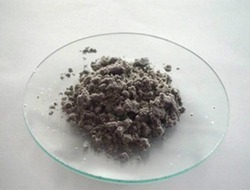
NaH is colorless, although samples generally appear grey. NaH is around 40% denser than Na (0.968 g/cm3).
NaH, like LiH, KH, RbH, and CsH, adopts the NaCl crystal structure. In this motif, each Na+ ion is surrounded by six H− centers in an octahedral geometry. The ionic radii of H− (146 pm in NaH) and F− (133 pm) are comparable, as judged by the Na−H and Na−F distances.
A very unusual situation occurs in a compound dubbed "inverse sodium hydride", which contains H+ and Na− ions. Na− is an alkalide, and this compound differs from ordinary sodium hydride in having a much higher energy content due to the net displacement of two electrons from hydrogen to sodium. A derivative of this "inverse sodium hydride" arises in the presence of the base [36]adamanzane. This molecule irreversibly encapsulates the H+ and shields it from interaction with the alkalide Na−. Theoretical work has suggested that even an unprotected protonated tertiary amine complexed with the sodium alkalide might be metastable under certain solvent conditions, though the barrier to reaction would be small and finding a suitable solvent might be difficult.
Industrially, NaH is prepared by introducing molten sodium into mineral oil with hydrogen at atmospheric pressure and mixed vigorously at ~8000 rpm. The reaction is especially rapid at 250−300 °C.
The resultant suspension of NaH in mineral oil is often directly used, such as in the production of diborane.
NaH is a base of wide scope and utility in organic chemistry. As a superbase, it is capable of deprotonating a range of even weak Brønsted acids to give the corresponding sodium derivatives. Typical "easy" substrates contain O-H, N-H, S-H bonds, including alcohols, phenols, pyrazoles, and thiols.
NaH notably deprotonates carbon acids (i.e., C-H bonds) such as 1,3-dicarbonyls such as malonic esters. The resulting sodium derivatives can be alkylated. NaH is widely used to promote condensation reactions of carbonyl compounds via the Dieckmann condensation, Stobbe condensation, Darzens condensation, and Claisen condensation. Other carbon acids susceptible to deprotonation by NaH include sulfonium salts and DMSO. NaH is used to make sulfur ylides, which in turn are used to convert ketones into epoxides, as in the Johnson–Corey–Chaykovsky reaction.
Hub AI
Sodium hydride AI simulator
(@Sodium hydride_simulator)
Sodium hydride
Sodium hydride is the chemical compound with the empirical formula NaH. This alkali metal hydride is primarily used as a strong yet combustible base in organic synthesis. NaH is a saline (salt-like) hydride, composed of Na+ and H− ions, in contrast to molecular hydrides such as borane, silane, germane, ammonia, and methane. It is an ionic material that is insoluble in all solvents (other than molten sodium metal), consistent with the fact that H− ions do not exist in solution.
NaH is colorless, although samples generally appear grey. NaH is around 40% denser than Na (0.968 g/cm3).
NaH, like LiH, KH, RbH, and CsH, adopts the NaCl crystal structure. In this motif, each Na+ ion is surrounded by six H− centers in an octahedral geometry. The ionic radii of H− (146 pm in NaH) and F− (133 pm) are comparable, as judged by the Na−H and Na−F distances.
A very unusual situation occurs in a compound dubbed "inverse sodium hydride", which contains H+ and Na− ions. Na− is an alkalide, and this compound differs from ordinary sodium hydride in having a much higher energy content due to the net displacement of two electrons from hydrogen to sodium. A derivative of this "inverse sodium hydride" arises in the presence of the base [36]adamanzane. This molecule irreversibly encapsulates the H+ and shields it from interaction with the alkalide Na−. Theoretical work has suggested that even an unprotected protonated tertiary amine complexed with the sodium alkalide might be metastable under certain solvent conditions, though the barrier to reaction would be small and finding a suitable solvent might be difficult.
Industrially, NaH is prepared by introducing molten sodium into mineral oil with hydrogen at atmospheric pressure and mixed vigorously at ~8000 rpm. The reaction is especially rapid at 250−300 °C.
The resultant suspension of NaH in mineral oil is often directly used, such as in the production of diborane.
NaH is a base of wide scope and utility in organic chemistry. As a superbase, it is capable of deprotonating a range of even weak Brønsted acids to give the corresponding sodium derivatives. Typical "easy" substrates contain O-H, N-H, S-H bonds, including alcohols, phenols, pyrazoles, and thiols.
NaH notably deprotonates carbon acids (i.e., C-H bonds) such as 1,3-dicarbonyls such as malonic esters. The resulting sodium derivatives can be alkylated. NaH is widely used to promote condensation reactions of carbonyl compounds via the Dieckmann condensation, Stobbe condensation, Darzens condensation, and Claisen condensation. Other carbon acids susceptible to deprotonation by NaH include sulfonium salts and DMSO. NaH is used to make sulfur ylides, which in turn are used to convert ketones into epoxides, as in the Johnson–Corey–Chaykovsky reaction.
Recent media